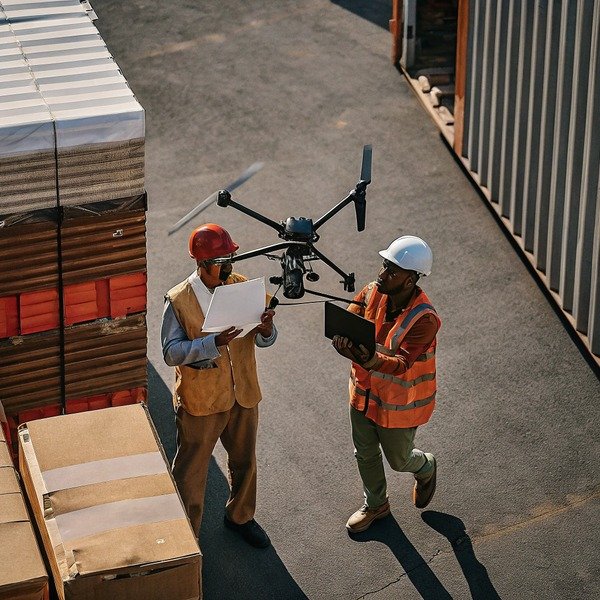
 Class 9 Dangerous Goods 1=”top-image-square”>
Delays at the port due to missing paperwork are a nightmare for our clients that we strive to prevent. We ensure every drone leaving our Xi’an factory has the right documentation to sail through customs effortlessly.
To clear customs smoothly, you need a Commercial Invoice detailing value, a Packing List specifying dimensions, a Bill of Lading, and Country of Origin certification. Crucially, you must also provide FCC authorizations for telemetry and lithium battery safety documents like MSDS to comply with strict import regulations.
Let’s break down the exact paperwork you need to avoid expensive storage fees and legal headaches.
Which essential shipping documents must accompany my agricultural drone shipment?
We meticulously double-check every file before our drones leave our production line because we know the stakes are high. Missing a single page can stop your business cold, leaving critical equipment stranded.
Your shipment requires a Commercial Invoice listing the HS code 8806.21.00, a precise Packing List, and a Bill of Lading. Additionally, you need a formal Purchase Order that matches the Proforma Invoice exactly to prove the transaction value and avoid valuation disputes with Customs and Border Protection.

When we prepare shipments for our US and European clients, we treat the documentation package with the same precision as the drone's flight controller calibration. The foundation of a successful import lies in the "Big Three" documents: the Commercial Invoice, the Packing List, and the Bill of Lading. However, for agricultural drones, the requirements go deeper due to the technical nature of the equipment.
The Commercial Invoice: Your Declaration of Value
The Commercial Invoice is the heartbeat of your customs entry. It is not just a bill; it is a legal declaration to customs authorities about what you are buying and how much it is worth. In our export department, we ensure this document includes the specific Harmonized System (HS) code 2 Harmonized System (HS) code. Harmonized System (HS) code 3 For agricultural drones, this is typically 8806.21.00 (Unmanned aircraft, other than those with a permanently integrated camera).
If we fail to list the correct HS code, or if the value on the invoice does not match your proof of payment, customs can flag the shipment for valuation fraud. This leads to audits and severe penalties. The description must be granular. We cannot simply write "Drone." We must specify "Agricultural Spraying Drone, Model SR-50, Net Weight 25kg." Agricultural Spraying Drone 4
Consistency is Key
One of the most common reasons for delays is a mismatch between the Purchase Order (PO), the Proforma Invoice (PI), and the final Commercial Invoice. If your PO says "10 units" but the Invoice says "1 box containing 10 units," and the weights don't align perfectly, the customs officer will pause the clearance.
Regulatory Compliance Documents (FCC)
Beyond the standard shipping papers, agricultural drones utilize radio frequencies for telemetry and control. This means they fall under the jurisdiction of the Federal Communications Commission (FCC) 5 Federal Communications Commission (FCC) in the US. We must provide an FCC Authorization or a Supplier's Declaration of Conformity (SDoC).
Without this document, the drone is technically illegal to import, market, or sell. Given the recent updates to the FCC "Covered List," showing that our equipment is authorized and compliant is more critical than ever to prove the hardware does not pose a national security risk.
Document Checklist for Importers
To help you organize your procurement, here is a breakdown of the essential documents and their specific functions.
| Document Name | Primary Function | Critical Data Points to Verify |
|---|---|---|
| Commercial Invoice | Used for duty calculation and value declaration. | HS Code (8806.xx), Incoterms, total value, detailed description. |
| Packing List | Used by customs for physical inspection and tallying. | Net/Gross weight, dimensions, package count, box markings. |
| Bill of Lading (B/L) | Proof of title and receipt of cargo. | Consignee details, Notify Party, Port of Loading/Discharge. |
| FCC Authorization | Proves radio frequency compliance. | FCC ID number, equipment class, frequency bands used. |
| Purchase Order | Proof of the agreed transaction. | Date, Model numbers, agreed price, payment terms. |
Do I need specific battery safety certificates like MSDS for customs clearance?
Our engineering team spends months testing battery safety to meet international standards before we ever ship a unit. Without concrete proof of safety, air freight is impossible, and sea freight becomes a liability.
Yes, you absolutely need a Material Safety Data Sheet (MSDS) and UN38.3 test summary for lithium batteries. These documents prove the hazardous materials are stable for transport. Without them, carriers will refuse the cargo, and customs will seize the shipment due to strict dangerous goods regulations.
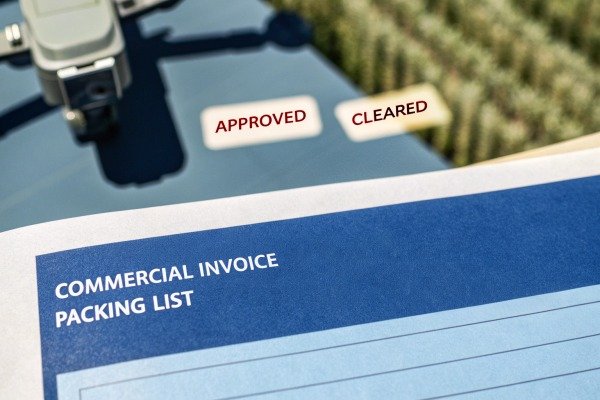
Agricultural drones rely on high-capacity Lithium Polymer (LiPo) batteries to power heavy payloads and long flight times. These are not standard AA batteries; they are powerful energy storage devices that are classified as Class 9 Dangerous Goods by international transport regulations (IATA for air, IMDG for sea).
The Necessity of the UN38.3 Test Summary
Before we can even book a slot on a vessel or plane, the carrier demands a UN38.3 Test Summary 6 UN38.3 Test Summary. This is a rigorous testing standard where our batteries are subjected to altitude simulation, thermal cycling, vibration, shock, short circuits, and crush tests.
If a supplier cannot provide a valid UN38.3 report from an accredited laboratory, you cannot import that drone legally. We have seen competitors' shipments rejected at the port of origin because they tried to ship batteries using generic or forged test reports. Customs authorities are trained to spot these discrepancies.
Material Safety Data Sheet (MSDS)
The MSDS (now often referred to as SDS – Safety Data Sheet) provides detailed information on the chemical composition of the battery and emergency procedures. Customs and port handlers need this to know how to react if a fire occurs. The MSDS must be current (usually issued within the last year) and match the specific model of the battery in the shipment.
Shipping Configurations and Regulations
The documentation requirements change slightly depending on how the batteries are packed.
- PI 965: Batteries shipped loose (bulk). This is the most strictly regulated and often forbidden on passenger aircraft.
- PI 966: Batteries packed with equipment (in the same box but not installed).
- PI 967: Batteries installed inside the equipment.
For our agricultural drones, we typically ship batteries separately via sea freight due to their size, classified under UN3480. This requires specific labeling on the outer boxes and a "Dangerous Goods Declaration" (DGD) signed by us.
Why This Matters for Clearance
If your customs broker submits the entry without the MSDS or DGD, the shipment will be flagged as "undeclared hazmat." This is a serious offense that can lead to fines starting at tens of thousands of dollars and the complete destruction of the goods.
| Battery Document | Purpose | Who Provides It? |
|---|---|---|
| UN38.3 Test Summary | Proves the battery design passed safety stress tests. | Manufacturer (Third-party lab certified). |
| MSDS / SDS | Lists chemical hazards and emergency response protocols. | Manufacturer. |
| Dangerous Goods Declaration | Formal statement to the carrier about hazmat contents. | Freight Forwarder / Supplier. |
| Drop Test Report | Proof that packaging can withstand rough handling (1.2m drop). | Manufacturer. |
How does a Certificate of Origin affect the import duties I pay on industrial drones?
We often help clients navigate tariff codes to optimize their landed costs and ensure compliance. Knowing exactly where your equipment is made impacts your bottom line significantly and determines legal entry.
A Certificate of Origin authenticates the manufacturing location, directly influencing duty rates and eligibility for trade agreements. For US imports, this document is vital for determining Section 301 tariffs on Chinese goods and proving compliance with the Forced Labor Prevention Act to prevent seizure.

The "Certificate of Origin" (COO) is more than just a piece of paper stating "Made in China." In the current geopolitical climate, it is a financial and legal instrument that determines the final cost of your agricultural drone fleet.
Impact on Tariff Duties
For our US clients, the COO is the primary document used to determine if the product is subject to the standard "Most Favored Nation" duty rate or if it triggers additional punitive tariffs, such as the Section 301 tariffs 7 Section 301 tariffs applied to many Chinese industrial products.
While agricultural equipment sometimes enjoys lower duty rates, drones are often categorized under aviation or electronics headers that attract higher fees. Without a valid COO, customs may default to the highest possible duty rate for that category. We provide a non-preferential Certificate of Origin certified by the Chamber of Commerce Chamber of Commerce 8 to ensure there is no ambiguity about the source.
The Uyghur Forced Labor Prevention Act (UFLPA)
This is a critical area where many inexperienced importers fail. US Customs and Border Protection (CBP) enforces the UFLPA 9 UFLPA strictly. They presume that goods mined, produced, or manufactured in the Xinjiang region of China are made with forced labor and are therefore banned.
As a responsible manufacturer based in Xi'an and Chengdu, we maintain a transparent supply chain. The Certificate of Origin, combined with our detailed supply chain mapping, helps prove that our components do not originate from restricted regions. If a supplier cannot provide this level of transparency, your shipment risks being detained indefinitely.
Preferential Trade Agreements
If you are importing into countries other than the US—say, Australia or members of ASEAN—a specific form of the COO (like Form E or ChAFTA certificates) can reduce your import duties to zero. We work with our local government agencies to issue these specific preferential certificates.
It is your right as a buyer to demand this document. If a supplier is hesitant to provide a certified COO, it may indicate they are transshipping goods to hide the true origin, a practice called "transshipment" that is illegal and prosecutable.
Duty Impact Scenarios
The table below illustrates how the COO and correct classification can change your financial outcome.
| Scenario | Document Status | Consequence |
|---|---|---|
| Correct COO & HS Code | Supplier provides certified COO; HS Code 8806.21.00. | Duties assessed correctly at standard rates (plus Section 301 if applicable). Quick clearance. |
| Missing COO | No proof of origin. | Customs may assess the highest "Column 2" duty rates (often 30-50% higher) or reject entry. |
| Transshipment Suspected | COO claims false origin (e.g., Vietnam) but goods are Chinese. | Heavy fines for evasion; seizure of goods; importer Importer of Record 10 flagged for future inspections. |
Can my supplier handle all the paperwork if I choose door-to-door delivery?
We offer door-to-door shipping to take the logistics stress off your procurement team. You shouldn’t have to become a customs expert just to upgrade your agricultural technology fleet.
Yes, a capable supplier can manage the entire documentation chain under DDP (Delivered Duty Paid) terms. However, you remain the importer of record legally. We prepare the invoices, packing lists, and certifications, then coordinate with customs brokers to ensure final delivery to your warehouse without your intervention.

Many of our clients, especially those new to international trade, prefer a "hands-off" approach. This is where DDP (Delivered Duty Paid) shipping comes into play. In this model, we, the manufacturer, take on the maximum responsibility. We hire the freight forwarder, we pay for the shipping, and we engage the customs broker on your behalf.
What the Supplier Do
When you choose our door-to-door service, our logistics team prepares the full packet:
- Commercial Invoice & Packing List: Adjusted for customs compliance.
- Bill of Lading: Consigned to our partner broker or your entity.
- Certifications: FCC, MSDS, COO attached to the digital entry.
- Duty Payment: We wire the funds for duties and taxes directly to the customs authority or via the broker.
This seamless process allows you to focus on your business operations rather than tracking vessels or arguing with port authorities.
The "Importer of Record" (IOR) Nuance
However, there is a critical distinction to make. Even if we handle the paperwork and pay the fees, you (the buyer) are typically the Importer of Record (IOR). The customs entry is filed against your tax ID (EIN in the US).
Why does this matter? Because legally, the accuracy of the information is your responsibility. If we make a mistake on the classification, the customs authority will look to you for an explanation. This is why we always send draft copies of all documents to our clients for approval before the ship sails.
The Role of the Customs Broker
We work with a network of trusted customs brokers in major ports like Long Beach, Rotterdam, and Hamburg. These brokers act as the bridge between our factory and your government. They take our documents and convert them into the digital codes required by the automated customs systems (like ACE in the US).
Non-Customs Documents: Software and Manuals
Beyond the port, door-to-door service also means ensuring the end-user experience is ready. We include the "Non-Military/Dual-Use Declaration" (certifying the drone is for agriculture, not war) and software licensing agreements. These aren't always needed for the entry itself, but they are vital if customs decides to inspect the cargo physically to verify its purpose.
Pros and Cons of Supplier-Managed Logistics
| Feature | Supplier Managed (DDP) | Buyer Managed (FOB/EXW) |
|---|---|---|
| Convenience | High. You wait for the truck to arrive. | Low. You manage freight, insurance, and clearance. |
| Control | Low. We choose the carrier and broker. | High. You choose the speed and cost of freight. |
| Cost Visibility | All-inclusive price upfront. | Costs can fluctuate with storage fees or exam fees. |
| Risk | Supplier holds risk until delivery. | Buyer holds risk once cargo leaves the factory (FOB). |
Conclusion
Smooth customs clearance for agricultural drones hinges on accurate, consistent, and comprehensive documentation. From the Commercial Invoice and Packing List to critical safety proofs like the MSDS and FCC authorizations, every page plays a role in protecting your investment. While we can manage the heavy lifting through door-to-door services, understanding these requirements ensures you remain compliant and avoid costly delays.
Footnotes
1. International standards for the air transport of lithium batteries as Class 9 goods. ↩︎
2. Official definition of the classification system used for import duties. ↩︎
3. Overview of the international system used to classify traded products for customs. ↩︎
4. Technical documentation for a widely used commercial agricultural spraying drone. ↩︎
5. Regulatory authority governing radio frequency device authorizations in the US. ↩︎
6. International standard for lithium battery transport safety required by carriers. ↩︎
7. Official USTR page detailing tariffs on Chinese industrial products. ↩︎
8. Guidelines from the world business organization on the issuance of certificates of origin. ↩︎
9. CBP official guidance on the Uyghur Forced Labor Prevention Act. ↩︎
10. Explanation of the legal entity responsible for ensuring imported goods comply with local laws. ↩︎

 English
  Español de México
  Deutsch
  Français
  Русский
  العربية
