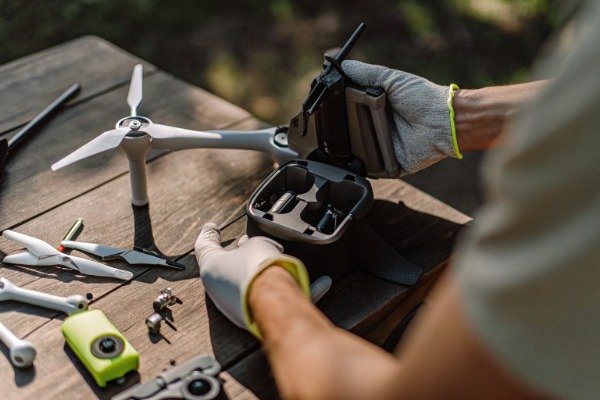
At SkyRover, we know that a missing screw can ground a critical mission. Equipment failure during a fire isn't just an inconvenience; it is dangerous.
Suppliers strongly recommend purchasing a comprehensive maintenance kit containing spare propellers, hot-swappable batteries, and sensor cleaning tools. Additionally, acquiring diagnostic software and proprietary disassembly tools is crucial for identifying hardware faults and performing on-site repairs to ensure continuous operation during emergencies.
Let's examine exactly what you need to keep your fleet airborne and operational.
Which Spare Parts Are Essential for Minimizing Downtime During Critical Operations?
Our flight testing team often replaces components worn down by heat and smoke. Without immediate spares, your operation stalls when it matters most, risking lives and property.
You must prioritize stocking high-wear consumables like propellers, landing gear, and high-capacity batteries. In high-heat environments, sensors and motor arms are also vulnerable, making modular replacement kits essential for rapid field repairs without returning the unit to the factory.
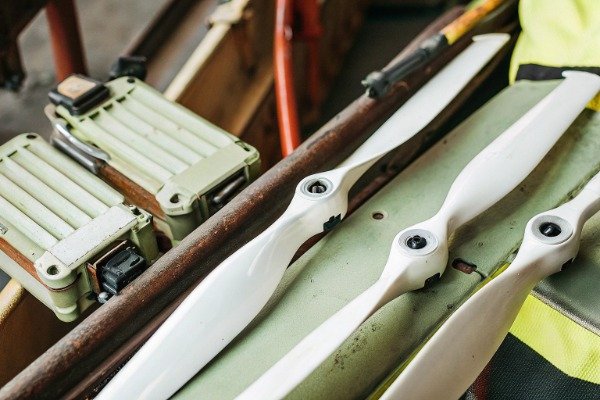
When you deploy drones into a fire zone, you are subjecting precision electronics to one of the harshest environments on Earth. Smoke particles are abrasive, heat degrades battery chemistry, and water spray can penetrate seals. Based on our manufacturing data, relying on a single set of components is a recipe for failure. You need a strategic inventory of spare parts available immediately on-site.
battery chemistry 1
High-Wear Consumables
Propellers are the most frequently replaced item. In firefighting scenarios, drones often fly close to structures or through dense canopy. Even a minor clip against a branch or wall can cause micro-fractures in a propeller. These fractures might not cause an immediate crash, but the vibration they generate can confuse the flight controller's IMU (Inertial Measurement Unit), leading to instability. We always advise clients to keep at least three full sets of propellers per drone in their transport case.
The Battery Lifeline
Batteries are your fuel, but they are also sensitive to temperature. Firefighting missions often require high current draw to lift heavy payloads like water hoses or fire extinguishing balls. This generates internal heat. If you combine that with high ambient temperatures from the fire, battery degradation accelerates. Swollen batteries are a common issue. You should invest in hot-swappable batteries that allow you to land, swap, and relaunch in seconds.
Sensor and Frame Protection
Thermal cameras and LiDAR sensors are expensive and delicate. Soot accumulation on a lens can render a $10,000 thermal camera useless. You need spare lens covers and specific cleaning solutions. Furthermore, landing gear often takes the brunt of hard landings in rough terrain. Having modular landing struts that can be swapped out with a simple hex key ensures that a rough landing doesn't end your day.
Recommended Spare Parts Inventory
| Component Category | Replacement Frequency | Criticality | Why It Fails |
|---|---|---|---|
| Propellers | Every 10-50 flights | High | Physical impact, heat warping, leading-edge erosion. |
| Batteries | Every 200-300 cycles | Critical | Internal resistance increase, cell swelling, connector oxidation. |
| Landing Gear | As needed | Medium | Hard landings on uneven terrain, debris impact. |
| Sensor Lenses | As needed | High | Soot buildup, scratching from cleaning with improper cloth. |
| Motor Arms | Rare (Crash dependent) | Medium | Structural stress or direct impact damage. |
By maintaining this inventory, you move from a reactive posture—waiting for parts to arrive from China—to a proactive posture, fixing issues in the field immediately.
Do You Need Proprietary Tools or Specialized Diagnostic Software for Field Repairs?
When we calibrate flight controllers, we use specific software to detect hidden faults. Relying solely on visual checks often misses internal circuit corrosion or subtle motor desynchronization.
thread locker 2
Yes, proprietary tools like torque wrenches and firmware update modules are often required for frame disassembly and system health checks. Specialized battery analyzers and diagnostic software are vital for monitoring voltage irregularities and identifying hardware failures before they cause mid-flight crashes.
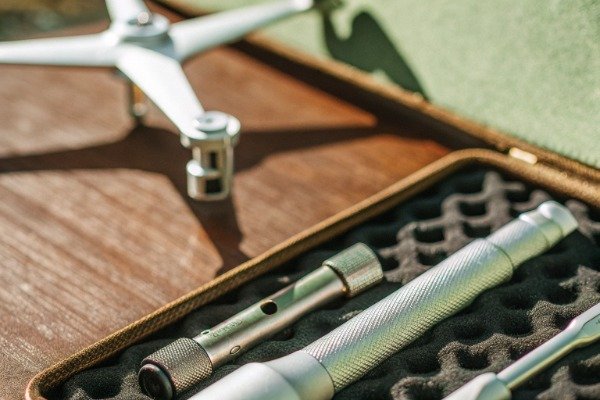
Many procurement managers assume that a standard hardware store toolbox is sufficient for drone maintenance. This is a dangerous misconception. Industrial drones are precision instruments, and using the wrong tool can strip soft aluminum screws or damage sensitive connectors. Furthermore, hardware is only half the battle; software diagnostics are equally important.
standard multimeter 4
Precision Hardware Tools
Most industrial drones use specific fasteners that require exact torque settings. If a screw is too loose, vibration will back it out mid-flight. If it is too tight, you risk cracking the carbon fiber frame or stripping the thread. We recommend a dedicated torque wrench set calibrated to the manufacturer's specifications (usually in Newton-meters). Additionally, you may need proprietary tools to remove snap-fit covers or specialized wrenches for motor mounts that standard sockets cannot reach.
Diagnostic Software and CMMS
Visual inspection cannot tell you if a motor is running 5 degrees hotter than usual or if a battery cell is lagging in voltage. This is where diagnostic software comes in. Manufacturers often provide a "Health Management System" (HMS) or recommend third-party CMMS (Computerized Maintenance Management System) software. These tools track flight hours and prompt you when maintenance is due. For example, after 50 hours of flight, the software might require a compass calibration or a motor bearing check.
Battery Analysis
A standard multimeter is useful, but a specialized battery analyzer is better. These devices can measure the internal resistance of each cell. A battery might show 100% charge but have high internal resistance, meaning it will suffer a sudden voltage drop under load. In a firefighting scenario, this voltage sag could cause the drone to trigger an emergency landing right over the fire.
Essential Maintenance Tools Checklist
| Tool Type | Purpose | Necessity Level |
|---|---|---|
| Torque Wrench (0.5-10 Nm) | Preventing frame damage and ensuring screw security. | Mandatory |
| Battery Analyzer | Checking cell health, internal resistance, and cycle count. | Highly Recommended |
| Offline Diagnostic Tablet | Running system checks in remote areas without internet. | Recommended |
| Optical Cleaning Kit | Removing corrosive soot from thermal and RGB lenses. | Mandatory |
| Soldering Station (Portable) | Emergency repair of severed wires or connectors. | Optional (Advanced) |
Investing in these tools allows your technicians to perform "Level 1" repairs on-site, drastically reducing the time your equipment spends in transit for service.
Computerized Maintenance Management System 5
How Can You Negotiate for Free Maintenance Kits and Ensure Local Compatibility?
In our experience exporting to the US, we often see buyers forget to check tool compatibility. Buying a kit you cannot use locally due to voltage or standard differences is a waste.
carbon fiber frame 6
Always ask suppliers which maintenance tools are included for free and negotiate for extra consumables like propellers or cables. Verify that all tools meet your local standards and that equivalent replacements can be sourced domestically to avoid reliance on overseas shipping.

When you are finalizing a purchase order for high-value industrial drones, you have significant leverage. Manufacturers want to secure the deal and build a long-term relationship. You can use this to your advantage to secure better maintenance terms and ensure the tools you get are actually usable in your region.
Thermal cameras 8
The "Free vs. Paid" Distinction
Never assume what is in the box. A "Standard Kit" might just include the drone and one battery. You need to explicitly ask: "What maintenance tools are included at no extra cost?" Often, simple tools like hex keys and basic cleaning cloths are free. However, specialized diagnostic tablets or advanced battery stations are usually paid add-ons.
- Strategy: If you are buying multiple units (e.g., a fleet of 5 drones), ask the supplier to throw in a "Field Repair Kit" for free. This kit should include extra propellers, landing gear, and a basic tool set.
Local Standards and Compatibility
We have seen customers receive high-end battery charging stations that come with Chinese standard plugs or require 220V input when their local grid is 110V. This renders the equipment useless without heavy transformers.
- Voltage: Confirm the input voltage for all soldering irons, battery chargers, and powered diagnostic tools.
- Measurement Units: Ensure the tools match the drone. If the drone uses metric screws (common in China), do not rely on your local imperial (SAE) hex keys. They will strip the screw heads.
Sourcing Equivalents Locally
While proprietary parts like motors must come from the manufacturer, many maintenance consumables can be sourced locally. Ask the supplier for the specifications of standard parts.
- Example: Instead of buying "Drone Manufacturer Brand" Loctite (thread locker), ask for the specific grade (e.g., Loctite 243). You can buy this at any local hardware store for half the price.
- Example: Ask for the specific type of screws used (e.g., M3x8 Titanium). This allows you to buy replacements from local industrial suppliers like McMaster-Carr in the US, rather than waiting weeks for shipping from China.
Negotiation Strategy Table
| Item to Negotiate | Strategy | Goal |
|---|---|---|
| Spare Propellers | "We are buying X units; include 2 extra sets per drone." | Free Inclusion |
| Diagnostic Software | "Include a 1-year license for the fleet management software." | Free Trial / Discount |
| Charging Station | "Ensure the plug and voltage match our local standard." | Compatibility Check |
| Repair Training | "Provide a video guide or manual for common field repairs." | Knowledge Transfer |
By clarifying these details upfront, you ensure that your maintenance capabilities are robust, cost-effective, and independent of long international supply chains.
LiDAR sensors 9
Conclusion
Investing in the right spares and tools ensures mission success. Plan ahead to keep your fleet operational, safe, and ready for any emergency.
Inertial Measurement Unit 10
Footnotes
1. Explains the chemical composition vulnerable to heat degradation. ↩︎
2. Explains the adhesive chemical used for securing fasteners. ↩︎
3. Technical explanation of the battery health metric. ↩︎
4. Overview of the common electrical testing tool. ↩︎
5. Definition of the software system mentioned for tracking maintenance. ↩︎
6. Information on the composite material used for drone frames. ↩︎
7. Details the precision tool required for proper assembly. ↩︎
8. Industry leader explaining the principles of thermal imaging. ↩︎
9. Authoritative government explanation of LiDAR technology. ↩︎
10. Defines the specific sensor technology mentioned in the text. ↩︎

 English
  Spanish
  German
  French
  Dutch
Dutch  Arabic
