
When our engineering team ships firefighting drones overseas, one question keeps coming back from American buyers. They want to know if our products will clear NDAA requirements 1. The problem is real. Get it wrong, and your entire inventory becomes unsellable to government-funded entities.
US distributors verify NDAA compliance for Chinese firefighting drones by requesting detailed supply chain documentation, checking components against prohibited entity lists, confirming Blue UAS or Green UAS certifications, auditing software and data transmission protocols, and conducting independent third-party cybersecurity assessments to ensure all critical parts meet federal procurement standards.
The following sections break down exactly what documentation you need, how to verify internal components, what cybersecurity standards apply, and how to evaluate a manufacturer’s engineering support capabilities.
What specific documentation should I request from my Chinese supplier to prove their firefighting drones are NDAA compliant?
Every week, our export team fields calls from US distributors worried about compliance paperwork. They need proof. Without the right documents, your customs broker cannot clear shipments. Your government clients will reject purchase orders.
Request a complete Bill of Materials listing every component's origin, manufacturer certifications, Entity List clearance statements, flight controller and camera source documentation, software licensing agreements, and a signed declaration confirming no covered foreign entity involvement in critical components like data links, gimbals, or operating systems.
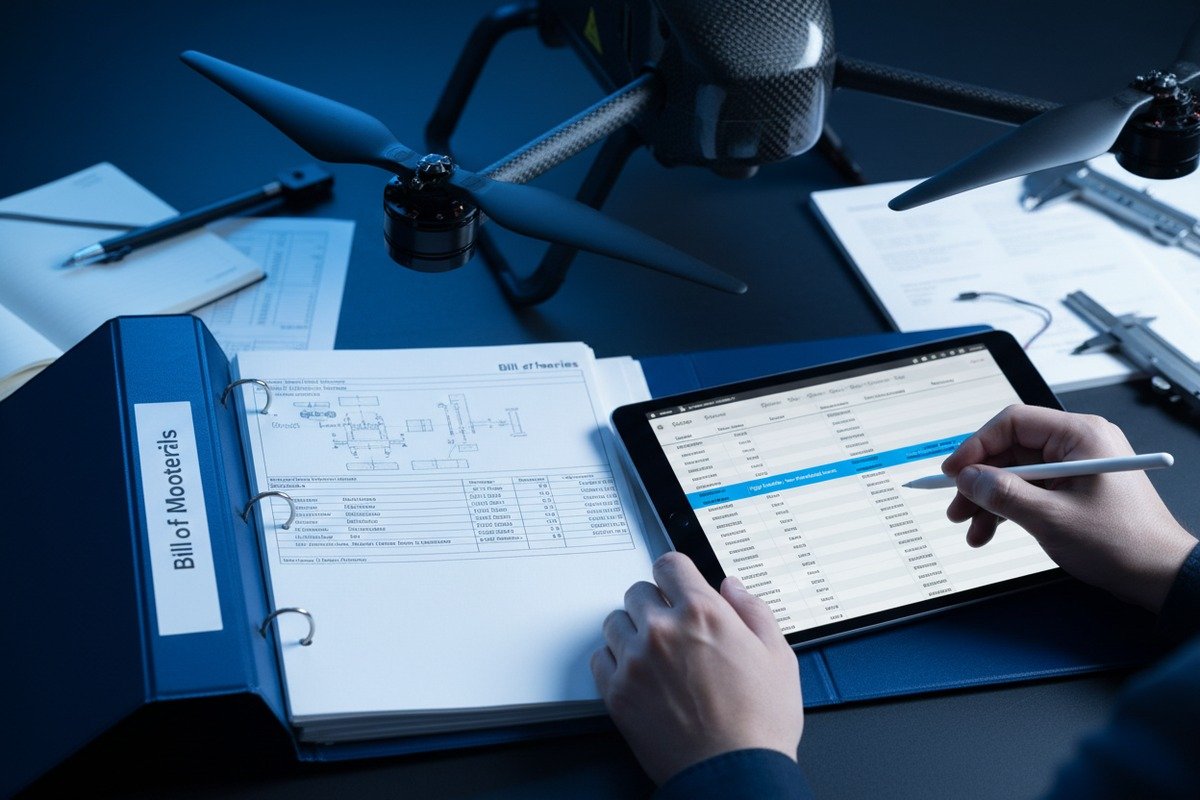
Understanding the Bill of Materials
The Спецификация 2 is your primary verification tool. It lists every part inside the drone. You need to see component names, manufacturers, countries of origin, and part numbers. When we prepare BOMs for US clients, we include traceability codes that link back to our suppliers.
A proper BOM should identify these critical components separately:
| Critical Component | Почему это важно | NDAA Risk Level |
|---|---|---|
| Полетный контроллер | Controls drone behavior, stores flight data | Высокий |
| Камера/Подвес | Captures and transmits imagery | Высокий |
| Data Link/Radio | Transmits telemetry and video | Высокий |
| GPS-модуль | Location tracking capability | Средний |
| Система управления батареей | Monitors power, some store usage logs | Низкая |
| Двигатели/ESC | Propulsion, no data transmission | Низкая |
Entity List Clearance
Your supplier must confirm their company does not appear on the US Entity List 3. They should also confirm their component suppliers are not listed. DJI was added to the Entity List in 2020 and the Chinese Military Companies List in 2022. Any connection to these entities creates compliance failure.
Manufacturer Declarations
Request a signed declaration from company leadership. This document should state:
- No critical components come from covered foreign entities
- The company has no ownership ties to prohibited organizations
- Software contains no backdoors or unauthorized data collection
- The manufacturer will support compliance audits
Software Licensing Documentation
Operating software needs clear licensing. You should see who developed the firmware, where it was coded, and whether it uses any open-source elements that might have compliance issues. Our software team maintains separate documentation packages for US-bound products.
How can I verify that the internal components and flight controllers in my imported drones don't violate US procurement bans?
In our production facility, we source components from multiple suppliers across different countries. This complexity is exactly what makes verification challenging. One restricted part buried inside a subassembly can invalidate your entire shipment.
Verify internal components by cross-referencing your supplier's BOM against the Commerce Department's Entity List, checking flight controllers against FY2020 NDAA §848 prohibited sources, confirming camera and radio manufacturers are not covered foreign entities, and using the Blue UAS Cleared List or Green UAS program as verification benchmarks for compliant alternatives.

The Critical Component Categories
FY2020 NDAA §848 4 specifically targets these component types:
| Категория компонента | Метод проверки | Acceptable Sources |
|---|---|---|
| Полетные контроллеры | Check manufacturer against Entity List | US, EU, Japan, Taiwan, South Korea |
| Камеры | Verify sensor and lens origins | Non-Chinese manufacturers |
| Radios/Data Links | Confirm transmission hardware source | NDAA-compliant suppliers |
| Gimbals | Check motor and control board origins | Verified supply chain |
| Ground Control Software | Audit code origins and data routing | US-developed or audited systems |
Using Blue UAS and Green UAS Lists
The Defense Innovation Unit created the Blue UAS program 5 to identify compliant drones. After January 2026, the Defense Contract Management Agency manages this list. Drones on Blue UAS have passed DoD cybersecurity and supply chain vetting.
Green UAS is an industry-led program through AUVSI. Green UAS program 6 It provides a pathway for manufacturers seeking eventual Blue UAS status. When we develop new models, our engineering team designs with Green UAS requirements in mind from day one.
Physical Inspection Methods
Sometimes documentation is not enough. Consider these verification steps:
- Open the drone housing and photograph all circuit boards
- Record serial numbers and manufacturer markings
- Compare markings against your BOM
- Check for any components not listed in official documentation
- Send samples to independent testing labs
The Motor Loophole
Here is something many distributors miss. NDAA restrictions focus on data-transmitting components. Motors, propellers, and structural parts from China are generally not prohibited because they do not collect or transmit data. Our quality control team keeps detailed records showing which components fall into which category.
However, this loophole has limits. The FY2026 NDAA House version proposes expanding restrictions to include software and spectrum equipment. Stay informed about pending legislation.
What measures can I take to ensure my drone's software and data transmission meet the latest US cybersecurity standards?
Our software development team rewrote our entire telemetry system last year. The reason was simple. US customers needed guarantees about where their data goes. Firefighting operations generate sensitive information. Flight paths over critical infrastructure. Thermal imagery of buildings. GPS coordinates of emergency personnel.
Ensure software compliance by auditing firmware for foreign code origins, verifying data transmission uses end-to-end encryption meeting FIPS 140-2 standards, confirming no telemetry routes through foreign servers, testing for unauthorized backdoors, and requiring source code access or independent security audits for ground control software.
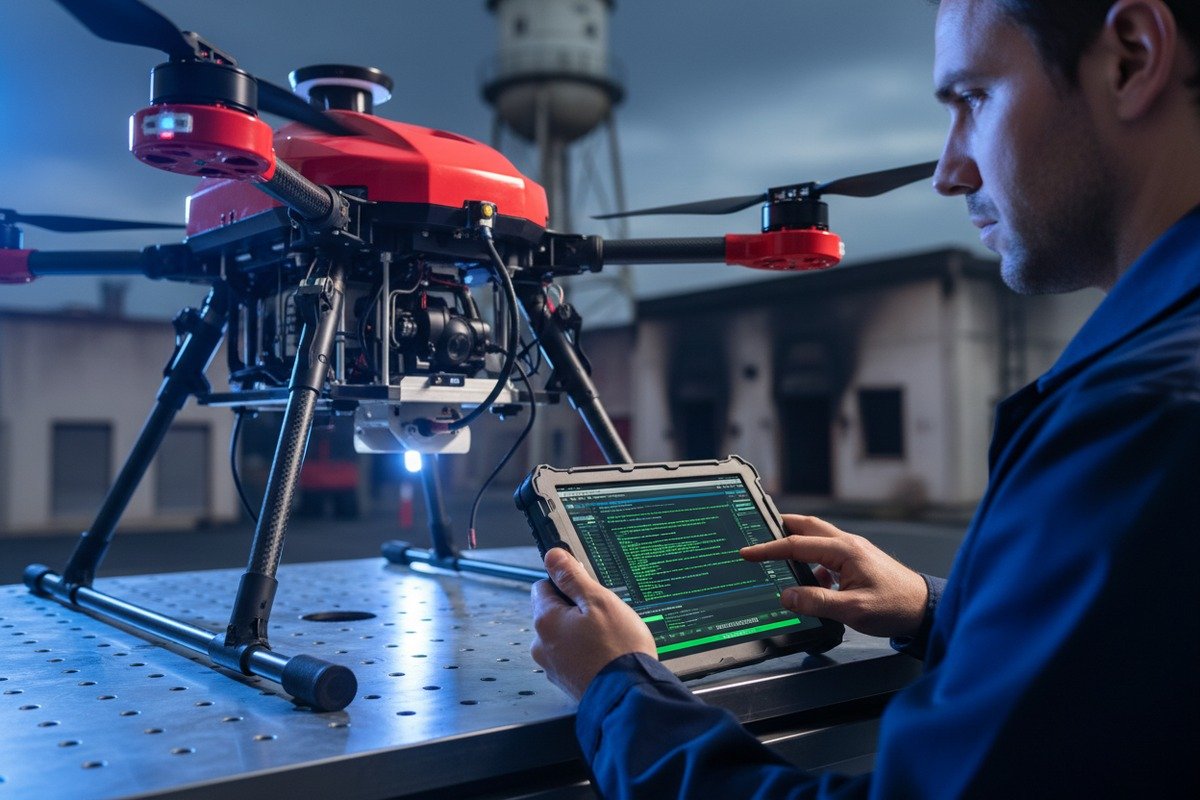
Data Transmission Architecture
Where does your drone send its data? This question matters more than most distributors realize. Some Chinese drones route telemetry through servers in China, even briefly. This creates compliance problems regardless of where the hardware was made.
Our engineering approach involves local-only data processing:
| Тип данных | Compliant Handling | Non-Compliant Handling |
|---|---|---|
| Телеметрия полета | Stored on local SD card, encrypted | Uploaded to foreign cloud servers |
| Video Feed | Direct transmission to controller | Routed through external servers |
| GPS-координаты | Local processing only | Shared with manufacturer servers |
| Maintenance Logs | Exportable files for user control | Automatic remote uploads |
| Обновления прошивки | Manual download from verified source | Automatic updates from foreign servers |
Стандарты шифрования
Federal cybersecurity requirements reference FIPS 140-2 encryption standards 7. Your supplier should confirm their data transmission meets this benchmark. Key points include:
- AES 256-bit encryption for stored data
- TLS 1.3 for any network communications
- No deprecated protocols like SSL 3.0
- Secure key management practices
Firmware Audit Procedures
Request firmware source code access or independent audit reports. Third-party cybersecurity firms can analyze drone software for:
- Hidden data collection routines
- Unauthorized network connections
- Hardcoded credentials or backdoors
- Encryption implementation flaws
When our products undergo these audits, we provide full cooperation. Manufacturers who refuse audit requests raise immediate red flags.
The FCC Covered List Impact
After December 2025, the FCC added unreviewed foreign UAS to its Covered List. This affects import authorizations and equipment certifications. Drones from Blue UAS-listed manufacturers are exempt. Others face significant barriers.
The FCC reassessment is scheduled for January 2027. Distributors should plan inventory decisions around this timeline. Products purchased now may face different regulatory status in eighteen months.
Ground Control Software Considerations
The drone itself is only half the system. Ground control software presents equal risks. Some manufacturers use software that phones home to servers in China. Others embed analytics that track usage patterns.
Ask your supplier these questions:
- Who developed the ground control software?
- Where are the development servers located?
- Does the software require internet connectivity to function?
- What data does the software collect about operations?
- Can the software operate in fully offline mode?
How do I vet a Chinese manufacturer's ability to provide the engineering support I need for customized, compliant drone solutions?
In our headquarters in Xi'an, seventy people work on design, production, and support. That team size matters. When you need custom firmware to remove problematic features, or hardware modifications to replace a non-compliant camera, you need engineers who can actually deliver.
Vet engineering capabilities by requesting case studies of previous compliance modifications, confirming dedicated R&D staff for customization projects, evaluating response times for technical inquiries, reviewing certifications like ISO 9001 and AS9100, and testing their willingness to provide ongoing remote support, spare parts, and documentation updates.
Evaluating Technical Response Quality
Send technical questions before placing orders. Measure how long responses take. Assess whether answers come from engineers or sales staff. Our technical support team aims for twenty-four hour response times on complex queries. Manufacturers who take weeks to answer simple questions will struggle with compliance modifications.
Customization Capability Assessment
NDAA compliance often requires product changes. Maybe you need a different camera. Perhaps the flight controller needs firmware modifications. Ask potential suppliers:
| Возможность | Вопросы, которые следует задать | Тревожные сигналы |
|---|---|---|
| Hardware Swaps | Can you integrate alternative cameras? | "We only use our standard components" |
| Firmware Modification | Can you remove cloud connectivity features? | "Our software cannot be modified" |
| Документация | Will you provide updated BOMs for modified units? | Reluctance to document changes |
| Тестирование | How do you verify modifications work correctly? | No quality control process |
| Сроки | How long for custom modifications? | Unrealistic promises |
Certification Review
Manufacturing certifications indicate process quality. ISO 9001 8 covers quality management systems. AS9100 adds aerospace-specific requirements. These certifications require documented procedures, traceability, and continuous improvement.
Request certification copies. Verify them with issuing bodies. Certifications that cannot be verified are worthless.
After-Sales Support Structure
Compliance is not a one-time event. Regulations change. Your customers will have questions. Equipment needs repairs. Evaluate support capabilities:
- Do they offer remote technical support?
- What languages do support staff speak?
- Can they provide on-site support for major issues?
- How do they handle warranty claims?
- What is their spare parts availability and pricing?
Соображения OEM и White-Label
Many US distributors want OEM products with their own branding. This adds complexity to compliance. Your supplier must maintain documentation under your brand. They must support warranty claims for products bearing your name.
Our OEM program includes complete documentation packages, custom packaging, and dedicated support contacts. Manufacturers who treat OEM as simple label changes will create problems later.
Site Visit Recommendations
If possible, visit manufacturing facilities. See production lines. Meet engineering staff. Review quality control procedures in person. Video calls provide some visibility, but nothing replaces direct observation.
During visits, ask to see:
- Component incoming inspection procedures
- Assembly line documentation practices
- Testing stations and equipment
- Engineering design offices
- Spare parts inventory
Заключение
NDAA compliance requires documentation, component verification, software audits, and capable manufacturing partners. The regulatory landscape continues evolving. Distributors who establish rigorous verification processes now will maintain competitive advantage as restrictions tighten through 2026 and beyond.
Сноски
1. Explains what NDAA compliance means for drones and restricted components. ↩︎
2. Defines Bill of Materials as a comprehensive list of components for product manufacturing. ↩︎
3. Official source explaining the US Department of Commerce’s Entity List and its purpose. ↩︎
4. Direct legislative text outlining the prohibition on foreign-made UAS components in the FY2020 NDAA. ↩︎
5. Official information from the Defense Innovation Unit about the Blue UAS program for vetted drones. ↩︎
6. Official AUVSI program for cybersecurity and supply chain compliance certification for drones. ↩︎
7. Direct NIST publication detailing security requirements for cryptographic modules used in federal systems. ↩︎
8. Explains ISO 9001 as a global standard for quality management systems and its purpose. ↩︎

 English
  Español de México
  Deutsch
  Français
  Русский
  العربية
