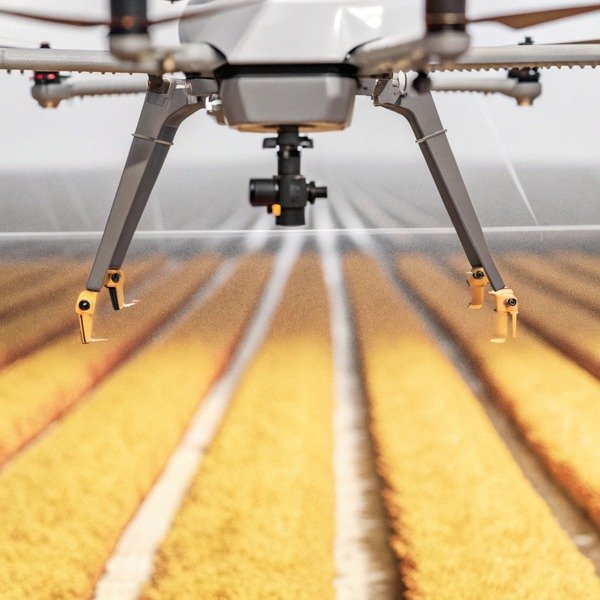
You invest heavily in your fleet, yet seeing chemicals drift off-target is a nightmare we often discuss drift off-target 1 with our clients during field tests. In our factory, we have seen how the wrong setup can waste 20% of your inputs, turning a profitable spray run into a financial loss.
To choose the right nozzle configuration, match the droplet size and spray pattern to your specific canopy density. Use air-induction nozzles for drift control in windy conditions and flat-fan nozzles for uniform coverage on open field crops. Always ensure your flow rate aligns with the drone’s speed and pump capacity.
Let’s break down the technical specifics to ensure your next flight delivers maximum ROI.
How do I determine the best nozzle type for penetrating dense canopies versus spraying open field crops?
When we collaborate with agronomists to fine-tune our spray systems, we notice that many operators struggle to reach the lower leaves of soybean or cotton plants. soybean or cotton plants 2 Failing to penetrate these thick layers often leads to pest flare-ups that require costly re-spraying.
For open fields, standard flat-fan nozzles provide the most uniform coverage. However, for dense canopies, you should select twin-pattern or hollow cone nozzles. These create multi-angled trajectories that bypass the upper leaf layer, utilizing the drone’s rotor downwash to drive smaller droplets deep into the lower crop foliage.
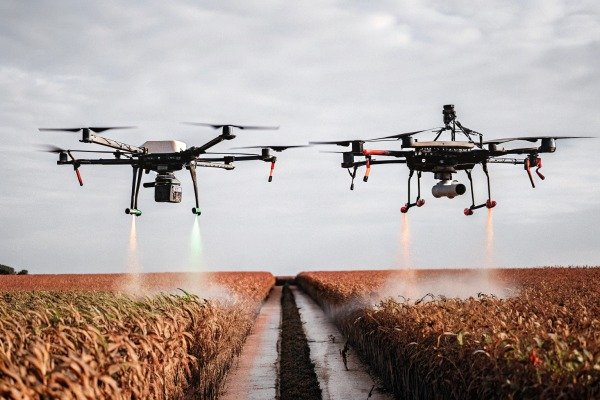
Understanding Canopy Architecture
The physical structure of your crop dictates the spray physics. spray physics 3 In our R&D labs, we simulate various crop stages to see how droplets behave. A wheat field in early spring is vastly different from a mature almond orchard.
Open Field Crops (Wheat, Lettuce, Young Corn):
These crops present a "flat" target. The goal here is horizontal uniformity. A standard Flat-Fan nozzle is ideal because it creates a consistent line of spray. When the drone flies a grid pattern, these lines overlap perfectly, ensuring no strip is missed. You do not need aggressive turbulence here; you need consistency.
Dense Canopy Crops (Soybeans at R3 stage, Mature Cotton, Citrus):
These are "3D" targets with layers of leaves acting like shingles on a roof. A vertical spray from a flat-fan nozzle often hits only the top leaves (the "umbrella effect").
- De oplossing: We recommend Twin-Flat Fan nozzles. These shoot two sprays simultaneously—one angled 30 degrees forward and one 70 degrees backward.
- The Physics: As the drone flies forward, the backward-facing spray hits the back of the target, while the forward spray hits the front. This dual angle significantly increases the chance of a droplet bypassing the top leaf and landing on the hidden leaves below.
The Role of Droplet Size (VMD)
Volume Median Diameter (VMD) is a critical metric we track. Volume Median Diameter (VMD) 4 Volume Median Diameter 5 It measures the average size of your spray droplets in microns.
- Fine Droplets (<200 microns): Great for coverage because they stick to small hairs on leaves. However, they lack the kinetic energy to punch through a canopy and are prone to drift.
- Coarse Droplets (>350 microns): These are heavy. They fall fast and hit hard, helping them crash through the top canopy layer. However, they provide less surface area coverage.
Selecting the Right Tool
Below is a guide based on the feedback we get from our heavy-lift drone users.
Table 1: Nozzle Selection Guide by Crop Scenario
| Crop Scenario | Recommended Nozzle Type | Spray Angle | Primair voordeel |
|---|---|---|---|
| Broadacre Herbicides | Air Induction (AI) Flat Fan | 110° | Massive drift reduction; large droplets stay on target. |
| Fungicide in Soybeans | Twin-Pattern Flat Fan | 30° Fwd / 70° Back | Angled attack hits stems and lower leaves. |
| Orchard/Vineyard | Hollow Cone | 80° | Swirling motion creates a cloud that coats fruit from all sides. |
| Spot Spraying (Weeds) | Standard Flat Fan | 65° or 80° | Concentrated impact on specific areas. |
Rotor Downwash Integration
The drone creates its own weather system. The air pushed down by the propellers helps push chemicals down. air pushed down by the propellers 6 However, if your nozzle produces droplets that are too fine (under 100 microns), the downwash can actually create a vortex, sucking the spray back up into the props. This is why we advise against "Very Fine" settings for dense canopy work unless you are flying very low (under 2 meters).
Should I prioritize centrifugal atomization or standard pressure nozzles for better droplet control on my drones?
Our engineering team frequently debates this with clients who want to switch from traditional boom sprayers to modern aerial platforms. You might feel torn between the reliability of old-school hydraulics and the high-tech appeal of rotary atomizers.
Prioritize centrifugal atomization if you need real-time control over droplet size without changing parts and want to avoid clogging. Choose standard pressure nozzles if your operation requires high-velocity impact for canopy penetration or if you are on a strict budget, as they are simpler to maintain and replace.

The Mechanics of Atomization
To make the right choice, you must understand how the liquid is broken apart.
Pressure (Hydraulic) Nozzles:
These are the traditional tips you see on ground tractors. The pump forces liquid through a tiny hole. The pressure shears the fluid into drops.
- Voordelen: High kinetic energy. The droplets shoot out with force, which helps penetrate thick leaves.
- Minpunten: Fixed droplet size. To change from "Fine" to "Coarse," you must land the drone and physically swap the plastic tip. They also clog easily with thick mixtures.
Centrifugal (Rotary) Atomizers:
These use a spinning disk or cup. spinning disk or cup 7 The liquid is fed onto the disk, which spins at thousands of RPM. Centrifugal force flings the liquid off the edge, creating droplets. Centrifugal force 8
- Voordelen: No clogging. The opening is large, so even thick slurry passes through. You can change droplet size mid-flight by adjusting the disk speed (RPM) via the remote controller.
- Minpunten: The droplets drift "softly" down. They lack the downward punch of pressure nozzles, relying entirely on the drone's rotor wash to reach the crop.
When to Use Which?
We install both systems depending on the customer's mission profile.
Scenario A: The Variable Rate Applicator
If you manage a farm with varying wind conditions or different buffer zones, Centrifugal is superior.
- Voorbeeld: You are spraying near a neighbor's house. You can tap a button to lower the disk RPM, instantly creating giant, heavy droplets that won't drift. Once you are in the middle of the field, you increase RPM for finer coverage.
Scenario B: The Deep Penetrator
If you are fighting aphids in the bottom third of a corn crop, Pressure Nozzles often win.
- Reason: The hydraulic pressure shoots the fluid down. When combined with the rotor wash, it drives chemicals deeper than the "floating" mist from a rotary atomizer.
Maintenance Reality Check
From our warranty department's perspective, this is a major factor.
- Pressure Nozzles: Cheap to buy ($5–$10 each). But, if you use unfiltered pond water, you will spend hours cleaning clogged tips with a toothbrush.
- Centrifugal: Expensive ($200+ per motor). If a branch hits the spinning disk, it shatters. However, they almost never clog.
Table 2: Technology Comparison Matrix
| Functie | Pressure Nozzles (Hydraulic) | Centrifugal Atomizers (Rotary) |
|---|---|---|
| Droplet Control | Manual (Swap tips) | Digital (Adjust RPM via App) |
| Clog Resistance | Low (Sensitive to particles) | High (Handles thick slurries) |
| Penetration | High (High velocity exit) | Medium (Relies on downwash) |
| Kosten | Low Initial / High Labor | High Initial / Low Labor |
| Beste gebruikscasus | Deep canopy fungicides | Variable rate & viscous liquids |
What flow rate and spray width settings do I need to maximize efficiency for large-scale agricultural operations?
When we design flight paths for 500-acre projects, we see that inefficiency usually stems from poor calibration, not battery life. If your settings are off, you will either waste chemicals or fly twice as many lines as necessary.
To maximize efficiency, target a flow rate that delivers 1.5 to 2.0 gallons per acre (GPA) for most row crops. Set your spray width between 4 to 6 meters, ensuring nozzle spacing on the boom is optimized (typically 0.60m) to provide uniform overlap without interference from the drone’s rotor turbulence.

The Math of Efficiency
Efficiency in drone spraying is a balancing act between Flight Speed, Flow Rate, and Spray Width.
1. Flow Rate (Gallons Per Minute – GPM):
This is how much liquid leaves the tank.
- The Trap: Many pilots set the flow rate too low (e.g., 0.5 GPA) to save battery and cover more acres per tank.
- Het risico: At such low volumes, the chemical is too concentrated or evaporates before it works. Most agricultural chemicals require a carrier volume of at least 1.5 to 2.0 GPA carrier volume 9 to be effective.
- Our Advice: Don't starve the crop. Use higher capacity pumps (5L/min+) to maintain proper GPA even when flying fast (7–10 m/s).
2. Effective Spray Width:
This is not just the length of the boom. It is the width of the "kill zone" on the ground.
- Rotor Influence: The propellers expand the spray pattern. A drone with a 2-meter physical width might have a 6-meter effective spray width.
- The Overlap: You must program a 20-30% overlap in your flight lines. If your effective width is 6 meters, set the flight line spacing to 4.5 or 5 meters. This compensates for wind shifts and ensures no streaks are missed.
Pulsbreedtemodulatie (PWM)
Modern efficiency relies on PWM. In the past, if the drone slowed down to turn, the pressure remained constant, leading to over-spraying at the edges.
- How PWM helps: It pulses the nozzles on and off rapidly (dozens of times per second). This controls the flow rate independently of pressure.
- Result: You keep the droplet size consistent (pressure stays high) even when flow is reduced during slow maneuvers. This saves chemical costs significantly.
Optimizing Nozzle Spacing
Where you mount the nozzle matters as much as the nozzle itself.
- The 0.60m Rule: Research and our internal testing suggest that spacing nozzles 0.60 meters apart on a boom provides the best compromise.
- Avoid the "Donut" Effect: If nozzles are placed directly under the center of the rotors, the high-speed air can blow the spray into a ring shape, leaving the center dry. Mounting nozzles slightly offset or on a boom extension helps smooth out the distribution.
Table 3: Recommended Flight Parameters for Efficiency
| Crop Type | Flight Height | Flight Speed | Target GPA | Effective Width (Est.) |
|---|---|---|---|---|
| Row Crops (Corn/Soy) | 2.5 – 3.0 m | 6 – 7 m/s | 1.5 – 2.0 | 5 – 6 meters |
| Orchards (Trees) | 3.5 – 4.5 m | 3 – 4 m/s | 3.0 – 5.0 | 3 – 4 meters |
| Rice/Wheat | 2.0 – 2.5 m | 5 – 6 m/s | 1.0 – 1.5 | 6 – 7 meters |
Handling Drift While Maintaining Speed
High efficiency often tempts pilots to fly faster. But speed increases drift. As speed increases, the spray angle sweeps backward.
- Correction: If you fly faster than 6 m/s, slightly increase your droplet size (use a coarser nozzle or lower RPM). Heavier drops resist the shear force of the wind created by the drone's own movement.
How can I customize nozzle configurations to handle different liquid viscosities like fertilizers and pesticides?
We often receive support tickets from customers reporting “pump failure,” only to find they were trying to push thick liquid fertilizer through a fine mist nozzle. liquid fertilizer 10 You need to treat your drone like a precision instrument, adapting it to the thickness of the fluid you are carrying.
To handle high-viscosity fluids like liquid fertilizers, use ceramic or hardened stainless steel nozzles with large orifice sizes (04 to 06) to prevent wear and clogging. For low-viscosity pesticides, switch to standard polymer tips with finer orifices, which generate the small droplets needed for thorough leaf coverage.
Material Selection: Combatting Wear
Different fluids eat nozzles at different rates.
Abrasive Fluids (Wettable Powders, Flowables):
These contain microscopic solids that act like sandpaper.
- The Problem: A standard plastic (polyacetal) nozzle will wear out in as little as 50 hours of use. As the hole widens, your flow rate increases without you knowing, leading to over-application.
- The Fix: Ceramic tips. They are brittle but incredibly hard. They last 10–20 times longer than plastic when spraying abrasive mixes.
Corrosive Fluids (Acidic Fertilizers):
- The Fix: Stainless Steel or specialized polymers like PVDF. Check the chemical compatibility chart. Avoid brass, as many modern fertilizers will corrode it rapidly.
Managing Viscosity (Thickness)
Viscosity changes how liquid flows. Water is thin; molasses is thick.
Thick Liquids (Foliar Fertilizers, Micronutrients):
- Challenge: Friction inside the nozzle tip increases. If you use a standard "02" size (yellow) tip, the pressure will skyrocket, but the flow will be a trickle.
- Configuration: You must "size up." Switch to an "04" (red), "05" (brown), or "06" (gray) orifice.
- Pressure Adjustment: You may need to increase pump pressure to maintain the spray pattern. Thick liquids tend to "collapse" into a stream rather than fanning out.
Thin Liquids (Herbicides, Insecticides):
- Challenge: These flow easily and can drift if atomized too finely.
- Configuration: Stick to standard sizes ("015" green to "03" blue). The goal here is usually coverage, so finer atomization is acceptable provided drift is managed.
O-Rings and Seals
It is not just the nozzle tip; it is the seal behind it.
- EPDM Seals: Good for most herbicides.
- Viton Seals: Essential if you are using oil-based adjuvants or harsh solvents. We have seen standard O-rings swell up and block the flow completely after one exposure to the wrong chemical.
Quick-Change Systems
Because you need to switch configurations based on the liquid, we highly recommend Quick-Connect Caps (Bayonet style).
- Instead of screwing nozzles on and off (which takes time and requires pliers), these caps twist and lock by hand.
- Pro Tip: Keep pre-assembled "Fertilizer Caps" (Large Ceramic) and "Herbicide Caps" (Medium Poly/Air Induction) in your field kit. You can swap the entire fleet's setup in under 5 minutes.
Table 4: Viscosity and Material Recommendations
| Liquid Type | Viscosity | Recommended Material | Recommended Orifice Size |
|---|---|---|---|
| Water Soluble Herbicide | Low (Water-like) | Polymer / Polyacetal | 015, 02, 03 |
| Fungicide | Laag-Middelmatig | Polymer / Ceramic | 02, 03 |
| Wettable Powder | Medium (Abrasive) | Ceramic | 03, 04 |
| Liquid Fertilizer | High (Syrup-like) | Stainless Steel / Ceramic | 04, 05, 06 |
Conclusie
Choosing the right nozzle configuration is the difference between a successful harvest and a drift disaster. By matching your nozzle type to the canopy density, utilizing centrifugal atomizers for flexibility, calibrating flow rates for speed, and selecting durable materials for viscous fertilizers, you ensure your drone operates at peak efficiency. We recommend testing these configurations on a small plot first to verify coverage before committing to large-scale operations.
Voetnoten
1. Official EPA guidance on reducing pesticide drift, a key concern mentioned in the article. ↩︎
2. General background on one of the primary crops discussed for canopy penetration. ↩︎
3. Industry leader explaining the fundamental mechanics of spray application. ↩︎
4. University extension defining VMD and droplet size standards. ↩︎
5. ASABE S572.1 is the industry standard for spray nozzle classification by droplet size. ↩︎
6. Educational resource discussing drone mechanics and agricultural application. ↩︎
7. Leading manufacturer of rotary atomizers explaining the technology. ↩︎
8. Scientific explanation of the physics behind rotary atomization mentioned in the text. ↩︎
9. Authoritative resource on pesticide application rates and carrier volumes. ↩︎
10. Industry organization providing standards on fertilizer handling. ↩︎

 English
  Spanish
  German
  French
  Dutch
Dutch  Arabic
