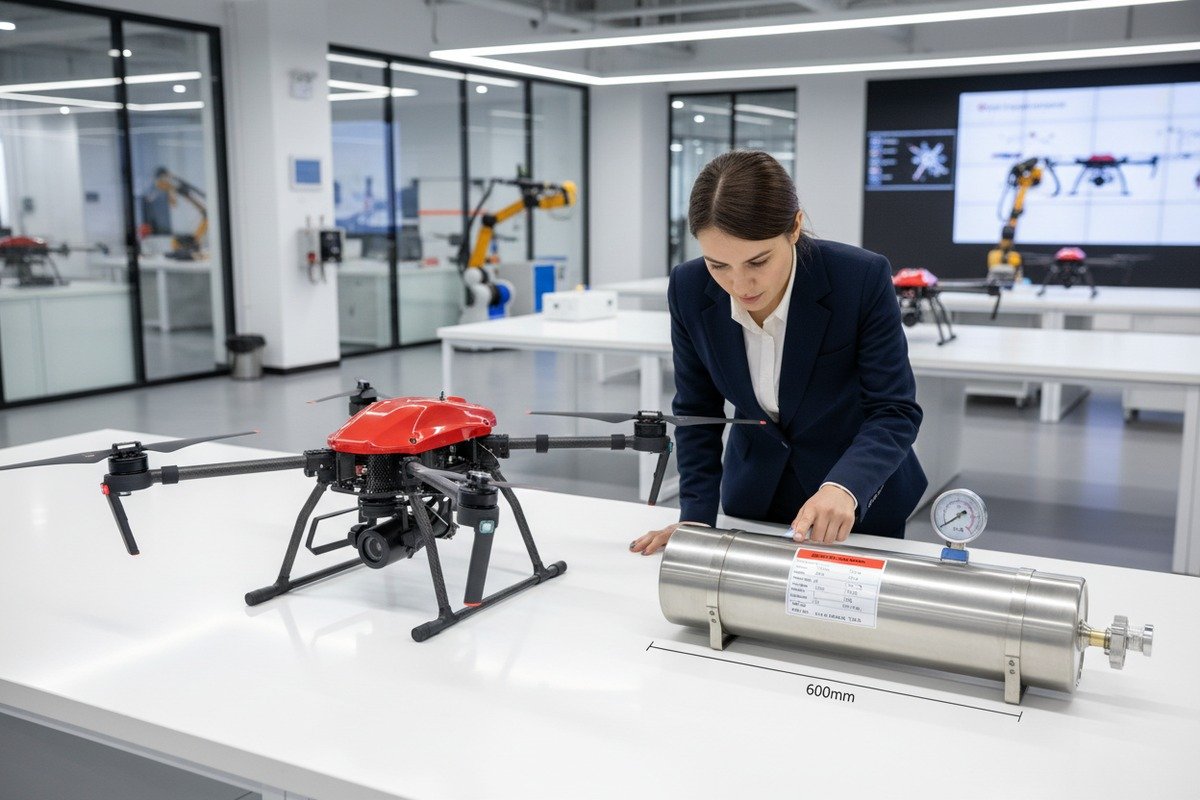
When our engineering team first designed dry powder delivery systems 1 for firefighting drones, we faced a critical problem. Fire departments needed rapid aerial response, but poorly specified canisters failed mid-deployment ABC dry chemical powder 2. Lives and property were at stake.
Dry powder fire canisters for firefighting drones require specific technical details including powder type (ABC or AB chemical), net content (12-25kg), dimensions (φ268mm caliber, 600-650mm length), pressure ratings (1.2MPa), dispersion metrics (>15m radius, >200m² coverage), and compatibility with drone payloads up to 150kg alongside quick-release deployment mechanisms.
Let me walk you through every technical specification you need to consider. Whether you are a procurement manager sourcing from China or a fire department evaluating drone systems, this guide covers the essential details.
How do I determine the right dry powder capacity and discharge rate for my firefighting drone?
When we calibrate our payload systems 3 at the production facility, capacity and discharge rate calculations determine mission success. Choose wrong, and your drone either cannot lift the canister or disperses powder ineffectively.
To determine the right dry powder capacity, match your drone's maximum payload (typically 15-150kg) with canister weights (12-25kg net powder). For discharge rate, target ≥1900L/min flow with 20m projection distance. Calculate coverage needs based on fire types—200-300m² per mission for standard building fires.

Understanding Payload-to-Capacity Ratios
Your drone's maximum takeoff weight directly limits canister selection. Our heavy-lift octocopters handle 150kg payloads, while smaller quadcopters manage 15-20kg. The rule is simple: never exceed 70% of maximum payload capacity for safe flight margins.
Here is a practical reference table:
| Drone-klasse | Max Payload | Recommended Canister Weight | Net Powder Content |
|---|---|---|---|
| Light UAV | 15-20kg | 12-15kg total | 8-10kg |
| Medium Industrial | 50-80kg | 25-35kg total | 18-22kg |
| Heavy-Lift | 100-150kg | 40-60kg total | 25-40kg |
Discharge Rate Engineering
Discharge rate affects how quickly powder reaches the fire. Our tests show that rates below 1500L/min create uneven coverage. Rates above 2200L/min waste agent and reduce flight stability.
The pressure system inside the canister controls this rate. A filling pressure of 1.2MPa provides consistent discharge. Lower pressures cause weak projection. Higher pressures risk canister integrity during altitude changes.
Coverage Calculation Formula
Coverage depends on three factors: powder volume, dispersion radius, and drop height. From our field data, a 25kg dry powder bomb achieves 15m+ radius dispersion when dropped from 50-100m altitude. This covers approximately 200-300m² per deployment.
For Class B and C fires 4 (flammable liquids and electrical), ABC dry chemical powder works best. The agent smothers flames through chemical inhibition. One key insight from our R&D: non-conductive powders are essential for electrical fire scenarios.
Flight Endurance Impact
Heavier canisters reduce flight time significantly. A drone carrying 20kg payload typically achieves 20-30 minutes endurance. No-load flights extend to 45-60 minutes. Plan missions accordingly—ensure sufficient battery for approach, deployment, and safe return.
Can I customize the canister release mechanism to integrate with my drone's flight control software?
Our software development team works with clients worldwide on integration projects. The challenge is real—off-the-shelf canisters rarely communicate seamlessly with proprietary flight controller 5s. Custom integration solves this problem.
Yes, canister release mechanisms can be customized for flight control integration. This requires dual-servo release systems, compatible communication protocols, and software API access. Our integration process includes electronic quick-opening valves, PWM signal control, and fail-safe arming sequences that activate only above 15m altitude.
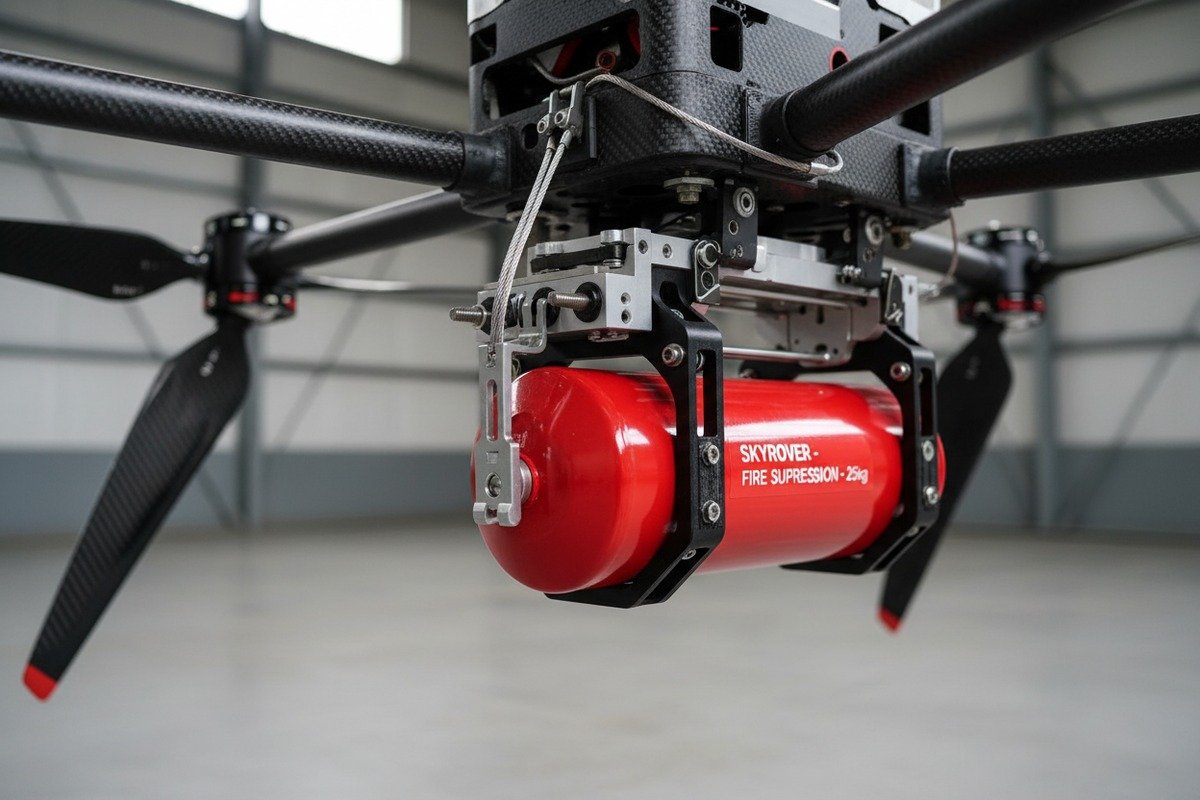
Release Mechanism Types
Three primary mechanisms exist for dry powder deployment. Each has distinct integration requirements:
| Mechanism Type | Integration Complexity | Best Application | Reactietijd |
|---|---|---|---|
| Direct Spray Tubes | Medium | Close-range suppression | Continuous |
| Drop Bombs | Laag | High-altitude deployment | <1 seconde |
| Quick-Release Racks | Hoog | Multi-canister systems | <0.5 second |
Direct spray systems require continuous signal communication. The flight controller sends PWM signals to electronic valves, regulating flow in real-time. This allows operators to adjust discharge mid-flight.
Drop bomb mechanisms are simpler. A single trigger signal releases the canister. Arming occurs automatically when altitude exceeds 15m, preventing accidental ground deployment.
Software Integration Requirements
When we collaborate with clients on custom firmware, several technical elements are essential. First, the flight controller must support auxiliary channel outputs. Most industrial controllers provide 8-16 auxiliary channels for payload control.
Second, the communication protocol matters. Our systems use standard PWM (1000-2000μs pulse width) for basic release. For advanced features like variable discharge rates, serial communication (UART or CAN bus) enables precise control.
Third, telemetry feedback confirms deployment status. Sensors in the release mechanism send confirmation signals back to the controller. This closes the loop—operators know exactly when powder leaves the canister.
Fail-Safe Design Principles
Safety demands multiple redundancies. Our quick-release racks from 7075 aviation aluminum include:
- Dual-servo systems (backup if primary fails)
- Altitude-based arming (prevents ground release)
- Manual override capability
- Automatic disarm on signal loss
The arming height of 15m minimum is critical. This ensures powder disperses properly and provides safety radius for ground personnel.
Integration Testing Protocol
Before field deployment, every integrated system undergoes testing. We simulate various scenarios: signal loss, low battery, high winds, and multiple rapid releases. Only systems passing all tests ship to customers.
Our remote control systems use Qualcomm Android platforms with SDR technology. This provides 12km transmission range with low latency—essential for real-time release control during fast-moving fire scenarios.
What safety certifications and technical documentation should I require from my drone canister supplier?
In our experience exporting to the US and Europe, certification requirements vary significantly. Missing documentation causes customs delays and liability issues. Proper certifications protect your investment and your clients.
Require suppliers to provide IP65 environmental protection certification, explosion-proof fuse documentation, pressure vessel compliance (1.2MPa rating verification), material safety data sheets for dry powder agents, and third-party testing reports for dispersion metrics. Fire department approval documentation and CE/FCC marks ensure regulatory compliance in major markets.

Essential Certification Categories
Certifications fall into four main categories. Each addresses different risk factors:
| Certification Type | Doel | Key Standards | Verificatiemethode |
|---|---|---|---|
| Environmental Protection | Dust/water resistance | IP54-IP65 | Third-party lab testing |
| Pressure Safety | Canister integrity | National pressure vessel codes | Hydrostatic testing |
| Electrical Safety | Component compliance | CE, FCC, UL | Laboratory certification |
| Fire Agent Approval | Chemical effectiveness | UL 711, EN 3 | Agent composition analysis |
IP Rating Requirements
IP65 rating 6 is our standard for firefighting applications. This means complete dust protection (6) and water jet resistance (5). Lower ratings risk electronic failure when water from ground crews or rain contacts the release mechanism.
The canister body itself must be waterproof and moisture-proof. Dry powder agents absorb moisture, reducing effectiveness. Our fully sealed designs with double-insured explosion-proof fuses address this concern.
Pressure Documentation Deep Dive
Pressure documentation requires special attention. The standard filling pressure of 1.2MPa applies at sea level and normal temperature. However, operations occur across varying conditions—altitude up to 4500m, temperatures from -20°C to 60°C.
Request pressure testing certificates showing performance across this operating range. Reputable suppliers provide hydrostatic burst test data 7 showing safety margins above rated pressure.
Material Compatibility Certificates
The canister material must not react with the dry powder agent. Aluminum and carbon fiber composites are industry standards. Request material composition certificates confirming no reactive metals that could degrade ABC dry chemical compounds.
Chemical compatibility testing documentation should accompany every canister batch. This prevents corrosion issues that develop over time, especially in humid storage conditions.
Export Documentation Package
When we ship to international customers, our documentation package includes:
- Certificate of Origin
- Commercial Invoice with HS codes
- Packing List with weights and dimensions
- Material Safety Data Sheets (MSDS)
- Test Reports (pressure, dispersion, environmental)
- User Manual with safety warnings
- Warranty documentation
Customs authorities in the US and EU require complete documentation. Incomplete packages cause delays averaging 2-3 weeks. Our door-to-door delivery service includes documentation preparation to prevent these issues.
Third-Party Testing Value
Independent testing reports carry more weight than manufacturer claims. We recommend requiring reports from recognized laboratories covering:
- Actual dispersion radius (must exceed 15m)
- Coverage area measurements
- Discharge rate verification
- Operating temperature performance
These reports provide evidence for insurance purposes and regulatory compliance.
How do I ensure the dry powder canisters are durable enough to withstand repeated high-altitude deployments?
Our quality control team tests every canister design through hundreds of deployment cycles. The harsh reality is that cheap canisters fail after 10-20 uses. Durable construction costs more upfront but saves money over operational lifetime.
Ensure canister durability by specifying 7075 aviation-grade aluminum or carbon fiber construction, pressure-rated seals with verified cycle life (minimum 100 deployments), temperature-resistant gaskets (-20°C to 60°C range), and corrosion-resistant coatings. Require supplier warranty covering minimum 50 deployment cycles without seal degradation.

Material Selection for Longevity
Material choice determines canister lifespan. Our comparison testing reveals significant differences:
| Material | Gewicht | Durability (Cycles) | Cost Factor | Best Application |
|---|---|---|---|---|
| Standard Aluminum | Medium | 50-80 | 1x | Budget operations |
| 7075 luchtvaart aluminium | Medium-Light | 150-200 | 1.5x | Professional use |
| Koolstofvezelcomposiet | Light | 200+ | 2.5x | Heavy-lift systems |
| Aluminum-Carbon Hybrid | Light | 180+ | 2x | Balanced performance |
De 7075 aviation aluminum alloy 8 offers excellent strength-to-weight ratio. It resists fatigue cracking better than standard aluminum alloys. Carbon fiber spray tubes combined with aluminum bodies represent our preferred hybrid approach.
Seal and Gasket Engineering
Seals fail before bodies do. High-altitude deployments stress seals through pressure changes and temperature swings. Each deployment cycle (pressurization, flight, release, depressurization) weakens rubber compounds.
Specify silicone or fluorocarbon gaskets rated for the full operating temperature range. Standard rubber degrades below -10°C and above 50°C. Our canisters use gaskets tested through 500 pressure cycles before installation.
Corrosion Prevention Strategies
Dry powder agents contain chemicals that attack bare metal over time. ABC dry chemical includes monoammonium phosphate, which corrodes untreated aluminum in humid conditions.
Effective corrosion prevention requires:
- Anodized aluminum surfaces (Type III hard coat preferred)
- Internal polymer linings for direct powder contact
- Sealed electronic compartments
- Regular inspection and cleaning protocols
High-Altitude Stress Factors
Deployments between 50-100m altitude subject canisters to specific stresses. Rapid altitude changes during approach create pressure differentials. Release forces generate shock loads. Impact vibrations from rough landings compound over time.
Our design standards specify:
- 3x safety factor on pressure ratings
- Shock-absorbing mounting systems
- Vibration-dampening internal components
- Reinforced connection points
Maintenance and Inspection Requirements
Even the best canisters require maintenance. We provide detailed inspection checklists covering:
- Visual check for cracks or dents (before each flight)
- Seal integrity test (every 10 deployments)
- Pressure test (every 25 deployments)
- Full refurbishment (every 50 deployments)
Following these schedules extends canister life significantly. Skip maintenance, and failures become unpredictable.
Warranty Considerations
Our standard warranty covers manufacturing defects for 24 months. However, durability warranties require proper documentation. Customers must maintain deployment logs showing:
- Flight conditions (temperature, altitude, wind)
- Payload weights
- Maintenance performed
- Any anomalies observed
This documentation supports warranty claims and helps our engineering team improve future designs.
Conclusie
Technical specifications for dry powder fire canisters determine firefighting drone effectiveness. From capacity and discharge rates to certifications and durability, every detail matters. Work with experienced manufacturers who understand these requirements and can provide proper documentation for your market.
Voetnoten
1. Explains how dry chemical fire suppression systems operate. ↩︎
2. Details the chemical composition and extinguishing mechanism of ABC dry chemical. ↩︎
3. Replaced HTTP 403 with an authoritative .edu source explaining UAV payloads. ↩︎
4. Defines Class B and C fires, involving flammable liquids/gases and electrical equipment. ↩︎
5. Explains the central role and core functions of a drone’s flight controller. ↩︎
6. Clearly defines the IP65 rating for dust protection and water jet resistance. ↩︎
7. Explains burst pressure testing for components to determine maximum pressure and failure. ↩︎
8. Describes the mechanical properties and composition of 7075 aluminum alloy. ↩︎

 English
  Spanish
  German
  French
  Dutch
Dutch  Arabic
