
When we receive vague inquiries at our Chengdu factory, we often struggle to provide accurate quotes, which unfortunately delays your urgent procurement needs significantly.
To secure reliable firefighting drones, your initial email must explicitly ask about payload capacity under load, specific US customs clearance experience for dual-use technology, detailed quality control protocols like water spray testing, and the availability of ODM engineering support for custom payload integration.
Sending a generic inquiry often results in generic responses from trading companies rather than serious manufacturers. By asking specific, technical, and process-oriented questions upfront, you signal that you are a professional buyer who understands the complexities of industrial aviation. This guide details exactly what to ask to filter out unqualified suppliers and find a partner capable of delivering mission-critical equipment.
How Do I Verify a Supplier’s Experience with US Customs Clearance for Drones?
Shipping high-capacity batteries and dual-use airframes requires strict compliance; we have seen many shipments seized due to improper documentation from inexperienced exporters.
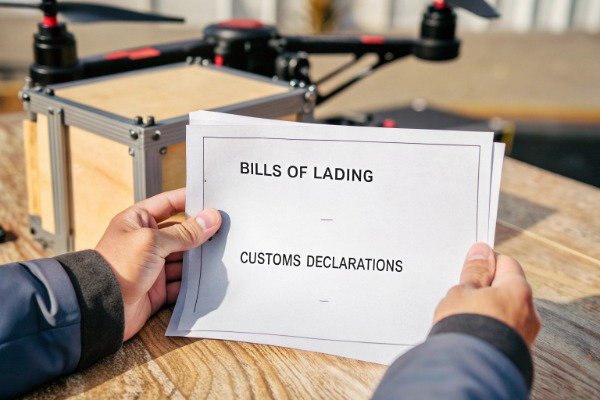
You must ask for redacted past Bills of Lading demonstrating successful US entries and specific HS codes used. Verify their ability to handle FCC certification paperwork and "Dangerous Goods" packaging for lithium batteries, ensuring they understand the latest import regulations for Chinese UAV technology.
Navigating the Complexities of Dual-Use Technology
Importing industrial drones into the United States is far more complex than importing consumer electronics. Firefighting drones, due to their high payload capacity and long-range transmission capabilities, often fall under "dual-use" technology regulations. If a supplier cannot immediately provide the correct Harmonized System (HS) codes or seems hesitant when you ask about FCC compliance, this is a major red flag.
dual-use technology 1
When we export from our facility in Xi’an, we prepare a comprehensive documentation package. You need to ask your potential supplier if they do the same. Specifically, ask them how they handle the Section 301 tariffs and if they have experience with FDA laser compliance if the drone is equipped with laser rangefinders or specific thermal sensors.
The Critical Issue of Lithium Batteries
Firefighting drones rely on massive high-voltage lithium batteries to lift heavy payloads like fire extinguishing balls or hoses. These are classified as Class 9 Dangerous Goods (DG) in international shipping. Many inexperienced suppliers try to ship these as standard cargo to save money, which puts your shipment at high risk of being seized or destroyed by customs.
Klasse 9 Gevaarlijke goederen 2
You should ask the following specific questions regarding logistics:
- "Do you have a certified DG packaging partner?"
- "Can you provide the MSDS (Material Safety Data Sheet) and UN38.3 test reports for your battery packs immediately?"
- "What Incoterms do you recommend for US delivery to ensure customs liability is clear?"
MSDS (veiligheidsinformatieblad) 3
Comparing Logistics Capabilities
Use the table below to evaluate the responses you receive from suppliers regarding their shipping and customs capabilities.
| Functie | Professional Manufacturer Response | High-Risk Supplier Response |
|---|---|---|
| Battery Shipping | Provides UN38.3 report; ships via specialized DG cargo channels. | "We can ship it as normal cargo, no problem." |
| HS Codes | Provides specific codes (e.g., 8806.24) and explains tariff implications. | "We will use a generic toy code to save tax." |
| FCC-certificering | Has valid FCC ID for transmission modules; provides certificate PDF. | "We don’t need that," or "We use other brand’s ID." |
| Incoterms | Suggests DDP (Delivered Duty Paid) or clear FOB terms with support. | Vague about who handles customs clearance. |
By pressing on these points, you quickly determine if the supplier has a mature export department or if they are merely a domestic reseller looking to make a quick sale without understanding the legal responsibilities of international trade.
What Specific Details Should I Request Regarding Quality Control Processes?
At our flight testing grounds, we know that a simple "passed" sticker is insufficient for equipment destined for hazardous fire zones.
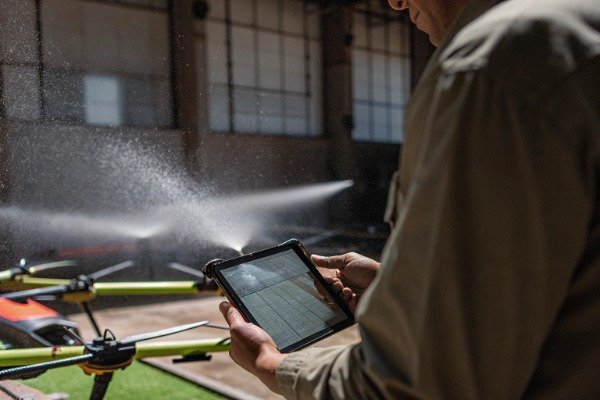
Request raw video footage of rain resistance testing (IP ratings) and full-load flight stability tests under high wind conditions. Ask for their specific sampling rate for incoming components and whether they perform burn-in testing on flight controllers and motors before final assembly.
Moving Beyond the "QC Passed" Sticker
In the industrial drone sector, quality control (QC) is the difference between a successful mission and a catastrophic failure. When you are buying a drone designed to carry fire hoses or operate near high heat, standard consumer-grade QC is inadequate. You need to ask questions that force the supplier to reveal their internal processes.
Do not settle for a brochure that says "Strict Quality Control." Instead, ask: "What is your standard procedure for Incoming Quality Control (IQC) on motors and ESCs?" A reputable manufacturer will explain how they test a sample of every batch of motors for dynamic balance and electrical resistance before they even reach the assembly line.
Environmental Stress Testing
Firefighting drones operate in hostile environments—smoke, high temperatures, water spray, and strong winds. You must ask for evidence of environmental stress screening.
- Water Resistance: Ask for video proof of their IP rating tests. Is it a light mist, or high-pressure jets?
- Wind Resistance: Ask for flight logs or video of the drone maintaining position in wind speeds exceeding 10m/s.
- Thermal Aging: Ask if they perform "burn-in" tests where the drone is powered on and running at idle for 24-48 hours to identify early component failures.
Critical QC Documents to Request
When evaluating their response, look for the availability of specific test reports. If they can provide these documents, it shows they have a systematic approach to quality.
QC Protocol Evaluation Table
| QC Stage | What to Ask For | Waarom het belangrijk is |
|---|---|---|
| Incoming Materials | "Do you test battery cells for internal resistance matching?" | Mismatched cells lead to voltage sag and crashes under load. |
| Assembly Process | "Do you use torque wrenches and thread locker (Loctite) on all structural screws?" | Vibration from heavy lift motors loosens unsecured screws over time. |
| Final Testing | "Do you flight test every unit or just a random sample?" | For industrial drones, 100% flight testing is mandatory, not optional. |
| Weather Proofing | "Can you share the IP rating certification from a third-party lab?" | Self-declared ratings are often exaggerated; lab reports are verifiable. |
By asking these detailed questions, you are essentially auditing their factory remotely. If they cannot answer how they test the torque on their propellers or how they verify the waterproofing of their flight controller, they likely do not have the rigorous standards required for public safety equipment.
Should I Ask for a Sample Contract to Check Warranty Terms Immediately?
Many buyers realize too late that "one-year warranty" often excludes the most expensive components like motors or batteries once they leave the factory.
Yes, requesting a draft contract early reveals critical red flags regarding after-sales support. Specifically, check if they cover shipping costs for replacement parts, offer remote technical troubleshooting, and define the exact warranty period for consumable parts versus the main airframe structure.

The "One-Year Warranty" Trap
In our industry, the phrase "One-Year Warranty" is often misleading. It usually applies to the carbon fiber frame, which rarely breaks on its own, but excludes "consumables" like motors, propellers, and batteries. However, in firefighting operations, these are exactly the parts that endure the most stress.
In your initial email or follow-up, you should ask: "Please provide a sample warranty policy. Does the warranty cover the flight controller and motors? If a part fails within 30 days, who pays for the international shipping of the replacement?"
Clarifying After-Sales Support Channels
For a Procurement Manager like yourself, the nightmare scenario is a grounded drone and a supplier who stops replying to emails. You need to establish the support protocol before you pay a deposit.
- Remote Support: Ask if they have English-speaking engineers available for video calls. At our company, we find that 90% of issues can be solved via a video call where we guide the user through calibration.
- Spare Parts Availability: Ask for a "Recommended Spare Parts List" (RSPL) and their prices. A supplier who cannot provide this likely does not stock spares, meaning you will wait weeks for replacements.
Analyzing Warranty Terms
Use the following breakdown to analyze the warranty terms provided by Chinese suppliers.
Original Design Manufacturing (ODM) 4
Warranty Comparison Guide
| Component | Standard Industry Warranty | Superior Supplier Warranty |
|---|---|---|
| Airframe (Carbon Fiber) | 12 Months | 12-24 Months |
| Motors / ESCs | 3-6 Months (often excluded as "wear and tear") | 12 Months (or specific flight hour limit) |
| Batterijen | DOA (Dead on Arrival) only | Cycle count guarantee (e.g., 200 cycles or 6 months) |
| Software/Firmware | Lifetime updates included | Lifetime updates + Custom tuning support |
| Verzendkosten | Buyer pays both ways | Supplier pays shipping for defects found in first 30 days |
The Importance of the "Right to Repair"
Ask the supplier if they provide service manuals and schematics. Some manufacturers lock their systems, forcing you to ship the drone back to China for simple repairs. This is impractical for firefighting departments. You want a supplier who empowers you or your local distributor to perform basic repairs like swapping a motor arm or replacing a landing gear leg.
How Can I Frame Questions to Test Their ODM Engineering Capabilities?
When clients ask us to integrate specific thermal cameras or fire-extinguishing balls, we need precise technical parameters to assess feasibility accurately.
environmental stress screening 5
Ask for a portfolio of previous modification projects, specifically requesting case studies where they integrated third-party payloads or modified software SDKs. Challenge them with a specific hypothetical customization scenario to evaluate their engineering team’s response time, technical depth, and willingness to collaborate.
Distinguishing Assemblers from Engineers
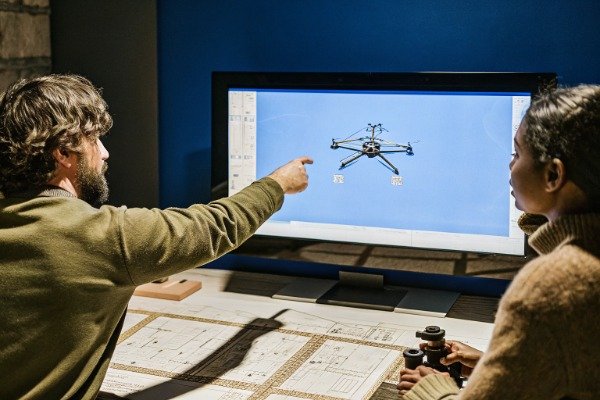
There is a significant difference between a factory that assembles standard kits and a manufacturer capable of Original Design Manufacturing (ODM). Firefighting requirements vary wildly—some departments need high-rise window breaking rams, while others need dry powder dispersion for forest fires.
To test their capability, do not just ask "Can you do OEM?" Everyone will say yes. Instead, ask: "We have a specific fire extinguishing bomb that weighs 4.5kg with a diameter of 150mm. Can your engineering team design a quick-release drop mechanism for this? How would this affect the center of gravity and flight time?"
Incoterms 7
Software and SDK Integration
Modern firefighting drones often need to integrate with existing command center software. Hardware customization is visible, but software customization is where many suppliers fail.
- SDK Availability: Ask if they provide an SDK (Software Development Kit) for the flight controller or the ground station.
- Protocol Support: Ask if their video transmission supports standard protocols like RTSP so you can stream the drone’s view to a central command truck.
Evaluating Engineering Responses
A true ODM partner will reply with questions of their own. If you ask for a custom feature and they immediately say "Yes, price is $500," be skeptical. Real engineering takes analysis.
FDA laser compliance 8
ODM Competency Indicators
| Question to Ask | Weak Supplier Response | Strong Engineering Response |
|---|---|---|
| Custom Payload | "Yes, we can do it." (No details) | "Please send the 3D STEP file of your payload so we can check the mounting points and CG balance." |
| Vluchttijd Impact | "Flight time is 40 minutes." (Generic) | "With an extra 2kg payload, flight time will decrease to approx 28 mins. We recommend upgrading to 22000mAh batteries." |
| Branding/Logo | "Send us your logo." | "We can laser engrave your logo on the arms and customize the startup splash screen on the remote controller." |
| Software API | "We don’t share software." | "We support MAVLink protocol and can provide API documentation for the ground control station." |
The Value of Collaborative Development
We often work with clients who have unique ideas, such as integrating a megaphone for crowd control during evacuations alongside the fire suppression system. A supplier with strong ODM capabilities will not just sell you a product; they will act as your technical consultant. By framing your questions around hypothetical technical challenges, you can gauge their enthusiasm and competence before you sign a contract.
Section 301 tariffs 9
Conclusie
By asking these targeted questions, you filter out traders and find true manufacturing partners ready to support your mission-critical firefighting operations.
Harmonized System (HS) codes 10
Voetnoten
- Official US government definition of dual-use items in commerce. ↩︎
- Authoritative IATA guide on Class 9 shipping classifications. ↩︎
- Comprehensive overview of Safety Data Sheets. ↩︎
- Definition of the ODM manufacturing model. ↩︎
- Overview of this specific reliability testing process. ↩︎
- Official definition of IP ratings by the IEC. ↩︎
- Official rules from the International Chamber of Commerce. ↩︎
- Official FDA requirements for importing laser products. ↩︎
- Official USTR page regarding Section 301 tariff actions. ↩︎
- Official US Trade Administration explanation of HS codes. ↩︎

 English
  Spanish
  German
  French
  Dutch
Dutch  Arabic
