
When our engineering team tests flight controllers before shipment, we often find buyers overlook IMU redundancy verification 1. This gap creates dangerous situations during firefighting missions where GPS signals fail near burning structures.
To verify redundant IMU design, request technical documentation showing dual or triple IMU architecture, review sensor fusion algorithm specifications, demand environmental test reports for vibration and thermal stress, and ask for real-world flight validation data demonstrating failover performance during simulated sensor failures in GPS-denied conditions.
This guide walks you through exactly what to check and what questions to ask your supplier MTBF test reports 2. Let’s break down each verification step so you can source firefighting drones with confidence.
What technical documentation should I request to verify the IMU redundancy in my firefighting drones?
Our quality control team reviews hundreds of IMU specifications each month. We see many buyers accept basic spec sheets without asking deeper questions. This approach risks mission failures when redundant systems don't perform as advertised.
Request IMU architecture diagrams showing physical sensor separation, sensor fusion algorithm documentation, MTBF test reports, environmental stress test results covering vibration isolation and thermal management, and compliance certificates for aviation safety standards relevant to critical drone operations.
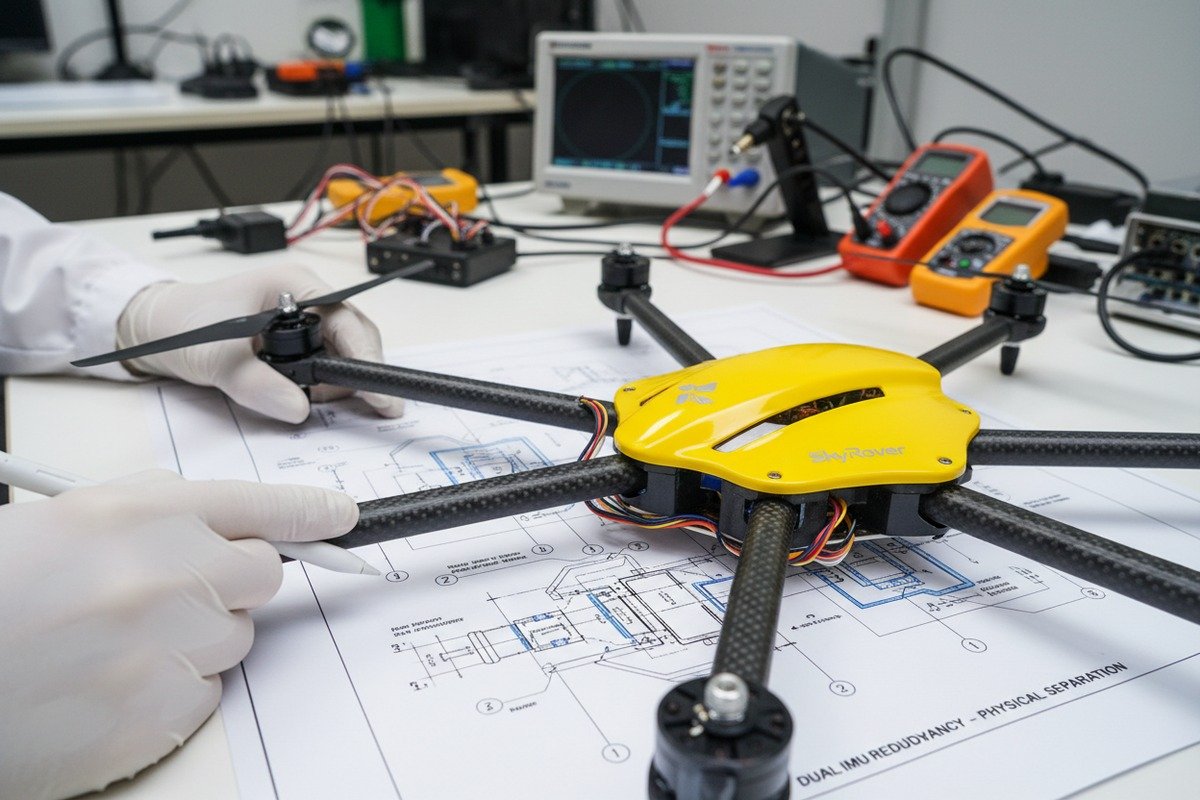
Understanding IMU Architecture Documentation
The first document you need is an architecture diagram. This shows how many IMU units exist and where they sit on the drone. Physical separation matters because common-mode failures can disable multiple sensors simultaneously. If both IMUs mount on the same board, a single vibration event or thermal spike could knock out your entire navigation system.
Look for dual or triple redundancy configurations. Commercial and military aviation typically uses triple redundancy or higher. For firefighting drones operating in extreme conditions, dual redundancy represents the minimum acceptable standard.
Sensor Fusion Algorithm Specifications
Your supplier should provide documentation on their sensor fusion approach. Most systems use Extended Kalman Filters 3 or Unscented Kalman Filters running at 100 to 2000 Hz. Higher fusion rates generally provide smoother flight control but consume more processing power.
| Algorithm Type | Update Rate | Complexiteit | Beste voor |
|---|---|---|---|
| Basic Kalman Filter | 100-200 Hz | Laag | Simple missions |
| Extended Kalman Filter | 200-500 Hz | Medium | Standard operations |
| Unscented Kalman Filter | 500-1000 Hz | Hoog | GPS-denied environments |
| Adaptive Fusion | 1000-2000 Hz | Zeer hoog | Critical firefighting missions |
Environmental Test Reports
Request test reports covering vibration isolation and thermal stress. Motor-induced noise typically falls in the 5 to 10 Hz range. If the IMU lacks proper isolation, this noise corrupts readings and degrades flight stability.
Thermal tests should cover the temperature ranges your firefighting drones will encounter. Standard industrial tests may not reflect conditions near active fires. Ask specifically for high-temperature exposure data.
Compliance and Certification Documents
Aviation safety certifications demonstrate third-party validation. While drone regulations vary by country, suppliers should show compliance with relevant standards for critical public safety operations. aviation safety standards 4
| Documenttype | What It Proves | Priority Level |
|---|---|---|
| IMU Architecture Diagram | Redundancy layout and separation | Kritisch |
| Sensor Fusion Specs | Algorithm reliability | Kritisch |
| MTBF Test Report | Long-term reliability | Hoog |
| Vibration Test Results | Noise immunity | Hoog |
| Thermal Stress Report | Heat resistance | Hoog |
| Safety Certifications | Third-party validation | Medium |
How can I ensure the redundant sensors will maintain flight stability during high-temperature missions?
In our thermal testing chamber, we simulate conditions firefighting drones face near active fires. Many suppliers skip this step, testing only at standard industrial temperatures. The result? Drones that work fine in the warehouse but fail when heat stress hits.
Ensure high-temperature stability by requesting thermal chamber test reports showing IMU performance at elevated temperatures, verifying thermal management systems like heat sinks and isolation barriers, and demanding flight test data from missions conducted in hot conditions exceeding 50°C ambient temperature.

The Thermal Challenge for Firefighting Drones
Standard industrial IMUs operate reliably between -40°C and 85°C. However, firefighting drones fly near flames producing temperatures far beyond these ranges. Even at safe distances, radiant heat can push drone surface temperatures well above normal operating limits.
IMU performance degrades as temperature rises. Bias stability increases, noise density grows, and sensor drift accelerates. These effects compound during missions, making position estimation increasingly unreliable.
What to Look for in Thermal Test Data
Ask your supplier for test data showing specific IMU parameters at various temperatures:
| Temperatuur | Acceptable Bias Stability | Acceptable Noise Density | Drift Rate Impact |
|---|---|---|---|
| 25°C (baseline) | <0.5°/hr | <0.01°/√hr | Basislijn |
| 50°C | <1.0°/hr | <0.02°/√hr | 2x baseline |
| 70°C | <2.0°/hr | <0.04°/√hr | 4x baseline |
| 85°C (max rated) | <5.0°/hr | <0.1°/√hr | 10x baseline |
If your supplier cannot provide data at elevated temperatures, their testing likely occurred only at room temperature.
Thermal Management Systems
Effective thermal management extends IMU reliability in hot conditions. Look for these features:
Heat sinks: Metal structures that draw heat away from sensitive electronics. Larger heat sinks provide better cooling but add weight.
Thermal isolation: Barriers that prevent heat from reaching the IMU from external sources like motors or radiant fire heat.
Active cooling: Fans or liquid cooling systems that actively remove heat. These add complexity but dramatically extend high-temperature operating time.
Real-World Validation Requirements
Laboratory tests don't capture all real-world conditions. Smoke particles, electromagnetic interference from emergency radios, and turbulent airflow near fires all affect IMU performance.
Ask your supplier for flight test data from actual high-temperature conditions or realistic simulations. This data should show:
- Flight duration before position drift exceeded acceptable limits
- Sensor fusion behavior during temperature transients
- Recovery time after thermal stress events
When we test our firefighting drones, we run them in enclosed hot chambers while monitoring IMU output. This reveals thermal weaknesses that bench testing misses.
What specific failover protocols should my supplier demonstrate to prove their flight controller reliability?
Our flight controller engineers spend months perfecting failover logic. We've learned that smooth failover isn't automatic—it requires careful design and extensive testing. Many buyers never ask about failover protocols until a sensor fails mid-mission.
Suppliers should demonstrate fault detection, isolation, and recovery (FDIR) protocols including automatic failure detection within milliseconds, seamless transition to redundant IMU data streams, pilot notification systems, and flight test videos showing stable flight continuation during simulated primary IMU failures.

Understanding FDIR Protocols
FDIR stands for Fault Detection, Isolation, and Recovery 5. This framework describes how flight controllers handle sensor failures.
Detection: The system must identify when an IMU produces invalid data. This happens through cross-checking between redundant sensors or monitoring individual sensor health metrics.
Isolation: Once a fault is detected, the system must identify which sensor failed and exclude its data from navigation calculations.
Recovery: The flight controller transitions to backup sensors and maintains stable flight without pilot intervention.
Detection Speed Matters
Fast detection prevents bad data from corrupting navigation estimates. Industry standards call for detection within 50-100 milliseconds. Slower detection allows erroneous IMU readings to influence position calculations, causing flight path deviations before failover completes.
Ask your supplier:
- What is the maximum detection time for IMU failures?
- What fault conditions trigger detection (complete failure, drift, noise increase)?
- How does detection work when failures are gradual rather than sudden?
Seamless Transition Requirements
Transition should be invisible to the pilot. The drone should maintain its position and heading without noticeable jerks or drifts. This requires:
Pre-processed backup data: The secondary IMU should already be running and producing filtered navigation estimates, ready for immediate use.
Weighted blending: Rather than hard switching, advanced systems gradually shift weighting from failed to functional IMUs.
State preservation: Navigation state (position, velocity, attitude) should transfer without reset.
Demonstration Methods
Don't accept verbal assurances. Request actual demonstrations:
| Demonstration Type | What It Shows | Reliability Indicator |
|---|---|---|
| Bench test video | Hardware failover capability | Basic |
| Flight test video | Real-world failover performance | Strong |
| Data logs from failover events | Timing and stability metrics | Very Strong |
| Repeated failover tests | Consistency and reliability | Uitstekend |
When we ship drones to US customers, we include failover test documentation showing multiple simulated failures during flight. This gives buyers confidence before the drone arrives.
Pilot Notification Systems
Even with automatic failover, pilots need awareness of system status. The flight controller should provide:
- Visual alerts (dashboard indicators, LED colors)
- Audio alerts (warning tones)
- Telemetry messages showing which sensors are active
- Degraded mode indicators when redundancy is exhausted
Can I get a detailed engineering report showing how the redundant IMU handles sensor interference on-site?
When we deploy test drones at actual emergency sites, interference sources surprise even experienced engineers. Radio communications, power lines, metal structures, and magnetic fields from equipment create navigation challenges that laboratory tests don't reveal.
Request engineering reports documenting IMU performance under electromagnetic interference, magnetic field disturbances, vibration from external sources, and GPS-denied conditions. Reports should include quantified position drift rates, sensor fusion adaptation behavior, and recovery time after interference events cease.

Types of Interference Firefighting Drones Face
Firefighting environments present unique interference challenges:
Electromagnetic interference (EMI): Emergency radios, pump motors, vehicle electronics, and power lines generate electromagnetic fields that can affect IMU electronics. Electromagnetic interference (EMI) 6
Magnetic interference: Metal structures, firefighting vehicles, and equipment create magnetic field disturbances that confuse magnetometers integrated with IMU data.
Vibration interference: Helicopter downwash, vehicle engines, and collapsing structures produce vibrations that propagate through the air and ground.
GPS denial: Smoke, structures, and terrain features block satellite signals, forcing the IMU to handle navigation independently.
What Engineering Reports Should Include
Detailed interference reports go beyond simple pass/fail statements. They should quantify degradation and recovery:
| Interference Type | Metrics to Report | Acceptable Performance |
|---|---|---|
| EMI exposure | Position drift rate during exposure | <10m drift over 60 seconds |
| Magnetic disturbance | Heading error magnitude | <5° deviation |
| External vibration | Attitude estimation error | <2° roll/pitch error |
| GPS denial 7 | Dead reckoning drift rate | <0.5 km/hour |
GPS-Denied Performance Data
GPS denial deserves special attention for firefighting drones. When GNSS signals fail, the IMU switches to dead reckoning 8—estimating position based on measured accelerations and rotations.
Tactical-grade IMUs drift at 0.1 to 1 km per hour during dead reckoning. This drift rate directly limits mission duration. If your firefighting drone must operate near structures for 10 minutes without GPS, you need to understand how much position error will accumulate.
Ask your supplier:
- What is the measured dead reckoning drift rate?
- How was this measured (flight test or bench test)?
- What environmental conditions applied during testing?
Adaptive Fusion Capabilities
Advanced IMU systems use adaptive fusion algorithms that respond to interference in real-time. These systems:
- Detect when specific sensors produce unreliable data
- Dynamically adjust weighting between sensors
- Increase reliance on unaffected sensors during interference
- Return to normal weighting after interference clears
Request documentation showing how the adaptive fusion responds to different interference types. Video demonstrations showing real-time sensor weighting during interference events provide strong evidence.
Cybersecurity Considerations
Sensor interference can also be intentional. Spoofing attacks inject false data into navigation systems. Your supplier should document:
- Data stream encryption between IMU and flight controller
- Authentication protocols preventing false data injection
- Anomaly detection that identifies spoofing attempts
While deliberate attacks on firefighting drones seem unlikely, protecting against spoofing also protects against accidental interference that mimics attack patterns.
Conclusie
Verifying redundant IMU design protects your firefighting drone investment and mission success. Request architecture documentation, demand thermal and interference test reports, and insist on failover demonstrations. Your supplier should welcome these requests—we certainly do.
Voetnoten
1. Explains how redundant IMUs increase reliability and ensure fault tolerance in systems. ↩︎
2. Defines Mean Time Between Failures (MTBF) as a crucial metric for system reliability. ↩︎
3. Provides a foundational explanation of this non-linear filtering technique for state estimation. ↩︎
4. Official source for drone regulations and safety guidelines from a leading aviation authority. ↩︎
5. Replaced with an authoritative NASA document detailing Fault-Detection, Fault-Isolation and Recovery (FDIR) techniques. ↩︎
6. Comprehensive overview of EMI, its sources, and effects on electronic circuits and systems. ↩︎
7. Discusses causes and mitigation strategies for GNSS signal denial in various environments. ↩︎
8. Explains the navigation method of estimating position using a previous fix and movement. ↩︎

 English
  Spanish
  German
  French
  Dutch
Dutch  Arabic
