
Last year, one of our customers lost $50,000 in replanting costs 1 when an untested drone jammed his tractor’s GPS mid-season. That painful lesson taught us both the true cost of skipping interference verification during sourcing.
To verify agricultural drone radar interference with farm equipment, you must request detailed EMC test reports from manufacturers, conduct on-site spectrum analysis before purchase, run field trials with your specific equipment, and confirm compliance with FCC and international standards for agricultural RF environments.
The following sections break down each verification step. You will learn exactly what to ask manufacturers, which tests matter most, and how to protect your farm investment from costly electromagnetic conflicts.
How can I test if the drone's radar signal will interfere with my existing tractor GPS systems?
When we ship our hexacopters to farms across America and Europe, GPS compatibility is always the first concern customers raise. A single frequency overlap can turn precision planting into an expensive guessing game.
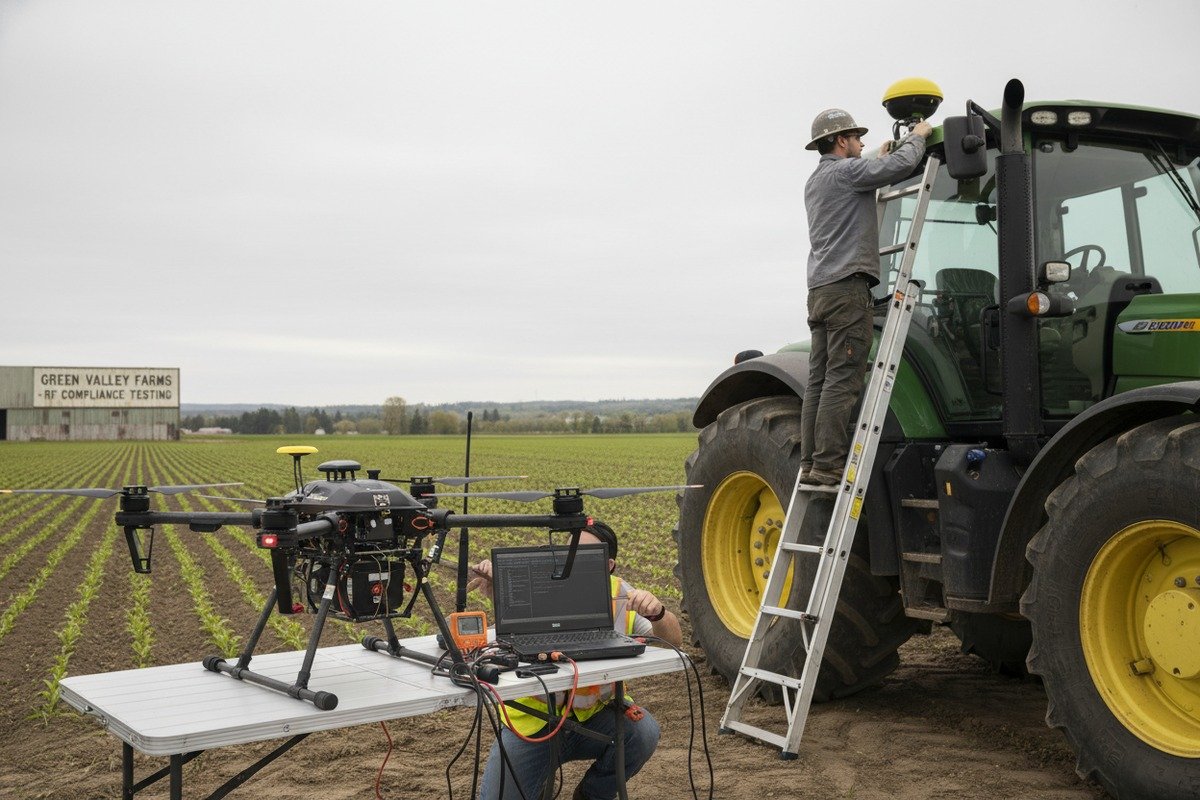
To test for GPS interference, rent a spectrum analyzer to scan the drone's emissions near your tractor, compare frequency bands against your GPS receiver specifications, and run simultaneous operation tests at various distances and altitudes to identify signal degradation thresholds.

Understanding the Frequency Overlap Problem
GPS receivers in modern tractors 2 typically operate at L1 (1575.42 MHz) and L2 (1227.60 MHz) frequencies. Agricultural drones emit signals across multiple bands. Control links use 2.4 GHz or 5.8 GHz. Radar altimeters operate at 24 GHz. Obstacle avoidance sensors may use mmWave frequencies between 60-94 GHz.
The real danger comes from harmonic emissions 3 and spurious signals. A drone transmitting at 2.4 GHz can produce harmonics that creep into GPS bands. Our engineering team measures these harmonics during production. But field conditions differ from lab conditions.
Step-by-Step Testing Protocol
First, gather baseline data. Turn off the drone and record your tractor's GPS accuracy 4. Most RTK systems show 2-centimeter accuracy under normal conditions.
Second, power on the drone at 100 meters distance. Monitor GPS accuracy readings. Move the drone closer in 20-meter increments. Note when accuracy starts degrading.
Third, vary altitude. Fly the drone at 10 meters, then 30 meters, then 50 meters above ground. Record GPS performance at each height.
| Test Parameter | Normal Range | Warning Threshold | Critical Failure |
|---|---|---|---|
| GPS-nauwkeurigheid | <5 cm | 5-15 cm | >15 cm |
| Signal Lock Time | <30 sec | 30-60 sec | >60 sec |
| Satelliettelling | >12 | 8-12 | <8 |
| HDOP Value | <1.0 | 1.0-2.0 | >2.0 |
Equipment You Need
A basic spectrum analyzer 5 costs around $500 to rent for a week. Models like the RF Explorer or TinySA Ultra work well for initial screening. For comprehensive testing, hire an RF engineer with professional equipment.
Record everything. Create a test matrix showing drone position, altitude, tractor location, and GPS readings. This documentation helps if you need to return a non-compliant drone or request modifications from the manufacturer.
What specific EMC test reports should I request from the manufacturer during the sourcing process?
Our quality control team runs dozens of electromagnetic compatibility tests 6 before any drone leaves our facility. But not all manufacturers are this thorough. Knowing which reports to demand separates serious suppliers from those cutting corners.
Request IEC 61000 series compliance reports, ISO 14982-2 agricultural machinery EMC test data, radiated emissions measurements across 30 MHz to 6 GHz, conducted emissions reports, immunity test results, and harmonic analysis documentation with specific test methodology details.

Essential EMC Report Categories
Electromagnetic compatibility testing falls into two categories: emissions and immunity. Emissions tests measure what the drone puts out. Immunity tests measure what the drone can withstand from external sources.
For agricultural use, both matter equally. Your drone must not jam your tractor. Your tractor must not jam your drone.
Specific Standards to Verify
| Standaard | Wat dekt het? | Waarom het belangrijk is |
|---|---|---|
| IEC 61000-4-3 | Radiated immunity | Drone survives RF from farm radios |
| IEC 61000-4-6 | Conducted immunity | Handles interference through cables |
| CISPR 11/32 | Radiated emissions | Won't jam nearby equipment |
| ISO 14982-2 | Ag machinery EMC | Specifically designed for farm use |
| EN 55011 | Industrial equipment | European compliance |
Red Flags in EMC Documentation
Watch for vague language. Phrases like "meets general requirements" or "substantially compliant" mean nothing. Demand specific pass/fail data with test frequencies and measured values.
Check the test lab accreditation. Reports should come from ISO 17025 certified facilities. Our drones undergo testing at accredited labs in both China and destination countries.
Ask for the test configuration. Was the drone tested while flying? While spraying? With all sensors active? A drone tested only in idle mode may behave differently under full operational load.
Vragen aan uw leverancier
Request the following information in writing:
What frequency bands does the obstacle avoidance radar use? What is the peak radiated power? Have you tested against common precision agriculture GPS receivers? Can you provide before-and-after immunity test data showing the drone operates normally when exposed to common farm frequencies?
If a manufacturer cannot answer these questions clearly, consider that a warning sign. At our facility, we provide this data as standard documentation because we understand what is at stake for farm operations.
Can I ask for a custom engineering simulation to see how the drone's radar performs near my other farm machinery?
When our engineering team works with large farm operations, we often create custom simulations before shipping a single unit. This prevents expensive surprises and builds trust. The question is whether your supplier has the capability and willingness to do the same.
Yes, you can and should request custom engineering simulations. Ask manufacturers for computational electromagnetic modeling showing radar field patterns, GPS interference zones, and predicted performance near your specific equipment list, including brand names and model numbers.

What Custom Simulations Reveal
Computational electromagnetic modeling software like CST Studio 7 or ANSYS HFSS can predict how radar signals propagate in specific environments. When you provide your equipment list, engineers can model interactions before any physical testing.
These simulations show interference zones. You learn exactly how far the drone must stay from your combine's yield monitor. You see which approach angles are safe and which create problems.
Information to Provide for Accurate Simulation
Give your supplier a complete equipment inventory. Include:
| Equipment Category | Details Needed | Example |
|---|---|---|
| GPS Receivers | Brand, model, frequency bands | Trimble NAV-900, L1/L2/L5 |
| Yield Monitors | Operating frequency, antenna type | John Deere StarFire 6000 |
| Variable Rate Controllers | Communication protocol, frequency | AgLeader InCommand 1200 |
| Farm Radios | Frequency, power output | Motorola VHF 150 MHz, 25W |
| Irrigation Controllers | Wireless frequency | Netafim 900 MHz |
The more detail you provide, the more accurate the simulation becomes. Our engineers have modeled dozens of farm configurations. Each one is different.
Evaluating Simulation Quality
A serious simulation report includes several elements. Look for 3D field pattern diagrams showing signal strength at various distances. Expect frequency spectrum plots identifying potential conflict zones. Demand numerical data, not just pretty pictures.
Ask about boundary conditions. Did the model include ground reflections? Metal buildings? Crop canopy effects? These factors change real-world results significantly.
Cost and Timeline Expectations
Custom simulations require engineering time. Expect to pay $2,000-$5,000 depending on complexity. Turnaround time ranges from two to four weeks.
This investment pays for itself many times over if it prevents a single GPS failure during planting season. Some manufacturers include basic simulation services for large orders. We offer this for customers ordering five or more units as part of our technical support package.
How do I ensure the drone's obstacle avoidance sensors remain stable when operating alongside my high-frequency electronic equipment?
Our sprayer drones rely heavily on obstacle avoidance sensors to navigate around trees, power lines, and structures. When these sensors fail because of interference from your own equipment, the consequences range from mission aborts to crashed aircraft. This problem appears more often than manufacturers admit.
Ensure sensor stability by verifying the drone uses multi-band frequency hopping, dual-redundant IMUs, shielded sensor modules, and firmware with interference rejection algorithms. Test the drone near your pivot irrigation controllers, weather stations, and any equipment operating above 900 MHz.
Common High-Frequency Interference Sources on Farms
Modern farms contain more RF emitters than most people realize. Each one poses potential conflict with drone sensors.
| Equipment Type | Typical Frequency | Interference Risk Level |
|---|---|---|
| Pivot Irrigation Control | 900 MHz – 2.4 GHz | Hoog |
| Weather Stations | 433 MHz – 915 MHz | Medium |
| Soil Moisture Sensors | 900 MHz – 2.4 GHz | Medium |
| RFID Livestock Tags | 125 kHz – 915 MHz | Laag |
| Electric Fence Chargers | Broadband EMI | Hoog |
| Variable Frequency Drives 8 | Broadband EMI | Hoog |
Electric fence chargers and variable frequency drives on irrigation pumps produce broadband electromagnetic noise. This noise can confuse radar-based obstacle detection systems that expect clean signal returns.
Sensor Redundancy Requirements
Never purchase a drone with single-point sensor failure modes. Our hexacopters include dual IMUs, dual compasses, and multiple obstacle detection methods. If one sensor receives interference, the system cross-references with others.
Ask specifically about sensor fusion algorithms. How does the flight controller respond when the front obstacle sensor receives corrupted data? Does it halt? Does it rely on side sensors? Does it switch to GPS-only navigation?
Shielding and Hardware Protection
Internal shielding matters more than external factors. Our engineering team wraps flight controllers in mu-metal shielding. We use twisted-pair wiring with ferrite cores. These design choices cost more but prevent EMI problems.
Request photos of the drone's internal construction. Visible shielding around the flight controller and ESCs indicates quality engineering. Bare circuit boards with no protection suggest cost-cutting.
Firmware-Based Interference Rejection
Modern drone firmware includes digital signal processing to filter interference. Features to verify include:
Adaptive notch filtering that automatically identifies and removes interference frequencies. Kalman filtering that weighs sensor inputs based on reliability scores. Automatic failsafe modes that trigger when sensor confidence drops below threshold.
Some manufacturers offer firmware updates specifically tuned for agricultural environments. We release quarterly updates addressing newly identified interference patterns reported by customers in the field.
Field Testing Protocol for Sensor Stability
Run your irrigation system at full power. Activate all wireless sensors. Turn on every piece of electronic equipment on the farm. Then fly the drone through its standard survey pattern.
Watch for these warning signs: erratic altitude readings, unexpected obstacle warnings, compass errors, or "sensor conflict" messages. Any of these indicates a compatibility problem requiring manufacturer attention before deployment.
Conclusie
Verifying drone radar interference protects your farm investment and prevents costly operational failures. Request detailed EMC reports, conduct thorough field testing, and work only with manufacturers who provide transparent technical documentation and engineering support throughout your sourcing process.
Voetnoten
1. Background on the agricultural process of replanting crops after a failure. ↩︎
2. Overview of the history and technology of modern agricultural tractors. ↩︎
3. Explains the physics of harmonic frequencies and their impact on electronics. ↩︎
4. Official government specifications for GPS accuracy levels and performance standards. ↩︎
5. Replaced HTTP 404 with a comprehensive Wikipedia article on spectrum analyzers. ↩︎
6. International standards body for electromagnetic compatibility across all electronic devices. ↩︎
7. Official documentation for high-end computational electromagnetic simulation software. ↩︎
8. Government guide on how variable frequency drives operate in industrial settings. ↩︎

 English
  Spanish
  German
  French
  Dutch
Dutch  Arabic
