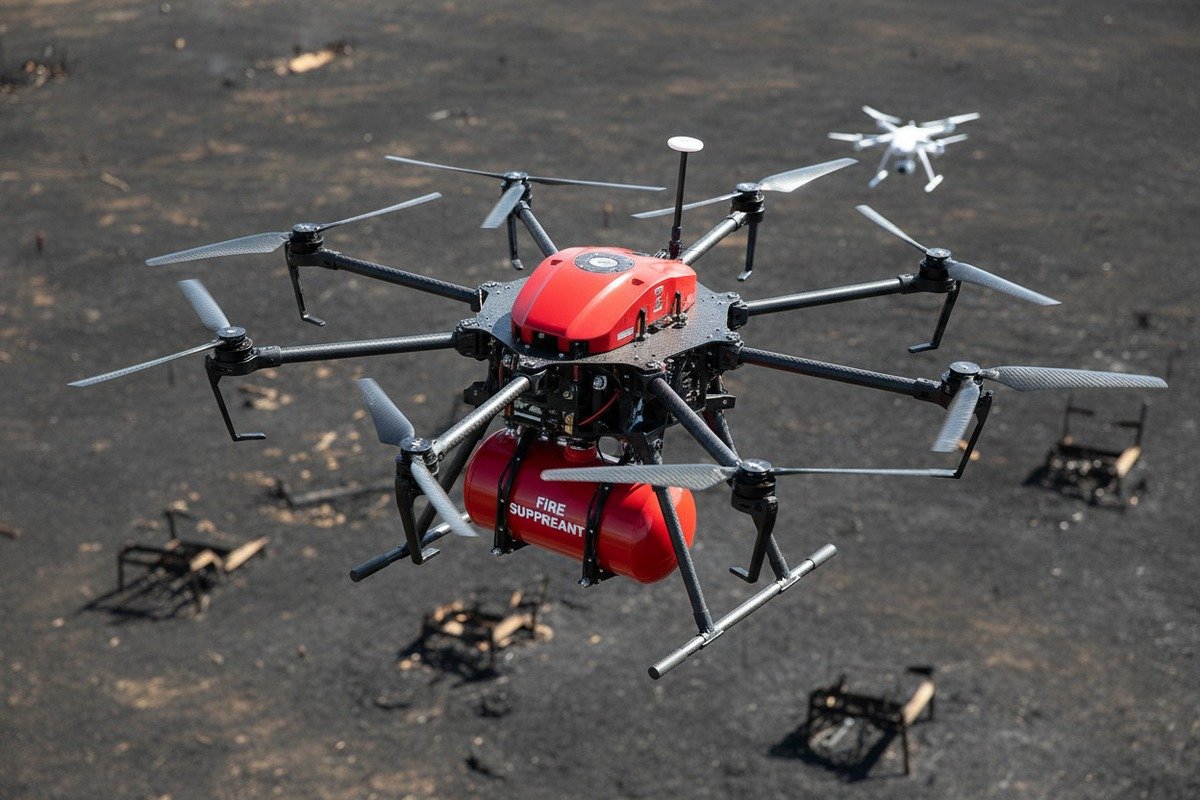
When our engineering team started exporting blusdrones 1 to US fire departments three years ago, we faced a tough question from every buyer: why should we import from China when Skydio and Draganfly are right here? The problem is clear. Many US-made drones excel at surveillance but fall short on direct fire suppression. This gap creates real risk for firefighters who need heavy-lift capability 2 now.
To identify firefighting drone USPs versus US competitors, evaluate payload capacity for suppressant delivery, flight endurance for extended missions, AI-driven autonomy for hazardous navigation, and heavy-lift capabilities exceeding 20kg. US brands typically focus on thermal imaging and monitoring, while superior firefighting drones must demonstrate direct suppression capabilities that domestic options often lack.
This guide walks you through the exact criteria our US distributors use to compare imported drones against domestic options. Let’s examine what truly sets a firefighting drone apart in today’s market.
How do I evaluate the flight endurance and payload capacity of these drones compared to US brands?
Every procurement manager we work with asks about flight time first. Yet our field tests reveal that payload capacity 3 under load matters more than advertised specs. The real challenge is finding drones that maintain performance when carrying 20kg of brandvertrager 4 through smoke and heat.
Evaluate flight endurance by testing actual loaded flight times, not manufacturer claims. Compare payload capacity at maximum takeoff weight, focusing on drones carrying 20kg or more for suppressant delivery. US brands like Skydio and Draganfly typically max out at 5-10kg payloads, while heavy-lift imports can deliver 25-50kg of fire retardant per mission.

Understanding Real-World Endurance Metrics
Flight endurance 5 numbers on spec sheets rarely match field performance. When our production team tests each drone before shipping, we measure endurance under three conditions: empty weight, half payload, and maximum payload. Most US surveillance drones advertise 30-40 minutes of flight time. However, these numbers apply to empty or lightly loaded aircraft.
Heavy-lift firefighting drones face different demands. A drone carrying 25kg of foam concentrate will see endurance drop by 40-50%. This is physics, not a design flaw. The key question is whether the remaining flight time allows meaningful fire suppression operations.
Payload Categories and Fire Suppression Reality
| Payload Category | Weight Range | Primair gebruik | US Brand Examples | Import Alternatives |
|---|---|---|---|---|
| Micro | Under 2kg | Thermal surveillance | Autel EVO, Parrot ANAFI | Limited suppression value |
| Light | 2-10kg | Monitoring, small rescue kits | Skydio X10, Draganfly Commander | Basic retardant drops |
| Medium | 10-20kg | Targeted suppressant delivery | AeroVironment (limited) | Most OEM firefighting drones |
| Zwaar | 20-50kg | Full suppression operations | None in US market | SkyRover and similar imports |
The table above shows a critical gap. US manufacturers dominate the micro and light categories. They build excellent surveillance platforms. But fire departments needing actual suppression capability must look at medium and heavy categories, where imports lead.
Testprotocol voor inkoopteams
When we train US distributors, we recommend a three-phase evaluation:
First, request loaded flight test data, not just spec sheets. Any manufacturer should provide video of their drone flying at 80% maximum payload for at least 20 minutes.
Second, compare power systems. Hybrid propulsion systems 6 extend range by 30-40% over pure battery drones. This matters for wildfire operations where recharging stations are miles away.
Third, calculate cost per effective flight minute. A cheaper drone with half the payload capacity may cost more per kilogram of retardant delivered.
Can I leverage custom OEM features to gain a competitive edge over domestic firefighting drone suppliers?
Our OEM partnerships with US distributors started because standard products couldn't meet regional fire department needs. California wildfire conditions differ from Texas industrial fires. One-size-fits-all drones miss the mark. Custom features let you solve specific problems your domestic competitors cannot address.
Custom OEM features provide significant competitive advantages through tailored payload systems, proprietary software integration, and specialized certifications. Work with manufacturers offering collaborative development to create unique suppressant delivery mechanisms, custom sensor packages, and software that integrates with your clients' existing emergency response platforms.

What OEM Customization Actually Means
When procurement managers hear "OEM," they often think about logo placement. Real OEM partnership goes much deeper. At our facility, we collaborate with US clients on three levels of customization.
Hardware modifications include custom payload release mechanisms, specialized camera mounts, and modified airframes for specific operating conditions. One Texas distributor requested a heat-shielded electronics bay for refinery fire applications. This modification took eight weeks to develop and test.
Software customization covers flight control parameters, autonomous mission planning, and integration APIs. Fire departments using specific dispatch systems need drones that communicate with existing infrastructure. Our engineering team has built custom data bridges for five different US emergency management platforms.
Certification support means preparing documentation for FAA Part 107 waivers 7, NFPA compliance, and state-specific requirements. This paperwork takes time but creates barriers for competitors who lack manufacturer support.
Competitive Advantages Through Customization
| Customization Type | Development Time | Competitive Moat | Example Application |
|---|---|---|---|
| Payload mechanism | 6-10 weeks | Hoog | Custom foam dispersion nozzle |
| Flight software | 4-8 weken | Very high | Autonomous smoke navigation |
| Sensor integration | 3-6 weeks | Medium | Multi-spectral fire detection |
| Airframe modification | 8-12 weeks | Hoog | Arctic-rated components |
| Certification package | 4-6 weeks | Medium | State wildfire authority approval |
Each customization creates switching costs for your customers. Once a fire department trains on your custom system, moving to a competitor means retraining and recertification.
Working with Overseas Manufacturers on Custom Projects
Time zone differences and communication barriers concern many US buyers. Here's how we structure OEM projects to minimize risk.
Phase one involves detailed specification documents with drawings, not just descriptions. Visual communication crosses language barriers better than text.
Phase two requires prototype approval before production. Our team ships single units for US-side testing before committing to batch production.
Phase three establishes ongoing engineering support channels. We maintain a US-hours support team specifically for OEM partners who need real-time troubleshooting.
The 70% faster deployment advantage cited in market research comes partly from custom solutions. Standard drones require field adaptation. Custom OEM units arrive ready for specific mission profiles.
What should I look for in terms of build quality and durability to justify importing over buying locally?
Durability questions came up in every conversation when we first entered the US market. Buyers worried that imported drones would fail after a few missions. Fair concern. Our response was simple: test our products against any US alternative in real fire conditions. Build quality shows in performance, not marketing claims.
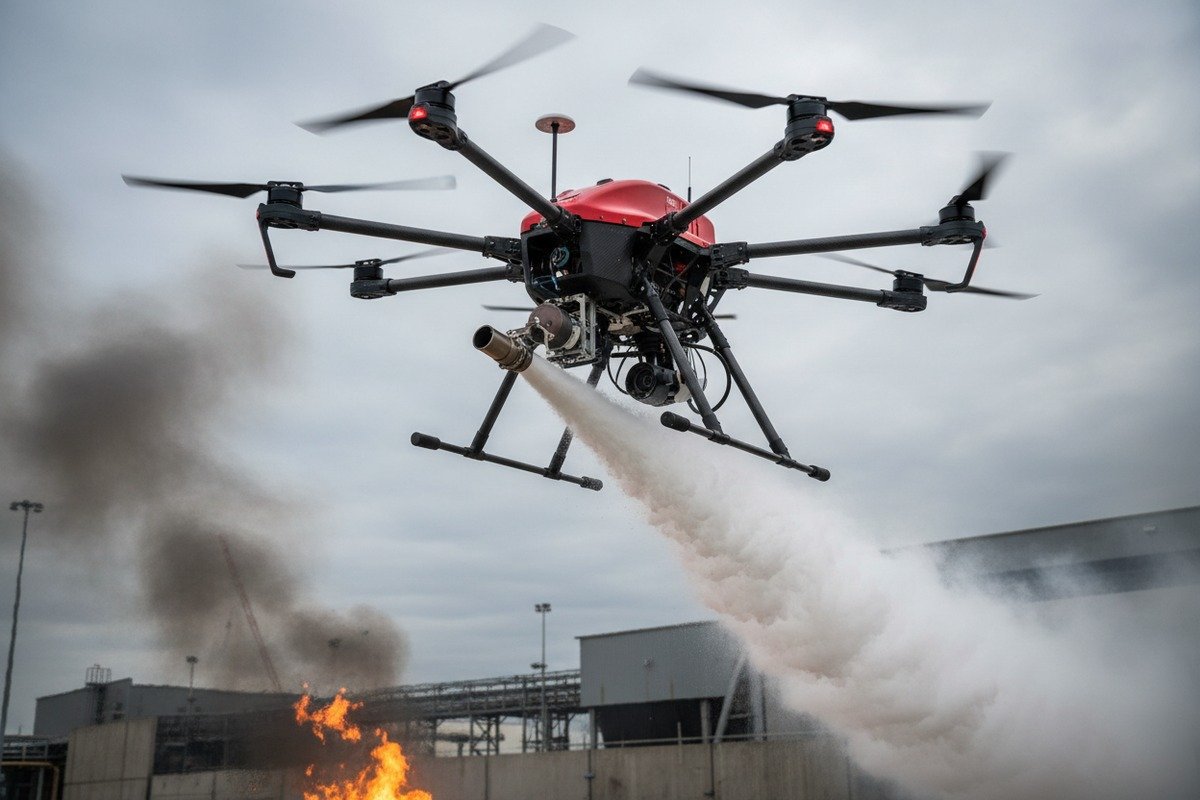
Justify importing over local purchase by examining carbon fiber frame construction, IP-rated electronics housing, motor quality under thermal stress, and documented MTBF (mean time between failures) data. Quality imports use aerospace-grade materials with IP54 or higher ratings, while some domestic options prioritize lightweight surveillance designs that sacrifice durability for agility.
Material Quality Indicators
Frame construction tells you most of what you need to know about durability. Our production line uses woven carbon fiber with specific resin systems rated for temperature extremes. carbon fiber frame construction 8 This differs from consumer drone carbon fiber, which may delaminate under heat stress.
Look for these specific quality markers:
Motor housings should be machined aluminum, not plastic. Firefighting drones operate near heat sources that deform polymer components.
Propeller attachment systems need metal-to-metal contact. Plastic prop adapters crack under vibration stress over time.
Wire harnesses require aviation-grade connectors with positive locking mechanisms. Consumer-grade connectors work loose during repeated thermal cycling.
Electronics enclosures need documented IP ratings. IP54 minimum for dust and splash resistance. IP67 for operations involving water drops or foam spray. IP-rated electronics housing 9
Durability Testing Standards
| Testcategorie | Standard Requirement | Premium Requirement | Testmethode |
|---|---|---|---|
| Bedrijfstemperatuur | -10°C to +40°C | -20°C to +55°C | Environmental chamber |
| Vibration resistance | 2G random vibration | 5G random vibration | Shake table testing |
| Drop impact | 1m drop survival | 2m drop survival | Controlled drop testing |
| Dust ingress | IP5X | IP6X | Dust chamber exposure |
| Water resistance | IPX4 | IPX7 | Water spray/immersion |
| Motor thermal | 30 min at 80% load | 60 min at 100% load | Dynamometer testing |
Request actual test certificates, not just claimed ratings. Any serious manufacturer maintains test documentation from third-party laboratories.
Total Cost of Ownership Perspective
Import duties and shipping add 15-25% to landed cost. However, durability affects long-term economics more than purchase price.
A drone requiring major maintenance every 50 flight hours costs more over three years than a premium unit lasting 200 hours between overhauls. Our US partners track maintenance data carefully. The 45% operational cost savings cited in industry research comes largely from reduced maintenance frequency.
Spare parts availability also matters. We maintain US-based parts inventory for common wear items. Waiting six weeks for motor replacements from overseas destroys the economic case for imports.
Field Durability Verification
Before committing to volume purchases, request field trial units. Run them hard for 30 days. Document any failures. Quality manufacturers welcome this testing because it builds long-term trust.
Our standard trial agreement includes full technical support during testing and replacement of any units that fail within normal operating parameters. This confidence comes from knowing our build quality standards exceed what testing will reveal.
How do I verify that a Chinese manufacturer can provide the engineering support my US clients require?
Support capability worried us more than product quality when we started US operations. A great drone means nothing if buyers can't get help when problems arise. We built our support infrastructure before scaling sales because this concern is legitimate. Verification requires specific evidence, not promises.
Verify engineering support capability by requesting documented response time guarantees, confirming US-timezone technical staff availability, reviewing case studies of past support tickets, and testing support channels before purchase. Quality manufacturers provide 24-hour initial response commitments, dedicated English-speaking engineers, and remote diagnostic capabilities that eliminate most support delays.

Support Infrastructure Requirements
Engineering support for firefighting drones differs from consumer product support. Fire departments need answers fast. A drone grounded during wildfire season costs lives, not just money.
Evaluate these specific support elements:
Response time guarantees should be contractual, not aspirational. Our standard agreement promises initial response within four hours during US business hours, with escalation paths clearly defined.
Technical staff qualifications matter. Request credentials of engineers who will handle your account. Drone troubleshooting requires flight controller expertise, battery chemistry knowledge, and payload system understanding simultaneously.
Remote diagnostic capabilities reduce resolution time dramatically. Our drones transmit flight logs automatically after each mission. When support tickets arrive, our engineers already have diagnostic data before the first call.
Support Verification Checklist
| Verification Step | What to Request | Rode vlaggen |
|---|---|---|
| Response time | Written SLA with penalties | Vague "best effort" language |
| Technical staff | Engineer credentials and certifications | Sales staff handling technical issues |
| Language capability | Direct engineer communication in English | Translation-only communication |
| Remote diagnostics | Demonstration of diagnostic system | Manual log submission required |
| Parts availability | US inventory list with quantities | All parts ship from overseas |
| On-site support | Technician visit option and pricing | No field service capability |
| Training resources | Video library and documentation | Training materials only in Chinese |
Testing Support Before Volume Commitment
Run a support test before signing major purchase agreements. Submit a technical question through normal channels. Time the response. Evaluate the quality of the answer.
Our US partners regularly test our support team with increasingly complex scenarios. This keeps us sharp and gives them confidence in our capability.
One distributor sent us a deliberately obscure flight controller question at 4 PM Pacific time. Our Xi'an team had an answer with diagnostic steps within three hours, despite the 15-hour time difference. This test convinced them to expand their order.
Documentation and Training Support
Engineering support extends beyond troubleshooting. Fire departments need training materials, maintenance guides, and operational procedures.
Quality manufacturers provide comprehensive documentation in English, not machine-translated text. Our technical writing team includes native English speakers who review all US-facing documentation.
Video training libraries reduce support load and improve operator competence. We maintain over 40 hours of training content covering pre-flight inspection, mission planning, payload operation, and maintenance procedures.
Certification support documentation helps fire departments secure FAA authorizations and state-level approvals. This paperwork is tedious but essential. Manufacturers who support the certification process demonstrate long-term partnership commitment.
Conclusie
Identifying firefighting drone USPs requires systematic evaluation of payload capacity, endurance, build quality, and support infrastructure. US domestic competitors excel at surveillance but lag in heavy-lift suppression capability. The verification steps outlined here help procurement managers make confident import decisions that serve their fire department clients effectively.
Voetnoten
1. Explains how drones benefit fire departments, including real-time surveillance and thermal imaging. ↩︎
2. Details the capabilities and applications of heavy-lift drones across various industries. ↩︎
3. Defines drone payload capacity and factors influencing it, including motor thrust and battery power. ↩︎
4. Provides information on flame retardant chemicals, their uses, and associated concerns. ↩︎
5. Discusses factors affecting drone flight endurance, such as aerodynamic efficiency and propulsion. ↩︎
6. Explains hybrid propulsion systems for UAVs, highlighting increased mission endurance and fuel efficiency. ↩︎
7. Official FAA guidance on applying for operational waivers under Part 107 regulations. ↩︎
8. Discusses the use of carbon fiber in drone frame manufacturing for lightweight and durable designs. ↩︎
9. Official IEC information on Ingress Protection (IP) codes for electrical enclosures against dust and water. ↩︎

 English
  Spanish
  German
  French
  Dutch
Dutch  Arabic
