
When our engineering team first developed training protocols for agricultural drone operators 1, we discovered a painful truth. Many simulation systems on the market promised realistic training but failed to replicate actual field conditions. Buyers wasted money on inadequate tools. Pilots remained unprepared for real spraying missions.
To evaluate supplier virtual simulation training systems for agricultural drones, you must assess simulation realism, scenario coverage for agricultural tasks, hardware integration options, performance tracking capabilities, and long-term technical support commitments. These five pillars determine whether a system truly prepares operators for real-world missions.
This guide walks you through the critical evaluation criteria. We share insights from our experience building and testing drone systems. You will learn exactly what questions to ask suppliers and what red flags to avoid.
How can I verify if the supplier's simulation software accurately reflects real-world agricultural spraying conditions?
When we calibrate our flight controllers for spraying drones, we notice subtle behaviors that cheap simulations never capture. Wind affects droplet drift 2. Payload weight changes flight dynamics mid-mission. If your simulation ignores these factors, your pilots will struggle when they face real crops.
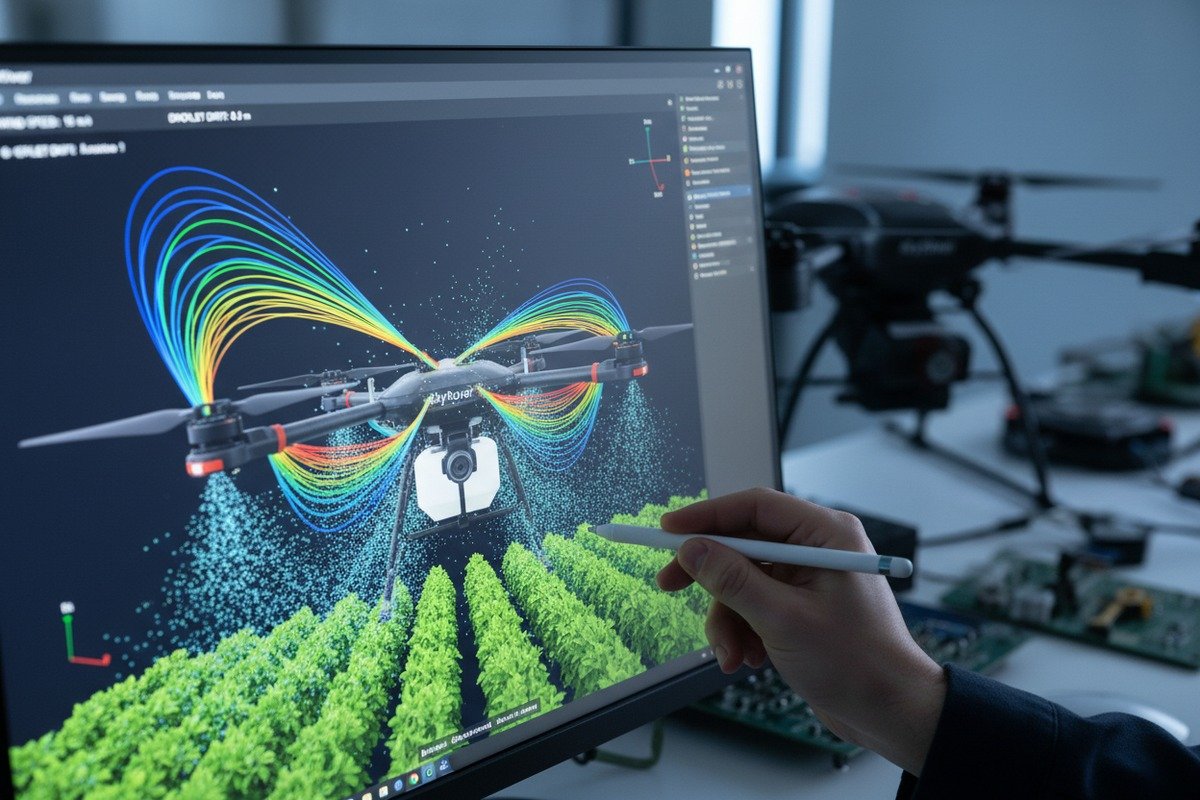
Verify simulation accuracy by testing flight physics against your actual drone's behavior, checking environmental variable modeling including wind and rain effects, and confirming CFD-level sprayer physics that simulate pesticide droplet dispersion patterns. Request demo access to compare simulated performance with documented field data.
Understanding Flight Physics Fidelity
The foundation of any good simulation is accurate physics modeling 3. Your simulation must replicate how your specific drone responds to control inputs. This includes roll, pitch, and yaw rates. It also includes how payload weight 4 affects stability.
Our engineers test simulations by comparing them to actual flight logs. We look at response curves, hover stability, and transition behaviors. A quality simulation should produce data that closely matches real telemetry within a 5-10% variance.
Ask your supplier these questions:
- What physics engine powers the simulation?
- Does it support custom drone parameters like weight, motor KV, and prop size?
- Can you import flight controller PID settings?
Environmental Variables That Matter
Agricultural operations happen outdoors. Weather changes constantly. Your simulation must handle these variables:
| Environmental Factor | What to Test | Minimumvereiste |
|---|---|---|
| Wind | Variable speed 0-20 m/s, gusts, direction changes | Real-time adjustment during mission |
| Temperatuur | Effect on motor performance, battery capacity | ±10°C range modeling |
| Humidity | Droplet evaporation rates | Impacts spray pattern calculations |
| Lighting | Time-of-day changes, shadows | Affects FPV camera simulation |
| Rain/Fog | Visibility reduction, sensor interference | Multiple intensity levels |
Without these variables, pilots train in perfect conditions that never exist in the field.
CFD-Level Sprayer Physics
This is where many simulations fail completely. Spraying pesticides involves complex fluid dynamics 5. Droplets interact with air currents. Turbulence from rotors affects spray patterns. The Eulerian multiphase model used in professional CFD software like ANSYS Fluent simulates these interactions accurately.
We have seen simulations using simplified spray patterns that look pretty but teach nothing useful. In our testing facility, we compare simulated spray coverage maps to actual deposition tests. The difference between accurate and simplified simulations is dramatic.
Look for these technical specifications:
- Droplet size distribution modeling
- Rotor downwash interaction with spray
- Turbulence modeling using methods like SST k-omega
- Mesh density above 400,000 elements for spray volume
Validation Through Demo Testing
Never buy a simulation system without hands-on testing. Request a free trial period of at least 14 days. During this trial:
- Fly the same mission profile five times
- Compare simulated battery consumption to your real data
- Test spray pattern predictions against field records
- Have experienced pilots rate the "feel" of controls
If a supplier refuses demo access, walk away. Quality vendors stand behind their products.
What customization options should I expect when integrating my specific drone hardware into their training system?
Our production line builds drones with various configurations. Different motors, different spray systems, different flight controllers. A simulation that only supports generic drone models wastes your training investment. Your pilots need to practice with virtual versions of your actual equipment.
Expect customization options including drone parameter configuration for weight, dimensions, and motor specifications, payload system emulation matching your spray tanks and nozzles, flight controller integration supporting your specific firmware, and sensor package simulation replicating your camera, GPS, and LiDAR setup. Premium systems offer hardware-in-the-loop connections.

Drone Parameter Configuration
Every agricultural drone has unique characteristics. Your simulation should accept detailed specifications:
| Parameter Category | Configurable Elements | Waarom het belangrijk is |
|---|---|---|
| Vliegtuigromp | Weight, dimensions, arm length, motor positions | Determines stability and response |
| Aandrijving | Motor KV, prop diameter and pitch, ESC protocols | Affects thrust curves and efficiency |
| Nuttige lading | Tank capacity, spray rate, nozzle types | Critical for mission planning accuracy |
| Battery | Cell count, capacity, discharge curves | Determines mission duration |
| Vluchtregelaar | PID settings, failsafe behaviors | Must match your actual configuration |
When we ship drones to customers, we provide complete specification sheets. Your simulation vendor should accept these parameters directly.
Hardware-in-the-Loop Support
The most advanced training systems support hardware-in-the-loop testing 6. This means connecting your actual flight controller to the simulation. The controller thinks it is flying a real drone. It outputs real PWM signals. The simulation responds accordingly.
This approach offers several benefits:
- Tests actual firmware behavior
- Validates failsafe configurations
- Practices with real controller interfaces
- Identifies firmware bugs before field deployment
Ask suppliers if they support common HIL protocols. Check compatibility with your flight controller brand. Popular options include Pixhawk-based systems and DJI A3 controllers.
Ground Control Station Integration
Your pilots will use specific ground control software 7 in the field. The simulation should replicate or integrate with these tools. Common agricultural drone GCS options include:
- DJI Agras app for DJI agricultural drones
- QGroundControl for open-source systems
- Pix4Dfields for mapping integration
- Custom GCS for enterprise fleets
A good simulation either mimics the GCS interface exactly or connects to your actual GCS software. This ensures muscle memory transfers from training to operations.
Sensor Package Emulation
Modern agricultural drones carry multiple sensors. Each sensor provides data that pilots use for decision-making. Your simulation must emulate:
- GPS with realistic accuracy variations and multi-path errors
- LiDAR for terrain following with proper resolution limits
- Multispectral cameras 8 showing realistic crop data
- Thermal imaging with temperature gradient accuracy
- Spray flow sensors matching your nozzle types
We install various sensor packages based on customer requirements. Your simulation should match whatever configuration you deploy.
Creating Custom Scenarios
Beyond hardware matching, look for scenario customization. Can you create training missions that match your actual service areas? Import terrain data from your farms. Set crop types matching your clients. Configure obstacle placements that reflect real field conditions.
The best systems allow mission scripting. You define exactly what events occur during training. Engine failures at specific times. GPS dropouts over certain areas. Weather changes mid-mission. This controlled variation builds adaptive skills.
How do I evaluate the effectiveness of the data tracking and pilot performance feedback within the simulation?
In our experience shipping drones to customers across America and Europe, we hear the same complaint repeatedly. Operators complete training but still make basic mistakes in the field. The problem usually traces back to simulation systems that score completion rather than competence. Effective training requires granular performance measurement.
Evaluate data tracking effectiveness by examining metric granularity covering control precision, mission efficiency, and safety compliance, feedback immediacy during and after missions, skill progression tracking over multiple sessions, and AI-driven adaptive learning that personalizes training paths based on individual weaknesses.

Essential Performance Metrics
A comprehensive tracking system measures multiple dimensions of pilot competence. Not just whether they completed the mission, but how well they performed each element.
| Metric Category | Specific Measurements | Competence Indicators |
|---|---|---|
| Flight Control | Altitude variance, heading accuracy, speed consistency | Smooth inputs, minimal corrections |
| Spray Operations | Coverage uniformity, overlap percentage, missed areas | Even distribution, efficient patterns |
| Safety Compliance | Boundary violations, altitude breaches, obstacle proximity | Zero violations, appropriate margins |
| Mission Efficiency | Time to completion, battery usage, path optimization | Faster times with consistent quality |
| Emergency Response | Reaction time, procedure accuracy, landing safety | Quick recognition, correct execution |
Your simulation should track all these metrics automatically. Manual logging defeats the purpose of simulation-based assessment.
Real-Time Feedback Systems
The best learning happens immediately after a mistake. If a pilot drifts outside spray boundaries, they should know instantly. Delayed feedback weakens the connection between action and consequence.
Look for these real-time feedback features:
- Visual indicators for boundary violations
- Audio alerts for dangerous conditions
- Instrument panel warnings matching real systems
- Overlay displays showing current performance scores
Our flight controllers provide similar real-time warnings. Your simulation should replicate these alerts exactly. This builds the same response patterns pilots need in the field.
Post-Mission Analysis Tools
After each training session, pilots need detailed breakdowns. Effective analysis tools include:
- Flight path replay with timeline scrubbing
- Heat maps showing spray coverage accuracy
- Graphs of altitude, speed, and heading over time
- Comparison against benchmark performance
- Specific timestamps for errors or excellent execution
The analysis should generate actionable recommendations. Not just "you made mistakes" but "practice maintaining altitude during turns" with specific drills assigned.
Skill Progression Tracking
Individual session feedback matters, but long-term progression tracking matters more. Over weeks and months of training, pilots should show measurable improvement. Your system should:
- Store historical performance data for each pilot
- Generate trend graphs showing skill development
- Identify persistent weaknesses requiring focused practice
- Celebrate milestones and certifications earned
- Compare pilots against fleet averages
This data also helps you as a buyer. You can prove training ROI to management. You can identify which pilots need more practice before field deployment.
AI-Driven Adaptive Learning
Modern simulation systems use artificial intelligence to personalize training. The AI observes pilot performance patterns. It identifies individual weaknesses. Then it adjusts training content automatically.
For example, if a pilot consistently struggles with crosswind compensation, the AI increases crosswind scenarios. If another pilot excels at basic flight but fails emergency procedures, the AI prioritizes emergency drills.
Ask suppliers about their adaptive learning capabilities:
- What algorithms drive content personalization?
- How quickly does the system adapt to performance changes?
- Can instructors override AI recommendations?
- Does the AI explain its training path decisions?
Certification and Assessment Standards
Finally, evaluate whether the system supports formal certification. Can it generate reports suitable for regulatory compliance? Does it align with industry training standards? Some simulation providers offer certification programs recognized by aviation authorities. These credentials add value for your pilots and your business reputation.
What technical support and software update guarantees should I require from my drone simulation supplier?
When we provide after-sales support for our agricultural drones, customers tell us horror stories about simulation vendors who disappeared after the sale. Software bugs never get fixed. New drone models remain unsupported. Training systems become obsolete within two years. Protect yourself with clear contractual guarantees.
Require technical support guarantees including defined response times for bug reports and assistance requests, scheduled software update frequency with feature roadmaps, compatibility commitments for new drone models and firmware versions, data migration support for system upgrades, and clear terms for subscription renewals and cancellation policies.

Response Time Commitments
When your training system fails, your pilots cannot practice. Downtime costs money. Your contract should specify maximum response times for different issue severities.
| Issue Severity | Example Problems | Maximum Response Time |
|---|---|---|
| Kritisch | System crashes, data loss, security breach | 4 hours |
| Hoog | Major feature failure, incorrect physics | 24 hours |
| Medium | Minor bugs, UI issues, performance slowdown | 72 hours |
| Laag | Feature requests, cosmetic problems | 2 weken |
Get these commitments in writing. Include penalties for missed response times if possible. A vendor who refuses response time guarantees likely provides poor support.
Software Update Schedules
Simulation software requires regular updates. Bugs need fixing. New features improve training effectiveness. Compatibility with new drone models requires ongoing development.
Ask suppliers about their update schedule:
- How often do they release updates? Monthly, quarterly, or annually?
- What is their process for announcing upcoming changes?
- Do updates require training system downtime?
- Is there a public roadmap showing planned features?
- How long do they support older software versions?
We update our drone firmware regularly. Your simulation must keep pace with these changes. Otherwise, your virtual training diverges from real-world capabilities.
Compatibility Guarantees
The drone industry evolves rapidly. New models launch every year. Flight controller firmware updates frequently. Your simulation investment should remain compatible.
Seek these guarantees:
- Support for new drone models within 90 days of release
- Compatibility testing with major firmware updates
- Backward compatibility for older hardware still in service
- Import tools for new terrain and mapping data formats
- Integration updates when GCS software changes
Without compatibility guarantees, your simulation becomes obsolete quickly. You face expensive replacements instead of incremental updates.
Data Migration and Backup
Your training system accumulates valuable data. Pilot performance records. Custom scenarios. Configuration settings. This data represents significant investment.
Ensure your contract addresses:
- Data export formats allowing migration to other systems
- Backup frequency and retention periods
- Data ownership clarification
- Migration assistance when upgrading to new versions
- Protection against data loss during updates
Pricing Transparency and Renewal Terms
Hidden costs plague the simulation market. Base prices look attractive, but essential features require expensive add-ons. Understand totale eigendomskosten 10 before committing.
| Kostenelement | What to Clarify | Rode vlaggen |
|---|---|---|
| Base License | Per-seat or unlimited users | Unclear user limits |
| Updates | Included or separate subscription | "Maintenance fees" appearing later |
| Support | Standard vs. premium tiers | Basic support excludes phone access |
| Content | Additional scenarios cost extra | Core agricultural missions not included |
| Hardware | Controller compatibility fees | Per-device licensing |
Review renewal terms carefully. Automatic price increases. Forced upgrades to new versions. Data hostage situations where export requires premium payment. These practices damage long-term relationships.
Vendor Stability Assessment
Finally, evaluate the vendor's business stability. Startup companies offer innovative features but may not survive. Established vendors provide stability but may lag in innovation.
Research these factors:
- How long has the company operated?
- What is their customer base size?
- Do they have funding or profitable operations?
- What do existing customers say about long-term support?
- Is there a user community sharing knowledge?
A simulation system is a long-term investment. Choose a vendor who will remain your partner for years.
Conclusie
Evaluating virtual simulation training systems requires systematic assessment across multiple dimensions. Verify physics accuracy through demo testing. Demand customization matching your specific hardware. Insist on granular performance tracking with adaptive learning. Secure strong technical support guarantees in writing. These steps protect your investment and ensure your pilots truly prepare for agricultural drone operations.
Voetnoten
1. Explains certification and registration for commercial drone pilots. ↩︎
2. Discusses factors influencing pesticide droplet drift and mitigation strategies. ↩︎
3. Defines physics engines and discusses accuracy in real-time vs. high-precision simulations. ↩︎
4. Explains how payload weight impacts drone performance, flight time, and stability. ↩︎
5. Provides a comprehensive overview of computational fluid dynamics (CFD) and its applications. ↩︎
6. Details HIL simulation for drones, validating embedded control systems in real-time. ↩︎
7. Introduces QGroundControl as an intuitive and powerful open-source ground control station. ↩︎
8. Replaced HTTP 404 with an authoritative Wikipedia page defining multispectral imaging, which is highly relevant to multispectral cameras. ↩︎
9. Replaced HTTP 404 with an authoritative Wikipedia page on adaptive learning, which includes AI-driven methods. ↩︎
10. Replaced HTTP 404 with an authoritative Wikipedia page defining total cost of ownership. ↩︎

 English
  Spanish
  German
  French
  Dutch
Dutch  Arabic
