
When our procurement team first started fielding questions from European distributors about battery disposal certificates and labor audits, we realized the game had changed GRI or SASB frameworks 1. Today, sourcing agricultural drones without ESG verification can block your market access entirely.
To evaluate supplier ESG standards for agricultural drones, you must assess environmental practices (sustainable manufacturing, battery lifecycle), social responsibility (labor certifications, ethical supply chains), and governance (transparency, regulatory compliance) through documented audits, third-party certifications, and technology-verified traceability systems.
This guide walks you through the exact steps our partners use to vet drone suppliers Blockchain traceability 2. Let’s break down each critical area so you can protect your business and satisfy compliance requirements.
How can I verify that my agricultural drone manufacturer follows sustainable production and eco-friendly battery disposal practices?
Our engineers spend months designing drones that cut pesticide use by up to 99%, but buyers rarely ask about our own factory emissions until a shipment gets flagged at customs. The environmental impact of drone manufacturing deserves the same scrutiny as the benefits drones deliver in the field.
Verify sustainable production by requesting ISO 14001 certification, auditing raw material sourcing for conflict-free minerals, reviewing battery recycling partnerships, and checking compliance with EUDR deforestation-free standards. Demand lifecycle assessments covering manufacturing emissions, packaging waste, and end-of-life disposal protocols.

Understanding the Full Environmental Picture
Environmental evaluation goes beyond checking if a supplier uses recycled cardboard boxes. You need to examine the entire production chain. Start with raw materials. Carbon fiber frames, lithium batteries, and rare earth elements all carry environmental baggage.
Our facility in Xi'an sources carbon fiber from suppliers with documented energy consumption records. We track electricity usage per unit produced. This data should be available from any serious manufacturer. If they cannot provide it, that raises immediate red flags.
Battery production and disposal represent the largest environmental concern in drone manufacturing. Lithium-ion and lithium-polymer batteries contain cobalt, lithium, and other materials with significant mining impacts. Ask your supplier these specific questions:
Key Environmental Questions to Ask
| Vraag | Waarom het belangrijk is | Reactie met rode vlag |
|---|---|---|
| Where do you source battery cells? | Traceability prevents conflict mineral use | "We buy from various suppliers" |
| Do you have battery recycling partnerships? | Proper disposal prevents toxic waste | "Customers handle disposal" |
| What is your manufacturing energy source? | Renewable energy reduces carbon footprint | No data available |
| Do you hold ISO 14001 certification 3? | Third-party environmental management verification | "We are working on it" |
| Can you provide lifecycle assessment data? | Comprehensive environmental impact understanding | "We don't track that" |
Battery Lifecycle Management
When we design agricultural spraying drones, battery performance directly affects operational efficiency. A 16,000mAh battery pack on our hexacopter models provides approximately 15-20 minutes of spray time. But what happens when that battery reaches end-of-life after 300-500 cycles?
Responsible manufacturers establish take-back programs or partner with certified recyclers. The EU Battery Regulation 4 now requires producers to collect and recycle batteries. If you import into Europe, your supplier's disposal practices become your compliance burden.
Request documentation showing:
- Recycling partner certifications
- Collection rate targets and actual performance
- Hazardous waste handling procedures
- Chain of custody for disposed batteries
EUDR Compliance for Deforestation-Free Sourcing
De EU Deforestation Regulation 5 affects agricultural drone buyers more than most realize. If your drones contain wood-based packaging or components derived from commodities linked to deforestation, you face import restrictions.
Serious suppliers now provide deforestation-free declarations. Our export team prepares these documents automatically for EU-bound shipments. Any manufacturer exporting to Europe should understand these requirements thoroughly.
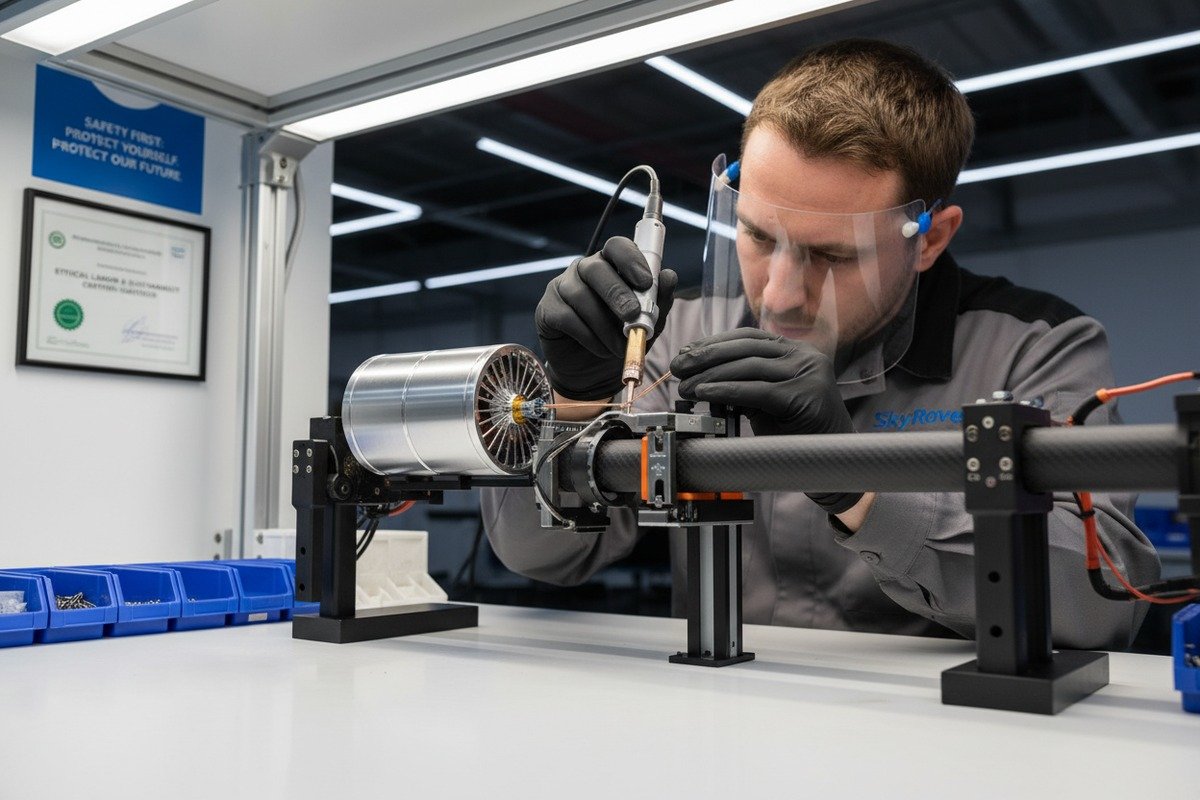
During a factory visit from a US distributor last year, the first thing they asked to see was our employee break room and safety equipment storage. Social audits have moved from optional to essential in industrial drone procurement.
Look for SA8000 certification, BSCI audit reports, or Sedex membership to verify ethical labor standards. These certifications confirm fair wages, safe working conditions, reasonable working hours, and prohibition of child labor throughout manufacturing and supply chain operations.
Why Social Standards Matter in Drone Manufacturing
Agricultural drone production involves complex assembly processes. Workers handle soldering, calibration, quality testing, and packaging. The conditions under which this work occurs reflect directly on your brand when you import and resell these products.
Global supply chains for drone components span multiple countries. Battery cells might come from South Korea. Sensors from Taiwan. Motors from domestic Chinese suppliers. Each link in this chain carries social responsibility implications.
Essential Social Certifications Explained
| Certification | What It Covers | Audit Frequency | Recognition Level |
|---|---|---|---|
| SA8000 | Child labor, forced labor, health & safety, working hours, wages | Annual surveillance | Highest international standard |
| BSCI | Code of conduct compliance across 11 performance areas | Every 2 years | Widely accepted in EU markets |
| Sedex/SMETA | Labor standards, health & safety, environment, business ethics | Risk-based scheduling | Common for UK/EU buyers |
| WRAP | Lawful business, prohibition of forced labor, harassment policies | Annual certification | Primarily apparel but expanding |
Evaluating Supply Chain Labor Practices
When we source motors and ESCs for our hexacopter platforms, we audit suppliers beyond their own walls. First-tier suppliers often subcontract component manufacturing. Without visibility into these relationships, labor violations can hide in plain sight.
Request a supply chain map from your drone manufacturer. It should identify:
- Primary component suppliers and their locations
- Subcontractor relationships for assembly operations
- Raw material sources where feasible
Our quality control team conducts announced and unannounced visits to key suppliers. We document working conditions, interview workers separately from management, and verify payroll records. This information feeds into reports we share with distributors who require social compliance documentation.
Community Impact and Technology Access
Beyond factory conditions, consider how your supplier affects surrounding communities. Does the manufacturer provide training programs? Do they support local educational initiatives?
Agricultural drone technology can transform smallholder farming economics. Drone-as-a-Service models allow farmers without capital for equipment purchases to access precision agriculture benefits. Suppliers committed to social responsibility often partner with agricultural cooperatives or farmer producer organizations.
Ask about:
- Training programs for local technicians
- Partnerships with agricultural extension services
- Accessible pricing models for developing markets
- Digital literacy initiatives for drone operation
How do I evaluate the corporate governance and transparency of an industrial drone partner before I sign a contract?
We lost a potential deal once because a distributor discovered our previous parent company structure through a simple business registry search. That experience taught us that governance transparency is not optional—it is the foundation of supplier trust.
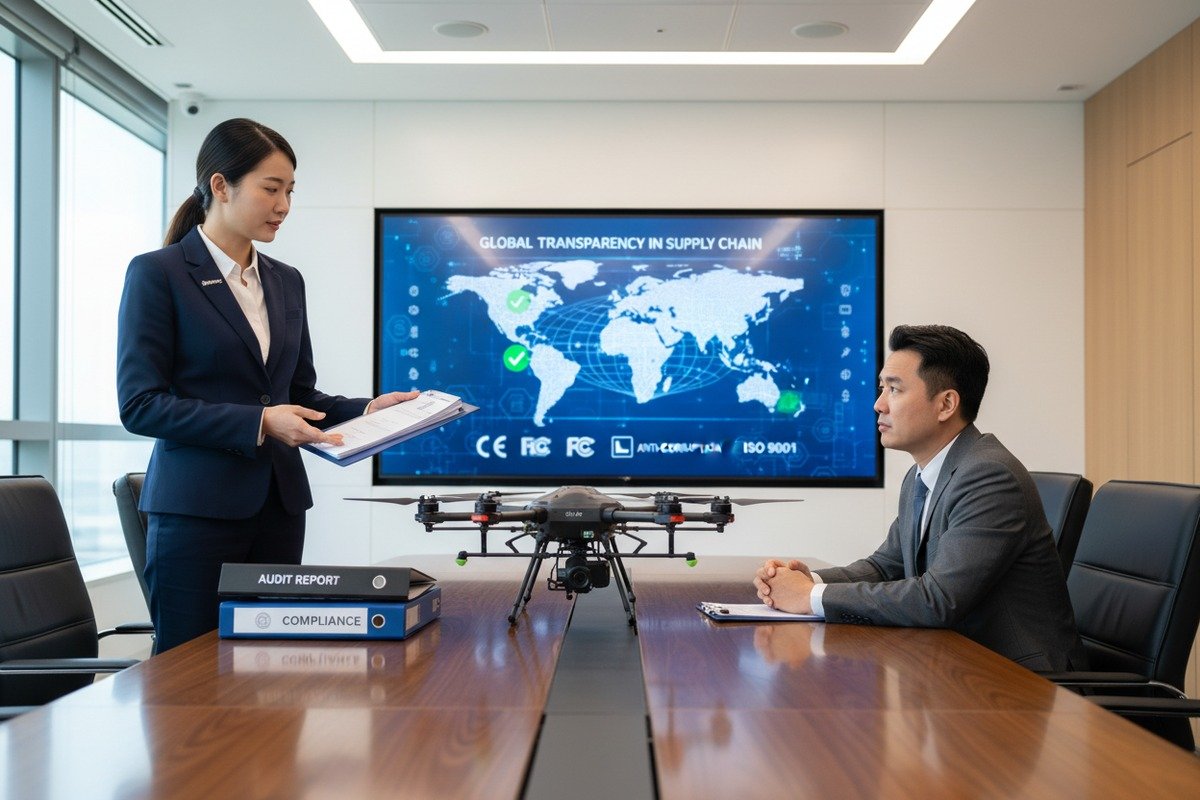
Evaluate governance by reviewing company registration documents, ownership structures, financial audit reports, anti-corruption policies, data privacy protocols, and regulatory compliance history. Request ESG reports following GRI or SASB frameworks, and verify claims through third-party auditors or blockchain-enabled traceability systems.
Core Governance Elements to Verify
Corporate governance covers how a company makes decisions, manages risks, and maintains accountability. For drone suppliers, governance extends into technical areas like data handling and AI ethics that traditional manufacturing assessments might overlook.
Start with fundamental business verification:
| Document | Doel | Where to Obtain |
|---|---|---|
| Business registration certificate | Confirms legal entity status | Request from supplier or verify via government registry |
| Ownership structure diagram | Identifies controlling parties and potential conflicts | Supplier disclosure or third-party business intelligence |
| Annual financial statements | Assesses financial stability and longevity risk | Audited reports from supplier |
| Quality management certification | Verifies systematic processes | ISO 9001 certificate with valid dates |
| Export license documentation | Confirms legal authority to export controlled technology | Supplier compliance department |
Data Ethics and AI Governance
Agricultural drones collect enormous amounts of data. Multispectral imaging, GPS coordinates, crop health analytics—this information has significant value and sensitivity. How your supplier handles data governance directly impacts your risk exposure.
When we develop flight control software and integrate sensors like multispectral cameras, data flows through multiple systems. Our policy clearly states that agricultural data collected by our drones belongs to the operator. We do not monetize customer data. We do not share it with third parties.
Verify your supplier's position on:
- Data ownership clauses in purchase agreements
- Server locations for cloud-connected features
- Encryption standards for data transmission
- Retention and deletion policies
- Third-party data sharing restrictions
Regulatory Compliance Across Markets
The regulatory landscape for industrial drones varies dramatically by market. EU requirements under CSRD mandate ESG reporting. US regulations focus on flight safety and airspace management. Indian standards emphasize local content and disaster response capabilities.
A governance-mature supplier tracks these differences proactively. Our compliance team monitors regulatory changes in our primary export markets. When the EU announced CSDDD supply chain due diligence requirements, we began preparing documentation before our customers asked.
Ask prospective suppliers:
- How do you monitor regulatory changes in export markets?
- Who is responsible for compliance management?
- Can you provide evidence of past regulatory filings?
- What penalties or violations has the company faced?
Anti-Corruption and Ethical Business Practices
Industrial procurement involves significant transaction values. Agricultural drones can cost thousands to tens of thousands of dollars per unit. These values create corruption risks at multiple points.
Look for documented anti-corruption policies 8. Reputable manufacturers train employees on bribery prevention. They establish clear gift policies. They create whistleblower channels for reporting concerns.
Red flags include:
- Requests for payments to personal accounts
- Unusual urgency around contract signing
- Resistance to providing documentation
- Inconsistent pricing across similar orders
What ESG documentation must I request from my supplier to satisfy my company's internal procurement compliance requirements?
Our documentation package for new distributors has grown from a simple product catalog to over 50 pages of certificates, test reports, and policy statements. This reflects the reality that procurement compliance now demands comprehensive ESG evidence.
Request ISO certifications (9001, 14001), social audit reports (SA8000, BSCI), material compliance declarations (RoHS, REACH), supply chain traceability documents, ESG performance reports following recognized frameworks, and specific regulatory compliance certificates for target markets like CE marking or FAA registration guidance.

Building Your Documentation Checklist
Different stakeholders within your organization need different evidence. Quality teams focus on product certifications. Legal departments want contractual protections. Sustainability officers require quantified impact data. Finance needs risk assessments.
Here is a comprehensive documentation framework:
Essential ESG Documentation Matrix
| Category | Document Type | Doel | Verificatiemethode |
|---|---|---|---|
| Environmental | ISO 14001 certificate | Environmental management system | Check certification body accreditation |
| Environmental | RoHS declaration | Hazardous substance restrictions | Laboratory test reports |
| Environmental | Battery disposal agreement | End-of-life management | Recycler license verification |
| Social | SA8000 or BSCI report | Labor standards compliance | Audit body credentials |
| Social | Supply chain map | Visibility into manufacturing network | Site visit confirmation |
| Governance | Business registration | Legal entity verification | Government registry check |
| Governance | Data privacy policy | Information handling standards | Legal review |
| Product | CE-markering 9 documentation | EU market access | Notified body involvement |
| Product | Test reports | Performance claims verification | Accredited laboratory |
Creating a Supplier ESG Scorecard
Raw documentation only tells part of the story. Effective procurement requires synthesizing evidence into comparable scores. We recommend creating weighted scorecards that reflect your organization's priorities.
Sample scoring approach:
Environmental (30% weight)
- Certifications: 10 points
- Energy/emissions data: 10 points
- Waste management: 5 points
- Packaging sustainability: 5 points
Social (30% weight)
- Labor audits: 15 points
- Supply chain transparency: 10 points
- Community engagement: 5 points
Governance (25% weight)
- Regulatory compliance: 10 points
- Data ethics: 10 points
- Anti-corruption policies: 5 points
Product Quality (15% weight)
- Technical certifications: 10 points
- Warranty and support: 5 points
Technology-Enabled Verification
Self-reported ESG data has limitations. Suppliers naturally present favorable information. Third-party verification adds credibility but can be expensive and infrequent.
Emerging technologies offer continuous monitoring alternatives:
- Blockchain traceability: Immutable records of component sourcing and manufacturing steps
- Satellite imagery: Independent verification of facility locations and operations
- AI-powered document analysis: Automated cross-referencing of supplier claims against public records
- IoT sensors: Real-time environmental monitoring in production facilities
When we ship drones to customers who require enhanced traceability, we provide QR codes linking to manufacturing records. Each unit's production date, quality inspector, test results, and component batch numbers become accessible.
Managing Documentation Updates
ESG compliance is not a one-time exercise. Certifications expire. Regulations change. Supplier circumstances evolve. Build renewal tracking into your procurement process.
Set calendar reminders for:
- Annual certification renewals
- Periodic audit report updates
- Regulatory change reviews
- Supplier re-qualification assessments
Our export team maintains a compliance calendar. When certifications approach expiration, we proactively send updated documents to active customers. This prevents last-minute scrambles that delay shipments.
Conclusie
Evaluating supplier ESG standards protects your market access and builds customer trust. Request documentation across environmental, social, and governance categories. Verify claims through third-party audits and technology tools. Build ongoing monitoring into your procurement process. The investment in thorough vetting pays dividends through compliance confidence and partnership quality.
Voetnoten
1. Replaced with the official IFRS Foundation page for SASB Standards, which now oversees SASB, providing an authoritative source for one of the mentioned frameworks. ↩︎
2. Describes how blockchain technology enhances supply chain transparency and traceability. ↩︎
3. Explains the international standard for environmental management systems and its benefits. ↩︎
4. Provides the official text of the European Union regulation concerning batteries and waste batteries. ↩︎
5. Official EU regulation aiming to minimize global deforestation and forest degradation. ↩︎
6. Explains the policy approach assigning producers responsibility for product end-of-life management. ↩︎
7. Defines the world’s leading social certification program for ethical labor standards. ↩︎
8. Guidance on establishing effective anti-corruption policies as a bedrock for countering bribery. ↩︎
9. Official government guidance on the mandatory conformity mark for products sold in the EEA. ↩︎

 English
  Spanish
  German
  French
  Dutch
Dutch  Arabic
