
Every week, our engineering team receives calls from factory owners who purchased blusdrones 1 only to discover they cannot deploy them safely. The problem is not the drone itself. It is the lack of proper takeoff evaluation before buying.
To evaluate firefighting drone takeoff requirements for your factory, you must assess four key areas: physical space and clearance specifications, signal and power infrastructure compatibility, safety certifications and local regulations, and supplier engineering support for custom deployment protocols. Each factor directly impacts whether your drone can launch quickly and safely during emergencies.
Let me walk you through each evaluation area based on what we have learned from hundreds of factory installations across the United States and Europe.
What physical space and clearance should I prepare for safe firefighting drone takeoff at my industrial facility?
When our installation teams arrive at a new factory site, the first question is always about space Transport Canada registration 2. Many facility managers underestimate how much room a firefighting drone needs to launch safely and return during an active fire scenario.
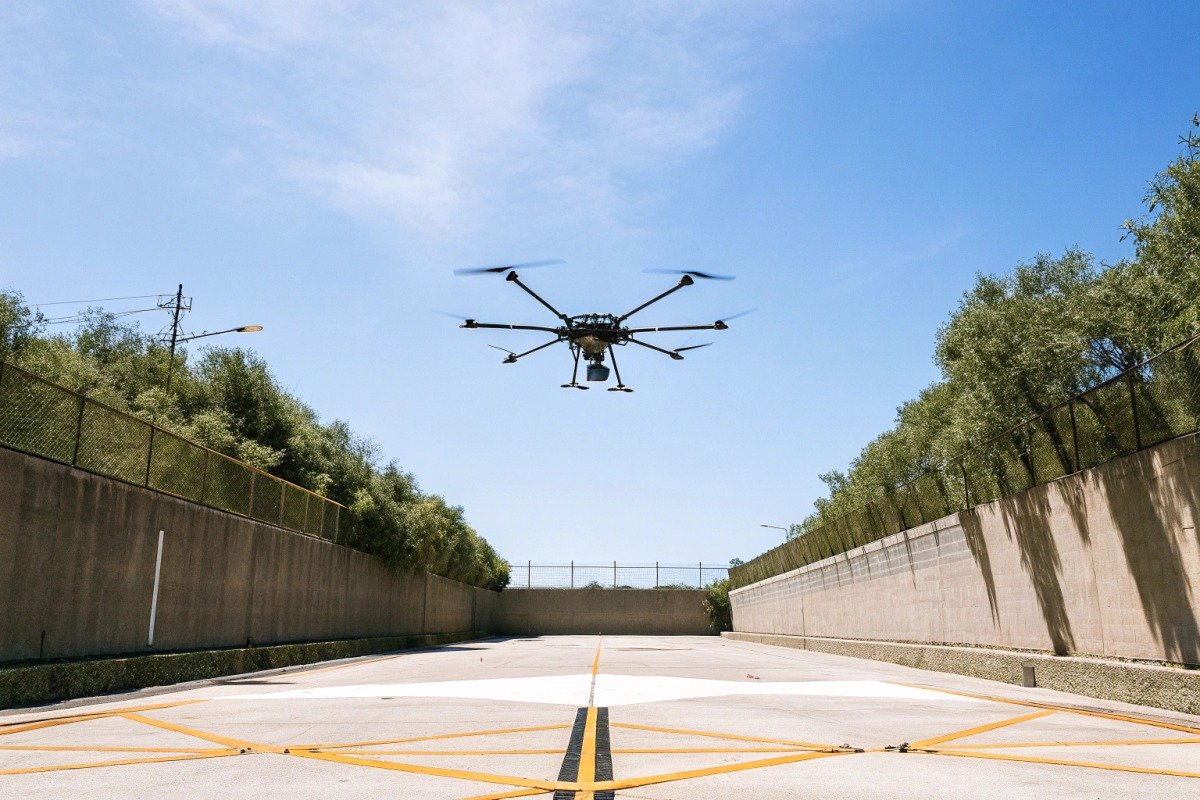
You need a minimum clear area of 10 meters by 10 meters for standard quadcopter takeoff, with vertical clearance of at least 15 meters free from overhead obstacles. For larger octocopter systems carrying 150 kg payloads, expand this to 15 meters by 15 meters with 20 meters vertical clearance.
Understanding Vertical Takeoff Requirements
Firefighting drones use Vertical Takeoff and Landing (VTOL) technology 3. This means they lift straight up before moving horizontally. Unlike fixed-wing aircraft, they do not need runways. However, they do need unobstructed vertical space.
Our engineers have found that factories with overhead cranes, exhaust stacks, or cable trays often overlook these obstacles. During an emergency, pilots do not have time to calculate clearances. The takeoff zone must be pre-cleared and permanently marked.
Ground Surface Considerations
The takeoff surface matters more than most buyers realize. A firefighting drone carrying 150 kg of extinguishing agent generates significant downwash. Loose gravel, sand, or debris will become projectiles. Concrete or asphalt pads work best. If your factory yard has mixed surfaces, designate a specific paved area.
| Surface Type | Suitability | Required Preparation |
|---|---|---|
| Concrete pad | Uitstekend | Mark boundaries only |
| Asphalt | Goed | Ensure no loose patches |
| Compacted gravel | Fair | Add rubber matting |
| Loose gravel | Poor | Install concrete pad |
| Grass | Poor | Compact and add platform |
Horizontal Clearance for Emergency Returns
Your drone will return to its launch point after each mission. If obstacles have moved into the zone during the emergency, you have a collision risk. We recommend a buffer zone of 5 additional meters around your primary launch area.
Elevated Launch Platforms
For multi-story factories or facilities with limited ground space, rooftop or elevated platforms offer solutions. Our team has installed launch pads on warehouse roofs, gantry crane platforms, and dedicated steel structures. These positions provide immediate aerial vantage and bypass ground-level obstacles.
However, elevated platforms require additional structural assessment. A drone with 257.8 kg maximum takeoff weight landing repeatedly creates fatigue stress. Your structural engineer must verify load capacity.
| Platform Location | Voordelen | Belangrijkste vereisten |
|---|---|---|
| Rooftop | Clear vertical space | Load rating verification |
| Gantry platform | Height advantage | Vibration isolation |
| Dedicated tower | Optimal positioning | Wind load analysis |
| Ground level | Easy maintenance access | Obstacle-free perimeter |
How do I verify that my factory's signal and power infrastructure can support rapid drone deployment?
Our production facility in Xi'an operates dozens of test flights daily. We have learned that even the best drone becomes useless if your factory's electromagnetic environment or power systems interfere with operations.
Verify your infrastructure by conducting a site signal survey to identify radio frequency interference, ensuring dedicated 220V/30A power circuits for charging stations, confirming GPS satellite visibility exceeds 12 satellites at launch points, and testing control link stability across your entire facility footprint.

Radio Frequency Interference Assessment
Modern factories contain numerous RF emitters. Radio Frequency Interference 4 Variable frequency drives, wireless sensors, radio communications, and Bluetooth devices all create electromagnetic noise. Firefighting drones typically operate on 2.4 GHz and 5.8 GHz frequencies for control links.
Before purchasing, request a signal survey from your supplier. Our technical teams bring spectrum analyzers to identify interference sources. Common culprits include:
- Industrial WiFi networks
- Welding equipment
- Motor drives with poor shielding
- Security systems
- Neighboring cellular towers
GPS Reception Quality
Firefighting drones rely on GPS for position holding 5, return-to-home functions, and autonomous flight paths. Metal buildings, overhead structures, and electrical equipment can block or reflect satellite signals.
Test GPS reception at your proposed launch sites during different times of day. You need reliable lock on 12 or more satellites. Fewer than 8 satellites creates positioning drift that makes precise operations dangerous.
Power Infrastructure for Charging Stations
Rapid deployment requires batteries ready to fly at all times. Hot-swappable battery systems need continuous charging infrastructure. For a single drone system, plan for:
| Component | Power Requirement | Circuit Specification |
|---|---|---|
| Fast charger (primary) | 3.5 kW | 220V/20A dedicated |
| Fast charger (backup) | 3.5 kW | 220V/20A dedicated |
| Control station | 500 W | Standard outlet |
| Battery warming cabinet | 1 kW | 220V/10A |
| Total recommended | 8.5 kW | 50A service panel |
Network Connectivity for Integrated Systems
Advanced factory integrations connect drones to Building Management Systems (BMS) or SCADA networks. This enables automated takeoff upon fire detection. Your IT infrastructure must support:
- Low-latency connections under 100 ms
- Dedicated VLAN for drone systems
- Firewall exceptions for control protocols
- Backup communication pathways
When we configure these integrations, we work with your IT team to ensure cybersecurity standards remain intact while enabling rapid emergency response.
Which safety certifications and local regulations must I consider when setting up a drone launch zone on my property?
Our export team handles certification documentation for customers in over 30 countries. The regulatory landscape for firefighting drones varies significantly by jurisdiction, and non-compliance can result in grounded aircraft and legal penalties.
You must consider drone registration requirements, pilot certification levels, airspace authorization, Special Flight Operations Certificates for beyond-visual-line-of-sight operations, and local fire department coordination protocols. In the United States, FAA Part 107 or Part 91 compliance is mandatory, while Canadian operations require Transport Canada registration and potentially Advanced RPAS certification.

Registration Requirements by Region
Every jurisdiction requires drone registration before operation. The specific requirements depend on aircraft weight and intended use.
| Regio | Weight Threshold | Registration Authority | Typische tijdlijn |
|---|---|---|---|
| Verenigde Staten | Over 0.55 lbs | FAA | 1-3 dagen |
| Canada | 250g to 25kg | Transport Canada | 1-2 weken |
| Europese Unie | Over 250g | National CAA | 2-4 weken |
| Verenigd Koninkrijk | Over 250g | CAA UK | 1-2 weken |
For firefighting drones exceeding 55 pounds (25 kg), additional certifications apply. Our YSF-150 system with 257.8 kg maximum takeoff weight requires special authorization in all jurisdictions.
Pilot Certification Standards
Operating firefighting drones near industrial facilities typically requires advanced pilot certification. Basic certifications restrict operations away from people and controlled airspace. Emergency response rarely fits these limitations.
In the United States, pilots need Part 107 certification at minimum. Operations dispensing materials (like fire suppressants) require additional experience: 7 hours on the specific drone model and 25 hours as pilot-in-command for dispensing operations.
Canadian Advanced RPAS certification permits flights in controlled airspace, within 30 meters of people, and over people if additional safety requirements are met. Your factory location determines which certification level your pilots need.
Airspace Authorization
Factories near airports, hospitals, or government facilities often fall within restricted airspace. Before purchasing, verify your launch zone's airspace classification.
The 400-foot altitude limit applies to most commercial drone operations. Firefighting may require temporary waivers for higher altitudes when suppressing fires on tall structures. These waivers require advance application and approval.
Special Flight Operations Certificates
Beyond-visual-line-of-sight (BVLOS) operations 6 enable drones to patrol large factory complexes autonomously. However, BVLOS requires Special Flight Operations Certificates (SFOC) 7 in Canada or similar waivers in other jurisdictions.
The SFOC application requires documentation including:
- Detailed operation location and nature
- Risk mitigation measures
- Operator qualifications
- Drone technical specifications
- Airspace coordination details
Application timelines range from 30 to 90 days. Plan your purchase timeline accordingly.
Local Fire Department Coordination
Even with all aviation certifications, you must coordinate with local fire departments. Firefighting drones operating during an active emergency must integrate with ground-based response teams. Uncoordinated drone operations can interfere with manned aircraft, including fire helicopters.
We help customers develop coordination protocols as part of our implementation support. This includes communication procedures, shared airspace deconfliction, and joint training exercises.
Can my supplier provide the engineering support I need to customize takeoff protocols for my factory's specific layout?
When customers visit our Xi'an headquarters, they see our 70-person team includes dedicated application engineers. We believe purchasing a firefighting drone without engineering support is like buying industrial machinery without installation services.
Yes, qualified suppliers should provide comprehensive engineering support including site surveys, custom flight path programming, integration with existing fire detection systems, pilot training programs, maintenance protocols, and ongoing technical assistance. Request detailed documentation of these capabilities before purchasing.

Site Survey and Assessment Services
Before finalizing your purchase, your supplier should conduct an on-site assessment. Our engineering teams evaluate:
- Physical takeoff zone options
- Obstacle mapping for flight corridors
- Signal environment analysis
- Power infrastructure assessment
- Integration opportunities with existing systems
This survey identifies potential problems before they become expensive modifications. Remote assessments using submitted documentation work for initial evaluation, but complex facilities benefit from in-person visits.
Custom Flight Path Programming
Every factory layout differs. Pre-programmed flight paths ensure your drone can navigate to fire-prone areas efficiently. Our software teams create custom waypoint sequences based on:
- Building layout and dimensions
- Fire risk zones (chemical storage, electrical rooms, fuel areas)
- Obstacle locations and heights
- Optimal surveillance patterns
- Emergency return routes
These customizations transform a generic drone into a purpose-built firefighting tool for your specific facility.
Integration With Existing Systems
Modern fire protection involves interconnected systems. Your firefighting drone should integrate with:
| System | Integration Type | Benefit |
|---|---|---|
| Fire alarm panel | Automated launch trigger | Immediate response |
| BMS/SCADA | Status monitoring | Centralized control |
| Security cameras | Coordinated surveillance | Enhanced situational awareness |
| Sprinkler systems | Activation coordination | Complementary response |
| Access control | Automated door opening | Clear flight paths |
We develop custom integration protocols for each installation. Our engineering team works with your facilities and IT departments to ensure seamless communication between systems.
Training Program Comprehensiveness
Operating firefighting drones requires specialized training. Manufacturer programs typically range from 40-80 hours covering:
- Flight operations and safety protocols
- Maintenance and troubleshooting procedures
- Tactical deployment strategies
- Regulatory compliance requirements
- Emergency procedures
Your supplier should provide initial training and refresher courses. Turnover happens, and new operators need certification before flying.
Ongoing Technical Support
After installation, problems arise. Equipment needs calibration. Software requires updates. Regulations change. Your supplier must provide:
- Remote technical support via phone, email, or video
- On-site support for complex issues
- Spare parts availability with reasonable delivery times
- Software updates and security patches
- Regulatory compliance updates
When we export to the United States and Europe, we maintain regional support capabilities. Time zone differences should not delay emergency assistance.
Documentation and Compliance Assistance
Your supplier should provide all documentation needed for regulatory compliance. This includes:
- Aircraft specifications and test reports
- Airworthiness statements
- Maintenance manuals
- Training certificates
- Customs clearance documentation
Our export team prepares comprehensive documentation packages that satisfy import requirements in destination countries. This prevents delays at customs and ensures your drone reaches operational status quickly.
Conclusie
Evaluating firefighting drone takeoff requirements demands careful assessment of physical space, infrastructure, regulations, and supplier support. Our team is ready to guide you through each step to ensure your investment delivers reliable emergency response capability.
Voetnoten
1. Provides a comprehensive overview of drones used in firefighting operations and their applications. ↩︎
2. Official requirements for drone registration in Canada, outlining necessary steps and criteria. ↩︎
3. Replaced with an authoritative Wikipedia page explaining VTOL technology. ↩︎
4. Defines RFI, its sources, and how it can disrupt electronic device functioning. ↩︎
5. Explains how GPS works and its critical role in determining precise location and navigation. ↩︎
6. Explains BVLOS drone operations and the regulatory framework for flying drones outside visual range. ↩︎
7. Official information on SFOCs required for non-standard or complex drone operations in Canada. ↩︎
8. Official FAA regulations for small unmanned aircraft systems, crucial for drone operations in the US. ↩︎

 English
  Spanish
  German
  French
  Dutch
Dutch  Arabic
