
Every week, our export team receives tender documents from European fire departments. Many specify requirements that seem simple but hide complex compliance traps. One wrong certification or missing document can disqualify your bid instantly.
To evaluate firefighting drone supplier tender support, European public safety agencies should assess engineering customization capability, verify CE and EASA certifications, confirm logistics expertise for EU customs, and demand long-term technical support with guaranteed spare parts availability. These four pillars determine tender success and operational reliability.
Let me walk you through each evaluation criterion. We have learned these lessons through years of exporting industrial drones to Germany, France, and Scandinavia. The details matter more than you might expect.
How can I assess a supplier's engineering capability to customize firefighting drones for my specific tender?
Public safety tenders often require unique payload configurations or software integrations. Our R&D department has faced requests ranging from specialized thermal cameras to custom communication protocols. Not every manufacturer can deliver these modifications reliably.
Assess a supplier's engineering capability by examining their in-house R&D team size, previous customization case studies, prototype development timelines, and willingness to sign technical specification agreements. Request evidence of successful modifications for similar European agencies.

Understanding Technical Customization Depth
When we develop custom firefighting drones, the process involves multiple engineering layers. Surface-level modifications like housing colors or logo placement require minimal expertise. Deep customization involves flight controller programming, payload integration, and communication system adaptation.
European tenders often specify requirements like integration with TETRA radio networks or compatibility with specific incident command software. These demands require suppliers with embedded software engineers, not just assembly technicians.
Key Questions to Ask Your Supplier
Before committing to any tender partnership, request detailed answers to these questions:
| Vraagcategorie | Specific Questions to Ask | Red Flags to Watch |
|---|---|---|
| Team Composition | How many R&D engineers work full-time? What are their specializations? | Vague answers about "technical staff" without specifics |
| Previous Projects | Can you share documentation from similar public safety customizations? | No verifiable case studies or references |
| Development Process | What is your typical timeline from specification to prototype? | Unrealistic promises under 60 days for complex modifications |
| IP Protection | How do you protect our custom specifications from competitors? | No NDA templates or IP agreements available |
| Testing Protocols | What validation testing do you perform on custom units? | No independent test reports or certification processes |
Evaluating Prototype and Iteration Capability
Our production line can manufacture standard units efficiently. Custom projects require different workflows. We maintain a dedicated prototyping workshop separate from mass production. This separation prevents quality inconsistencies.
Ask potential suppliers about their prototyping facilities. Request photos or video tours. A supplier without dedicated prototyping space will struggle with tender-specific modifications.
The iteration process matters equally. European tenders often evolve during evaluation periods. Agencies may request specification changes mid-process. Your supplier needs flexibility to accommodate these adjustments without restarting development entirely.
Documentation Standards for Tender Compliance
European procurement requires extensive documentation. Your supplier must provide complete technical files including detailed Bill of Materials, component compliance declarations, and third-party test reports for restricted substances under RoHS directives 1.
We maintain documentation packages specifically formatted for EU tender submissions. This includes EU Declarations of Conformity signed by authorized representatives and technical construction files meeting Regulation (EU) 2019/945 2 requirements.
What certifications should I look for to ensure my drone manufacturer meets European public safety standards?
When our quality team prepares export documentation, we follow strict checklists. Missing one certification can delay shipments for months. European public safety agencies face similar pressures—incorrect certifications mean disqualified tenders and wasted preparation time.
Look for CE marking with complete EU Declaration of Conformity, EASA C-class drone classifications under Regulation (EU) 2019/945, RoHS compliance certificates, and industry-specific certifications like IP ratings for environmental resistance. Demand third-party test reports, not self-declarations alone.

The CE Marking Framework
CE-markering 3 remains the foundational requirement for any drone sold in the European Economic Area. However, not all CE marks carry equal weight. Self-declared CE marking without supporting documentation provides minimal assurance.
Our manufacturing process includes third-party testing through accredited laboratories. These tests verify electromagnetic compatibility, radio equipment compliance, and electrical safety. The resulting test reports accompany every shipment to European customers.
EASA Drone Classifications Explained
The European Union Aviation Safety Agency introduced C-class markings to standardize drone categories. EASA C-class classifications 4 These classifications determine where and how drones can operate legally.
| EASA Class | Weight Limit | Belangrijkste vereisten | Typical Use Cases |
|---|---|---|---|
| C0 | Under 250g | Basic identification | Consumer photography |
| C1 | Under 900g | Remote ID, geo-awareness | Light commercial |
| C2 | Under 4kg | Low-speed mode, tethering | Professional operations |
| C3 | Under 25kg | Remote ID, geo-awareness | Industrial inspection |
| C4 | Under 25kg | Legacy category | Existing commercial drones |
| C5/C6 | Various | Special operations | Public safety, emergency response |
Firefighting drones typically fall into C3 or higher categories due to payload requirements. Verify that your supplier provides appropriate C-class markings with corresponding technical documentation.
Beyond Basic Certifications
European public safety agencies operate under conditions that exceed standard commercial requirements. Our engineering team designs firefighting drones to withstand extreme temperatures, water exposure, and debris impacts.
Request IP-classificaties 5 (Ingress Protection) appropriate for emergency operations. IP54 provides basic dust and splash resistance. IP67 offers protection against temporary water immersion. Firefighting applications often require IP65 or higher.
Additional certifications to verify include:
- EMC testing reports showing electromagnetic compatibility
- Battery safety certifications (UN38.3 for lithium batteries 6)
- Environmental testing results for temperature extremes
- Vibration and shock resistance documentation
GDPR and Data Compliance
The Germany ADELE project demonstrated that firefighting drones must operate with "optimised and low-risk flight trajectories" while maintaining full GDPR compliance 7. Your supplier should provide clear documentation about data handling procedures.
Questions to ask include: Where is flight data stored? Who has access? What encryption standards protect sensitive imagery? How long is data retained before deletion?
Our systems store operational data on EU-based servers when required by customer specifications. We provide data processing agreements aligned with GDPR Article 28 requirements.
How do I verify that my supplier can handle the complex logistics and customs for my European deliveries?
Our shipping department processes dozens of European orders monthly. Each country presents unique customs requirements. Germany demands different documentation than Portugal. Italy requires specific battery shipping declarations. These details determine whether your equipment arrives on schedule.
Verify logistics capability by requesting evidence of previous successful EU deliveries, confirmed relationships with customs brokers in target countries, complete export documentation templates, and clear timelines for door-to-door delivery including customs clearance estimates.

Understanding EU Import Requirements
Industrial drones face stricter import scrutiny than consumer electronics. Lithium batteries require special handling documentation. Thermal imaging equipment may need export licenses from origin countries. Radio transmitters must comply with frequency allocations.
We maintain relationships with customs brokers in major European ports. These partnerships enable smoother clearance processes. Our documentation packages include pre-approved formats that customs officers recognize.
Critical Documentation Checklist
| Documenttype | Doel | Common Problems |
|---|---|---|
| Commerciële factuur | Value declaration for duties | Incorrect product classifications |
| Paklijst | Contents verification | Missing serial numbers |
| Certificaat van oorsprong | Trade agreement eligibility | Incorrect country designation |
| EU Declaration of Conformity | Regulatory compliance proof | Missing authorized signatures |
| Battery Safety Documents | Hazardous materials compliance | Outdated UN38.3 certificates |
| Technical Construction File | Product specification details | Incomplete component declarations |
Delivery Timeline Realities
European public safety tenders often include strict delivery deadlines. Late arrivals can trigger penalty clauses or contract cancellations. Your supplier must demonstrate realistic timeline planning.
From our experience, standard shipments from China to Western European ports require 30-40 days by sea freight. Air freight reduces this to 7-10 days but increases costs significantly. Add 5-15 days for customs clearance depending on documentation completeness.
Ask potential suppliers about their contingency planning. What happens if customs holds a shipment? Do they maintain buffer inventory in European warehouses? Can they arrange expedited shipping if delays occur?
Incoterms and Responsibility Boundaries
International shipping uses Incoterms 8 to define responsibility boundaries. Our standard offering includes DDP (Delivered Duty Paid) terms for European customers. This means we handle all logistics, customs duties, and delivery to your specified location.
Some suppliers offer only FOB (Free on Board) or CIF (Cost, Insurance, Freight) terms. These shift customs clearance responsibility to the buyer. For public safety agencies without import expertise, DDP terms significantly reduce procurement risk.
Battery Shipping Considerations
Lithium batteries powering firefighting drones require special shipping procedures. International Air Transport Association (IATA) regulations classify these as dangerous goods. Improper packaging can result in shipment rejection or safety violations.
Our packaging meets Section II requirements under IATA Dangerous Goods Regulations 9. Each battery shipment includes proper labeling, documentation, and containment. We work with carriers certified for lithium battery transport.
What kind of long-term technical support and spare parts availability should I demand from my drone partner?
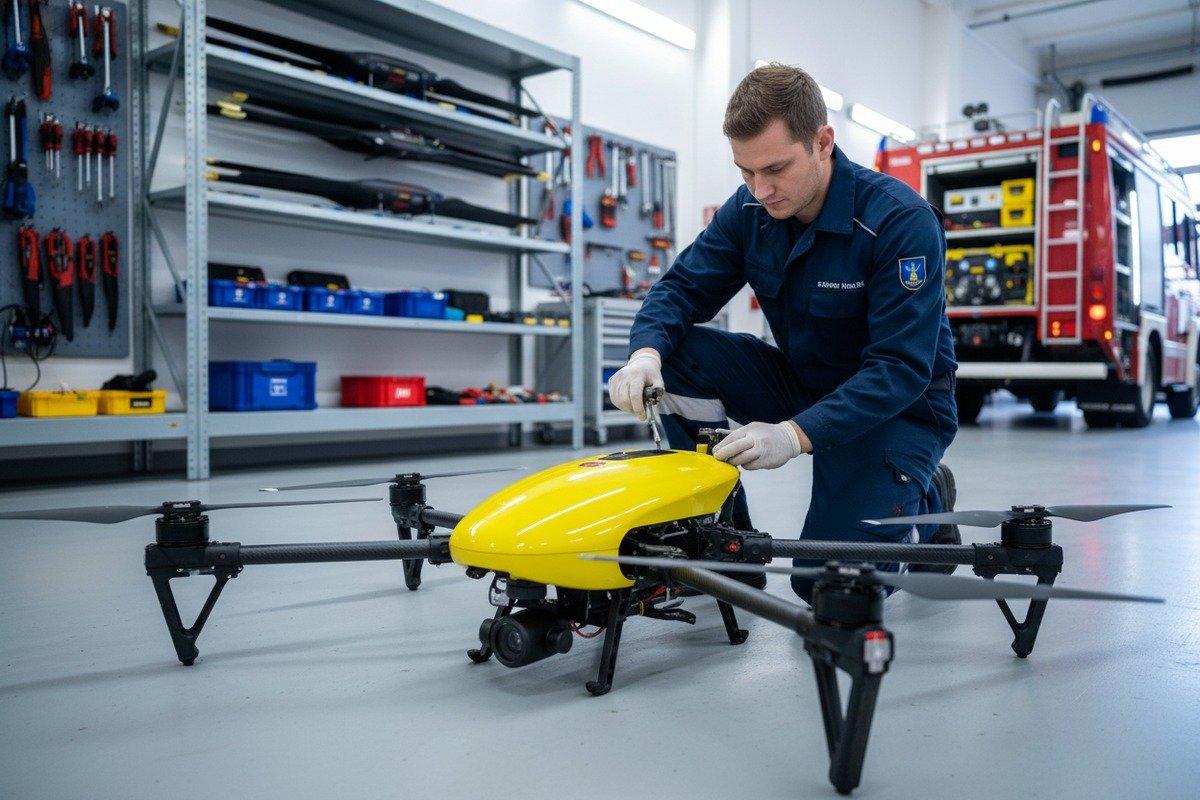
After delivering over 500 units to European customers, our support team handles hundreds of technical inquiries monthly. The questions that arrive three years after purchase matter as much as initial delivery quality. Long-term partnerships require sustained support commitments.
Demand minimum five-year spare parts availability guarantees, defined response times for technical support requests, remote diagnostic capabilities, on-site training options, and clear firmware update policies. Require these commitments in written contracts with penalty clauses for non-compliance.
Defining Support Response Standards
European public safety operations cannot tolerate extended equipment downtime. When a firefighting drone fails during wildfire season, response delays cost lives. Your supplier must commit to specific response timeframes.
| Support Level | Reactietijd | Resolution Target | Typical Coverage |
|---|---|---|---|
| Emergency Critical | 4 hours | 24 hours | System-down situations |
| High Priority | 8 hours | 48 hours | Major functionality issues |
| Standaard | 24 hours | 5 werkdagen | Non-critical problems |
| General Inquiry | 48 hours | 10 business days | Information requests |
We maintain dedicated European support channels operating during Central European business hours. Technical specialists fluent in English and German handle priority requests. After-hours emergency support connects to our headquarters team.
Spare Parts Strategy
Italy's National Fire Department has logged over 4,000 flight hours with their drone fleet since 2016. This operational intensity requires robust spare parts availability. Motors, propellers, and batteries experience regular replacement cycles.
Your tender evaluation should address these spare parts questions:
- What is the minimum availability guarantee period?
- Are spare parts priced separately or included in service contracts?
- What is the typical delivery time for commonly replaced components?
- Does the supplier maintain European inventory or ship from origin?
We stock high-turnover spare parts at a European distribution partner. This reduces replacement delivery times from weeks to days. Critical components like flight controllers and motors ship within 72 hours to most EU destinations.
Firmware- en software-updates
Modern firefighting drones depend on software as much as hardware. Flight controllers, camera systems, and communication modules require periodic updates. Your supplier should provide clear policies covering:
- Security patches and their deployment timeline
- Feature updates and compatibility testing
- Version support duration for legacy systems
- Update procedures (remote vs. on-site)
Our firmware update policy guarantees security patches within 30 days of vulnerability identification. Feature updates undergo 90-day beta testing before general release. We support legacy firmware versions for minimum three years after product discontinuation.
Training and Knowledge Transfer
Portugal built one of Europe's largest public safety drone networks with over 700 pilots. This scale requires comprehensive training infrastructure. Your supplier should offer multiple training pathways.
Initial training should cover basic operation, safety procedures, and maintenance routines. Advanced training addresses mission-specific applications like thermal imaging interpretation and nighttime operations. Certification programs should align with European aviation authority requirements.
We offer three training tiers: online self-paced courses, regional classroom sessions, and on-site customized programs. Training materials are available in multiple European languages. Certification records integrate with common fleet management platforms like AirHub.
Service Contract Structures
Long-term partnerships benefit from structured service agreements. These contracts should specify coverage scope, response commitments, pricing stability, and renewal terms.
Annual service contracts from our company include unlimited remote technical support, firmware updates, priority spare parts pricing, and annual maintenance inspections. Multi-year agreements lock pricing against inflation adjustments.
Request sample service contracts from potential suppliers. Review termination clauses, liability limitations, and dispute resolution mechanisms. European agencies should ensure contracts specify EU jurisdiction for legal matters.
Conclusie
European firefighting drone tenders demand thorough supplier evaluation across engineering capability, certification compliance, logistics expertise, and long-term support commitment. These four pillars protect your investment and ensure operational success.
Voetnoten
1. EU rules restricting hazardous substances in electrical and electronic equipment. ↩︎
2. Official EU regulation defining requirements for UAS design, manufacture, and operation. ↩︎
3. Mandatory conformity label for products sold in the European Economic Area. ↩︎
4. Official EASA guidance on drone classifications for standardized European operations. ↩︎
5. International standard defining protection levels against solids and liquids for enclosures. ↩︎
6. Mandatory safety testing standard for lithium batteries during transportation. ↩︎
7. EU regulation ensuring data privacy and protection for individuals’ personal data. ↩︎
8. International rules published by ICC defining responsibilities for global trade. ↩︎
9. Global standard for safe air transport of dangerous goods, including lithium batteries. ↩︎

 English
  Spanish
  German
  French
  Dutch
Dutch  Arabic
