
When our engineering team first tested thermal detection systems 1 three years ago, we watched helplessly as the AI flagged a sun-heated boulder as a wildfire. That single false positive 2 cost precious response time. Today, fire departments worldwide face this exact challenge—drones that cannot reliably distinguish actual flames from ambient heat sources create dangerous delays and resource waste.
To evaluate firefighting drone AI accuracy, you must test thermal sensor resolution against controlled heat sources, request manufacturer benchmarks showing 78% or higher detection accuracy with false positive rates below 10%, verify multi-sensor fusion capabilities, and confirm the system can be calibrated to your department’s specific operational parameters and safety standards.
This guide walks you through every critical evaluation step. We will cover sensor specifications, testing protocols, urban environment challenges, and customization options. By the end, you will know exactly what to demand from any drone supplier.
How do I assess the thermal sensor resolution needed to separate actual flames from high-temperature surfaces?
Our production floor handles thermal camera calibration daily, and we have learned that resolution numbers on a spec sheet rarely tell the whole story. thermal sensor resolution 3 Many buyers focus only on pixel count while ignoring the far more critical factors that determine real-world flame detection accuracy.
To separate flames from hot surfaces, you need thermal sensors with at least 640×512 pixel resolution, temperature sensitivity (NETD) below 50mK, and a spectral range of 7.5-13.5μm. These specifications allow the AI to detect temperature gradients as small as 0.05°C, which is essential for identifying the dynamic heat signatures unique to active combustion.

Understanding Thermal Sensor Specifications
Thermal resolution is measured in pixels, but sensitivity matters more for flame detection. The Noise Equivalent Temperature Difference 4 (NETD) measures how small a temperature change the sensor can detect. Lower NETD values mean better sensitivity.
Here is what each specification means for your fire detection accuracy:
| Specificatie | Minimumvereiste | Optimal Level | Waarom het belangrijk is |
|---|---|---|---|
| Resolution | 640×512 pixels | 1024×768 pixels | Higher resolution shows flame edges more clearly |
| NETD | <50mK | <30mK | Better sensitivity catches early-stage fires |
| Spectral Range | 7.5-13.5μm | 7.5-14μm | Wider range detects more heat signatures |
| Beeldsnelheid | 30Hz | 60Hz | Faster rates track flame movement patterns |
| Temperature Range | -40°C to 550°C | -40°C to 1500°C | Higher ceiling needed for intense fires |
The Dynamic Heat Signature Test
Static heat sources like sun-warmed rocks maintain constant temperatures. dynamic heat signatures 5 Flames fluctuate. When we calibrate our flight controllers, we test this by placing the drone at 100 meters altitude above both a controlled fire and a heated metal plate.
The AI must recognize these differences:
- Flames show temperature fluctuations of 50-200°C within seconds
- Hot surfaces maintain steady temperatures within a 5°C range
- Flame edges are irregular and constantly changing shape
- Hot surface edges are consistent and geometric
Practical Testing Protocol
Before accepting any drone system, conduct this test yourself. Place the drone 50 meters above a small controlled fire next to a running vehicle engine. The engine will read between 80-120°C. The fire will read 400-800°C but with visible flickering patterns.
Ask the supplier to demonstrate the AI tracking both heat sources simultaneously. The system should tag the fire as "active flame" and the engine as "static heat source" within 3 seconds. If it cannot make this distinction, the sensor resolution or AI algorithm is inadequate.
Altitude and Distance Considerations
Thermal resolution degrades with distance. A 640×512 sensor at 100 meters can resolve details as small as 15 centimeters. At 500 meters, that same sensor only resolves 75-centimeter details. This matters because small ignition points may appear identical to hot rocks at extreme distances.
Our engineers recommend testing at your actual operational altitudes. If your department typically flies at 300 meters for safety reasons, test detection accuracy at 300 meters—not at the 50-meter showcase distance many manufacturers prefer.
What testing protocols should I request from a manufacturer to prove their AI can handle complex heat signatures?
In our experience exporting to the US and Europe, we have encountered fire departments with vastly different testing expectations. Some accept basic demonstration videos. Others demand rigorous third-party validation. The departments with stricter requirements consistently achieve better field results.
Request controlled burn tests with documented accuracy rates above 78%, false positive testing against at least 10 common heat sources (vehicle engines, HVAC units, reflective surfaces), dawn/dusk "thermal crossover" evaluations, smoke penetration tests at multiple densities, and processing speed verification showing detection-to-alert latency under 2 seconds.

The Complete Testing Framework
Any manufacturer serious about their product should provide documentation covering five critical test categories. If they cannot produce these records, their claims are unverified.
| Testcategorie | What to Request | Acceptable Results | Rode vlaggen |
|---|---|---|---|
| Accuracy Benchmark | Lab results with standard datasets | ≥78% detection accuracy | Only showing best-case scenarios |
| False Positive Rate | Tests against 10+ heat sources | <10% false positive rate | No testing against common heat mimics |
| Processing Speed | Frame-by-frame timing data | <0.02s per frame analysis | Vague claims without specific metrics |
| Environmental Testing | Dawn/dusk, fog, smoke conditions | ≥70% accuracy in adverse conditions | Only clear-weather demonstrations |
| Real-World Validation | Field deployment records | Documented successful detections | Only lab or simulation results |
Specific Heat Sources for False Positive Testing
When we test our own systems, we use a standard set of heat sources that commonly trigger false alarms in the field. HVAC systems 6 Your manufacturer should test against all of these:
- Running vehicle engines (80-120°C)
- Sun-heated asphalt (50-70°C in summer)
- Metal roofing reflecting sunlight (variable, can spike to 100°C+)
- HVAC exhaust vents (40-60°C)
- Industrial machinery (varies widely)
- Wildlife body heat (35-40°C)
- Decomposing organic matter (can reach 60°C)
- Electrical transformers (40-80°C)
- Solar panel arrays (can exceed 70°C)
- Recently extinguished fire remnants (cooling signatures)
The Thermal Crossover Challenge
Dawn and dusk create the most difficult detection conditions. During these periods, ground temperatures change rapidly while air temperatures shift in the opposite direction. This "thermal crossover" confuses many AI systems.
A proper manufacturer test should include:
- Pre-dawn testing (4:00-6:00 AM local time)
- Post-sunset testing (7:00-9:00 PM local time)
- Documentation of accuracy rates during these windows
- Comparison to midday accuracy rates
Expect a 10-15% accuracy drop during crossover periods. If the manufacturer claims identical performance at all times, they have not conducted honest testing.
AI Model Benchmarks to Reference
The research community has established benchmark accuracy rates for leading detection models. Use these as reference points when evaluating manufacturer claims:
| AI Model | Detection Accuracy | Processing Speed | Beste gebruikscasus |
|---|---|---|---|
| Scaled-YOLOv4 | 80.6% | 0.016s/frame | Speed-critical operations |
| EfficientDet-D2 | 78.1% | 0.019s/frame | Balanced performance |
| Faster R-CNN | 82.3% | 0.089s/frame | High-accuracy priority |
| MobileNet-SSD | 71.2% | 0.011s/frame | Limited computing power |
Ask your manufacturer which model or proprietary variant they use. Request their internal benchmark data compared to these published standards. Any legitimate AI system should meet or exceed the 78% accuracy threshold.
Third-Party Validation
The strongest proof comes from independent testing organizations. Ask if the manufacturer has submitted their system to:
- University research partnerships
- Government firefighting agency trials
- Insurance industry validation programs
- International certification bodies
Documentation from these sources carries more weight than internal manufacturer testing alone.
How will my firefighting drone's AI minimize false positives when operating in urban environments with multiple heat sources?
Our engineering teams have spent considerable time in urban test environments, and the challenge is immense. A single city block can contain dozens of heat sources that register in the same temperature range as small fires. Without proper AI discrimination, your operators will waste hours investigating false alarms.
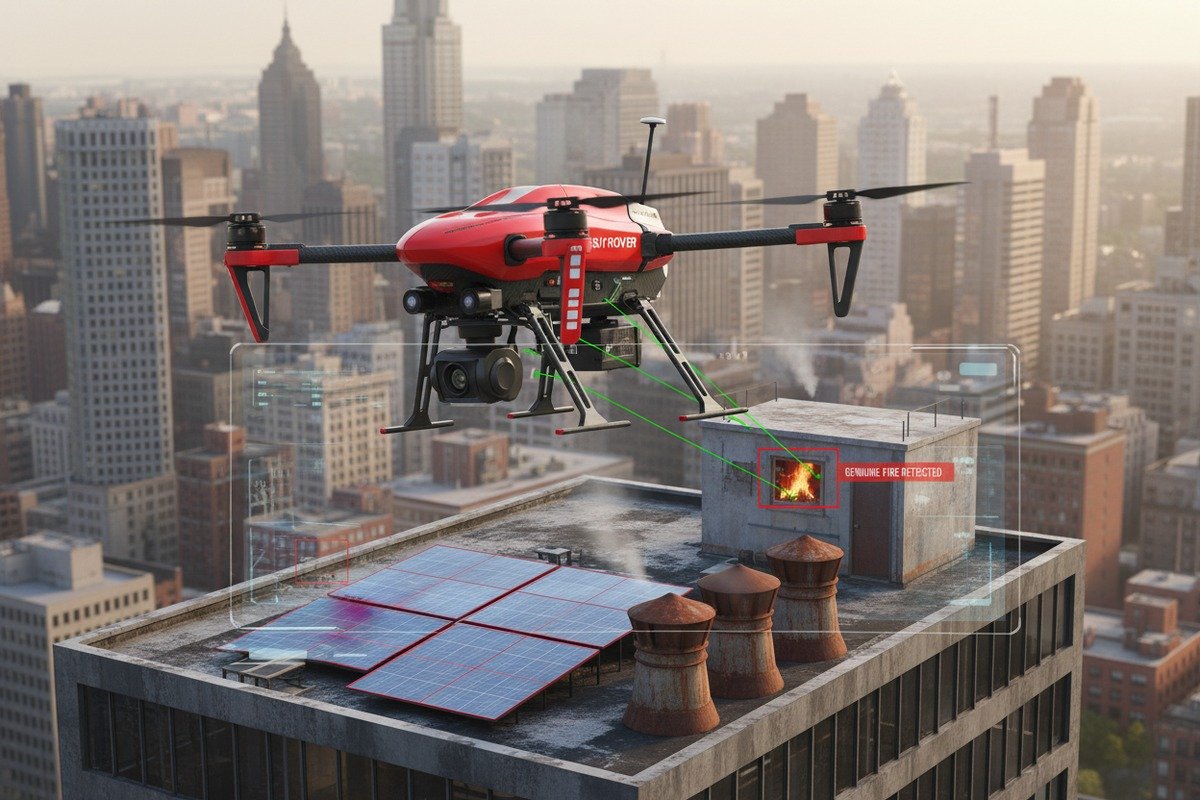
Urban false positive minimization requires multi-sensor fusion combining thermal, optical, and gas detection data. The AI must use temporal tracking to identify dynamic flame behavior versus static heat, implement bounding box analysis achieving up to 92.6% false alarm reduction, and cross-reference detected heat sources against known infrastructure heat signatures like HVAC systems and vehicle traffic patterns.
Multi-Sensor Fusion Architecture
Single-sensor systems fail in urban environments. Our most successful deployments combine three sensor types that cross-validate each detection:
Thermal cameras identify heat anomalies but cannot distinguish fire from other hot objects alone.
Optical cameras provide visual confirmation of smoke, visible flames, or flame color signatures.
Gas sensors detect combustion byproducts like carbon monoxide and smoke particulates.
When all three sensors agree, confidence levels exceed 95%. When only thermal data indicates a fire, the system flags it as "unconfirmed heat source" rather than triggering a full alarm.
Temporal Tracking Technology
The most effective false positive reduction technique is temporal tracking. This means the AI watches each heat source over time—typically 3-10 seconds—to analyze its behavior pattern.
Flames exhibit specific temporal characteristics:
- Temperature fluctuation of 50-200°C within seconds
- Visible movement and shape changes
- Growing heat signature over time
- Irregular edge boundaries
Static heat sources show:
- Consistent temperature within 5°C
- Fixed shape and position
- No growth pattern
- Regular geometric edges
Bounding box tracking around suspected heat sources allows the AI to monitor these characteristics. bounding box analysis 7 Research shows this technique reduces false alarms by up to 92.6% compared to single-frame analysis.
Urban Heat Source Database Integration
Advanced systems maintain databases of known urban heat signatures. When the drone flies over a documented HVAC exhaust location or transformer station, the AI automatically adjusts its confidence threshold for that area.
This requires:
- GPS-tagged heat source mapping
- Regular database updates as infrastructure changes
- Adjustable confidence thresholds per location type
- Manual override capability for operators
Processing Architecture for Urban Density
Urban environments generate massive data volumes. A drone flying over a commercial district might detect 50+ heat sources per second. Processing this requires specific architecture choices:
Edge computing handles initial filtering onboard the drone, reducing transmission delays. The AI eliminates obvious non-threats before sending data to ground stations.
Cloud backup provides secondary analysis for ambiguous detections. If edge processing cannot reach a confident determination, the data transmits to more powerful processors for deeper analysis.
Hybrid approaches offer the best balance. Initial detection happens on the drone in under 0.02 seconds. Complex cases transmit for ground-based analysis in 2-5 seconds.
Operational Protocols for Urban Deployment
Technology alone cannot eliminate all false positives. Your department needs clear operational protocols:
-
Confirmation flights: When AI detects a possible fire, the drone automatically performs a closer inspection pass before alerting dispatch.
-
Confidence thresholds: Set minimum confidence levels for automatic alerts versus operator review requirements.
-
Heat source whitelisting: Pre-map known industrial heat sources in your coverage area.
-
Time-of-day adjustments: Increase sensitivity during high-risk periods (overnight, weekends when buildings are unoccupied).
-
Correlation with dispatch data: Cross-reference detections against existing emergency calls to prioritize confirmed incidents.
Can I customize the AI detection parameters with my supplier to meet the specific safety standards of my local fire department?
When we collaborate with clients on design and development, customization discussions reveal how well a supplier truly understands firefighting operations. Many manufacturers offer products with fixed parameters. Serious partners provide adjustable systems that adapt to your specific operational needs.
Yes, reputable suppliers offer AI parameter customization including adjustable temperature thresholds, confidence level tuning, alert priority weighting, integration with local GIS databases, and custom training on regional fire characteristics. Request contractual guarantees for ongoing calibration support and periodic model updates to maintain accuracy as conditions change.

Core Customization Categories
Your supplier should offer adjustment capability in these key areas:
| Parameter Category | Customization Options | Impact on Operations |
|---|---|---|
| Temperature Thresholds | Minimum fire detection temp, alert trigger points | Balances sensitivity vs. false positives |
| Confidence Levels | Minimum confidence for alerts, review thresholds | Controls automation vs. human oversight |
| Alert Prioritization | Fire size weighting, location priority zones | Directs resources to highest-risk detections |
| Sensor Weighting | Thermal vs. optical vs. gas sensor priority | Adapts to your environment type |
| Geographic Integration | Local maps, infrastructure databases | Reduces known-source false positives |
False Positive vs. False Negative Cost Framework
Every fire department must decide their operational priority. Missing a real fire (false negative) carries catastrophic risk. Responding to false alarms (false positives) wastes resources and creates response fatigue.
Work with your supplier to define your acceptable balance:
High sensitivity settings catch more fires but generate more false alarms. Use this for:
- High-risk areas with fast fire spread potential
- Overnight monitoring when human detection is limited
- Dry season conditions with elevated fire danger
High specificity settings reduce false alarms but may miss small fires. Use this for:
- Urban areas with many heat sources
- Areas with frequent thermal interference
- Situations where response resources are limited
Your supplier should provide documentation showing how each sensitivity level affects both detection rates and false alarm rates.
Training on Local Fire Characteristics
Fire behavior varies by region. Forest fires in the Pacific Northwest look different from grassland fires in Texas. Urban structure fires differ from rural barn fires.
Ask your supplier whether they can:
- Accept training data from your historical fire incidents
- Incorporate regional vegetation fire signatures
- Adjust smoke detection algorithms for local climate conditions
- Update models based on your deployment feedback
This customization requires ongoing partnership, not a one-time purchase. The best suppliers offer annual model retraining as part of their service agreements.
Integration with Existing Systems
Your fire department likely uses existing dispatch software, mapping systems, and communication networks. GIS databases 9 AI customization must include integration planning:
CAD integration: Detection alerts should flow directly into your Computer-Aided Dispatch system.
GIS compatibility: Drone detection coordinates must align with your existing mapping infrastructure.
Communication protocols: Alerts should use your established radio frequencies and notification chains.
Data storage: Detection logs must meet your department's record-keeping requirements.
Ongoing Calibration and Support
AI systems drift over time. Sensors degrade. Environmental conditions change. New construction alters heat source patterns. Your agreement should specify:
- Quarterly accuracy audits with documented results
- Annual recalibration services included
- Remote diagnostics capability for troubleshooting
- Guaranteed response time for accuracy complaints
- Clear escalation procedures for persistent problems
Request these commitments in writing before purchase. Verbal assurances provide no protection when problems arise.
Certification Alignment
Different jurisdictions have different standards. NFPA guidelines 10, state fire marshal requirements, and local ordinances all affect acceptable performance parameters. Your supplier should:
- Understand the certification requirements in your jurisdiction
- Provide documentation supporting compliance claims
- Assist with approval applications if required
- Update systems when standards change
If your supplier cannot articulate how their system meets your specific regulatory requirements, they lack the expertise needed for a successful partnership.
Conclusie
Evaluating firefighting drone AI accuracy demands rigorous attention to sensor specifications, testing protocols, urban environment capabilities, and customization options. Partner with suppliers who provide documented benchmarks, support ongoing calibration, and commit to meeting your department's specific operational requirements. The right system saves lives. The wrong one wastes critical response time.
Voetnoten
1. Explains how thermal detection systems are used in firefighting drones for early fire detection. ↩︎
2. The original link was broken. This replacement provides a clear explanation of false positives in machine learning, which aligns with the article’s context of AI flagging a sun-heated boulder as a wildfire. ↩︎
3. Highlights advancements in higher-resolution thermal sensors for improved hotspot detection in fire management. ↩︎
4. Defines NETD and its importance for thermal camera sensitivity and detection accuracy in various applications. ↩︎
5. Explores how thermal imaging sensors are used to analyze temperature differences in fire detection scenarios. ↩︎
6. Illustrates how thermal imaging cameras can detect heat from various sources, including industrial equipment. ↩︎
7. Explains bounding box analysis as a core technique in object detection for AI systems. ↩︎
8. The original link was broken. This Wikipedia page provides a comprehensive and authoritative overview of sensor fusion, which is relevant to understanding multi-sensor fusion capabilities in drones. ↩︎
9. The original link was broken. This Wikipedia page offers an authoritative explanation of Geographic Information Systems, which inherently includes the concept and function of GIS databases. ↩︎
10. Provides the standard for small unmanned aircraft systems (sUAS) used in public safety operations. ↩︎

 English
  Spanish
  German
  French
  Dutch
Dutch  Arabic
