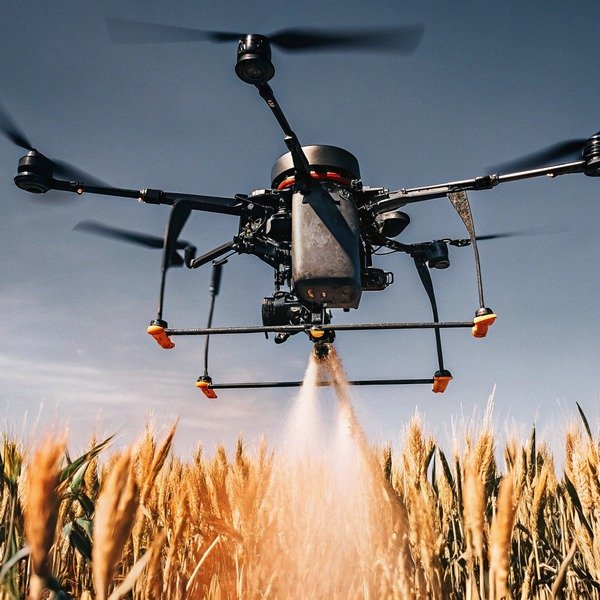
When our engineering team sits down with new clients to finalize custom specifications, we frequently notice a common hesitation regarding tank sizes. Many buyers worry that choosing the wrong size will ruin their operational efficiency or blow their budget.
Payload capacity is the primary factor defining an agricultural drone’s class, typically ranging from entry-level 10kg models to heavy-duty 100kg systems. To distinguish between them effectively, you must analyze how liquid weight impacts battery drain, refill frequency, and the physical maneuverability required for your specific field geometry.
To help you make the right choice, let’s break down the critical differences in capacity and performance.
How does payload capacity directly influence the daily coverage area I can spray?
During field tests at our Xi’an flight facility, we track exactly how much time is lost when a pilot has to land and refill the tank.
Payload capacity dictates your refill frequency; a larger tank allows for longer continuous spraying intervals, significantly reducing the downtime associated with landing significantly reducing the downtime 1, refilling, and swapping batteries. While a 10L drone may land every 8 minutes, a 50L system keeps working, doubling your hourly acreage coverage. doubling your hourly acreage coverage 2

To understand coverage, you have to look beyond the drone's speed. The real killer of efficiency in agricultural spraying is the "refill loop." in agricultural spraying 3 Every time a drone runs out of liquid, it must return return to the home point 4 to the home point, land, have its tank refilled, and fly back to the breakpoint.
The Refill Loop Math
When we analyze flight logs from our clients, we see that small drones spend nearly 40% of their operational time on the ground or flying empty to and from the refill station. A 10kg (10L) drone empties its tank very quickly, often in under 10 minutes depending on the flow rate.
If you have a 100-acre field, a small drone might need to land 40 times to finish the job. In contrast, a 50kg capacity drone carries five times the liquid. It stays in the air longer, reducing those interruptions to perhaps just 8 landings. This drastic reduction in transition time is why larger payloads achieve massive daily coverage figures.
Swath Width Factors
Capacity also influences the spray width (swath). spray width 5 Heavier drones use larger frames and more powerful motors, which generate a stronger downward airflow (propeller wash). This allows them to support wider spray bars and more nozzles.
A small entry-level drone might have a swath width of 4-5 meters. A heavy-lift drone can have a swath width of 10-12 meters. By carrying more liquid and spraying a wider strip, the larger machine covers the field in fewer passes.
Comparison of Coverage by Class
Here is a breakdown of how different payload classes perform based on our standard efficiency tests.
| Drone-klasse | Laadvermogen | Effective Swath Width | Refills per 100 Acres (Approx) | Hourly Coverage (Est.) |
|---|---|---|---|---|
| Entry-Level | 10kg – 20kg | 4 – 6 meters | ~40 – 50 stops | 15 – 20 acres |
| Mid-Range | 30kg – 40kg | 7 – 9 meters | ~15 – 20 stops | 35 – 45 acres |
| Heavy-Duty | 50kg – 100kg | 10 – 13 meters | ~5 – 10 stops | 60+ acres |
Is a larger payload agricultural drone always a better investment for my budget?
We often have to advise enthusiastic buyers against purchasing our largest, most expensive models when their operations do not justify the cost.
A larger payload drone is not always a better investment because the initial purchase price and operating costs scale exponentially with weight. operating costs scale exponentially 6 Heavy-lift drones require expensive high-voltage batteries, specialized transport vehicles, and generator systems, making them financial overkill for farms smaller than 100 acres. making them financial overkill 7

There is a common misconception that buying the biggest drone available "future-proofs" your business. However, in the drone industry, larger capacity introduces complexity and costs that can erode your return on investment (ROI) if not managed correctly.
The Hidden Costs of Heavy Lifting
When you move from a 30kg payload to a 60kg or 100kg payload, the price of the airframe is just the beginning. The real budget shock comes from the support ecosystem.
- Battery Costs: To lift 50kg+ of liquid, plus the drone's own weight, you need massive, high-voltage smart batteries. These are significantly more expensive than standard batteries. If a set of batteries for a small drone costs $500, a set for a heavy lifter can easily exceed $2,000. You typically need 4 to 6 sets for continuous operation.
- Charging Infrastructure: You cannot charge these massive batteries with a standard wall outlet. You need powerful gasoline generators or superchargers. A generator capable of charging a T50 or T100 equivalent battery in 9 minutes consumes a lot of fuel and is a heavy piece of equipment itself.
- Transportation: A folded 10kg drone fits in the trunk of a sedan. A 70kg drone does not. We have seen clients buy large drones only to realize they also need to buy a flatbed truck or a trailer to transport the drone and its mixing tanks to the field.
When Small is Smarter
For many of our partners targeting small to medium-sized farms, the "sweet spot" is often the mid-range category (30kg-40kg). These units offer a balance of good coverage without requiring industrial-scale logistics.
If your budget is tight, starting with two smaller drones might actually be safer than one giant drone. If your giant drone crashes, your operation stops entirely. If you have two smaller units, you have redundancy.
Investment Tier Breakdown
| Functie | Entry-Level (10-20kg) | Heavy-Duty (50kg+) |
|---|---|---|
| Drone Cost | Low ($5k – $10k) | High ($25k – $50k+) |
| Battery Price | Affordable | Zeer hoog |
| Transport Needs | SUV / Pickup | Trailer / Truck |
| Crash Risk Cost | Manageable repairs | Expensive component replacement |
| Best ROI For | Orchards, Plots < 50 acres | Industrial Farms > 200 acres |
How do flight time and battery requirements change as I increase payload capacity?
Our battery suppliers work closely with us to manage the immense heat generated when heavy-lift motors draw peak current.
As you increase payload capacity, flight times generally remain short, between 10 to 15 minutes per flight between 10 to 15 minutes 8, because the energy required to lift heavy liquid loads drains batteries rapidly. This necessitates a robust rotation of rapid-charging batteries to ensure continuous operation without pauses.
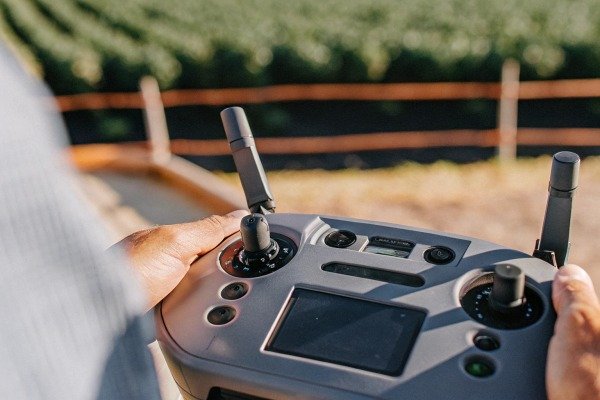
It is intuitive to think that a bigger drone has a bigger battery, so it should fly longer. This is technically true for the battery size, but false for flight duration. The physics of flight works against us here.
The Weight Penalty
To lift a 50kg or 70kg payload, the drone's motors must spin at very high RPMs, drawing massive amounts of current. Even though the battery capacity is larger (measured in milliamp-hours, mAh), the discharge rate (C-rating) is intense.
Consequently, whether you fly a small 10L drone or a massive 100L drone, the actual flight time with a full tank is remarkably similar—usually around 10 to 15 minutes. The industry goal is not to make the drone fly for an hour; it is to make it fly just long enough to empty the tank.
The Heat Challenge
When we design frames for heavy-payload drones, heat dissipation is a major priority. High current generates heat. If the battery gets too hot, it cannot be recharged immediately; it must cool down first. This creates a bottleneck.
For high-capacity drones, we often use batteries with internal heat dissipation structures or liquid cooling compatibility. If you choose a heavy-lift drone, you must invest in a "cool-down" solution, such as a water cooling tank or air-conditioned charging box, or else you will need double the number of batteries to maintain a rotation.
Battery Cycle Management
Because heavy drones push batteries to their limits, the lifespan of these batteries is often shorter than those used in lighter applications. A battery for a 50kg payload drone might be rated for 1,000 to 1,500 cycles.
You must calculate your cycle usage carefully.
- Flight Time: 12 minutes fully loaded.
- Charge Time: 9 to 12 minutes (fast charge).
- Cooling Time: 5 to 10 minutes.
If your charging and cooling time exceeds your flight time, your drone will sit on the ground waiting for power.
Which payload size is best suited for the specific terrain and crop types I manage?
We always ask our American clients to send us photos of their land topography before recommending a specific model.
Large payload drones are best suited for flat, open broad-acre crops like corn and wheat where straight-line efficiency is key. Conversely, smaller, lighter payload drones are superior for complex terrains like hillside orchards or fragmented plots because they offer better agility and terrain following.
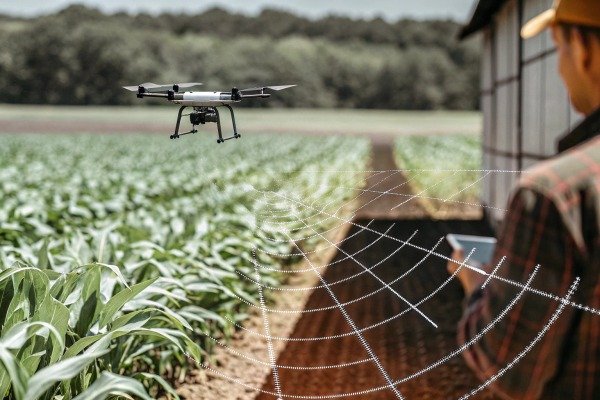
The landscape dictates the machine. A 100kg drone is like a freight train; it has high inertia. has high inertia 9 It takes time to speed up and, more importantly, distance to slow down.
The Physics of Inertia
In flat fields (like the Midwest US), a heavy drone is king. It can reach full speed and cruise for hundreds of meters. However, if you are managing a vineyard on a slope or a citrus orchard with irregular tree heights, a heavy drone can be dangerous.
If a heavy drone needs to stop suddenly to avoid a power line or a tree branch, its momentum carries it forward. avoid a power line 10 Smaller drones (10kg-20kg) are much more "twitchy" and responsive. They can stop on a dime, change elevation quickly, and navigate tight spaces between tree rows without the risk of drifting into obstacles due to weight.
Crop Penetration and Downwash
The type of crop also matters.
- Orchards: You need powerful downward pressure to flip the leaves and spray the undersides. While big drones have strong wind fields, they often fly higher to stay safe. A medium-sized drone flying lower can sometimes achieve better penetration in dense canopies.
- Rice/Wheat: These crops are fragile. A massive drone flying too low can flatten the crop with its propeller wash. For these crops, the spray nozzles need to be calibrated perfectly, or the drone must fly at a higher altitude, which increases the risk of wind drift.
Terrain Suitability Matrix
| Terrain Type | Recommended Payload | Reason |
|---|---|---|
| Open Plains / Flat Fields | 50kg – 100kg (Heavy) | Maximizes speed and swath width; few obstacles. |
| Terraced Hills / Slopes | 20kg – 30kg (Mid) | Good balance of power and agility for elevation changes. |
| Small Orchards / Vineyards | 10kg – 20kg (Entry) | High maneuverability; fits between rows; safer stopping distance. |
| Fragmented / Irregular Plots | 10kg – 20kg (Entry) | Easier to transport between multiple small sites; faster setup. |
Conclusie
Selecting the right agricultural drone requires balancing raw power with practical logistics. If you manage vast, flat acreage, invest in high-capacity 50kg+ models for maximum efficiency. However, for complex terrain or tighter budgets, a nimble 20-30kg system often delivers better ROI and operational safety.
Voetnoten
1. Academic research on agricultural operational efficiency and downtime reduction. ↩︎
2. Official manufacturer data comparing coverage rates of various drone models. ↩︎
3. Provides general background on the history and methods of aerial crop application. ↩︎
4. Technical documentation on automated return-to-home features for spraying drones. ↩︎
5. ISO standard for agricultural sprayers and nozzle requirements for drift reduction. ↩︎
6. News report discussing the rising costs and economic scale of agricultural drones. ↩︎
7. Educational resource on farm economics and equipment investment analysis. ↩︎
8. Technical overview of battery energy density limitations and flight duration. ↩︎
9. Scientific explanation of inertia and its impact on heavy vehicle maneuverability. ↩︎
10. Official FAA regulations for commercial drone operations near obstacles like power lines. ↩︎

 English
  Spanish
  German
  French
  Dutch
Dutch  Arabic
