
At SkyRover, we see procurement managers struggle to match drone specs with chaotic fire scenes. Choosing the wrong airframe risks mission failure and wasted budget when seconds count.
To select suitable drone models for US firefighting, match the airframe to the specific environment: heavy-lift drones (50kg+ payload) with long endurance are essential for forest suppression, while agile, high-zoom quadcopters with IP55 ratings excel in high-rise reconnaissance. Prioritize modular payloads and robust data links for versatility across diverse operational scenarios.
Let’s break down the technical criteria for your specific deployment needs to ensure you invest in the right equipment.
What specific features are required for stable flight near high-rise buildings with strong wind shear?
Urban canyons create unpredictable wind tunnels that ground lesser aircraft. Our flight tests show that standard stabilization isn’t enough when lives depend on high-altitude hovering near burning structures.
Urban canyons create unpredictable wind tunnels 1
Stable flight near high-rises requires a drone with a high thrust-to-weight ratio and wind resistance ratings exceeding 12m/s (Level 6-7). Look for redundant IMU systems, RTK positioning for centimeter-level accuracy, and optical flow sensors that maintain stability even when GPS signals bounce off glass skyscrapers.
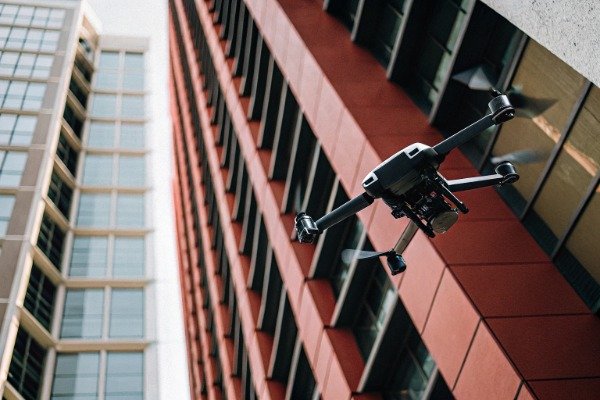
The Aerodynamics of Urban Canyons
Flying a drone near a skyscraper is not the same as flying in an open field. In our engineering labs, we simulate the "Venturi effect," where wind speed increases as it is funneled between buildings. For a drone to maintain a steady hover to deliver a fire hose or stream thermal video, it needs a propulsion system capable of instant torque adjustments.
simulate the "Venturi effect," 2
We recommend looking for hexacopters or quadcopters with large propellers and low KV motors. These configurations provide the torque necessary to fight sudden downdrafts without overheating the motors. If a drone is too lightweight, the "propeller wash" (the air pushed down by the drone) can interact with the building’s surface and destabilize the aircraft, or worse, fan the flames through broken windows.
low KV motors 3
Navigation Redundancy is Critical
In high-rise environments, GPS is notoriously unreliable. The signal from satellites can bounce off glass facades, causing "multipath interference." This makes the drone think it is in a different location, leading to potential crashes.
causing "multipath interference." 4
To counter this, the drone model you select must have:
- RTK (Real-Time Kinematic) Positioning: This corrects GPS errors in real-time.
- Visual Positioning Systems: Cameras and sensors that lock onto the building’s visual features to hold position without GPS.
- Redundant IMUs (Inertial Measurement Units): If one sensor is confused by vibration or magnetic interference from the building’s steel structure, the backup takes over immediately.
Wind Resistance Capabilities by Drone Class
When evaluating specs for your department, use this comparison to judge stability:
| Drone-klasse | Max Wind Resistance | Beste gebruikscasus | Stability Mechanism |
|---|---|---|---|
| Light Commercial (Mavic type) | 10 m/s (Level 5) | Low-rise inspection | GPS + Visual Flow |
| Heavy Industrial (SkyRover type) | 12-15 m/s (Level 6-7) | High-rise suppression | RTK + High Torque Motors |
| Tethered Systems | 15+ m/s (Level 7) | Persistent monitoring | Physical Tether + Power |
How do I ensure the drone has sufficient range and signal strength for deep forest operations?
Losing connection over a blazing forest is a nightmare we help clients avoid. Standard antennas often fail against dense canopy and rugged terrain interference, risking the loss of expensive equipment.
Ensure sufficient range by selecting drones with dual-link transmission systems capable of 10-15km distances and low-frequency bands (like 900MHz) that penetrate foliage better than 2.4GHz. Utilize portable repeater stations or tethered relay drones to extend signal coverage into deep valleys where line-of-sight is obstructed.
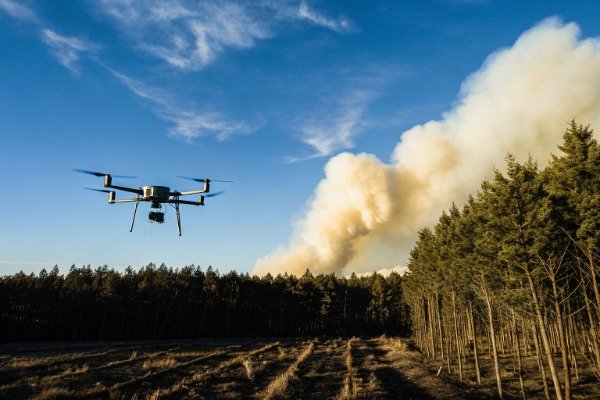
Overcoming Line-of-Sight (LOS) Limitations
In US forestry operations, the fire front can be miles away from the command center, often behind ridges or mountains. Standard 2.4GHz or 5.8GHz video signals travel in straight lines. If a mountain blocks that line, the screen goes black.
When we design drones for these scenarios, we integrate "frequency hopping" technology. However, for deep forest operations, the hardware matters more than the software. You should look for systems that support 900MHz or 433MHz frequencies (where legal). These longer wavelengths can bend slightly around obstacles and punch through tree canopies much better than the high-frequency signals used in cities.
The Role of Repeater Stations
For large-scale wildfires, a single drone is often not enough. The most robust solution involves a "relay" architecture. This is where you place a repeater station on a high point (like a hill) or use a second drone hovering at high altitude to bounce the signal from the operation drone down to the pilot.
Battery Chemistry and Endurance Under Load
Range isn’t just about signal; it’s about having the power to get back. Manufacturers often list flight times based on an empty drone hovering in calm air. This is misleading for firefighters.
When you attach a heavy payload—like a water tank or a drop mechanism—the flight time can drop by 50%. In our testing, a drone rated for 60 minutes might only fly for 28 minutes when carrying a full load of fire retardant. You must calculate your "Point of No Return" carefully. We always advise procurement managers to buy sets of high-voltage, high-density solid-state batteries if the budget allows, as they perform better in the extreme heat of a fire than standard Li-Po batteries.
solid-state batteries 5
Signal and Power Specifications
| Functie | Standaard specificatie | Recommended for Forest Ops | Why? |
|---|---|---|---|
| Transmission Frequency | 2.4GHz / 5.8GHz | 900MHz / 433MHz | Better penetration through trees/smoke. |
| Max Transmission Range | 5-8 km | 15 km+ | Buffer for signal degradation in terrain. |
| Battery Type | Standard Li-Po | High-Voltage / Solid State | Heat resistance and longer endurance. |
| Relay Support | Geen | Native Relay Mode | Essential for BVLOS (Beyond Visual Line of Sight). |
Which payload systems are most effective for urban chemical fires versus wildfires?
A water drop won’t stop a chemical leak, and a zoom camera can’t extinguish a treeline. We design modular mounts because every fire demands different tools, and using the wrong one is ineffective.
For urban chemical fires, prioritize multi-gas detectors and high-resolution thermal cameras to identify leak sources and heat gradients without ignition risks. Conversely, wildfires require heavy-lift suppression payloads, such as dry powder bombs or 50kg water tanks, alongside aerial ignition systems for controlled backburning operations.
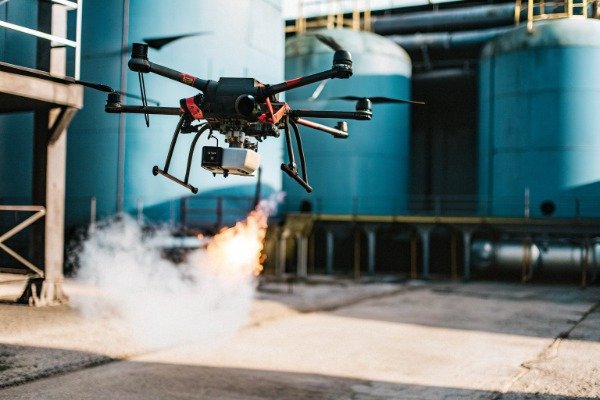
Precision Sensors for HazMat Incidents
In an urban chemical fire, the goal is often containment and information gathering, not just dumping water. Water can sometimes react violently with chemicals. Therefore, the drone acts as a remote sensor.
react violently with chemicals 6
We equip our industrial units with "Sniffer" modules—multi-gas detectors that transmit data back to the pilot’s screen in real-time. This tells the fire commander exactly what chemicals are burning (e.g., ammonia, chlorine) before they send human teams into the danger zone.
Additionally, a Radiometric Thermal Camera is vital. Unlike standard thermal cameras, a radiometric one measures the specific temperature of every pixel. This allows you to see the liquid level inside a storage tank (since the liquid is cooler than the gas above it), helping predict tank failures or explosions.
Heavy-Lift Suppression for Wildlands
Wildfires are a game of volume and perimeter control. Here, the drone becomes a workhorse. The most effective payloads are:
- Fire Extinguishing Bombs: These contain dry powder and are dropped precisely on hotspots to smother small fires before they grow.
- Liquid Tanks (Sprayers): Used for creating "wet lines" to stop a fire from creeping across a path.
- Aerial Ignition Systems (Ping Pong Balls): This sounds counterintuitive, but dropping chemically injected spheres to start controlled burns (backburns) is a primary tactic in US forestry to consume fuel ahead of the main fire.
Payload Selection Matrix
| Scenario | Primary Objective | Recommended Payload | Key Feature |
|---|---|---|---|
| Urban Chemical Fire | Identification & Safety | Multi-Gas Detector + 30x Zoom Camera | Remote chemical analysis. |
| High-Rise Fire | Rescue & Assessment | Thermal Camera + Megaphone/Spotlight | Locating victims through smoke. |
| Forest Wildfire | Suppression & Containment | 50kg Water Tank or Fire Bombs | Direct attack on hotspots. |
| Forest Prevention | Fuel Management | Aerial Ignition System (AIS) | Controlled backburning. |
How do I verify that the drone’s obstacle avoidance system works in smoke-filled environments?
Visual sensors go blind in thick smoke, leading to crashes during critical missions. We advise clients to look beyond standard cameras for true environmental awareness when visibility hits zero.
Verify obstacle avoidance in smoke by ensuring the drone utilizes millimeter-wave radar or LiDAR sensors, which can penetrate particulate matter better than visual cameras. Test the system’s detection range in controlled, low-visibility simulations to confirm it autonomously holds position or reroutes when optical sensors are obscured.
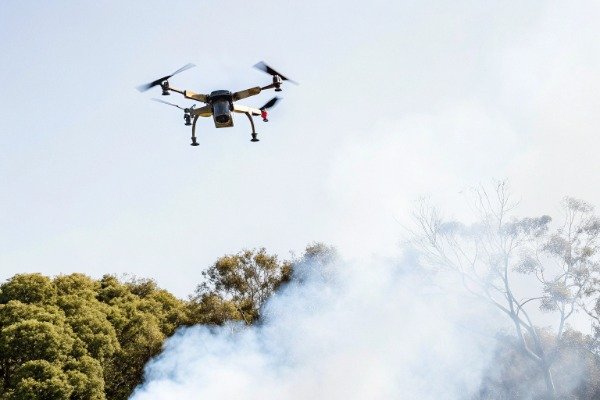
Why Visual Cameras Fail in Smoke
Most consumer and prosumer drones rely on "binocular vision"—cameras that work like human eyes to judge depth. In a fire, smoke particles scatter light. To a visual camera, thick smoke looks like a solid wall. The drone will either slam on the brakes and refuse to move, or it will fail to see the actual wall hidden behind the smoke and crash.
IP55 or IP67 rated 7
When we build drones for fire departments, we assume the camera will be useless for navigation. That is why relying solely on visual obstacle avoidance is dangerous for firefighting.
Aerial Ignition Systems (Ping Pong Balls) 8
The Radar and LiDAR Advantage
To fly safely in smoke, you need sensors that use wavelengths longer than visible light.
integrate "frequency hopping" technology 9
- Millimeter-Wave Radar (CSR): This is the gold standard for smoke. Radar waves pass right through smoke and dust. A 360-degree radar module can detect power lines, tree branches, and building edges even in pitch-black, smoke-filled conditions. It provides a "bubble" of safety around the drone.
- LiDAR (Light Detection and Ranging): While some LiDAR can be affected by very dense smoke, modern industrial LiDAR is far superior to cameras. It creates a real-time 3D map of the environment.
Testing and Verification
Before purchasing, ask the supplier for "Ingress Protection" (IP) details and sensor specs. A drone might have radar, but if the drone itself isn’t IP55 or IP67 rated, the smoke particles (which are conductive and corrosive) will get inside the electronics and cause a short circuit.
We recommend a simple test protocol for verification:
- The Smoke Tent: Fly the drone in a controlled environment with smoke machines.
- The Drift Test: Hover the drone and obscure the visual cameras with tape. Does it hold its position using radar/GPS, or does it drift?
- The Return-to-Home (RTH) Test: Trigger RTH in a low-visibility setting. The drone should climb to a safe altitude using radar altimeters, not visual sensors.
Conclusie
Selecting the right drone saves lives. Whether for high-rises or forests, prioritize wind resistance, signal range, and specialized payloads like radar and gas detectors. Contact SkyRover to discuss how our custom industrial solutions fit your specific safety missions.
RTK (Real-Time Kinematic) Positioning 10
Voetnoten
- Defines the specific meteorological phenomenon affecting drone flight stability in cities. ↩︎
- Explains the aerodynamic principle causing wind acceleration between buildings. ↩︎
- Technical guide explaining what KV ratings mean for drone motor torque and efficiency. ↩︎
- Official government source explaining sources of GPS signal degradation. ↩︎
- Explains the advanced battery technology recommended for high heat and endurance. ↩︎
- Authoritative database on chemical reactivity and hazmat safety. ↩︎
- International standard definition for ingress protection against dust and water. ↩︎
- Official US government guide on aerial ignition equipment and protocols. ↩︎
- Explains the anti-interference method used in robust drone communications. ↩︎
- Detailed definition of the precision positioning technology mentioned. ↩︎

 English
  Spanish
  German
  French
  Dutch
Dutch  Arabic
