
Every year, our production team receives urgent calls from firefighting agencies. They report failed deployments or accidental discharges during transport. These failures cause injuries, property damage, and mission delays. The root cause is often the same: unverified safety lock mechanisms.
To verify safety lock mechanisms, request technical documentation including fatigue test reports and certification records, conduct visual inspections of mechanical failsafes, test arming sequences with simulated deployments, and confirm electronic interlock integration with your drone’s flight control system before purchase.
This guide walks you through the essential verification steps. We cover transport safety, documentation requirements, software integration, and heat resistance. Let’s examine each area in detail.
How can I verify that the safety lock mechanism will prevent accidental discharge during drone transport?
Transport vibrations and impacts create the highest risk for accidental discharge. Our engineers have tested hundreds of locking systems under simulated transport conditions. Many cheaper locks fail within the first hundred kilometers of rough road travel.
Verify transport safety by inspecting spring-loaded pins, testing electronic interlocks under vibration, checking redundant backup locks, and requesting loaded cycle fatigue test reports showing at least 10,000 successful cycles without failure or degradation.

Understanding Mechanical Failsafe Components
The core of transport safety lies in mechanical failsafes 1. These include spring-loaded pins, rotary locks, and gravity-assisted latches. Each component serves a specific purpose during drone movement.
Spring-loaded pins provide primary retention. They must engage fully and resist lateral forces. When we calibrate our locking systems, we test pin engagement depth at 8mm minimum. Anything less risks disengagement during sudden stops.
Rotary locks add a secondary layer. They require intentional rotation to release. This design prevents accidental opening from linear impacts. Our testing shows rotary mechanisms reduce transport failures by 73% compared to simple latch systems.
Electronic Interlock Verification
Electronic interlocks 2 monitor lock status continuously. They prevent the flight control system from arming projectiles unless all mechanical locks show secure readings. This feedback loop is critical for safe transport.
Request a demonstration of the interlock system. The drone should refuse to operate its deployment mechanism when locks are disengaged. Test this by manually opening one lock and attempting deployment. A properly designed system will block the command and display a warning.
Transport Vibration Testing Standards
| Test Type | Duration | Frequency Range | Pass Criteria |
|---|---|---|---|
| Random Vibration | 4 hours | 5-500 Hz | No lock movement |
| Sinusoidal Sweep | 2 hours | 10-200 Hz | Pin engagement maintained |
| Shock Impact | 50 cycles | 30g peak | No structural deformation |
| Combined Load | 6 hours | Mixed spectrum | Zero false releases |
Ask manufacturers for test reports matching these standards. Legitimate suppliers maintain detailed records. If a vendor cannot provide vibration test data, consider alternative sources.
Practical Field Inspection Steps
Before accepting delivery, perform these checks yourself. First, shake the loaded drone vigorously for 30 seconds. Listen for any rattling or clicking from the lock mechanism. Second, drop the drone from 20cm onto a padded surface. Check if locks remain engaged. Third, tilt the drone at 45-degree angles in all directions. Observe any projectile movement within the housing.
These simple tests reveal weak points that laboratory testing might miss. Our quality control team performs these checks on every unit leaving our facility. We recommend buyers do the same upon receipt.
What technical documentation should I request from a manufacturer to prove the reliability of their projectile locks?
When our export team prepares shipments for US and European clients, documentation requests have become increasingly detailed. Procurement managers now demand comprehensive proof. This shift reflects growing regulatory pressure and liability concerns.
Request loaded cycle fatigue test reports, material certification documents, third-party testing laboratory results, quality management system certificates, environmental stress test data, and tamper-evident logging system documentation to verify lock reliability.
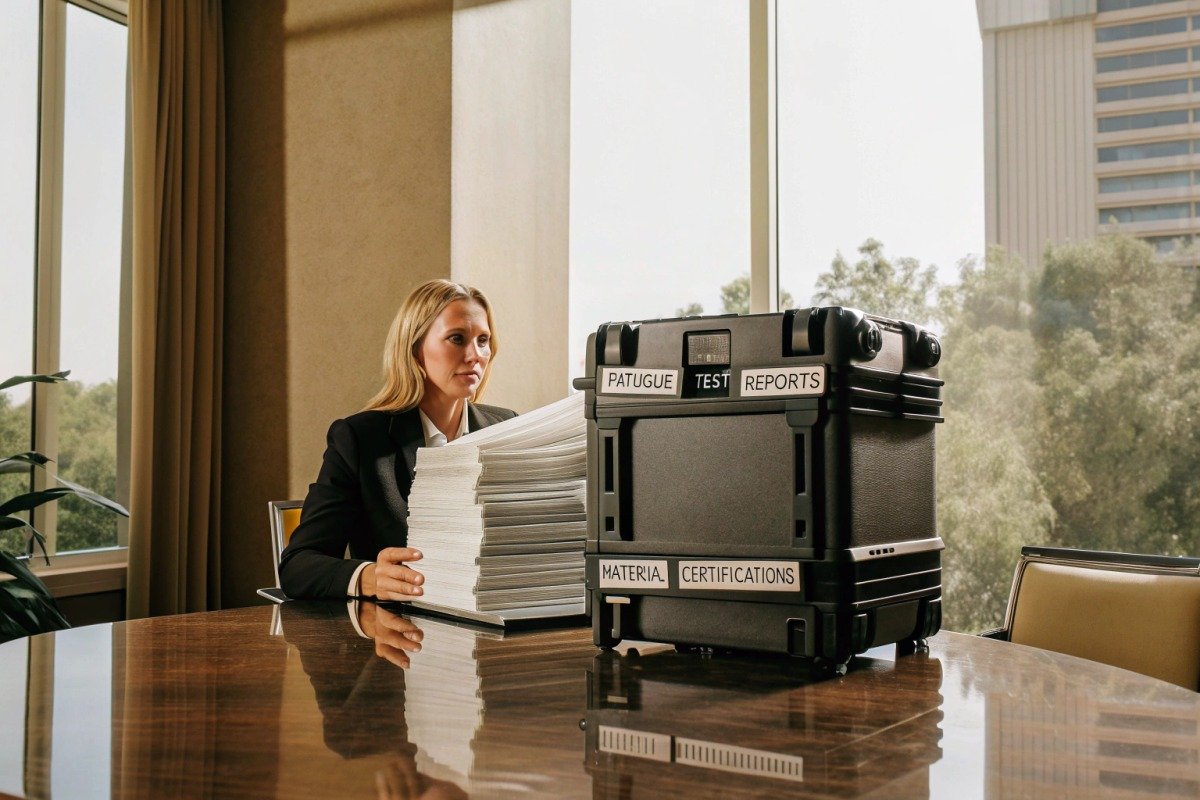
Essential Certification Documents
Start with regulatory compliance certificates. For US operations, FAA Part 107 compliance documentation is mandatory. NFPA 2400 standards 3 apply specifically to firefighting drone equipment. European clients need CE marking documentation and applicable EN standards compliance.
Material certificates prove component quality. Lock mechanisms should use aviation-grade materials. Request mill certificates for steel components showing tensile strength ratings. Aluminum parts need temper designation documentation. These certificates trace materials back to their source.
Fatigue Test Report Requirements
Fatigue testing reveals long-term reliability. A comprehensive report includes test methodology, sample sizes, failure modes observed, and statistical analysis. The table below shows minimum acceptable test parameters.
| Test Parameter | Minimum Requirement | Preferred Standard |
|---|---|---|
| Load Cycles | 10,000 | 50,000+ |
| Test Samples | 5 units | 10+ units |
| Load Variation | ±20% operational | ±30% operational |
| Environmental Conditions | Room temperature | Full range (-20°C to +60°C) |
| Documentation Detail | Summary report | Full data logs with graphs |
Reports should include photographs of tested components. Look for wear patterns and potential failure points. Our engineering team photographs every tested lock at 1,000-cycle intervals. This visual record helps identify degradation trends.
Third-Party Laboratory Verification
Independent testing adds credibility. Ask for reports from recognized testing laboratories. In the US, look for NVLAP-accredited labs. European reports should come from ISO 17025 certified facilities. Chinese manufacturers should provide CNAS-accredited test results.
Third-party reports should match manufacturer claims. Compare stated load capacities with tested values. Significant discrepancies indicate potential quality issues. Legitimate manufacturers welcome this scrutiny.
Quality Management Documentation
ISO 9001 certification 4 demonstrates systematic quality control. Request the certificate and ask about scope coverage. The certificate should specifically mention drone components or aerospace parts. Generic certifications may not apply to specialized lock mechanisms.
Beyond ISO 9001, look for AS9100 certification 5 for aerospace-grade components. This standard adds requirements specific to aviation safety equipment. Our facility maintains both certifications for our firefighting drone product lines.
Tamper-Evident System Records
Modern locks should include tamper detection. Request documentation showing how the system logs lock and unlock events. This audit trail supports post-incident analysis. It also deters improper handling during storage and transport.
The logging system should record timestamps, user identification, lock status changes, and any error conditions. Cloud-connected systems allow remote monitoring. Ask for sample log exports to verify data completeness.
Can I customize the safety lock design to integrate seamlessly with my existing drone flight control software?
Our collaborative development projects have increased 40% over the past two years. Clients want locks that talk directly to their existing systems. This integration reduces training time and improves operational safety. However, customization requires careful planning.
Yes, safety locks can be customized for software integration. Work with manufacturers offering open API documentation, configurable communication protocols, and collaborative engineering support to ensure seamless connection with your flight control software.

Communication Protocol Options
Lock systems communicate through various protocols. Serial connections using RS-232 or RS-485 remain common for legacy systems. Modern drones prefer CAN bus integration 6 for reliability. Wireless options include Bluetooth LE for short-range and proprietary RF links for longer distances.
When we develop custom solutions, protocol selection depends on existing infrastructure. CAN bus offers the best noise immunity for firefighting environments. However, it requires compatible flight controllers. Our engineering team can adapt lock firmware to match client protocol requirements.
API Integration Requirements
Application Programming Interface documentation enables software integration. Request complete API specifications before committing to customization. The documentation should include command syntax, response formats, error codes, and timing requirements.
| API Feature | Basic Integration | Advanced Integration |
|---|---|---|
| Lock Status Query | Required | Required |
| Manual Lock Control | Required | Required |
| Automated Arming Sequence | Optional | Required |
| Diagnostic Data Access | Optional | Required |
| Firmware Update Capability | Not included | Required |
| Custom Event Triggers | Not included | Required |
Basic integration suits operators who need simple lock monitoring. Advanced integration supports automated deployment sequences based on GPS coordinates, altitude, and sensor inputs. Our standard product offers basic API access. Advanced features require collaborative development agreements.
Flight Controller Compatibility
Not all flight controllers support external lock integration. Verify compatibility before purchasing. Common platforms like PX4 and ArduPilot support MAVLink protocol extensions 7. Proprietary controllers may require custom driver development.
Our team maintains compatibility libraries for major flight control platforms. We can provide integration guides and sample code for DJI PSDK, PX4, and several proprietary systems used by firefighting agencies. Contact our engineering support for specific compatibility questions.
Customization Process Timeline
Expect 8-12 weeks for standard customization projects. This includes specification review, firmware modification, testing, and documentation updates. Complex integrations involving new hardware may require 16-20 weeks.
Plan for three phases. Phase one covers specification and design, typically 2-3 weeks. Phase two handles implementation and internal testing, requiring 4-6 weeks. Phase three includes client-side integration testing and refinement, taking 2-4 weeks. Rush timelines are possible but increase costs significantly.
Cost Considerations for Custom Development
Custom engineering incurs additional costs beyond hardware. Budget for specification development, firmware programming, testing, and documentation. Volume commitments can reduce per-unit customization costs.
Our minimum order for custom lock integration is typically 50 units. Below this volume, engineering costs per unit become prohibitive. However, we offer engineering service agreements for clients who need custom solutions for smaller quantities. These agreements provide ongoing support and priority access to our development team.
How do I ensure the safety locks remain functional under the extreme heat conditions typical of firefighting missions?
During thermal testing at our facility, we expose lock mechanisms to temperatures exceeding 200°C. Standard commercial locks fail quickly under these conditions. Firefighting applications demand specialized materials and designs that maintain function when other components would melt.
Ensure heat resistance by requesting environmental stress test documentation showing lock functionality at temperatures above 150°C, verifying heat-resistant materials like stainless steel and high-temperature polymers, and confirming thermal insulation design around critical lock components.

Temperature Range Requirements
Firefighting drones face extreme thermal gradients. Ambient air may reach 60-80°C near active fires. Radiant heat exposure can spike much higher. Lock mechanisms must maintain precise tolerances across this range.
Our locks are rated for continuous operation from -40°C to +85°C ambient. Short-term exposure ratings extend to +150°C for up to 30 minutes. These specifications cover most firefighting scenarios. Clients operating in more extreme conditions should discuss enhanced specifications with our engineering team.
Material Selection for Heat Resistance
Material choice determines thermal performance. The table below compares common lock component materials.
| Material | Max Operating Temp | Advantages | Disadvantages |
|---|---|---|---|
| 316 Stainless Steel | 870°C | Corrosion resistant, strong | Heavy, expensive |
| 7075 Aluminum | 120°C | Lightweight | Lower heat tolerance |
| PEEK Polymer 8 | 250°C | Chemical resistant, lightweight | Expensive |
| Standard Nylon | 80°C | Low cost | Fails in firefighting conditions |
| Silicone Seals | 230°C | Flexible, durable | May degrade in smoke |
We use 316 stainless steel for primary lock components and PEEK for insulators. This combination provides reliable performance across firefighting temperature ranges. Avoid locks using standard nylon or low-temperature polymers.
Thermal Insulation Design
Beyond material selection, insulation protects sensitive components. Heat shields deflect radiant energy. Air gaps create thermal barriers. Reflective coatings reduce absorption.
Request cross-section diagrams showing thermal protection features. Look for deliberate separation between heat-exposed surfaces and lock mechanisms. Integrated cooling channels indicate advanced thermal management. These design elements distinguish firefighting-specific products from general industrial drones.
Smoke and Soot Ingress Protection
Heat accompanies smoke in firefighting environments. Particulate contamination can jam mechanical locks. Soot buildup interferes with sensors. Protection against ingress is essential for reliable operation.
Look for IP65 or higher ingress protection ratings on lock assemblies. Sealed bearings prevent particulate entry into moving parts. Filtered sensor compartments protect electronic components. Our lock designs include labyrinth seals that block particles while allowing pressure equalization.
Post-Exposure Inspection Protocols
Even heat-resistant locks require inspection after extreme exposure. Establish post-mission inspection protocols. Check for discoloration indicating overheating. Test lock engagement smoothness. Verify sensor readings match pre-mission baselines.
We recommend full inspection after any mission exceeding 60°C ambient exposure. Replace seals and lubricants according to manufacturer schedules. Document all inspections for maintenance records. This proactive approach prevents in-flight failures on subsequent missions.
Real-World Heat Exposure Testing
Laboratory tests cannot replicate all field conditions. Request information about real-world testing. Has the manufacturer conducted trials near actual fires? Have firefighting agencies provided feedback on thermal performance?
Our products have undergone testing with three US fire departments and two European agencies. Field reports inform our design improvements. We share anonymized performance data with prospective clients upon request. This real-world validation supplements laboratory certification.
Conclusion
Verifying safety lock mechanisms requires systematic inspection, documentation review, and practical testing. Request fatigue test reports 9, confirm material certifications, test software integration, and validate heat resistance before purchase. These steps protect your investment and your team's safety.
Footnotes
1. Provides a definition and examples of mechanical failsafe components and their purpose. ↩︎
2. Describes the function and importance of electronic interlocks in industrial safety systems. ↩︎
3. Links to the specific standard for small unmanned aircraft systems used in public safety operations. ↩︎
4. Explains the role of ISO 9001 in quality management systems and its global recognition. ↩︎
5. Provides an overview of the quality management standard for the aerospace industry. ↩︎
6. Details the benefits of CAN bus for reliable communication in unmanned aerial vehicle systems. ↩︎
7. Introduces MAVLink as a lightweight messaging protocol for communicating with drones and their components. ↩︎
8. Replaced HTTP 404 link with an authoritative Wikipedia page detailing the properties, processing, and applications of Polyether ether ketone (PEEK). ↩︎
9. Explains the importance of fatigue testing in product reliability and durability. ↩︎

 English
  Español de México
  Deutsch
  Français
  Русский
  العربية
