
Every week, our production team receives calls from frustrated buyers who just discovered they overpaid for basic drone components Electronic Speed Controllers 1. They bought propellers at twice the market rate or paid premium prices for generic motors. This problem costs agricultural operations thousands of dollars annually.
To verify if agricultural drone spare parts prices are market-competitive, you must gather quotes from at least three authorized suppliers, compare OEM versus aftermarket options, calculate total landed costs including shipping and customs, and benchmark against industry-standard price ranges for each component category.
The agricultural drone market 2 is growing rapidly, expanding from $3.39 billion in 2025 to $4.41 billion in 2026. This growth creates pricing volatility. Let me walk you through exactly how to protect your budget and ensure you get fair value for every component you purchase.
How do I know if I am getting the best wholesale price for my agricultural drone spare parts?
When our sales team works with distributors across 30 countries, we see enormous price variations for identical parts CE marking 3. A motor that costs $80 from one supplier might cost $180 from another. This gap exists because many buyers simply do not know the true market price.
You know you are getting the best wholesale price when your per-unit cost falls within established market ranges, you receive volume discounts on orders exceeding 10 units, and your supplier provides transparent pricing breakdowns without hidden fees or unexplained markups.

Understanding Standard Price Ranges
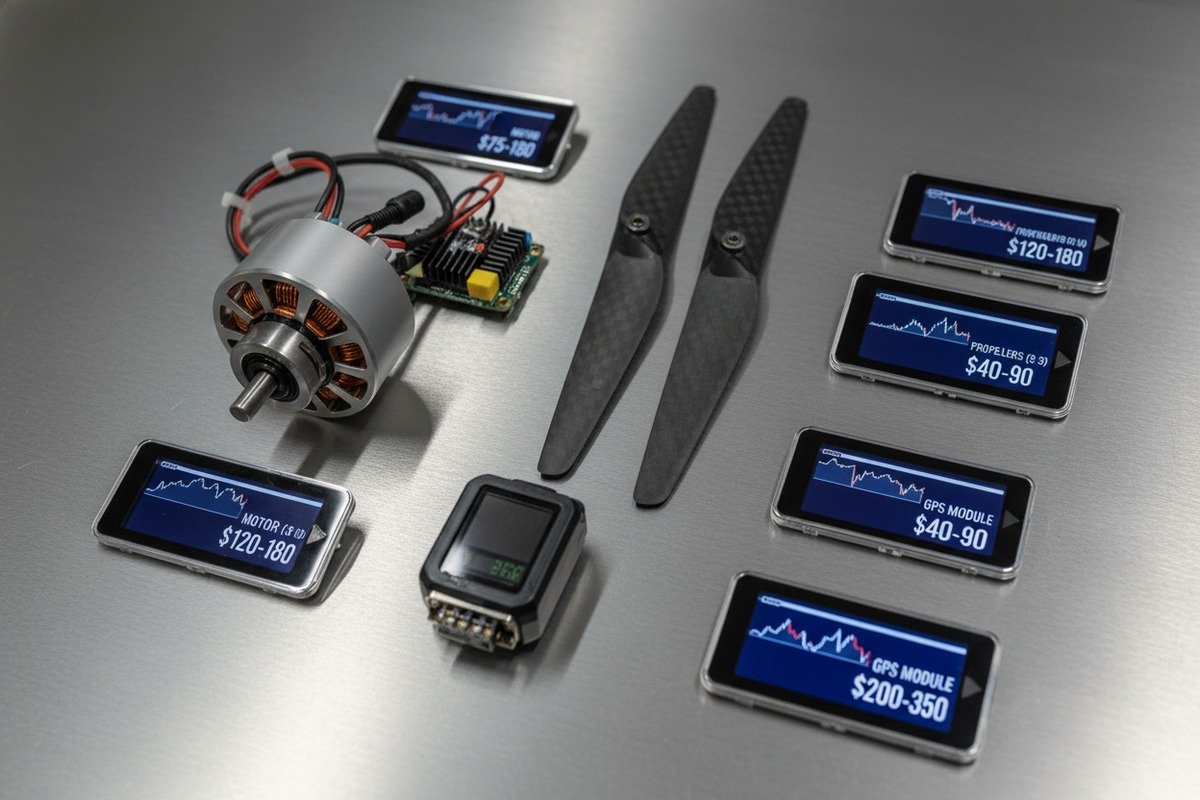
Before negotiating with any supplier, you need baseline knowledge. Our engineering team tracks component costs across the industry. Here are the standard wholesale price ranges for major agricultural drone parts:
| Component | Budget Range | Mid-Range | Premium Range |
|---|---|---|---|
| Brushless Motors 4 | $50-$80 | $80-$150 | $150-$200 |
| Electronic Speed Controllers | $20-$30 | $30-$50 | $50-$80 |
| Propellers (per set) | $10-$25 | $25-$40 | $40-$60 |
| Flight Batteries | $80-$150 | $150-$250 | $250-$400 |
| Carbon Fiber Frame Parts | $50-$100 | $100-$300 | $300-$600 |
| GPS Modules | $30-$60 | $60-$120 | $120-$200 |
If your supplier quotes prices significantly above these ranges without clear justification, you may be overpaying.
Volume Discount Expectations
Wholesale buyers should always negotiate volume discounts. In our experience shipping to American distributors, the standard discount structure looks like this:
- Orders of 10-50 units: 5-10% discount
- Orders of 51-100 units: 10-15% discount
- Orders of 100+ units: 15-25% discount
If your supplier does not offer volume discounts, they may not be operating at true wholesale levels. Many resellers pose as manufacturers but actually purchase from the same factories we operate. They add markups without adding value.
Red Flags in Pricing
Watch for these warning signs:
- Prices that change frequently without market justification
- Refusal to provide itemized quotes
- No discount for bulk orders
- Prices far below market range (suggesting counterfeit or low-quality parts)
- Hidden fees revealed only at checkout
What steps can I take to compare my supplier's component pricing with other top-tier Chinese manufacturers?
Our factory in Xi'an competes with dozens of other Chinese manufacturers daily. We know exactly how our competitors price their products because our customers tell us. The smart buyers always get multiple quotes before committing.
To compare pricing with top-tier Chinese manufacturers, request detailed quotes from at least five suppliers through platforms like Alibaba and direct outreach, specify identical part numbers and specifications, compare landed costs rather than FOB prices, and verify each supplier's manufacturing credentials before price comparison.
Step 1: Identify Legitimate Manufacturers
Not every company on Alibaba or Made-in-China is a real manufacturer. Many are trading companies that add 15-30% markups. Here is how to identify actual manufacturers:
- Request factory photos and video tours
- Ask for production capacity details
- Check business licenses for "manufacturing" classification
- Verify export history and certifications
- Request references from existing customers
Step 2: Create Standardized Quote Requests
When requesting quotes, use identical specifications for each supplier. Include:
- Exact part numbers or detailed specifications
- Quantity requirements
- Preferred shipping method
- Destination port or address
- Payment terms you prefer
- Delivery timeline requirements
This standardization allows true apples-to-apples comparison.
Step 3: Build a Comparison Matrix
| Evaluation Criteria | Supplier A | Supplier B | Supplier C | Supplier D |
|---|---|---|---|---|
| Unit Price (USD) | ||||
| MOQ (Minimum Order) | ||||
| Volume Discount % | ||||
| Shipping Cost | ||||
| Lead Time (Days) | ||||
| Payment Terms | ||||
| Warranty Period | ||||
| Certification Status | ||||
| Total Landed Cost |
Fill this matrix for every major supplier you evaluate. The total landed cost row matters most.
Step 4: Verify Quality Credentials
Price means nothing if quality fails. Before finalizing any supplier based on price, verify:
- ISO 9001 certification 5 for quality management
- CE marking for European markets
- FCC compliance for U.S. sales
- Product liability insurance coverage
- Third-party testing reports
Our quality control team rejects about 3% of incoming components during inspection. Cheap suppliers often have rejection rates above 10%, which erases any cost savings.
Step 5: Test Sample Orders
Before committing to large orders, purchase samples from your top three candidates. Test these samples under real operating conditions. Calculate the true cost per flight hour 6, not just the purchase price.
How can I evaluate if the cost of my drone maintenance parts reflects their actual quality and lifespan?
When we design components for our hexacopter drones, every material choice affects both cost and longevity. A carbon fiber arm that costs twice as much might last four times longer. Understanding this relationship helps you evaluate whether prices reflect genuine value.
Evaluate price-quality correlation by calculating cost per flight hour rather than purchase price, requesting material specifications and testing data, comparing warranty coverage periods between suppliers, and tracking real-world performance data from existing users in agricultural drone communities.

The True Cost Formula
Purchase price is misleading. True cost requires this calculation:
True Cost Per Hour = (Purchase Price + Installation Cost) ÷ Expected Flight Hours
For example, consider two battery options:
| Factor | Budget Battery | Premium Battery |
|---|---|---|
| Purchase Price | $120 | $280 |
| Charge Cycles | 200 | 500 |
| Flight Time Per Charge | 15 minutes | 20 minutes |
| Total Flight Hours | 50 hours | 167 hours |
| Cost Per Flight Hour | $2.40 | $1.68 |
The "expensive" battery actually costs 30% less per hour of operation. This is the analysis that matters for agricultural operations where flight time equals revenue.
Material Quality Indicators
Higher quality parts use better materials. Here are key indicators:
Propellers:
- Premium: Carbon fiber reinforced polymers, UV stabilization
- Budget: Basic ABS plastic, no UV protection
- Impact: Premium props maintain balance longer, resist sun damage
Motors:
- Premium: Japanese or German bearings, copper windings
- Budget: Generic bearings, aluminum windings
- Impact: Premium motors run cooler, last 2-3x longer
Frames:
- Premium: Aerospace-grade carbon fiber, CNC aluminum joints
- Budget: Lower-grade carbon fiber, injection-molded joints
- Impact: Premium frames survive crashes that destroy budget frames
Warranty as Quality Signal
Warranty length signals manufacturer confidence. Compare warranty periods:
- Budget suppliers: 30-90 days
- Mid-tier suppliers: 6-12 months
- Premium suppliers: 12-24 months
Our components carry 12-month warranties because we trust our quality control processes. Suppliers offering only 30-day warranties often know their parts will fail.
Community Intelligence
Join agricultural drone forums and communities. Experienced operators share real-world data about component performance. Look for:
- Flight hour reports for specific part numbers
- Failure mode descriptions
- Brand comparisons under agricultural conditions
- Recommendations from commercial operators
This crowd-sourced data often provides better quality signals than manufacturer claims.
How do I factor in shipping and customs to ensure my landed spare parts price remains market-competitive?
In our experience exporting to the United States and Europe, we have seen customers focus entirely on unit price while ignoring logistics costs. Then they discover shipping and customs added 40% to their total cost. This mistake destroys their competitive position.
Factor shipping and customs into landed cost by calculating freight charges based on volumetric weight, researching applicable tariff codes and duty rates for your destination country, adding customs brokerage fees, and comparing DDP (Delivered Duty Paid) quotes against FOB (Free on Board) pricing to find the most competitive total cost.

Understanding Shipping Cost Variables
Shipping costs depend on multiple factors:
Weight and Volume:
Carriers charge based on actual weight or volumetric weight, whichever is higher. Volumetric weight formula: (Length × Width × Height in cm) ÷ 5000 = volumetric weight in kg.
Drone parts often have low density but high volume. A box of propellers might weigh 2 kg but have volumetric weight of 8 kg.
Shipping Method Comparison:
| Method | Transit Time | Cost Range (per kg) | Best For |
|---|---|---|---|
| Air Express | 3-7 days | $8-$15 | Urgent, high-value |
| Air Freight | 7-14 days | $4-$8 | Medium urgency |
| Sea Freight | 25-40 days | $0.50-$2 | Large, planned orders |
| Rail (China-Europe) | 18-25 days | $2-$4 | Europe-bound cargo |
For spare parts, air freight often provides the best balance of cost and speed.
U.S. Customs and Tariffs
Agricultural drone parts entering the United States face specific tariff classifications:
- Motors: HTS 8501.10 – 8501.64 (0-6.5% duty)
- Batteries: HTS 8507.60 (3.4% duty)
- Carbon fiber parts: HTS 8803.30 (0% duty for aircraft parts)
- Electronic components: HTS 8542-8543 (0-2% duty)
However, Section 301 tariffs 7 add 7.5-25% on many Chinese-origin goods. Check current rates at the USITC website before calculating landed costs.
Calculating True Landed Cost
Here is the complete formula:
Landed Cost = Product Cost + Shipping + Insurance + Customs Duty + Brokerage Fees + Local Delivery
Example calculation for a $1,000 motor order:
| Cost Component | Amount |
|---|---|
| Product Cost (FOB) | $1,000 |
| Freight (Air) | $120 |
| Insurance (0.5%) | $5 |
| Customs Duty (6.5%) | $73 |
| Section 301 Tariff (25%) | $281 |
| Brokerage Fee | $75 |
| Local Delivery | $50 |
| Total Landed Cost | $1,604 |
The $1,000 "price" became $1,604 landed cost—a 60% increase.
Strategies to Reduce Landed Costs
Consolidate Shipments: Larger shipments have lower per-unit freight costs. Plan orders quarterly rather than monthly.
Use DDP Terms: When suppliers quote DDP (Delivered Duty Paid) 8, they handle all logistics and customs. This provides cost certainty and often better rates due to volume.
Explore Free Trade Zones: Some countries have duty-free zones or preferential trade agreements that reduce tariffs.
Negotiate Incoterms: Different shipping terms shift cost responsibility. CIF includes shipping and insurance. DDP includes everything. Compare total costs under different terms.
Conclusion
Verifying market-competitive pricing for agricultural drone spare parts requires systematic comparison, quality evaluation, and total landed cost calculation. Use multiple quotes, track component lifespans, and always calculate the full cost of getting parts to your door. Your bottom line depends on this diligence.
Footnotes
1. Describes the function and importance of electronic speed controllers in drone operation. ↩︎
2. Provides context on the growth and size of the agricultural drone market. ↩︎
3. Explains the meaning and necessity of CE marking for products sold in Europe. ↩︎
4. Explains the technology and working principles of brushless motors. ↩︎
5. Details the requirements and benefits of ISO 9001 for quality management systems. ↩︎
6. Provides a detailed explanation of calculating the true cost of drone components over time. ↩︎
7. Explains the background and impact of Section 301 tariffs on imported goods. ↩︎
8. Clarifies the responsibilities and implications of DDP Incoterms for international trade. ↩︎

 English
  Español de México
  Deutsch
  Français
  Русский
  العربية
