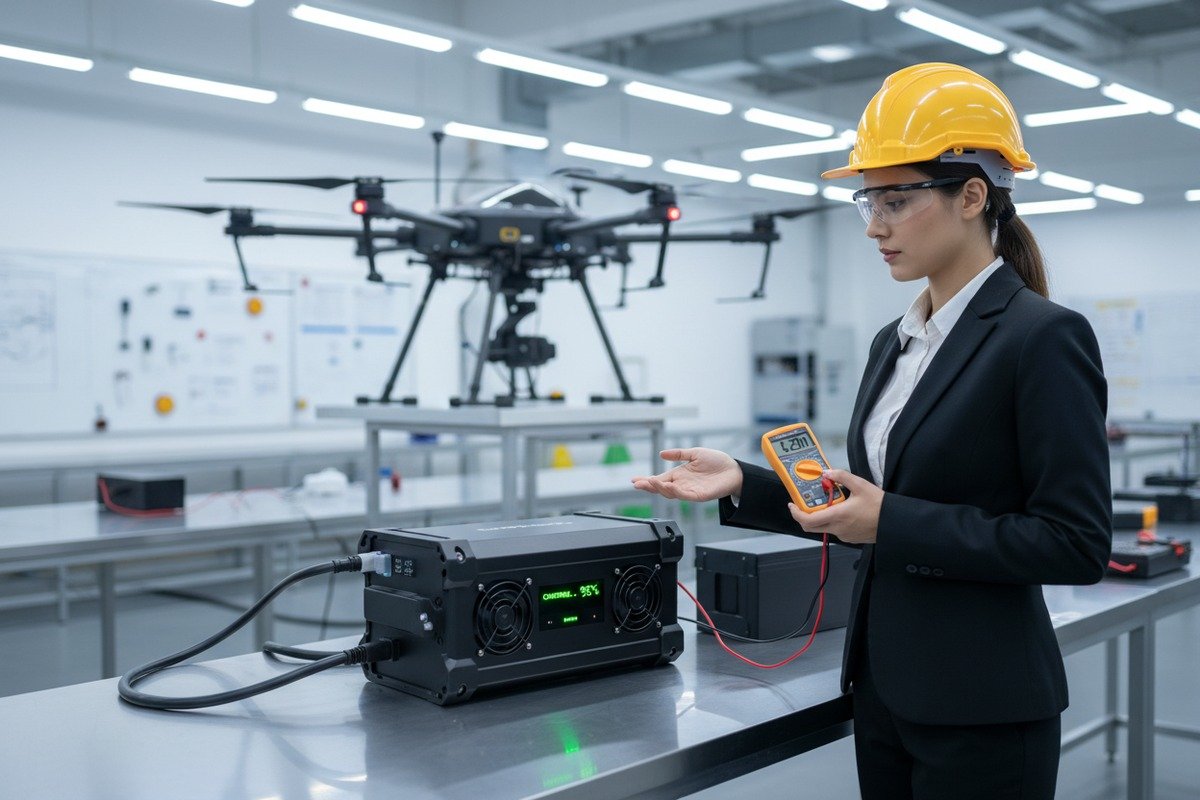
Last year, one of our overseas clients sent us photos of a swollen battery pack 1 that nearly caught fire during field charging. The charger they used lacked proper protection circuits OCP (over-current protection) 2. This incident reminded our engineering team why safety verification matters before any purchase.
To verify charger overcharge and overheat protection, request technical documentation showing OCP (over-current protection), OTP (over-temperature protection), and BMS integration. Conduct live demonstrations with temperature monitoring, check for certifications like CE or UL, and test voltage balance across cells using a multimeter during the charging cycle.
This guide walks you through practical verification steps, documentation requirements, and long-term considerations. Whether you import drones for resale or operate a large farm, these insights help you avoid costly failures and safety hazards.
How can I verify that the charger's overcharge protection actually works during field operations?
When we ship agricultural drones to distributors in the US and Europe, questions about charger safety come up constantly. Field conditions are harsh. Dust, pesticide residue, and temperature swings challenge every component. A charger that works fine in a lab may fail in a muddy field.
To verify overcharge protection in the field, monitor cell voltage during charging using a multimeter or the charger's built-in display. Each cell should stop charging at 4.2V for LiPo batteries. Request a live demonstration from your supplier showing automatic cutoff when cells reach full capacity, and check that the BMS communicates properly with the charger.

Understanding What Overcharge Protection Does
Overcharge protection prevents individual cells from exceeding their safe voltage limit. For lithium polymer batteries common in agricultural drones, this limit is 4.2V per cell. LiPo batteries 3 When a charger lacks this protection, cells can swell, vent toxic gases, or ignite.
Our production team tests every charger unit before shipment. We simulate overcharge conditions to confirm the protection circuit activates. But you should verify this yourself before committing to a large order.
Practical Verification Steps
Here is a step-by-step approach:
- Request a charging demonstration. Ask your supplier to charge a battery while you observe. Use a multimeter to check individual cell voltages.
- Monitor the cutoff point. The charger should stop automatically when cells reach 4.2V.
- Check the charge curve. Smart chargers reduce current as cells approach full capacity. This is called CC-CV (Constant Current – Constant Voltage) charging 4.
- Test cell balancing. After charging, measure each cell. The difference should be under 0.05V.
Key Specifications to Request
| Specification | Safe Value | Warning Sign |
|---|---|---|
| Cell cutoff voltage | 4.2V ± 0.05V | No automatic cutoff |
| Cell balance difference | < 0.05V | > 0.1V difference |
| Charge current (standard) | 1C | Exceeds 2C without safeguards |
| BMS communication | Active handshake | No BMS integration |
Field-Specific Challenges
Agricultural environments introduce unique risks. High ambient temperatures during summer spraying can push battery temps above safe limits. Our engineers recommend chargers with active monitoring that refuse to charge when battery temperature exceeds 40°C.
Additionally, pesticide exposure corrodes connectors over time. Look for chargers with gold-plated contacts and IP65 or higher ingress protection 5. During our product development, we found that double O-ring seals significantly extend charger lifespan in spray operations.
What technical documentation should I request from my supplier to confirm overheat safety?
Our export team regularly prepares documentation packages for clients who need to verify safety compliance. Without proper paperwork, you cannot confirm that a charger meets your requirements. Worse, you may face import issues or liability problems if something goes wrong.
Request these documents from your supplier: certification reports (CE, UL, or equivalent), test reports showing OTP activation thresholds, BMS specification sheets, IP rating certificates, and thermal management design documents. Also ask for charge profile documentation showing temperature-based inhibition settings and active cooling specifications.

Essential Certification Documents
Certifications prove that an independent lab tested the charger. Different markets require different certifications:
| Market | Required Certification | What It Verifies |
|---|---|---|
| United States | UL 2054 6, FCC | Battery safety, EMC compliance |
| European Union | CE marking 7, EN 62133 | Safety and environmental standards |
| International | IEC 62133-2 | Lithium battery safety |
If your supplier cannot provide these documents, consider it a red flag. Our company maintains all certifications and shares them freely with potential partners.
Thermal Management Documentation
Overheat protection relies on thermal management systems. Ask for documents that specify:
- OTP activation temperature. Most quality chargers inhibit charging above 40-42°C.
- Thermal sensor placement. Sensors should monitor both the charger and battery pack.
- Active cooling design. Fans or heat sinks help during rapid charging.
- Preheat function. Charging below 5°C damages cells. Good chargers warm the battery to 15-25°C first.
BMS Specification Sheets
The Battery Management System is critical. Request detailed specs including:
- Cell monitoring capability
- Communication protocol with charger
- Fault response time
- Logging and telemetry features
How to Evaluate Documentation Quality
Not all documents are equal. Look for:
- Third-party testing. In-house tests are less reliable than independent lab reports.
- Recent dates. Certifications expire. Ask for current documents.
- Specific model numbers. Generic documents may not apply to your exact charger model.
- Test conditions. Reports should show testing at various temperatures and load conditions.
When we prepare documentation for OEM partners, we include detailed thermal test data showing how our chargers behave at 25°C, 35°C, and 45°C ambient temperatures. This transparency builds trust.
How will these charger safety features affect the long-term durability of my drone batteries?
During conversations with our US distributors, battery replacement costs come up frequently. A quality charger does more than prevent fires. It directly impacts how long batteries last and how much money you spend over time.
Proper charger safety features extend battery lifespan by 30-50%. Chargers with cell balancing, temperature-based charge inhibition, and segmented charge profiles (1C to 80%, then 0.5C to 100%) reduce stress on cells. This translates to 200-300 full cycles instead of 100-150 cycles with unsafe charging practices.

The Connection Between Safety and Longevity
Every time a battery charges improperly, it degrades faster. Here is how safety features protect battery life:
| Safety Feature | How It Extends Battery Life |
|---|---|
| Overcharge protection | Prevents cell damage from exceeding 4.2V |
| Over-temperature protection | Stops degradation from heat stress |
| Cell balancing | Ensures even wear across all cells |
| Segmented charging | Reduces stress during final charge phase |
| Low-temperature inhibition | Prevents lithium plating that kills cells |
Understanding Charge Cycles and Degradation
Agricultural drone batteries typically last 200-300 full charge cycles 8. But this number assumes proper charging. Our testing shows:
- Charging above 40°C reduces lifespan by 20-30%.
- Skipping cooldown after flight causes similar damage.
- Using high-C charging (2C or above) accelerates wear.
- Ignoring cell imbalance leads to premature failure.
Calculating Total Cost of Ownership
Battery packs for agricultural drones are expensive. A single pack might cost $500-$2000 depending on capacity. If poor charging cuts lifespan in half, you double your battery costs.
Consider this example:
| Scenario | Cycles Achieved | Packs Needed (3 Years) | Total Battery Cost |
|---|---|---|---|
| Quality charger | 300 cycles | 2 packs | $2,000 |
| Poor charger | 150 cycles | 4 packs | $4,000 |
| Savings | — | 2 fewer packs | $2,000 |
The math is clear. Investing in a quality charger with proper safety features saves money over time.
Best Practices for Maximum Longevity
Based on our experience manufacturing drones, we recommend:
- Cool batteries before charging. Wait 15-30 minutes after flight until temperature drops below 40°C.
- Charge at 1C or lower. Resist the temptation to fast-charge.
- Store at 40-50% charge. Never store fully charged or fully depleted.
- Monitor cell balance regularly. Use a cell checker or the charger's display.
- Keep logs. Track cycle counts, charge times, and any anomalies.
Signs Your Charger Is Damaging Batteries
Watch for these warning signs:
- Batteries feel hot immediately after charging
- Flight duration decreases noticeably
- Cells show voltage differences above 0.1V
- Internal resistance exceeds 30mΩ
- Physical swelling appears
If you notice these symptoms, evaluate your charger immediately.
Can my OEM partner customize the charger's protection protocols to match my specific environmental needs?
When we work with OEM partners in Europe and North America, customization requests are common. Different climates and operating conditions require different protection settings. A charger designed for temperate climates may not suit desert operations or cold northern regions.
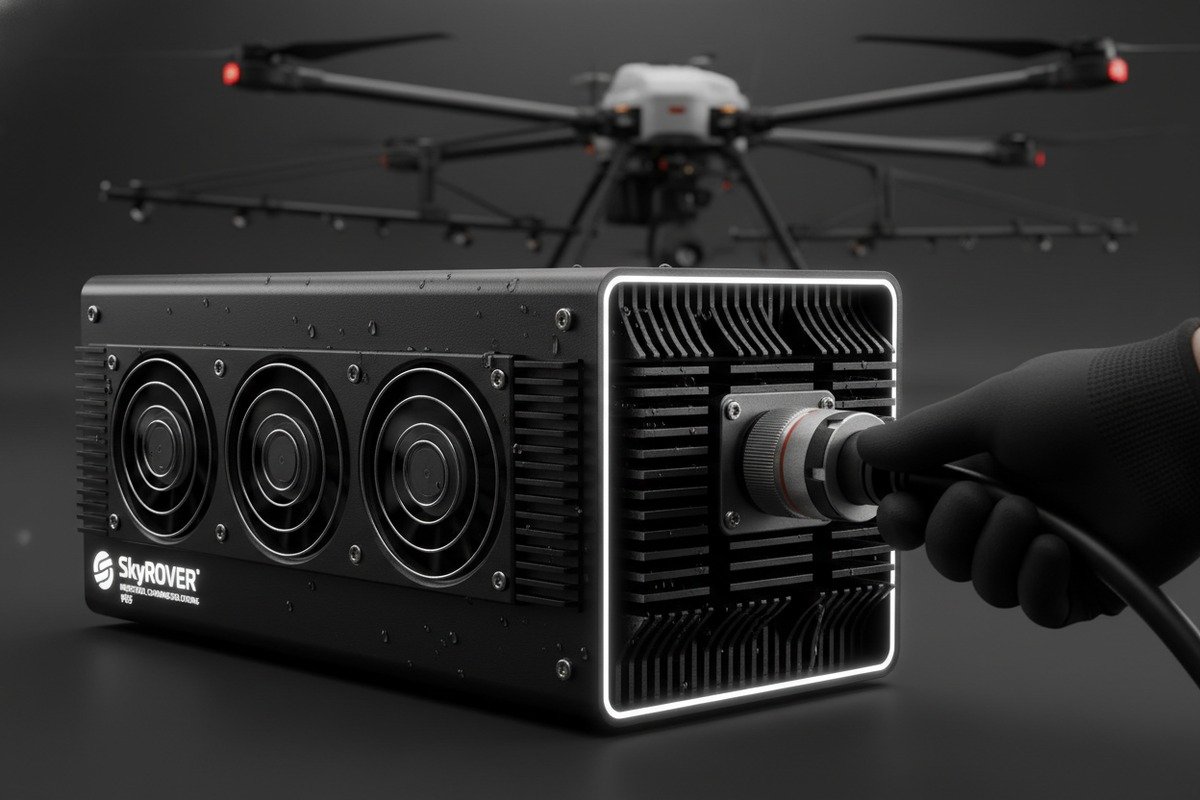
Yes, reputable OEM partners can customize charger protection protocols. Common customizations include adjusted temperature thresholds, modified charge profiles for specific battery chemistries, custom IP ratings for harsh environments, and integrated telemetry for fleet management. Discuss your specific environmental needs early in the partnership to ensure proper engineering support.
What Can Be Customized
Our engineering team regularly modifies charger specifications for OEM clients. Here are the most common customization areas:
| Customization Area | Options | Use Case |
|---|---|---|
| Temperature thresholds | Adjust OTP from 40°C to 45°C | Hot climate operations |
| Preheat settings | Enable below 10°C instead of 5°C | Cold region farming |
| Charge current | Fixed 0.8C for longevity focus | High-value battery packs |
| IP rating | Upgrade to IP67 | Heavy pesticide exposure |
| Connector type | Custom pinout or waterproof | Fleet standardization |
| Telemetry output | API for farm management software | Large-scale operations |
The Customization Process
Working with an OEM partner on charger customization typically follows these steps:
- Needs assessment. You describe your operating environment, battery types, and special requirements.
- Engineering review. The partner evaluates feasibility and proposes solutions.
- Prototype development. Custom firmware or hardware modifications are made.
- Testing and validation. Prototypes undergo rigorous testing.
- Production and documentation. Final units are manufactured with updated specs.
At our facility, this process takes 4-8 weeks depending on complexity. We provide full documentation for any customized product.
Questions to Ask Your OEM Partner
Before committing, ask these questions:
- Do you have in-house engineering capability for firmware modifications?
- What is the minimum order quantity for customized chargers?
- Can you provide test reports specific to my customization?
- How do you handle warranty for customized products?
- What is the lead time for engineering changes?
Environmental Customization Examples
Let me share some real customization cases from our experience:
Desert operations: A client in the Middle East needed chargers that could handle 50°C ambient temperatures. We modified the thermal management system and raised the OTP threshold with additional safety margins.
Northern Europe: A Scandinavian distributor required enhanced preheat functionality for early spring operations. We extended the preheat range and added faster warming circuits.
Coastal farms: Clients near ocean spray zones needed enhanced corrosion resistance. We upgraded to marine-grade connectors and added conformal coating to circuit boards.
Evaluating OEM Partner Capability
Not every manufacturer can deliver quality customizations. Look for partners who:
- Have dedicated R&D teams
- Maintain proper testing facilities
- Provide engineering support post-sale
- Offer reasonable MOQs for customization
- Share reference cases from similar projects
During your evaluation, request a factory visit or video tour. This reveals whether the partner has genuine engineering capability or simply resells generic products.
Conclusion
Verifying charger safety protects your investment, your customers, and your reputation. Request proper documentation, conduct live tests, and choose partners who offer customization and engineering support. These steps ensure your agricultural drone operations remain safe and profitable.
Footnotes
1. Explains causes, dangers, and handling of swollen lithium polymer batteries. ↩︎
2. Defines over-current protection and its role in battery management systems. ↩︎
3. Provides essential information on safe voltage limits for lithium polymer batteries. ↩︎
4. Explains the Constant Current-Constant Voltage charging method for lithium-ion batteries. ↩︎
5. Defines IP ratings and their significance for protection against environmental elements. ↩︎
6. Details the UL 2054 safety standard for household and commercial batteries. ↩︎
7. Found an authoritative source from the official European Union website explaining CE marking. ↩︎
8. Defines battery charge cycles and their impact on the lifespan of lithium-ion batteries. ↩︎

 English
  Español de México
  Deutsch
  Français
  Русский
  العربية
