
Working on our production line for agricultural drones, we hear the same concern from European vineyard owners every week CE Class markings (C5/C6) 1. Steep slopes, narrow terraced rows, and fragile vines create nightmares for conventional machinery. Many buyers rush into purchases without proper supplier verification, only to face equipment failures during critical spraying windows.
To verify agricultural drone suppliers for steep terrain European vineyards, request CE Class markings (C5/C6), confirm EASA compliance documentation, evaluate terrain-following sensor capabilities for slopes exceeding 30 degrees, check local service networks for parts availability, and demand documented case studies from comparable vineyard operations with measurable ROI data.
This guide breaks down the exact verification steps we recommend to our European partners EASA "Specific" category compliance documentation 2. Let’s examine each critical area so you can confidently select a supplier that meets your vineyard’s unique demands.
How do I evaluate if a supplier's drone flight control system is stable enough for my steep European vineyard slopes?
When we calibrate flight controllers at our facility, we run extensive tests on simulated gradients before any unit ships to Europe LiDAR or radar-based terrain-following sensors 3. But not every manufacturer takes this seriously. Many vineyard operators discover stability problems only after their drone crashes into century-old vines on a 40-degree slope RTK positioning capabilities 4.
Evaluate flight control stability by requesting documented flight endurance data for high-gradient operations, verifying LiDAR or radar-based terrain-following sensors, checking RTK positioning capabilities for centimeter-level accuracy, and demanding test flight videos from slopes comparable to your vineyard's terrain profile.

Why Slope Gradient Changes Everything
Flat-land drone specifications mean nothing in steep vineyards service level agreements 5. Power consumption increases dramatically during high-gradient take-offs. Wind patterns in narrow European river valleys create unpredictable turbulence. A drone that performs perfectly in test fields may fail completely on your terraced Mosel hillside.
Our engineering team has documented that drones operating on slopes exceeding 30 degrees consume 25-40% more battery than identical operations on flat terrain. This directly impacts flight time, coverage area, and operational efficiency.
Key Technical Specifications to Verify
| Specification | Minimum Requirement for Steep Terrain | Why It Matters |
|---|---|---|
| Terrain-Following Sensors | LiDAR or radar-based, not ultrasonic only | Ultrasonic fails on irregular surfaces |
| RTK Positioning | Centimeter-level accuracy | Essential for narrow row navigation |
| Slope Compensation | Automatic altitude adjustment for 30-45° grades | Prevents crashes on terrain changes |
| Wind Resistance | Stable operation in 10+ m/s winds | River valley conditions demand this |
| Emergency Protocols | Auto-return and hover-in-place functions | Protects expensive equipment and vines |
3D Flight Path Planning Capabilities
Suppliers must demonstrate software that accounts for terrain topography. Ask for live demonstrations of their 3D flight path planning system 6. The software should automatically generate routes that follow slope contours, adjust altitude continuously, and account for aerodynamic challenges unique to valley terrain.
Request specific data about how the system handles sudden elevation changes. In steep vineyards, a drone might need to adjust altitude by several meters within seconds. The flight controller must process terrain data fast enough to make these corrections smoothly.
Red Flags to Watch For
Suppliers who only provide flat-land test data are hiding something. If they cannot show you footage from steep terrain operations, their system probably cannot handle your vineyard. Also watch for vague specifications. Phrases like "suitable for slopes" without specific degree ratings indicate untested claims.
What certifications should I request to ensure my agricultural drone supplier meets European safety and import standards?
Our export documentation team spends significant time helping European customers navigate the complex certification landscape. We've seen shipments held at customs for weeks because suppliers provided incomplete paperwork. Worse, we've heard of vineyard operators fined for flying non-compliant equipment.
Request CE Class markings (C5 or C6 for agricultural spraying), EASA "Specific" category compliance documentation, national aviation authority authorizations from the relevant EU country, and proof of compliance with EU sustainability reporting requirements. For Swiss operations, confirm Federal Office of Civil Aviation approval.

Understanding the European Regulatory Framework
Switzerland pioneered vineyard drone regulations. In 2017, AgroFly became the first European company to receive official authorization from three Swiss agencies. By 2019, Switzerland introduced simplified procedures with reduced safety distances compared to helicopter operations. Today, five Swiss companies hold vineyard drone permits.
This regulatory precedent influences broader EU adoption. However, each country maintains specific requirements. Your supplier must understand not just general EASA rules but also national variations.
Essential Certifications Checklist
| Certification Type | Issuing Authority | Why Required |
|---|---|---|
| CE Class C5/C6 | EU Notified Bodies | Mandatory for agricultural spraying operations |
| EASA "Specific" Category | European Union Aviation Safety Agency | Required for commercial agricultural drone use |
| National Aviation Permit | Country-specific civil aviation authority | Legal operation in specific territory |
| Organic Certification Compatibility | National organic certification bodies | Required if serving organic vineyard clients |
| GDPR Compliance | EU Data Protection Authorities | All mapping and crop data must comply |
Import Documentation Requirements
Beyond flight certifications, you need import documentation. Your supplier should provide:
- Certificate of Origin
- Commercial Invoice with correct HS codes
- Declaration of Conformity
- Technical documentation for customs valuation
- Battery shipping compliance (dangerous goods regulations 7)
Experienced exporters like our team prepare these documents routinely. Suppliers who seem confused about paperwork requirements probably lack export experience and may cause customs delays.
Insurance Pre-Approval Considerations
Validate that your supplier's specific airframe is pre-approved by European agricultural insurance providers. High-risk steep-terrain operations require specialized coverage. Insurers maintain approved equipment lists. Flying non-approved drones may void your liability coverage entirely.
Can I find a manufacturer that offers OEM customization for my specific vineyard terrain and software needs?
When we collaborate with European vineyard operators on custom designs, we start by understanding their exact terrain challenges. Standard off-the-shelf drones often fail in specialized vineyard environments. The narrow rows of Alsace vineyards demand different solutions than the steep terraces of the Douro Valley.
Yes, manufacturers like our facility offer comprehensive OEM customization including branded hardware, custom spray system configurations, terrain-specific flight controller tuning, software integration with existing agri-platforms, and specialized sensor packages for multispectral vineyard monitoring. Request detailed development timelines and prototype testing protocols.

What OEM Customization Really Means
True OEM capability goes far beyond putting your logo on a standard drone. It means engineering modifications to meet your specific operational requirements. Our development team works directly with vineyard operators to understand:
- Exact slope gradients across all vineyard blocks
- Row spacing and vine height variations
- Chemical application requirements (organic vs. conventional)
- Integration needs with existing farm management software
- Local regulatory requirements
Hardware Customization Options
| Customization Area | Available Options | Application Benefit |
|---|---|---|
| Frame Material | Carbon fiber, aluminum alloy, hybrid composites | Weight and durability optimization for terrain |
| Spray System | Centrifugal nozzles, pressure nozzles, electrostatic | Droplet size control for vertical leaf walls |
| Tank Capacity | 10L to 30L+ configurations | Match to vineyard block sizes |
| Sensor Package | Multispectral, thermal, RGB, LiDAR combinations | Specific monitoring requirements |
| Battery System | Standard, extended, hot-swap configurations | Flight endurance for large operations |
Software Integration Requirements
Drones offering only hardware are insufficient for modern viticulture. Your supplier should demonstrate integration capabilities with agri-platforms for real-time vine monitoring and automated treatment scheduling.
Request details about data management workflows. Can the drone's software export data to your existing systems? Does it support industry-standard formats? Our software team has built integrations with multiple European farm management platforms. This experience matters because poorly integrated systems create operational bottlenecks.
Multispectral imaging should enable prediction of sugar, anthocyanin, and acid content before harvest. The supplier's software should generate detailed maps facilitating precise plot management. Ask for sample reports from existing customers.
Development Timeline Expectations
Custom development takes time. Realistic timelines for significant modifications:
- Branded exterior with standard internals: 4-6 weeks
- Modified spray system configuration: 8-12 weeks
- Custom flight controller tuning: 6-10 weeks
- Full software integration: 12-20 weeks
- Complete custom platform: 6-12 months
Suppliers promising faster timelines for complex work are likely cutting corners or will miss deadlines.
How do I verify that my supplier provides the long-term technical support and spare parts I need for my fleet?
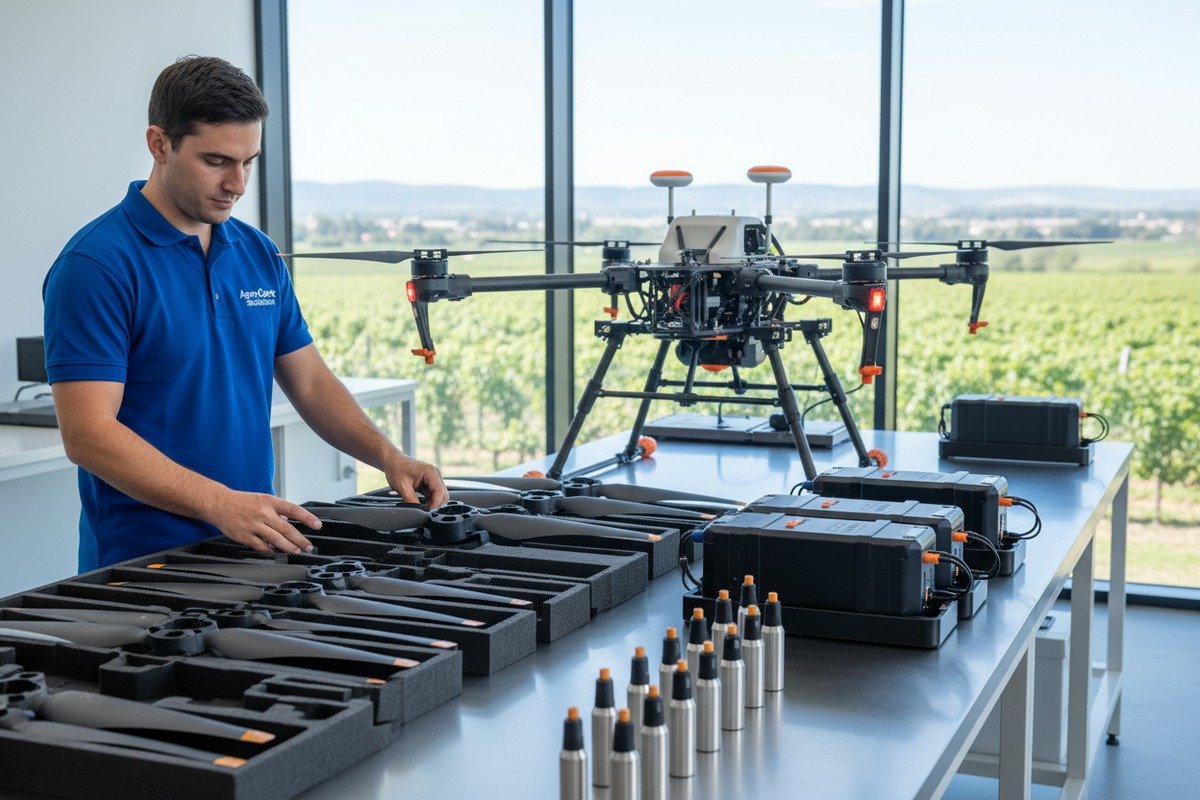
Our customer service team handles urgent calls during harvest season every year. A motor fails. A sensor malfunctions. A flight controller needs recalibration. These moments reveal whether your supplier truly supports your operation or disappears after the sale.
Verify long-term support by examining local European service network locations, requesting documented parts delivery timelines, reviewing service level agreements specifying response times, confirming technical team composition (pilots, data analysts, engineers), and demanding references from customers who have operated equipment for 2+ years.
The Critical Importance of Response Time
Vineyard operations have tight timing windows. Disease pressure waits for no one. When your drone fleet goes down during critical spraying periods, every hour matters. Your supplier's service infrastructure directly impacts your operational success.
Documented results from operational vineyards show 36% reduction in treatment costs when drones function reliably. But these savings evaporate if equipment sits broken during crucial application windows.
Service Network Evaluation Criteria
| Service Factor | Minimum Acceptable Standard | Ideal Standard |
|---|---|---|
| European Service Location | At least one EU warehouse | Multiple locations covering your region |
| Critical Parts Delivery | 5-7 business days | 48-72 hours for emergency items |
| Technical Support Response | 24-hour email response | Same-day phone support during season |
| On-Site Service Option | Available within 2 weeks | Available within 3-5 days |
| Training Programs | Initial pilot training included | Ongoing certification and updates |
Parts Availability and Pricing
Request a complete spare parts catalog with pricing before purchase. Some suppliers sell equipment cheaply then charge excessive markup on parts. Others simply don't stock parts, leaving you waiting weeks for shipments from overseas.
Ask specifically about:
- Motor assemblies
- Propeller sets
- Battery cells and complete packs
- Spray nozzles and pumps
- Flight controller boards
- Sensor modules
Our warehouse in Europe maintains stock of all critical components. We learned this lesson early: customers need parts fast, not excuses.
Training and Ongoing Support
Premium suppliers distinguish themselves through practical training and ongoing support. Your supplier should provide:
- Initial pilot certification training
- Flight planning software training
- Maintenance and basic repair training
- Annual refresher courses
- Access to technical support hotlines
- Regular software updates and patches
Companies should have technical teams including not only professional pilots but also experts in image analysis and data interpretation. This expertise directly impacts the actionable insights you receive from your drone investment.
Reference Verification Process
Contact at least three existing customers who have operated the supplier's equipment for more than two years. Ask specifically:
- How quickly does the supplier respond to service requests?
- Have they experienced parts availability problems?
- What hidden costs appeared after purchase?
- Would they purchase from this supplier again?
Suppliers who cannot provide long-term customer references likely have poor retention—a major warning sign.
Conclusion
Verifying agricultural drone suppliers for steep European vineyards requires systematic evaluation of flight stability, certifications, customization capabilities, and long-term support. Use this guide as your verification checklist, and contact suppliers who can demonstrate proven results in terrain similar to yours.
Footnotes
1. EASA provides information on drone classifications, including C5/C6 for specific operations. ↩︎
2. EASA outlines the requirements and procedures for operating drones in the ‘specific’ category. ↩︎
3. This source explains how LiDAR-based terrain following enhances drone operations in challenging environments. ↩︎
4. DroneDeploy provides a clear explanation of RTK technology and its benefits for drone accuracy. ↩︎
5. Robotic Skies details how they provide aviation-grade maintenance and support for drone OEMs. ↩︎
6. UgCS offers professional drone mission planning software with advanced terrain and obstacle management. ↩︎
7. IATA is the authoritative source for dangerous goods regulations, crucial for drone battery shipping. ↩︎
8. Funet Technology describes its OEM and assembly services for custom drone manufacturing. ↩︎

 English
  Español de México
  Deutsch
  Français
  Русский
  العربية
