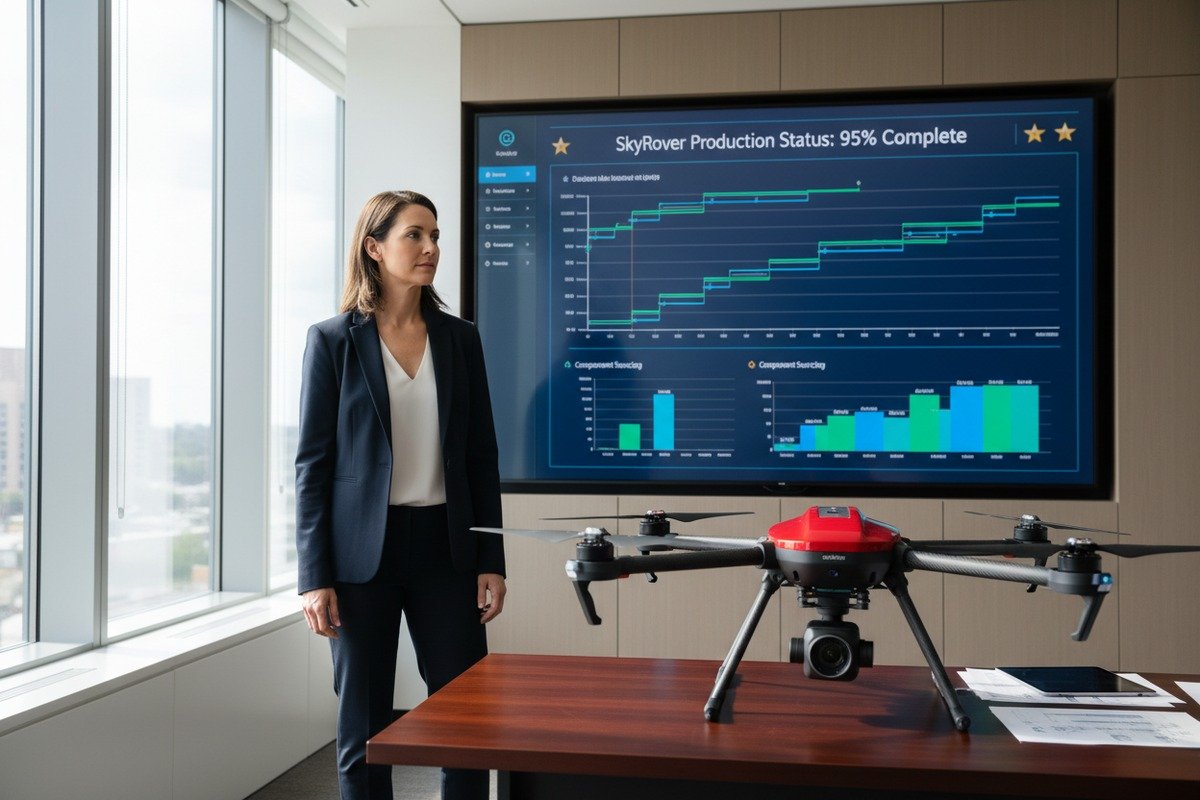
When our engineering team ships a custom firefighting drone with FLIR thermal imaging 1, the hardest part is not building it. The real challenge is keeping buyers informed about every production milestone, testing phase, and shipping update across different time zones.
Project management software syncs order progress by creating shared dashboards, automated milestone notifications, and real-time document sharing between you and your firefighting drone supplier. Tools like Monday.com, Asana, or FlytBase integrations track RFQs, manufacturing stages, quality testing, and shipping in one central hub, cutting delays by up to 40%.
In this guide, we will walk through the best tools, workflow setups, key features, and collaboration methods to ensure complete transparency throughout your firefighting drone procurement journey.
Which project management tools are best for tracking my firefighting drone manufacturing progress?
Our production floor handles everything from carbon fiber frame assembly 2 to thermal camera calibration. Choosing the right tracking tool can mean the difference between a smooth delivery and costly delays during peak fire season.
The best project management tools for firefighting drone manufacturing include Monday.com for visual timelines, Asana for milestone tracking, Jira for technical documentation, and industry-specific platforms like FlytBase or DroneSense that integrate directly with drone operations. These tools offer Gantt charts, custom compliance fields, and API connections.

Understanding Your Tracking Needs First
Before selecting any software, you need to map your procurement process Gantt charts 3. Firefighting drones are not simple consumer products. They involve multiple components like thermal sensors, autonomous flight controllers, docking stations, and specialized software licenses API access 4. Each component may come from different sub-suppliers.
Our team has found that most buyers need to track these stages:
- Request for Quotation (RFQ) 5 submission
- Design confirmation and customization specs
- Component sourcing (FLIR cameras, batteries, motors)
- Manufacturing and assembly
- Quality testing (autonomous flights, thermal accuracy)
- Regulatory documentation (FAA BVLOS compliance 6)
- Shipping and customs clearance
- Installation and training
Comparing Popular Project Management Tools
| Tool | Best For | Drone-Specific Features | Price Range |
|---|---|---|---|
| Monday.com | Visual timeline tracking | Custom fields for compliance docs, automation recipes | $10-20/user/month |
| Asana | Milestone management | Portfolio views, workload balancing | $11-25/user/month |
| Jira | Technical documentation | Issue tracking, version control integration | $8-17/user/month |
| FlytBase | Autonomous fleet ops | Native drone telemetry, 43 docking OEM integrations | Custom pricing |
| DroneSense | Public safety teams | Real-time flight data, incident management | Custom pricing |
| Trello | Simple visual boards | Easy setup, limited automation | Free-$17/user/month |
Industry-Specific Platforms vs General Tools
General tools like Monday.com and Asana work well for procurement tracking. But if you are managing an entire drone fleet, platforms like FlytBase act as "glue" connecting hardware from multiple vendors Kanban boards 7. They have 146 partners and support web-based controls that require no pilot certification.
For fire departments, DroneSense offers collaboration features designed for emergency response. It integrates with existing dispatch systems and provides secure web APIs for scaling public safety operations.
When we work with customers in the United States or Europe, we often recommend starting with a general tool for order tracking. Then, once the drones arrive, they can transition to FlytBase or DroneSense for operational management.
Key Features to Prioritize
Look for these essential capabilities:
- Gantt charts: Visualize the entire production timeline from order to delivery
- Custom fields: Add fields for FAA documentation, sensor serial numbers, and compliance certificates
- Automated notifications: Get alerts when milestones complete or delays occur
- File sharing: Store technical specs, CAD drawings, and test reports in one place
- API access: Connect with your ERP system or supplier portals
When we manufacture octocopter drones with eight dual-blade propellers for heavy payload missions, production involves dozens of checkpoints. Building a shared workflow keeps both sides aligned without constant email exchanges.
Build a shared workflow by creating a project template with standardized stages, inviting your supplier as a guest collaborator, setting up automated milestone triggers, and establishing a single source of truth for all updates. Use shared Kanban boards or Gantt views where both parties update progress in real-time.

Step 1: Map Your Production Stages
Start by documenting every phase of your drone order. Here is a typical workflow for a firefighting drone with thermal imaging capabilities:
| Stage | Duration | Key Deliverables | Responsible Party |
|---|---|---|---|
| RFQ & Quote | 3-5 days | Specifications confirmed, pricing agreed | Both |
| Design Review | 5-10 days | CAD drawings approved, features locked | Supplier |
| Component Sourcing | 14-21 days | Sensors, motors, batteries ordered | Supplier |
| Assembly | 10-15 days | Frame, electronics, camera integrated | Supplier |
| Quality Testing | 7-14 days | Flight tests, thermal calibration reports | Supplier |
| Documentation | 3-5 days | Compliance certs, user manuals | Supplier |
| Shipping | 7-21 days | Tracking number, customs docs | Both |
| Delivery & Setup | 1-3 days | Installation, training completed | Both |
Step 2: Set Up Your Project Structure
Create a master project in your chosen PM tool. We recommend using these elements:
Sections or Phases: Group tasks by production stage. Each section represents a major milestone like "Component Sourcing" or "Quality Testing."
Tasks and Subtasks: Break down each phase into specific actions. For example, "Quality Testing" might include subtasks for "Initial flight test," "Thermal camera calibration," and "Autonomous navigation check."
Custom Fields: Add fields for:
- Target completion date
- Actual completion date
- Status (Not Started, In Progress, Complete, Delayed)
- Notes or blockers
- Attached documentation
Step 3: Invite Your Supplier
Most modern PM tools allow guest access. Share the project with your supplier's project manager or sales contact. Set their permissions to allow task updates but restrict structural changes.
In our experience working with US fire departments and European distributors, we create a dedicated portal section where customers can view progress without accessing internal production details. This balances transparency with confidentiality.
Step 4: Automate Notifications and Updates
Set up automation rules to reduce manual work:
- When a task moves to "Complete," automatically notify the buyer
- When a deadline passes without completion, flag the task as "At Risk"
- When all subtasks in a phase complete, mark the parent milestone as done
- Weekly summary emails showing overall progress percentage
Step 5: Establish Communication Protocols
Even with great software, you need clear rules about how updates happen:
- Update frequency: Daily for critical phases like testing, weekly for routine manufacturing
- Escalation path: Who to contact if a task stays blocked for more than 48 hours
- Documentation standards: All test reports uploaded within 24 hours of completion
- Meeting cadence: Bi-weekly video calls for complex custom orders
What features should I look for to ensure real-time transparency during my drone's quality testing phase?
Quality testing is where our quadcopters with matte black carbon fiber frames and vibrant red housings prove their worth. This phase determines if your firefighting drone can handle real wildfire conditions. You need complete visibility into every test result.
For real-time transparency during quality testing, look for features including live dashboard updates, automated test report uploads, video documentation capabilities, configurable KPI tracking, instant alert notifications for test failures, and secure file sharing with version control. Integration with flight telemetry systems adds another layer of verification.

Critical Testing Milestones to Track
Firefighting drones undergo rigorous testing before shipment. Here are the key checkpoints our team monitors:
| Test Type | What It Measures | Pass Criteria | Documentation Required |
|---|---|---|---|
| Initial Flight | Basic stability, motor response | 15+ minutes stable hover | Flight log, video |
| Thermal Calibration | FLIR sensor accuracy | ±2°C temperature reading | Calibration certificate |
| Autonomous Navigation | GPS waypoint following | <1m deviation from path | Flight path data |
| Obstacle Avoidance | Sensor responsiveness | 100% detection rate | Test scenario video |
| Payload Capacity | Max weight handling | Rated capacity + 10% | Load test report |
| Battery Endurance | Flight time verification | Within 5% of spec | Discharge curve data |
| Communications Range | Signal strength at distance | Stable at max rated range | Signal strength log |
| Emergency Protocols | Return-to-home, low battery | Successful activation | Procedure video |
Essential Software Features for Testing Transparency
Live Progress Dashboards: Your PM tool should show testing progress in real-time. Configure dashboard widgets that display:
- Percentage of tests completed
- Pass/fail ratios
- Current testing phase
- Estimated completion date
Automated File Uploads: When our technicians complete a test, they should be able to upload reports directly to the project. Look for tools with mobile apps that allow field uploads from the test site.
Version Control: Test reports sometimes need revisions. Your system should track document versions so you always see the latest data while preserving history.
Comment and Annotation: Buyers often have questions about specific test results. Inline commenting allows discussions to happen directly on documents rather than in separate email threads.
Setting Up Test-Specific KPIs
Configure custom metrics in your PM tool to track testing quality:
- First-pass yield: Percentage of tests passed without rework
- Average test cycle time: Days from test start to completion
- Documentation completeness: Percentage of required documents uploaded
- Issue resolution time: Hours to fix identified problems
For firefighting drone procurement, we recommend setting a target of 95% first-pass yield and less than 5 days for the complete testing cycle.
Video Documentation Best Practices
Many buyers want visual proof of drone performance. Set up a system for video uploads that includes:
- Standardized naming conventions (Date_TestType_DroneSerialNumber)
- Timestamp requirements showing test duration
- Storage solutions that handle large files (cloud storage integration)
- Secure sharing links for sensitive footage
Our thermal imaging drones like the industrial quadcopters with FLIR cameras often require demonstration videos showing heat detection accuracy in various conditions.
How do I use collaborative software to manage technical documentation and shipping updates for my order?
Technical documentation for our heavy-duty industrial drones with yellow aerodynamic covers fills hundreds of pages. Shipping across international borders adds customs paperwork. Managing all these documents through email creates chaos. Collaborative software brings order to this complexity.
Use collaborative software to manage documentation by creating a centralized document library with folder structures mirroring your order phases, setting up automated shipping milestone tracking with carrier integrations, establishing approval workflows for critical documents, and enabling mobile access for real-time customs and delivery updates.

Building Your Document Library Structure
Organize technical documentation in a logical hierarchy that matches your procurement process:
Root Folder: [Order Number – Customer Name]
- /01_Specifications: RFQ, quotes, design documents
- /02_Manufacturing: Component lists, assembly photos
- /03_Testing: Flight logs, calibration certificates, test videos
- /04_Compliance: FAA documentation, CE marking 9, export certificates
- /05_Shipping: Commercial invoice, packing list, customs forms
- /06_Training: User manuals, maintenance guides, tutorial videos
Document Types Required for Firefighting Drone Orders
| Document Category | Specific Documents | When Generated | Who Creates |
|---|---|---|---|
| Commercial | Proforma invoice, commercial invoice, packing list | Order confirmation, shipment | Supplier |
| Technical | User manual, maintenance schedule, wiring diagrams | Post-manufacturing | Supplier |
| Compliance | Certificate of conformity, test reports, calibration certs | Post-testing | Supplier |
| Customs | Export license, HS code declaration, country of origin | Pre-shipment | Both |
| Insurance | Cargo insurance certificate, value declaration | Pre-shipment | Buyer/Supplier |
| Warranty | Warranty card, service agreement, parts list | Delivery | Supplier |
Integrating Shipping Tracking
Modern PM tools can integrate with shipping carriers through APIs or third-party connectors like Zapier. Set up your system to:
- Automatically pull tracking updates from DHL, FedEx, or freight forwarders
- Create tasks for customs clearance checkpoints
- Alert you when shipments reach customs or experience delays
- Update expected delivery dates based on real-time carrier data
For door-to-door delivery from China to the US or Europe, you might see these typical milestones:
- Shipment picked up from manufacturer
- Export customs cleared (China)
- Departed origin country
- Arrived at destination country
- Import customs processing
- Customs released
- Out for final delivery
- Delivered
Approval Workflows for Critical Documents
Some documents need formal sign-off before proceeding. Configure approval workflows for:
- Design specifications: Buyer approves final design before manufacturing starts
- Test reports: Buyer reviews and accepts test results before shipping
- Customs documentation: Both parties verify accuracy before submission
- Delivery confirmation: Buyer confirms receipt and condition
Most PM tools support multi-step approval chains. For example, a test report might need approval from the buyer's technical team, then their procurement manager, before the supplier can proceed to shipping.
Mobile Access for Real-Time Updates
When shipments are in transit, you need updates on the go. Ensure your chosen platform has:
- Native mobile apps for iOS and Android
- Push notifications for critical updates
- Offline access to key documents
- Camera integration for delivery photos
This becomes especially important during final delivery when customs issues or address problems need quick resolution.
Security and Access Control
Technical documentation for firefighting drones may contain sensitive information about autonomous flight systems, thermal imaging specifications, or integration protocols. Implement these security measures:
- Role-based access (suppliers see only their relevant folders)
- Watermarking on sensitive documents
- Download restrictions where appropriate
- Audit trails showing who accessed what documents
Conclusion
Project management software transforms firefighting drone procurement from a stressful waiting game into a transparent, collaborative process. By selecting the right tools, building shared workflows, and establishing clear documentation practices, you can ensure your thermal-equipped UAVs arrive on time and ready for deployment.
Footnotes
1. Official website for FLIR Systems, a leading manufacturer of thermal imaging cameras. ↩︎
2. Details the manufacturing and assembly processes for carbon fiber composites. ↩︎
3. Wikipedia provides a clear definition and historical context of Gantt charts in project management. ↩︎
4. Explains what API access is and its role in enabling software systems to communicate. ↩︎
5. Wikipedia provides a comprehensive definition and overview of the Request for Quotation process. ↩︎
6. Official Federal Aviation Administration (FAA) page on Beyond Visual Line of Sight (BVLOS) drone operations. ↩︎
7. Wikipedia provides a clear definition and explanation of Kanban boards for workflow management. ↩︎
8. Article from the Project Management Institute (PMI) discussing project management software. ↩︎
9. Official European Union portal detailing the requirements and significance of CE marking. ↩︎

 English
  Español de México
  Deutsch
  Français
  Русский
  العربية
