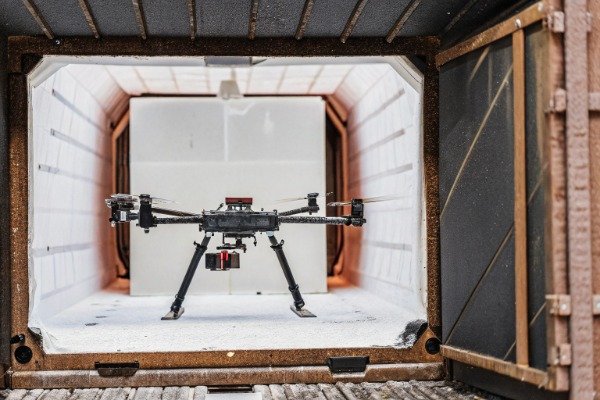
At our facility in Chengdu, we know that standard flight tests fail to predict behavior in extreme heat. When a drone operates near a blaze, equipment failure isn't just an inconvenience—it is a potential disaster.
To test firefighting drone performance in high temperatures, conduct thermal chamber simulations between 50°C and 70°C to verify battery safety and structural integrity. Perform field trials using NIST-aligned protocols to assess sensor accuracy, propulsion cooling efficiency, and signal stability under sustained radiant heat exposure.
Let's break down the specific testing protocols and engineering benchmarks we use to ensure mission readiness in the harshest environments.
What is the maximum operating temperature for the drone's battery and motors?
We often see batteries swell dangerously during our summer stress tests if not properly cooled. Without rigorous thermal management, a high-performance drone becomes a flying incendiary device rather than a rescue tool.
The maximum safe operating temperature typically ranges from 50°C to 60°C for industrial batteries and motors. Testing involves monitoring internal cell temperatures to prevent thermal runaway and ensuring motor windings do not exceed insulation ratings, which usually degrade rapidly above 100°C.
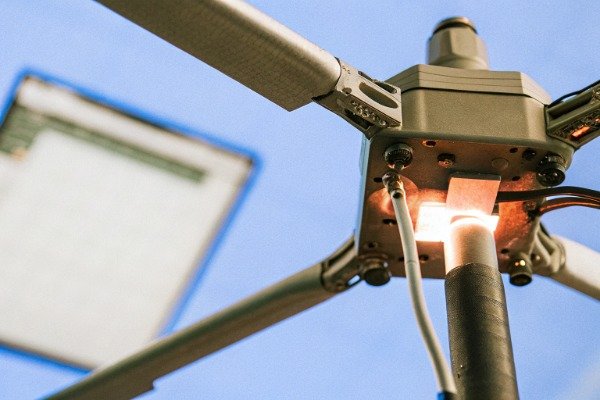
When we design the SkyRover series, the propulsion system is the first point of failure in high-heat environments. Industrial drones, especially those carrying heavy payloads like firefighting balls or water hoses, draw immense current. This current generates internal heat, which, when combined with high ambient temperatures, pushes components to their breaking point.
Testing Battery Thermal Management Systems (BMS)
The most critical test we perform involves the battery's discharge curve under heat stress. Lithium polymer (LiPo) and high-voltage lithium (LiHV) batteries suffer from increased internal resistance as they heat up excessively, or conversely, they may become chemically unstable.
Lithium polymer (LiPo) 1
To test this, you must place the drone in a controlled environmental chamber set to 50°C. Run the motors at hover throttle (usually 50-60% output). You need to monitor the telemetry data for "voltage sag." In our experience, a battery that performs well at 25°C might show a sudden voltage drop at 50°C, triggering a premature low-voltage landing. Furthermore, you must verify that the Battery Management System (BMS) triggers a warning rather than a hard cutoff. A hard cutoff in a fire zone means the drone falls into the fire; a warning allows the pilot to retreat.
Battery Management System (BMS) 2
Motor and ESC Efficiency in Low-Density Air
High temperatures mean lower air density. This forces the motors to spin faster (higher RPM) to generate the same amount of lift, increasing the thermal load on the Electronic Speed Controllers (ESCs).
Electronic Speed Controllers (ESCs) 3
We use laser thermometers to measure the bell housing temperature of the motors immediately after a 20-minute flight simulation. If the motor windings exceed their insulation class rating (usually Class H or higher for industrial use), the insulation melts, causing a short circuit. Similarly, the ESCs must be tested for "thermal throttling." Many modern ESCs will automatically reduce power output to protect themselves when they hit 100°C-110°C. In a firefighting scenario, this uncommanded power reduction can cause the drone to lose altitude unexpectedly.
insulation class rating 4
Critical Component Temperature Thresholds
Below is a reference table based on our internal quality control standards for industrial drones.
| Component | Normal Operating Range | Warning Threshold | Critical Failure Point | Potential Consequence |
|---|---|---|---|---|
| LiPo Battery | 20°C to 45°C | 60°C | > 70°C | Thermal runaway, swelling, fire |
| Brushless Motor | 40°C to 70°C | 90°C | > 120°C | Magnet demagnetization, winding short |
| ESC | 40°C to 60°C | 100°C | > 110°C | Power throttling, total shutdown |
| Flight Controller | 30°C to 60°C | 80°C | > 85°C | CPU throttling, erratic flight behavior |
By adhering to these thresholds, we ensure that the drone can survive the mission. We recommend installing temperature probes on these four key components during the prototype phase to gather real-world data.
How do I verify the heat resistance of the drone's outer shell materials?
Our engineers have watched standard plastic frames warp under radiant heat lamps during R&D. If the airframe deforms even slightly, flight stability vanishes instantly, risking the entire payload and surrounding personnel.
Verify heat resistance by exposing the airframe to sustained radiant heat sources while measuring tensile strength and dimensional stability. High-grade carbon fiber composites should maintain structural rigidity up to 120°C, whereas standard plastics may deform or lose integrity at significantly lower temperatures.

The structural integrity of a firefighting drone is not just about durability; it is about aerodynamics and vibration control. When materials heat up, they soften. This softening changes the resonant frequency of the frame. If the frame's natural frequency aligns with the motor vibrations, the flight controller (FC) will receive "noisy" gyro data, leading to unstable flight or a "fly-away" event.
Radiant Heat vs. Convection Heat
It is vital to distinguish between ambient air temperature (convection) and the direct heat coming from a fire (radiation). A drone might be flying in 40°C air, but the radiant heat from a fire 20 meters away can heat the bottom of the fuselage to over 100°C.
To test this, we do not just use ovens; we use radiant heat panels. We suspend the drone frame above a calibrated heat source that mimics a fire front. We then apply mechanical stress to the arms—simulating the torque of the motors. The goal is to measure deflection. If the arm bends more than 2-3mm under load when heated, the material is unsuitable for firefighting applications. This is why we exclusively use high-modulus carbon fiber with high-temperature epoxy resins for our SkyRover lines.
high-modulus carbon fiber 5
Material Deformation and Tensile Strength
Different materials react differently to heat. Standard ABS plastic, often used in consumer drones, has a glass transition temperature (Tg) of around 105°C, but it starts losing strength well before that.
glass transition temperature (Tg) 6
We conduct a "pull test" on the landing gear and arm joints after they have been "heat soaked" for 30 minutes. The most common failure point we find is not the carbon fiber itself, but the glue or adhesive used to bond the joints. Many industrial adhesives liquefy at 80°C.
Comparative Material Performance in Fire Scenarios
The following table illustrates why material selection is non-negotiable for our procurement partners.
| Material Type | Glass Transition Temp (Tg) | Heat Deflection Temp | Suitability for Firefighting | Notes |
|---|---|---|---|---|
| Standard ABS | ~105°C | ~98°C | Low | Warps rapidly; not recommended. |
| Polycarbonate | ~147°C | ~140°C | Medium | Good impact resistance, but heavy. |
| Carbon Fiber (Standard Epoxy) | ~120°C | > 150°C | High | Excellent stiffness; epoxy is the weak link. |
| Carbon Fiber (High-Temp Epoxy) | > 180°C | > 200°C | Critical | Required for close-proximity operations. |
| Aluminum Alloy (6061) | N/A (Melts >600°C) | N/A | High | Heavy, but acts as a heat sink for motors. |
When evaluating a supplier, ask for the Tg rating of the resin system used in the carbon fiber. If they cannot provide it, they likely haven't tested it for firefighting environments.
Will high temperatures affect the transmission range of the video feed?
We frequently troubleshoot signal dropouts during hot weather field trials in the Gobi Desert. Losing the video feed blinds the pilot, turning a precise rescue mission into a dangerous guessing game.
Gobi Desert 7
High temperatures significantly degrade video transmission range by increasing thermal noise in receiver circuits and causing transmitter throttling. You must test signal integrity in heat-soaked environments to ensure the system maintains a stable link despite the increased noise floor and potential hardware power reduction.

The link between the drone and the ground station is the lifeline of the operation. In firefighting, this link carries not just video, but critical telemetry and thermal data. Heat attacks this link from two angles: hardware degradation and atmospheric interference.
The Physics of Thermal Noise
In electronics, heat generates noise. As the temperature of the receiver and transmitter chips rises, the "thermal noise floor" increases. This reduces the Signal-to-Noise Ratio (SNR). Practically, this means that a drone that can transmit 5km in cool weather might struggle to reach 3km on a scorching day.
We test this by placing the air unit (the transmitter on the drone) in a heat chamber while the ground unit remains outside. We attenuate the signal artificially to simulate distance. We look for "packet loss" and increased latency. If the video starts to stutter or pixelate at a simulated distance of 1km when the unit is at 60°C, the system fails our certification.
Transmitter Throttling and Data Storage
Modern high-definition video transmitters (VTx) generate massive amounts of heat. They rely on airflow to stay cool. In a hot environment, especially if the drone is hovering (low airflow), the VTx chip will hit its thermal limit.
Most high-end systems have a safety feature that lowers the transmission power (e.g., dropping from 1 Watt to 25mW) to prevent burning out. While this saves the hardware, it cuts the range instantly. We verify this by monitoring the power output in real-time during heat tests.
Another often-overlooked issue is the onboard storage. We have found that SD cards and SSDs can throttle their write speeds when overheated. If you are recording 4K video or radiometric thermal data, a throttled SD card will result in corrupted files. We ensure our flight computers have dedicated heat sinks contacting the storage media to mitigate this.
Signal Attenuation Factors
| Factor | Mechanism | Impact on Range | Mitigation Strategy |
|---|---|---|---|
| Thermal Noise | Electron agitation in circuits | Reduces SNR (Signal-to-Noise Ratio) | High-gain antennas, active cooling for VTx. |
| Hardware Throttling | VTx reduces power to save chip | Drastic range reduction (up to 90%) | External heat sinks, high-airflow placement. |
| Atmospheric Density | Hot air changes refractive index | Signal multipath/fading | Lower frequency bands (e.g., 900MHz vs 2.4GHz). |
| Smoke/Particulates | Absorption and scattering | Signal blockage | Redundant link paths (4G/5G + RF). |
How long can the drone hover near a heat source without overheating?
In our wind tunnel tests, hovering creates heat traps that moving flight avoids. Stationary drones cook internally, leading to sudden shutdowns if not validated properly through rigorous stationary protocols.
A drone can typically hover near a heat source for 15 to 20 minutes before internal cooling systems become overwhelmed. Testing requires stationary hover trials at varying distances from a heat source to determine the exact time until thermal shutdown or battery efficiency drops below safe levels.
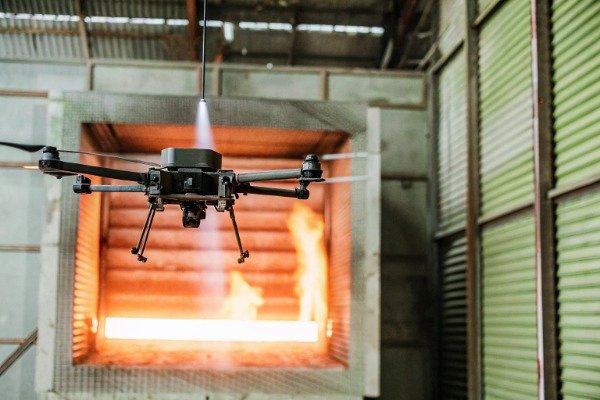
Hovering is the most difficult flight state for a drone's cooling system. During forward flight, air rushes over the fuselage, cooling the motors, ESCs, and batteries. In a hover, the drone relies solely on the "prop wash" (downward airflow) for cooling. However, if the air being pulled down is already superheated by a fire below, the cooling effect is negated.
The "Heat Soak" Effect
We conduct what we call "Heat Soak" endurance tests. We tether the drone in a secure area and place heat sources below it to simulate a ground fire. We measure how long it takes for the core temperature of the flight controller to rise by 10°C, 20°C, and so on.
The danger here is not just immediate failure, but the degradation of lubricants. The bearings in the motors contain grease that can liquefy and leak out at high temperatures, or carbonize and seize up. We have seen motors seize mid-air after prolonged hovering over a heat source because the lubricant failed.
NIST Standard Test Methods for Hovering
We align our testing with NIST (National Institute of Standards and Technology) protocols for aerial systems. Specifically, we use the "Stationary Loiter" test but adapt it for high temperatures.
National Institute of Standards and Technology 8
- Baseline Test: Hover at 25°C ambient temperature until battery depletion. Record time.
- Stress Test: Hover at 45°C ambient temperature (simulated in a chamber or hot climate). Record time.
- Recovery Drill: We force the drone to hover in high heat for 10 minutes, then command it to climb rapidly into cooler air. This tests the system's ability to recover from "thermal shock" without the gyro drifting.
Flight Time Reduction Analysis
It is crucial for procurement managers to understand that "Max Flight Time" on a spec sheet is usually measured at sea level at 20°C. In a fire scenario, flight time drops drastically.
- Battery Efficiency: As mentioned, hot batteries are less efficient.
- Power Consumption: The cooling fans inside the flight computer and payload run at max RPM, drawing more power.
- Aerodynamics: Hot air is less dense. The motors must work 15-20% harder to maintain the same hover altitude.
We provide our clients with a derating chart. For example, if a drone flies 50 minutes at 20°C, it might only fly 35 minutes at 50°C. This honest data allows incident commanders to plan battery swaps accurately without risking the drone falling out of the sky.
Signal-to-Noise Ratio (SNR) 9
Conclusion
Testing ensures reliability. We build drones to survive the heat, not just fly in it. By rigorously validating batteries, materials, and signals against extreme thermal loads, we ensure that when the heat rises, our equipment stays airborne to save lives.
thermal runaway 10
Footnotes
1. Defines the specific battery chemistry used in the drones. ↩︎
2. Details the electronic safety system responsible for monitoring the battery. ↩︎
3. Explains the component responsible for controlling motor speed. ↩︎
4. Defines the standard for electrical insulation temperature limits. ↩︎
5. Provides information on the advanced structural material used. ↩︎
6. Explains the thermal property where materials begin to soften. ↩︎
7. Provides context for the specific harsh environment mentioned. ↩︎
8. Links to the official standards organization mentioned. ↩︎
9. Defines the metric used to measure signal quality. ↩︎
10. Explains the critical battery failure mode mentioned. ↩︎

 English
  Spanish
  German
  French
  Dutch
Dutch  Arabic
