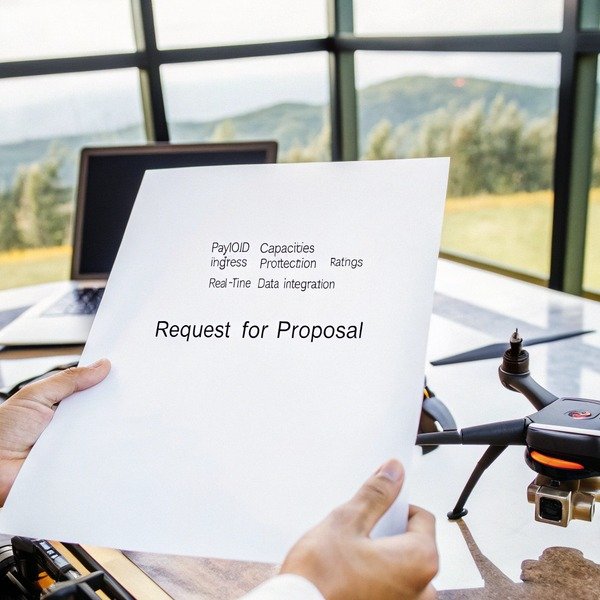
Seeing mismatched specs in procurement documents frustrates our engineering team because we know vague requirements often lead to operational failures when reliability matters most in the field.
A robust RFP must mandate specific payload capacities for fire retardant or high-resolution dual-sensor cameras, while defining strict ingress protection ratings for water and ash resistance. You should clearly outline requirements for real-time data integration, total ownership costs including maintenance, and compliance with aviation safety standards.
Let’s break down the essential components to ensure your procurement process yields a reliable aerial asset rather than just an expensive toy.
What key technical specifications must I include in the RFP for firefighting drones?
We frequently see RFPs missing crucial details about heat tolerance, which forces our engineering team to ask clarifying questions that delay the entire production and delivery schedule.
Your technical section should specify flight endurance with maximum payload, minimum IP45 rating for water resistance, and dual-sensor requirements for thermal and visual feeds. Explicitly request transmission range capabilities in interference-heavy environments and integration potential with existing incident command software.
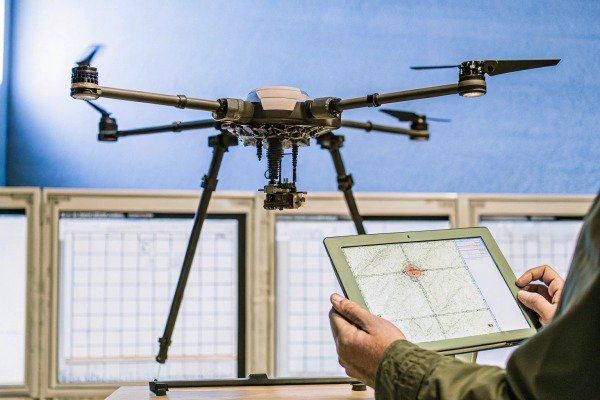
When drafting the technical specifications for a large quadcopter designed for firefighting, precision is your best defense against underperforming equipment. We often find that buyers focus solely on flight time without considering the payload weight. A large quadcopter carrying a fire retardant drop mechanism or a heavy dual-sensor gimbal fire retardant 1 will have significantly reduced endurance compared to an unloaded flight. You need to ask for performance charts that show flight time at maximum take-off weight (MTOW).
Core Airframe and Propulsion
Your RFP must demand a high Ingress Protection (IP) rating. Ingress Protection (IP) rating 2 In our testing facility, we subject drones to high-pressure water sprays to simulate rain and fire hoses. If you do not specify at least IP45 or IP55, the drone may fail when flying through the mist of a fire scene. Additionally, specify wind resistance levels. A large quadcopter should remain stable in winds of at least 12-15 meters per second to be useful in wildland fire scenarios.
Payload and Sensor Capabilities
For the camera systems, do not just ask for "thermal cameras." You must request high-resolution radiometric thermal imaging (at least 640×512 resolution). radiometric thermal imaging 3 This allows your team to read specific temperature data to identify hotspots, not just see heat blobs. Visual cameras should have significant optical zoom (30x or higher) to inspect structural integrity from a safe distance.
Data Link and Connectivity
Fire scenes are noisy electromagnetic environments. We recommend requiring a dual-link transmission system that can hop frequencies to maintain a stable video feed. Furthermore, if you use software like ATAK (Android Team Awareness Kit), your RFP should explicitly Android Team Awareness Kit 4 require API documentation or native compatibility to ensure the drone's location and video feed can be shared instantly with the ground team.
Table 1: Critical Technical Specifications vs. Common RFP Oversights
| Specification Category | What to Request in RFP | Common Oversight to Avoid |
|---|---|---|
| Environmental Protection | IP45 or higher rating; heat-resistant materials for near-fire ops. | "Water resistant" (too vague; leads to consumer-grade failure). |
| Flight Endurance | Flight time with full payload (e.g., 25 mins @ 10kg load). | "Max flight time" (usually measures hovering with no load). |
| Data Transmission | Encrypted, anti-interference link with 5km+ effective range in urban areas. | "Max range" (often theoretical open-field range, irrelevant in cities). |
| Payload Interface | Quick-release mechanism; standard ports for spotlight/loudspeaker swapping. | Fixed cameras that cannot be swapped for cargo drops. |
How should I define the requirements for after-sales support and technical training?
Nothing hurts our reputation more than a grounded drone waiting for parts, so we prioritize building support networks that prevent these costly operational downtime scenarios for our clients.
Define requirements for on-site pilot certification, 24/7 technical troubleshooting availability, and guaranteed turnaround times for repairs or replacement units. You must also request detailed maintenance schedules and costs for consumables like batteries and propellers to calculate the true total cost of ownership.

The relationship with your drone manufacturer begins, not ends, at delivery. In our experience shipping units to the US and Europe, the most successful agencies are those that demanded a comprehensive support plan upfront. When a drone is grounded due to a software error or a broken propeller arm, every hour counts.
Training Curriculums
Your RFP should mandate a two-tiered training program. First, operator training that covers flight maneuvers, emergency procedures, and payload operation. Second, and often overlooked, is maintenance training. Your team should be certified to perform basic repairs, such as swapping motors or arms, without voiding the warranty. We often suggest including a requirement for "Train the Trainer" courses so your agency can sustain its own proficiency.
Service Level Agreements (SLAs)
Be specific about downtime. Request a Service Level Agreement that defines the maximum turnaround time Service Level Agreement 5 for repairs (e.g., 10 business days). For critical fleets, you might request a "hot swap" program where the vendor ships a loaner unit immediately upon reporting a critical failure. This ensures your department is never without aerial coverage.
Spare Parts Availability
Supply chains can be fragile. We advise buyers to require a "Critical Spares Kit" to be included with the initial purchase. This kit should contain extra propellers, landing gear, and perhaps a replacement camera gimbal. In the RFP, ask the vendor to list the lead time for all major components. If a replacement battery takes six weeks to arrive, that is an operational risk you need to know about before signing the contract.
Table 2: Checklist for After-Sales Support Requirements
| Support Requirement | Detail Level Needed in RFP | Why It Matters |
|---|---|---|
| Onboarding Training | Min. 2 days on-site or at vendor facility. | Ensures pilots know safety features and software nuances. |
| Warranty Terms | 12-24 months; cover defects & non-pilot error. | Protects budget from early hardware failures. |
| Software Updates | Free lifetime firmware updates vs. paid subscription. | unexpected annual costs can break department budgets. |
| Remote Support | 24/7 phone/email access with <4 hour response. | Critical for troubleshooting during active emergency responses. |
Which safety certifications and compliance documents should I request from potential suppliers?
When we prepare export documentation for the US and Europe, we ensure every battery and component meets strict safety standards to avoid customs seizures or liability issues.
Request proof of compliance with aviation authority standards like FAA or EASA regulations, along with specific battery safety certifications such as UN38.3. For government-funded projects, mandate NDAA compliance or Blue UAS certification to ensure the technology is legally permissible for sensitive operations.

Safety and compliance are non-negotiable in the aviation industry. A drone falling from the sky due to a battery failure poses a lethal risk to firefighters and civilians below. Therefore, your RFP must act as a firewall against unproven technology.
Hardware and Battery Safety
The most critical document you must request is the UN38.3 certification for lithium lithium batteries 6 batteries. This proves the batteries have been tested for transport safety and stability under stress. We also recommend asking for evidence of quality control processes, such as ISO 9001 certification ISO 9001 certification 7 UN38.3 certification 8 for the manufacturing facility. This tells you that the drone was built in a factory with standardized quality checks, not in a garage.
Aviation Authority Compliance
In the United States, Remote ID is now a requirement. Your RFP must state that the drone must have a built-in, tamper-resistant Remote ID module that complies with FAA Part 89. FAA Part 89 9 If you plan to fly at night, the drone must have anti-collision lighting compliant with FAA requirements (visible for 3 statute miles). Asking for these specifically prevents you from having to retrofit the drone later.
Data Security and Geopolitics
For many Western buyers, data security is paramount. If you are using federal grant money, you may be restricted from buying compliant hardware. You should ask for a "Section 889 Representation" or evidence of NDAA (National National Defense Authorization Act 10 Defense Authorization Act) compliance if applicable. Even if not legally required, asking the vendor how they handle data—whether flight logs are stored locally on the controller or uploaded to a cloud server—is essential. We suggest preferring systems that allow for "Local Data Mode," ensuring no data leaves the device without your explicit action.
What criteria should I use to evaluate and compare proposals from different drone manufacturers?
We often lose bids to lower-priced competitors who hide long-term costs, only for the client to return later seeking our more durable, transparently priced solutions.
Evaluate proposals using a weighted scoring system that prioritizes technical compliance and safety features over lowest initial cost. Assess the total lifecycle cost, including spare parts and training, and verify the vendor's experience through case studies or references from similar public safety agencies.

Comparing a $15,000 drone to a $30,000 drone can be deceptive if you only look at the price tag. The cheaper option might lack a ruggedized controller, require expensive annual software licenses, or have fragile landing gear that breaks every month. A structured evaluation process helps you defend your decision to stakeholders.
Weighted Scoring Models
We recommend a "Best Value" approach rather than "Lowest Price." A typical scoring matrix for firefighting equipment might look like this:
- Technical Compliance (40%): Does the drone meet all the flight time, payload, and sensor requirements?
- Price and Lifecycle Cost (30%): Acquisition cost plus 3 years of estimated maintenance and batteries.
- Past Performance (20%): Has the vendor delivered to other fire departments? Can they provide references?
- Support and Warranty (10%): Strength of the training plan and repair turnaround times.
Total Cost of Ownership (TCO)
In your RFP, ask for a "Cost Breakdown Structure." This should list the unit price, but also the price of replacement batteries (which have a finite life cycle), propellers, and charger hubs. Ask the vendor to estimate the maintenance cost per flight hour. We often see competitors sell the airframe cheaply but charge exorbitant prices for proprietary batteries. By analyzing TCO, you can spot these traps.
Vendor Reliability Checks
Ask for case studies. A reputable manufacturer should be able to provide contact information for other agencies using their equipment. Call these references. Ask them about the durability of the carbon fiber arms, the stability of the software updates, and if the vendor actually answers the phone when things go wrong.
Table 3: Sample Evaluation Scoring Matrix for Firefighting Drones
| Evaluation Criteria | Weight | What to Look For |
|---|---|---|
| Technical Specifications | 40% | Compliance with IP rating, thermal resolution, flight time with load. |
| Cost (Total Lifecycle) | 30% | Includes airframe, 3 years of batteries, training, and spares. |
| Vendor Experience | 15% | Proven track record with public safety agencies; verified references. |
| Support & Training | 10% | Quality of training syllabus; location of service centers. |
| Delivery Timeline | 5% | Ability to deliver fully operational units within 60-90 days. |
Conclusion
Drafting a precise RFP ensures you receive safe, effective tools. Focus on specs, support, compliance, and value to protect your community and budget effectively.
Footnotes
1. Leading manufacturer of fire retardants commonly used in aerial firefighting operations. ↩︎
2. Official definition of IP codes by the International Electrotechnical Commission. ↩︎
3. Technical explanation of radiometry from a leading thermal sensor manufacturer. ↩︎
4. Official government website for the TAK software suite used in public safety. ↩︎
5. General overview of contractual service commitments and performance standards. ↩︎
6. Educational safety guidance on handling and storing lithium-ion batteries. ↩︎
7. Official standard for quality management systems from the International Organization for Standardization. ↩︎
8. Industry standards for the safe transport of lithium batteries by air. ↩︎
9. Official FAA regulation details regarding Remote ID compliance for drones. ↩︎
10. Official US government policy page regarding NDAA Section 889 procurement restrictions. ↩︎

 English
  Español de México
  Deutsch
  Français
  Русский
  العربية
