
When our production team started fielding requests from European distributors, we noticed a recurring challenge. Many buyers struggled to navigate the complex EU drone classification system 1. They risked purchasing non-compliant equipment that could ground their firefighting operations entirely.
To inquire about EU drone class labels when sourcing firefighting drones, request the manufacturer’s EU Declaration of Conformity, verify the physical C-class identification label (C0-C6) on the drone chassis, check EASA databases for certified components, and confirm Notified Body involvement for C1-C6 classifications under Regulation 2019/945.
Since January 1, 2024, all new drones sold in the EU must carry proper C-class markings. For firefighting operations, this requirement becomes even more critical. Let me walk you through exactly what you need to ask your supplier.
How can I verify that my firefighting drone supplier holds the correct EU class label certifications?
Our quality control team reviews certification documents daily for export shipments. We understand the frustration when suppliers provide vague answers about compliance. Getting this wrong means your drones cannot legally operate in EU airspace.
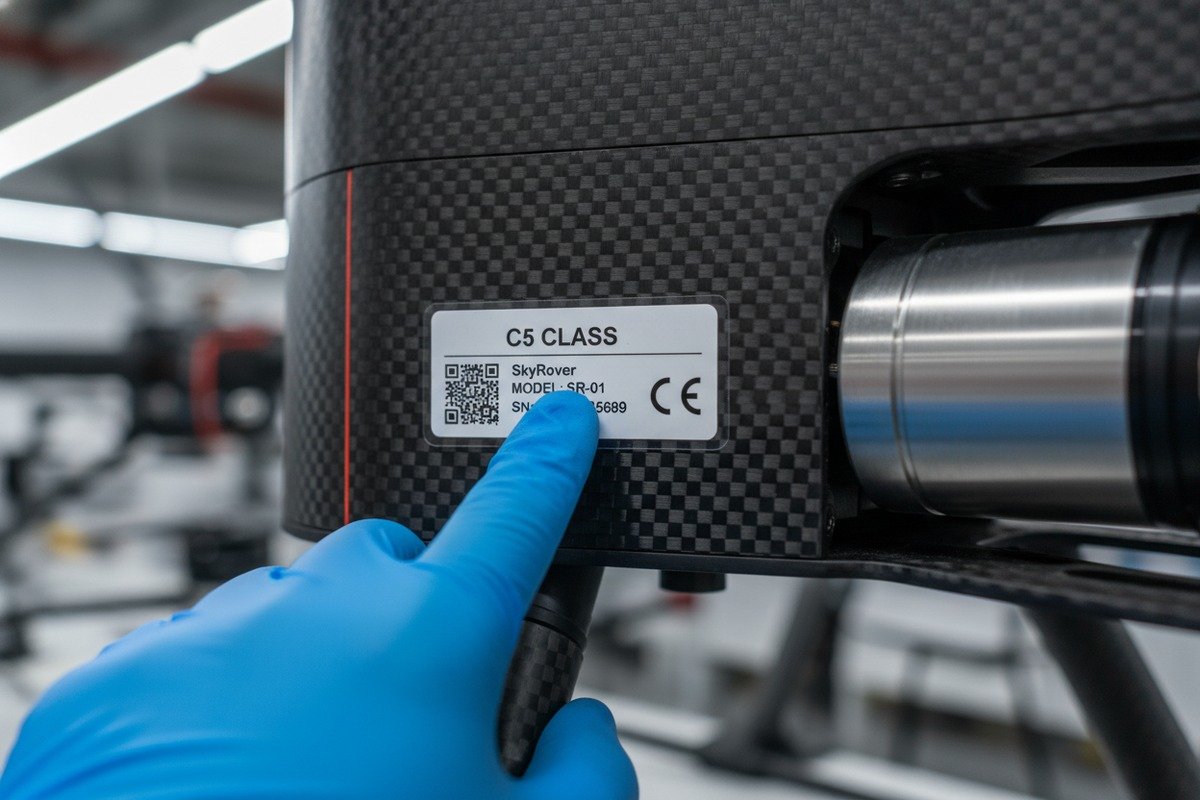
Verify your supplier's EU class label certifications by requesting the EU Declaration of Conformity document, inspecting the physical Class Identification Label on the drone, checking EASA's compliant component databases, and confirming third-party Notified Body involvement for higher-risk classifications like C5 and C6.
Start With the Declaration of Conformity
The EU Declaration of Conformity 2 (DoC) is your first checkpoint. This document proves the manufacturer has tested the drone against EU requirements. Ask your supplier to provide the full DoC, not a summary.
The DoC must reference Regulation (EU) 2019/945 3 specifically. It should include the drone model, serial number range, and the manufacturer's legal address. If your supplier hesitates to provide this document, consider it a red flag.
Physical Label Inspection
Every compliant drone must display a Class Identification Label 4 (CIL) on its chassis. These labels follow EASA's standardized designs. You can download official CIL templates from EASA's website to compare.
The label must be clearly visible and permanently attached. Some manufacturers try to use stickers that can be added later. This practice does not meet compliance requirements.
Use EASA Databases
EASA maintains lists of compliant Direct Remote Identification (DRI) modules 5 and certified components. Cross-reference your supplier's claims against these databases.
| Verification Step | What to Check | Where to Find It |
|---|---|---|
| Declaration of Conformity | Reference to EU 2019/945, serial numbers | Request from supplier |
| Class Identification Label | Physical C-marking on drone chassis | Inspect product samples |
| DRI Module Compliance | Listed on EASA compliant components | EASA official database |
| Notified Body 6 Certificate | Third-party certification for C1-C6 | Request certificate copy |
| Geo-awareness Software | ED-269 or JSON format compatibility | Technical specifications |
Notified Body Confirmation
For C1 through C6 classifications, a Notified Body must be involved in the certification process. Notified Bodies like Applus+ Laboratories perform conformity tests. Ask your supplier which Notified Body certified their drones.
You can verify this information directly with the Notified Body. They maintain records of all certifications they have issued. This step catches suppliers who falsely claim certification.
Watch for Common Problems
Some non-EU manufacturers do not fully understand these requirements. They may provide CE marks without proper C-class labeling. Remember that CE marking alone is not sufficient since January 2024.
Legacy drones manufactured before 2024 can still operate temporarily in Open category subcategories A1-A3. However, for professional firefighting operations, you need current C-marked equipment for full compliance.
Which specific EU drone class labels do I need for my industrial firefighting operations?
When we design firefighting drones at our facility, payload capacity and operational range are primary concerns. These factors directly determine which class label applies. Choosing the wrong class means your drone cannot legally perform its intended mission.
Industrial firefighting operations typically require C3, C5, or C6 class labels due to weight limits exceeding 4kg, Beyond Visual Line of Sight requirements, and payload demands. C5 and C6 are designed for Specific category operations with Standard Scenarios STS-01 and STS-02, which align with professional firefighting mission profiles.

Understanding the C-Class System
The EU divides drones into seven classes: C0 through C6. Each class has specific weight limits, speed requirements, and technical features. Firefighting drones rarely fit into lower classes due to their operational demands.
| Class | MTOM Limit | Key Features | Firefighting Suitability |
|---|---|---|---|
| C0 | <250g | No DRI required | Not suitable |
| C1 | <900g | DRI required, can fly over people | Not suitable |
| C2 | <4kg | Low-speed mode, DRI required | Limited use only |
| C3 | <25kg | DRI required, geo-awareness | Suitable for spotting |
| C4 | <25kg | No DRI, no geo-awareness, model aircraft rules | Not recommended |
| C5 | <25kg | STS-01 certified, 1:1 ground risk mitigation | Recommended |
| C6 | <25kg | STS-02 certified, BVLOS capable | Highly recommended |
Why Firefighting Needs Higher Classes
Firefighting drones carry water, extinguishing agents, or thermal imaging equipment. This payload pushes them beyond C0-C2 weight limits. Our firefighting models typically have Maximum Take-Off Mass between 15kg and 25kg.
Beyond Visual Line of Sight operations are common in wildfire scenarios. You cannot keep visual contact with a drone surveying a large fire perimeter. C5 and C6 classifications specifically address these operational needs.
Open vs. Specific Category
The Open category covers low-risk flights with minimal regulatory burden. Firefighting operations almost never qualify for Open category. The Specific category requires operational authorization but allows more demanding missions.
C5 drones are certified for Standard Scenario STS-01. Standard Scenarios STS-01 and STS-02 7 This covers flights over controlled ground areas. C6 drones meet STS-02 requirements for BVLOS operations. Both scenarios require Direct Remote Identification systems.
Geo-awareness Requirements
C3, C5, and C6 drones must have geo-awareness systems 8. These systems can load official airspace restriction files. EASA uses ED-269 and JSON formats for geographical zone data.
For firefighting operations, ask about "Blue Light" protocol support. Emergency services sometimes need exemptions from normal airspace restrictions. Your drone's software should accommodate these special permissions.
Payload Considerations
The MTOM limit includes everything the drone carries. A 20kg drone carrying 5kg of water cannot legally operate as a C3-C6 drone. Confirm that your supplier's weight specifications account for full operational payload.
| Payload Type | Typical Weight | Recommended Class |
|---|---|---|
| Thermal imaging camera | 0.5-2kg | C3 minimum |
| Water tank (small) | 3-5kg | C3 or C5 |
| Fire extinguisher ball | 1-3kg | C3 or C5 |
| Large water payload | 10-15kg | C5 or C6 |
| Rescue equipment | 5-10kg | C5 or C6 |
Can I request OEM branding on my drones without losing their EU class label compliance?
Our engineering team handles OEM customization requests weekly. Distributors want their brand on the products they sell. This is a reasonable business need, but it creates compliance questions that many buyers overlook.
Yes, you can request OEM branding without losing EU class label compliance, provided the original manufacturer retains responsibility for the Declaration of Conformity and the Class Identification Label remains unaltered. Any modifications affecting weight, performance, or safety features require recertification through the original assessment process.

The Legal Framework for OEM Branding
Under EU regulations, the entity placing the drone on the market bears compliance responsibility. For OEM arrangements, this responsibility can transfer to the importer or remain with the manufacturer. Clarity on this point protects everyone involved.
When we provide OEM services, we maintain our EU Declaration of Conformity. Your brand appears on external surfaces, but our compliance documentation remains valid. This arrangement satisfies both business and regulatory needs.
What You Can Change
Cosmetic changes generally do not affect compliance. You can apply your logo, change housing colors, and use custom packaging. Our carbon fiber frames and red or yellow housings can be produced in alternative colors for OEM customers.
Software interface branding is also acceptable. Your company name can appear on controller screens and companion apps. These changes do not alter the drone's certified performance characteristics.
What You Cannot Change
Any modification affecting certified parameters requires recertification. This includes weight changes, motor swaps, propeller modifications, and firmware alterations. Even seemingly minor changes can invalidate existing certification.
| Modification Type | Compliance Impact | Recertification Needed? |
|---|---|---|
| Logo application | None | No |
| Housing color change | None | No |
| Software interface branding | None | No |
| Battery capacity increase | Weight/performance affected | Yes |
| Motor upgrade | Performance affected | Yes |
| Propeller change | Performance affected | Yes |
| Payload mounting modification | Weight distribution affected | Yes |
Documentation Requirements
For OEM arrangements, you need clear documentation of responsibilities. The Declaration of Conformity should identify the original manufacturer. Your OEM agreement should specify who handles compliance queries and recalls.
Keep copies of all certification documents with your inventory records. If authorities question compliance, you need immediate access to this documentation. Delays in producing paperwork can result in product holds.
Importer Responsibilities
If you import drones into the EU, you assume certain legal obligations. You must verify that the manufacturer has completed proper conformity assessment. You must ensure documentation is available in the language required by destination countries.
Importers are liable if they place non-compliant products on the market. This liability exists even if you relied on manufacturer claims that proved false. Due diligence in supplier verification protects your business.
Working With Your Manufacturer
Discuss OEM requirements early in your sourcing process. We recommend providing your branding specifications before production begins. This approach avoids costly rework and potential compliance issues.
Ask about minimum order quantities for OEM customization. Custom branding typically requires larger orders to justify setup costs. However, some manufacturers maintain flexibility for strategic partnership opportunities.
What technical files must my manufacturer provide to prove my firefighting drones meet EU safety standards?
During our export processes, we prepare comprehensive documentation packages. Many buyers do not know what to request beyond basic product specs. Without proper technical files, you cannot demonstrate compliance to authorities or customers.
Your manufacturer must provide the EU Declaration of Conformity, technical construction file with design drawings and component specifications, test reports from conformity assessment procedures, risk analysis documentation, user instructions in required languages, and Notified Body certificates for C1-C6 classifications.

The EU Declaration of Conformity
This single-page document summarizes compliance claims. It must include the manufacturer's name and address, drone model identification, reference to applicable regulations, and a signature from an authorized representative.
The DoC is not optional documentation. It must accompany every drone sold in the EU market. Request this document before placing orders to verify your supplier can provide it.
Technical Construction File
The technical construction file contains detailed design information. This includes engineering drawings, component specifications, and materials lists. It demonstrates how the drone meets essential requirements.
For firefighting drones, the construction file should address payload mounting, waterproofing measures, and heat resistance. These features are critical for your operational safety and the drone's certified performance envelope.
Test Reports and Certificates
Conformity assessment procedures generate test reports. These reports document results from required testing. The testing must cover electromagnetic compatibility, mechanical strength, and performance parameters.
| Document Type | Content | Required For |
|---|---|---|
| EU Declaration of Conformity | Compliance summary statement | All classes |
| Technical construction file | Design specifications | All classes |
| Test reports | Conformity assessment results | All classes |
| Notified Body certificate | Third-party verification | C1-C6 |
| Risk analysis | Hazard identification | Specific category ops |
| User manual | Operating instructions | All classes |
| DRI module documentation | Remote ID compliance | C1-C6 |
Risk Analysis Documentation
Firefighting operations fall under the Specific category. This requires documented risk analysis. The analysis identifies hazards and mitigation measures for your intended operations.
Ask whether your supplier provides operation-specific risk templates. Some manufacturers prepare these documents for common use cases. Having manufacturer-supplied risk analysis simplifies your operational authorization applications.
User Instructions and Manuals
User manuals must be provided in the official language of destination countries. For EU-wide sales, this often means multiple language versions. Incomplete or missing translations can block market access.
The manual should include maintenance procedures, emergency protocols, and component replacement guidelines. For firefighting applications, specific guidance on heat exposure limits and decontamination procedures is valuable.
Direct Remote Identification Documentation
C1 through C6 drones require Direct Remote Identification systems. Your supplier should provide documentation proving DRI compliance. This includes module specifications and certification from EASA-listed components.
DRI broadcasts the drone's identity and location. This feature enables authorities to identify drones in flight. Non-functional DRI systems can result in operational violations even if other certifications are valid.
Requesting Complete Documentation
Create a documentation checklist before contacting suppliers. Share this checklist with potential manufacturers to assess their readiness. Suppliers who cannot provide complete documentation packages may struggle with other compliance aspects.
Our standard export packages include all required documents. We provide digital copies for immediate reference and hard copies with shipments. This approach eliminates documentation delays that could affect your market entry timelines.
Conclusion
Navigating EU drone class labels requires diligence and clear communication with your supplier. Request complete documentation, verify certifications independently, and ensure your firefighting drones match your operational requirements. Taking these steps protects your investment and ensures legal operation across European markets.
Footnotes
1. Provides an overview of the EU drone classification system and categories. ↩︎
2. Explains the manufacturer’s responsibility for the EU Declaration of Conformity. ↩︎
3. Direct link to the official EU regulation on unmanned aircraft systems. ↩︎
4. Official EASA page detailing drone Class Identification Labels (CILs). ↩︎
5. EASA information on Direct Remote Identification systems and compliant modules. ↩︎
6. Explains the role of Notified Bodies in drone conformity assessment. ↩︎
7. EASA’s official page describing Standard Scenarios for drone operations. ↩︎
8. EASA explanation of geo-awareness systems and geographical zones for drones. ↩︎
9. EASA’s official guidance on drone operations within the Specific category. ↩︎

 English
  Español de México
  Deutsch
  Français
  Русский
  العربية
