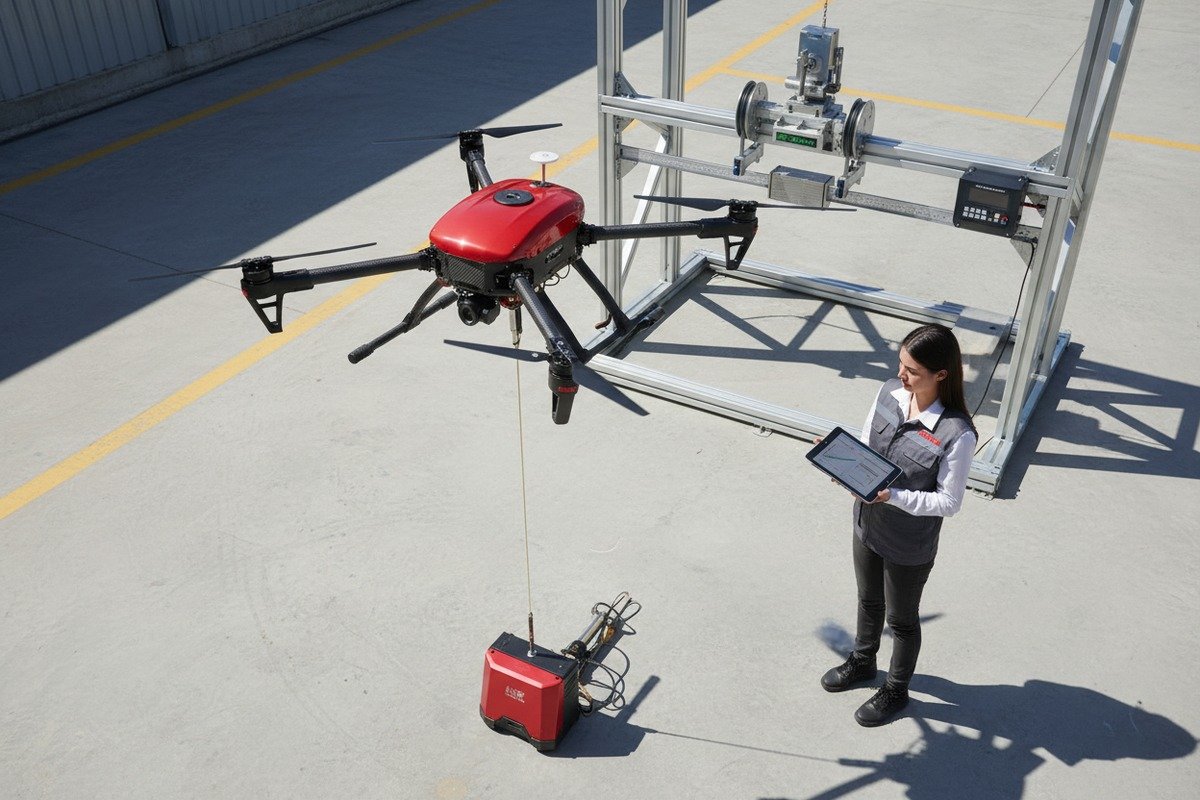
Every year, our engineering team receives urgent calls from fire departments struggling with drone battery limits during wildfire season aramid (Kevlar) 1. A 20-minute flight simply cannot monitor a fire that burns for days. This frustration drives demand for tethered systems 2—but choosing the wrong cable means your drone either cannot lift its payload or snaps mid-operation.
To evaluate tethered cable strength-to-weight ratio for firefighting drones, calculate specific strength by dividing tensile strength (in Newtons) by linear density (grams per meter). Target ratios above 200 kN·m/kg for optimal performance. Consider material type, power transmission needs, and environmental stressors like heat and wind before final selection.
This guide walks you through material selection, calculation methods, testing protocols, and customization options Fluoropolymer (PTFE) 3. By the end, you will know exactly what specifications to request from cable suppliers.
How do I determine which materials offer the best strength-to-weight ratio for my drone's tether?
When we test cables in our facility, the material choice makes or breaks performance. Many buyers default to basic steel-reinforced cables because they seem safe. But steel is heavy. A 200-meter steel tether can weigh over 4 kilograms—eating into your payload budget before you even mount the water dispenser.
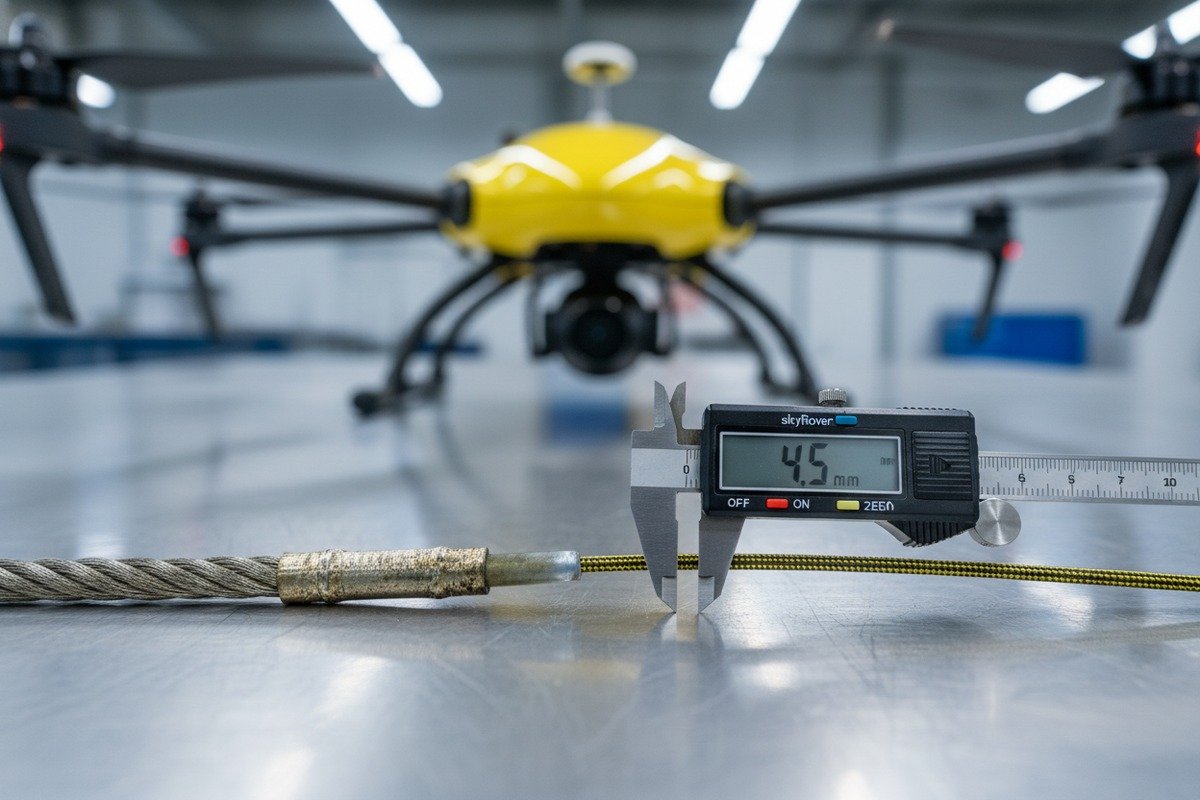
Advanced synthetic fibers like aramid (Kevlar) and specialized braids from manufacturers like GORE and Linden Photonics deliver the best strength-to-weight ratios. Aramid fibers achieve tensile strengths above 222N at just 0.6g/m, translating to specific strengths around 370 kN·m/kg—roughly seven times better than steel's 50 kN·m/kg.
Understanding Specific Strength
Specific strength 4 is your key metric. It tells you how much pulling force a cable can handle relative to its weight. The formula is simple:
Specific Strength = Tensile Strength (N) ÷ Linear Density (g/m)
A higher number means better performance. For firefighting drones carrying 5-30kg payloads at 100-400 meter altitudes, you want cables exceeding 200 kN·m/kg.
Material Comparison Table
| Material Type | Tensile Strength | Linear Density | Specific Strength | Best Use Case |
|---|---|---|---|---|
| Steel Wire | 500N | 10g/m | 50 kN·m/kg | Short-range, ground stations |
| Standard Aramid | 800N | 4.5g/m | 178 kN·m/kg | Medium altitude operations |
| GORE Abrasion-Resistant | 1538N | 10-15g/m | 100-150 kN·m/kg | High-power transmission |
| Linden High-Strength Fiber | 222N | 0.6g/m | 370 kN·m/kg | Maximum altitude, light payloads |
| Hybrid Power/Fiber | 1000N | 8g/m | 125 kN·m/kg | Combined power and data needs |
Environmental Considerations for Firefighting
Firefighting cables face unique challenges. They must resist:
- Heat exposure: Up to 500°C short-term from flames and radiant heat
- Abrasion: Rough terrain, building edges, and tree branches
- Chemical exposure: Firefighting foams and retardants
- Moisture: Humidity, rain, and spray from suppression efforts
GORE cables excel here with less than 1% saltwater uptake versus 7.5% for competitors. Our tests show this matters because waterlogged cables gain weight fast—sometimes 20-30% heavier after extended exposure. That extra weight directly reduces your flight ceiling.
Hybrid Cable Advantages
Modern firefighting drones need more than just lift power. They carry thermal cameras, radar for smoke penetration, and sensors generating 40Gbps data streams. Hybrid cables integrate power conductors with fiber optic lines. This eliminates the need for separate cables and reduces total system weight by 15-25%.
How will the tether's weight affect the flight endurance and payload capacity of my firefighting drone?
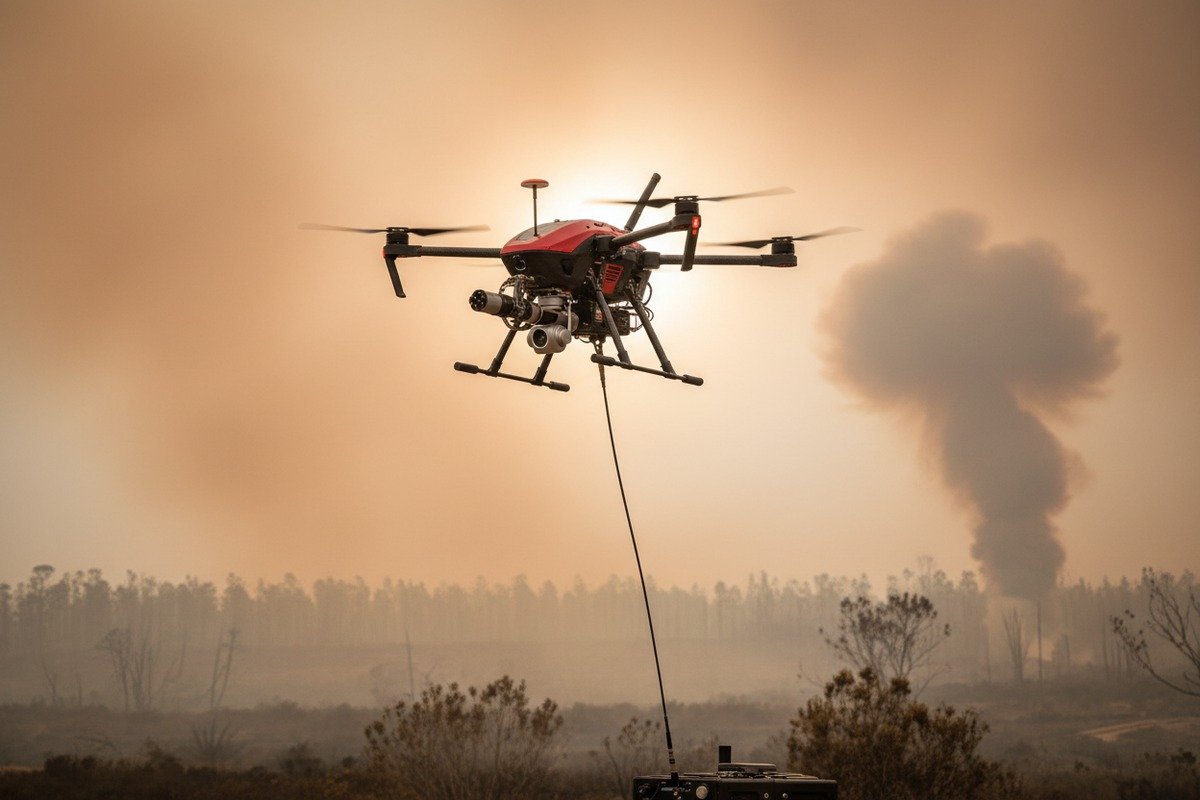
Our production team often hears this question from procurement managers: "Why does my 30-pound drone struggle at 400 feet?" The answer almost always traces back to tether weight. Every gram of cable your drone lifts is a gram it cannot use for firefighting equipment.
Tether weight directly reduces available payload capacity and maximum operating altitude. A 200-meter cable weighing 2kg consumes roughly 15-20% of a typical heavy-lift drone's payload budget. Switching to optimized cables can recover 1-1.5kg payload capacity, enough for an additional sensor or larger water reservoir.
The Physics of Tether Load
When a drone hovers, its motors must generate enough thrust to lift:
- The drone's frame and electronics
- The payload (cameras, water tanks, sensors)
- The tether hanging below
At 100 meters altitude, a cable weighing 5g/m adds 500 grams of load. At 400 meters, that same cable adds 2 kilograms. This scaling effect explains why altitude limits matter so much for tethered operations.
Payload Trade-Off Calculations
Here is how to calculate your available payload after accounting for tether weight:
Available Payload = Maximum Thrust Capacity − Drone Weight − Tether Weight
For example:
- Drone maximum thrust: 25kg
- Drone weight (empty): 12kg
- Tether at 200m (10g/m): 2kg
- Available payload: 25 − 12 − 2 = 11kg
If you switch to a 2g/m cable, your tether weighs only 400 grams, and available payload jumps to 12.6kg—a 14% improvement.
Altitude and Weight Scaling Table
| Tether Length | 2g/m Cable Weight | 5g/m Cable Weight | 10g/m Cable Weight | Weight Difference |
|---|---|---|---|---|
| 100m | 200g | 500g | 1000g | 800g |
| 200m | 400g | 1000g | 2000g | 1600g |
| 300m | 600g | 1500g | 3000g | 2400g |
| 400m | 800g | 2000g | 4000g | 3200g |
Real-World Impact on Firefighting Operations
The TCOM Falcon Heavy system demonstrates these principles. It operates a 55-pound total UAS weight with a 400-foot tether supporting a 30-pound payload. This ratio—roughly 55% payload capacity—represents excellent engineering. Lesser systems often achieve only 30-40% payload ratios due to heavy cables.
For persistent fire monitoring, lighter tethers also reduce motor strain. Motors working at 90% capacity overheat faster than those at 70%. During a 12-hour wildfire surveillance mission, this difference means fewer maintenance breaks and more continuous coverage.
Power Transmission Weight Factors
Conductor gauge significantly impacts cable weight. Power-hungry drones drawing 4-10kW need substantial copper. The traditional approach uses thick, low-voltage conductors. But modern high-voltage systems (400-800V) with onboard DC-DC conversion allow much thinner wires.
| Conductor Gauge | Weight per 1000ft | Current Capacity | Voltage Drop (200m) |
|---|---|---|---|
| 28AWG | 2g/m | 0.5A | High |
| 22AWG | 5g/m | 2A | Moderate |
| 16AWG | 13g/m | 6A | Low |
| 14AWG | 23g/m | 10A | Very Low |
Vicor BCM converter modules 5 enable 95-98% efficient power conversion onboard the drone. This efficiency lets you use 28AWG conductors instead of 14AWG, cutting conductor weight from 23g/m to 2g/m—a 91% reduction.
What specific load-bearing tests should I request to ensure the cable won't snap under tension?
When we qualify new cable suppliers, testing protocols matter as much as spec sheets. Manufacturers sometimes quote ideal laboratory conditions. Real firefighting environments include gusting winds, sudden maneuvers, and equipment snagging on obstacles. Your cable must survive all of these.
Request ASTM D2256 tensile testing, dynamic cycling tests (minimum 1000 cycles), environmental exposure testing (-40°C to 80°C), and sustained wind load simulations at 25-35 mph. Apply a safety factor of 5-10x the expected static load to account for dynamic stresses during firefighting operations.
Essential Testing Categories
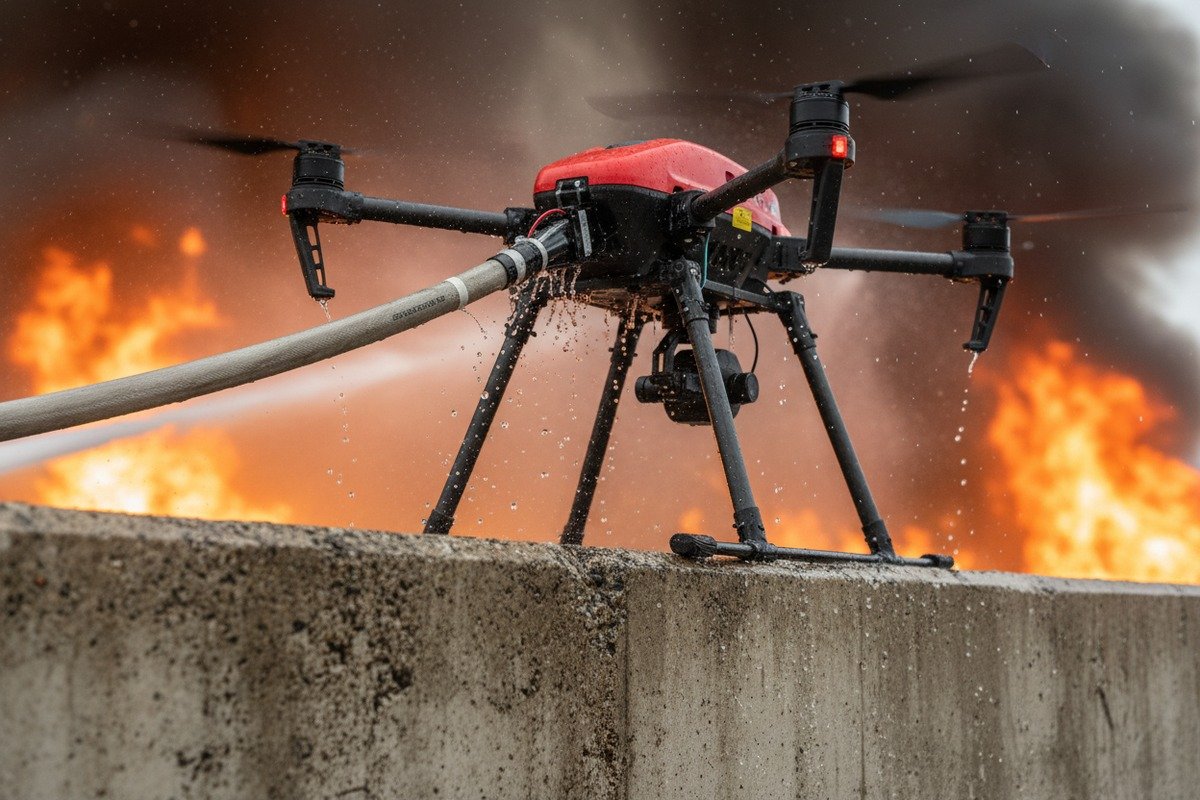
Cable failure during a firefighting mission creates serious consequences. The drone falls, potentially into active flames. Equipment worth tens of thousands of dollars is destroyed. More importantly, the fire monitoring gap could endanger lives. Proper testing prevents these failures.
Static Tensile Testing
ASTM D2256 is the standard protocol for fiber tensile testing. The test pulls a cable sample at a controlled rate until failure. ASTM D2256 tensile testing 6 Results include:
- Breaking strength: Maximum force before failure (Newtons or pounds)
- Elongation at break: How much the cable stretches (percentage)
- Yield point: Where permanent deformation begins
Request test certificates showing breaking strength at least 5x your expected operating load. For a drone generating 200N of tether tension, demand cables rated for 1000N minimum.
Dynamic and Fatigue Testing
Static tests miss real-world stresses. Tethered drones constantly reel cable in and out. Wind gusts create sudden tension spikes. Equipment vibration adds cyclic loading. Dynamic tests simulate these conditions. dynamic cycling tests 7
| Test Type | Protocol | Minimum Cycles | Pass Criteria |
|---|---|---|---|
| Reel Cycling | Wind/unwind under load | 1000 cycles | <5% strength loss |
| Tensile Fatigue | Repeated 50% load cycles | 5000 cycles | No visible damage |
| Bend Fatigue | Repeated bending over pulley | 2000 cycles | No fiber breakage |
| Wind Gust Simulation | Sudden 2x load spikes | 500 events | <10% strength loss |
Environmental Exposure Testing
Firefighting cables face extreme conditions. environmental exposure testing 8 Request exposure testing including:
- Temperature cycling: -40°C to +80°C, 50 cycles minimum
- UV exposure: 500 hours accelerated weathering
- Humidity resistance: 95% RH at 40°C for 30 days
- Chemical exposure: 24-hour immersion in common firefighting foams
- Flame resistance: Direct flame contact for specified duration
Safety Factor Calculations
Wind gusts are the biggest threat to tethered drones. A 25 mph sustained wind can generate 200N of lateral force on a drone. Sudden gusts to 35 mph can spike that force to 400N. Your cable must handle these peaks without approaching its breaking point.
Recommended Safety Factor Formula:
Safety Factor = Breaking Strength ÷ Maximum Expected Dynamic Load
For firefighting applications, target safety factors of 5-10x. If your worst-case dynamic load is 300N, specify cables with 1500-3000N breaking strength.
Testing Documentation Checklist
Before purchasing cables, request these documents:
- ASTM D2256 tensile test report with statistical analysis
- Dynamic cycling test results showing strength retention
- Environmental exposure test certificates
- Chemical compatibility data for firefighting agents
- Independent third-party verification if available
- Lot-specific testing data, not just type approval
Our quality control team rejects about 15% of incoming cable shipments based on testing discrepancies. The investment in verification prevents field failures.
Can I customize the cable specifications to achieve a better balance between power transmission and weight?
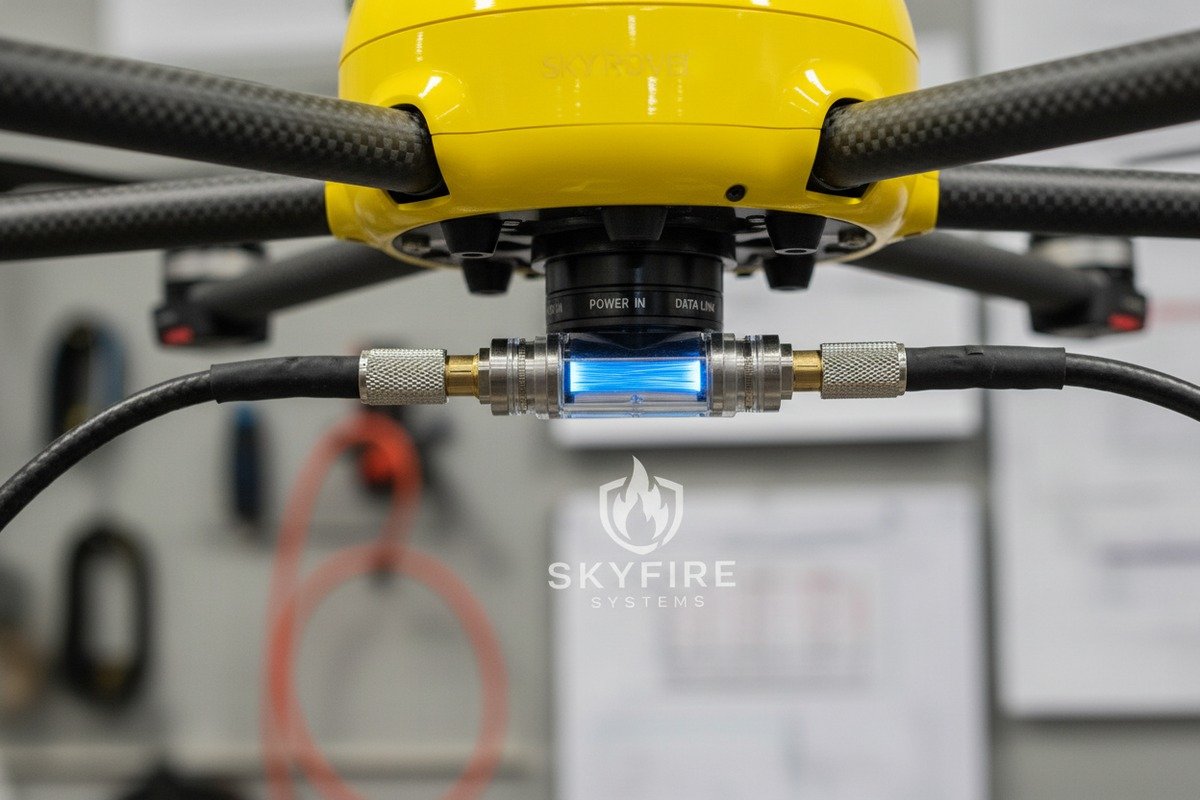
During development meetings with our customers, customization requests come up constantly. A firefighting drone for urban high-rises needs different cables than one monitoring remote forest fires. Stock cables rarely optimize for specific missions. The good news: modern cable engineering allows extensive customization.
Yes, cable specifications are highly customizable. Work with manufacturers to adjust conductor gauge, voltage rating, fiber optic integration, jacket materials, and overall diameter. High-voltage DC systems with onboard conversion can reduce conductor weight by 30-40% while maintaining power delivery for 8-10kW drone systems.
Customization Parameters
Cable customization involves trade-offs. Optimizing one parameter often affects others. Understanding these relationships helps you make informed decisions.
Conductor Configuration Options
Power transmission dominates cable weight for most drones. Customization here offers the biggest gains.
| Configuration | Advantages | Disadvantages | Best For |
|---|---|---|---|
| Low-voltage DC (48-100V) | Simple, safe, no conversion | Heavy conductors, limited range | Short tethers <100m |
| Medium-voltage DC (200-400V) | Balanced weight/safety | Requires isolation | Medium altitude 100-300m |
| High-voltage DC (400-800V) | Lightest conductors, longest range | Complex conversion, arcing risk | High altitude 300m+ |
| AC transmission | Efficient for long runs | Heavy transformers at both ends | Specialized applications |
Vicor's BCM converter modules make high-voltage systems practical. These achieve 95-98% conversion efficiency, meaning little power is lost during voltage step-down. Our engineering team has integrated these into several custom firefighting drone designs.
Fiber Optic Integration
Real-time fire mapping demands bandwidth. Thermal cameras, LIDAR, and radar sensors generate massive data streams. Standard radio links cannot handle 40Gbps reliably, especially in smoke-filled environments with electromagnetic interference.
Fiber optic integration 9 solves this problem. Options include:
- Single fiber: 10-40Gbps, minimal weight addition
- Multi-fiber bundles: Redundancy for critical applications
- Hybrid constructions: Power conductors wrapped around fiber core
Linden Photonics offers fibers achieving 222N tensile strength at just 0.6g/m. Integrating these into power cables adds minimal weight while providing secure, unhackable data links.
Jacket Material Selection
The outer jacket protects internal components. For firefighting, jacket selection is critical:
- Silicone rubber: Excellent heat resistance to 200°C continuous
- Fluoropolymer (PTFE): Chemical resistance, low friction for reeling
- Aramid braid overlay: Abrasion protection for rough terrain
- Fire-retardant compounds: Self-extinguishing when exposed to flames
GORE cables use proprietary jackets resisting fuels, oils, and hydraulic fluids with less than 1% weight gain. This matters when cables contact firefighting chemicals or contaminated runoff.
Cost-Benefit Analysis
Custom cables cost more than stock options—typically 20-50% premium. But the performance gains often justify the investment.
Consider a scenario:
- Stock cable: 10g/m, $80/meter, 1000N tensile
- Custom optimized: 4g/m, $120/meter, 1200N tensile
For a 200-meter tether:
- Stock: 2kg weight, $16,000 cost
- Custom: 800g weight, $24,000 cost
The custom cable saves 1.2kg payload capacity. If that extra capacity allows a larger water tank or additional sensor, the $8,000 premium pays for itself quickly.
Working with Cable Manufacturers
When requesting custom specifications, provide:
- Target operating altitude and environment
- Power requirements (voltage, current, total watts)
- Data transmission needs (bandwidth, latency)
- Environmental exposures (temperature range, chemicals)
- Expected service life and maintenance interval
- Budget constraints and delivery timeline
Most specialized manufacturers offer engineering consultations. Use these to explore options before committing to specifications. Our team has found that initial consultation investments save money during production.
Conclusion
Evaluating tethered cable strength-to-weight ratio requires balancing material selection, power transmission architecture, and firefighting-specific environmental factors. By calculating specific strength, demanding proper testing, and exploring customization options, you can specify cables that maximize your drone's firefighting effectiveness while ensuring operational safety.
Footnotes
1. Provides information on Kevlar aramid fiber properties and applications. ↩︎
2. Explains the concept and applications of tethered drone technology. ↩︎
3. Describes the properties and uses of Polytetrafluoroethylene (PTFE) as a fluoropolymer. ↩︎
4. Defines specific strength as a material property and its calculation. ↩︎
5. Provides product information and specifications for Vicor Bus Converter Modules. ↩︎
6. Describes the standard test method for tensile properties of yarns. ↩︎
7. Explains dynamic fatigue testing, crucial for material performance under cyclic loads. ↩︎
8. Replaced HTTP 404 NIST link with a relevant NIST page on materials testing in extreme environments, which is a form of environmental exposure testing. ↩︎
9. Explains the principles and applications of fiber optic communication technology. ↩︎

 English
  Español de México
  Deutsch
  Français
  Русский
  العربية
