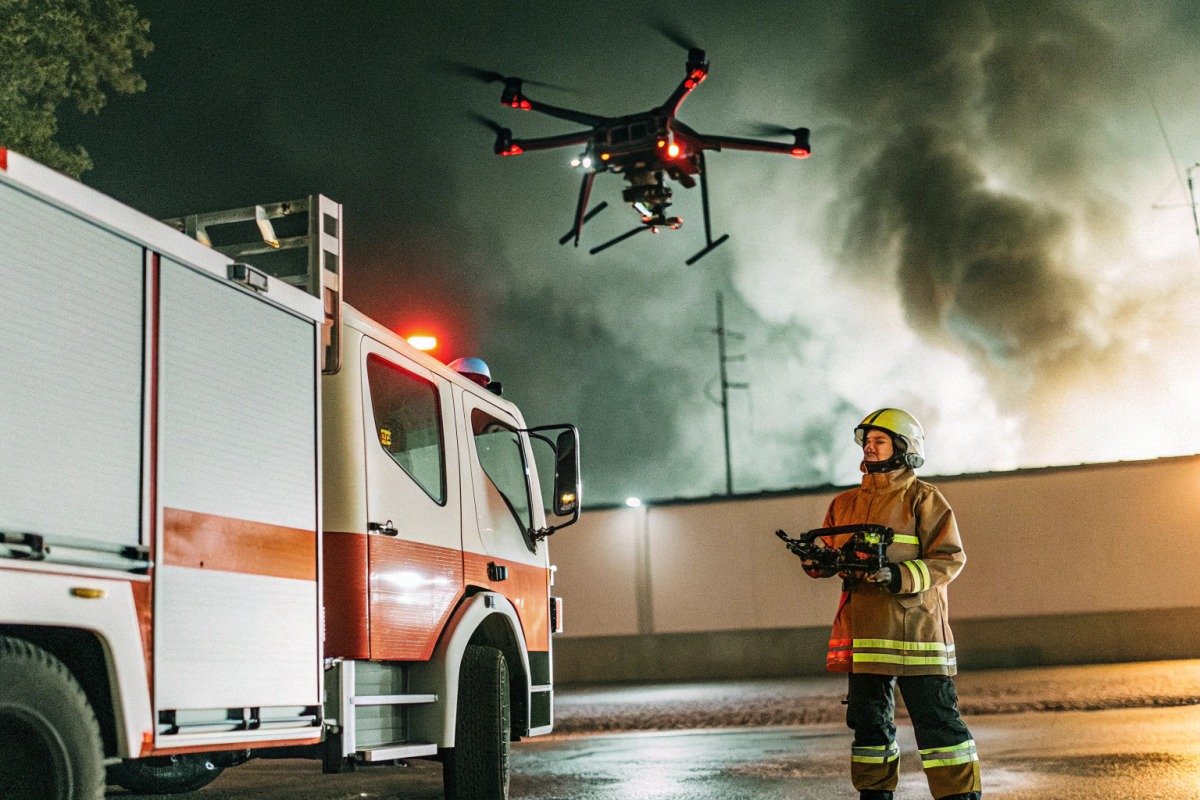
Every 30 seconds, a fire doubles in size. Our production team has witnessed this urgency firsthand when testing deployment systems Thermal sensitivity (NETD) 1. The gap between “arrived” and “too late” often comes down to minutes.
To evaluate rapid deployment for firefighting drones, measure launch-to-data time (under 5 minutes is ideal), assess autonomy levels for minimal operator input, verify environmental resilience in smoke and heat, check payload readiness for immediate use, and confirm integration capability with your existing emergency dispatch systems.
This guide breaks down the critical factors you must consider when sourcing firefighting drones 2 for emergency rescue. We will cover measurement methods, hardware priorities, software impacts, and manufacturer support. Let us dive in.
How can I accurately measure the time it takes to get my firefighting drones from the transport case into the air?
When we ship drones to fire departments across the United States and Europe, the first question they ask is about setup time hot-swappable battery designs 3. A drone sitting in its case during a structure fire is useless. The real value starts when it is airborne and sending data flight control software 4.
To measure deployment time accurately, track three phases: case-to-ready (unpack and power on), ready-to-launch (system checks and GPS lock), and launch-to-data (first actionable thermal image received). Use a stopwatch during training drills and record times under various weather conditions to establish realistic benchmarks.

Breaking Down the Deployment Timeline
The deployment process has distinct stages. Each stage can become a bottleneck. Understanding where time gets lost helps you choose better equipment emergency operations centers 5.
Our engineering team divides deployment into five measurable steps:
- Transport case opening – Latches, foam inserts, and component arrangement matter
- Drone assembly – Propeller attachment, payload mounting, antenna positioning
- Power-up sequence – Boot time, sensor calibration, controller pairing
- Pre-flight checks – GPS satellite acquisition, compass calibration, battery verification
- Launch and ascent – Takeoff to operational altitude
Deployment Time Benchmarks by System Type
| System Type | Average Deployment Time | Best Use Case |
|---|---|---|
| Portable Quadcopter | 3-7 minutes | First responder units |
| Drone-in-a-Box (DiaB) | 15 seconds – 2 minutes | Fixed station coverage |
| Tethered System | 5-10 minutes | Extended incident monitoring |
| Octocopter Heavy-lift | 8-15 minutes | Payload delivery missions |
Creating Realistic Test Protocols
Do not test only in perfect conditions. Our quality control process includes stress testing in wind, rain simulation, and low-light environments firmware update pathways 6. Your evaluation should mirror real emergency conditions.
Set up test scenarios that include:
- Night deployment with limited lighting
- Cold weather where batteries perform differently
- Multiple consecutive launches to test repeatability
- Gloved operation to simulate actual firefighter gear
Record every deployment attempt. Average times mean nothing without understanding variance. A drone that deploys in 4 minutes usually but takes 15 minutes occasionally will fail you during critical moments.
Hidden Time Killers
Through years of exporting drones globally, we have identified common delays that buyers overlook:
- Firmware update prompts blocking launch
- SD card formatting requirements
- Controller calibration drift over time
- Battery conditioning needs after storage
Ask your supplier how their system handles these scenarios. The best manufacturers build in safeguards that skip unnecessary checks during emergency modes.
What hardware specifications should I prioritize to ensure my drones are ready for immediate deployment in harsh conditions?
During our production line testing, we subject every drone to temperature extremes and debris exposure. Hardware that fails in controlled conditions will certainly fail when your team needs it most. Choosing robust specifications upfront prevents mission failures.
Prioritize IP ratings of IP45 or higher for dust and water resistance, operating temperature ranges from -20°C to 50°C, propulsion systems with redundant motors, hot-swappable battery designs, and thermal cameras with resolution of 640×512 pixels or greater for reliable smoke penetration.

Environmental Protection Ratings Explained
The IP rating system tells you exactly what conditions a drone can handle. IP ratings 7 This is not marketing language—it is standardized testing.
| IP Rating | Dust Protection | Water Protection | Firefighting Suitability |
|---|---|---|---|
| IP43 | Protected from objects >1mm | Protected from spray | Minimal—fair weather only |
| IP45 | Protected from objects >1mm | Protected from jets | Moderate—light rain capable |
| IP54 | Dust-limited ingress | Protected from splash | Good—most conditions |
| IP55 | Dust-limited ingress | Protected from jets | Excellent—recommended minimum |
| IP67 | Dust-tight | Submersion to 1m | Superior—extreme conditions |
When we design enclosures at our facility, we target IP55 as the baseline. Anything below this creates risk during active fire suppression where water spray is constant.
Thermal Imaging Specifications That Matter
Not all thermal cameras 8 perform equally in smoke. Our engineers have tested dozens of sensor configurations. The specifications that actually impact performance include:
Resolution: 640×512 pixels minimum. Lower resolutions miss small heat signatures like trapped victims.
Thermal sensitivity (NETD): Below 50mK is essential. This measures the smallest temperature difference the camera can detect.
Frame rate: 30Hz or higher prevents motion blur during rapid scanning.
Spectral range: 8-14μm wavelength penetrates smoke better than shorter wavelengths.
Battery Systems for Rapid Turnaround
Fires do not wait for recharging. The battery design determines how quickly you can get back in the air after the first flight.
Key battery features to evaluate:
- Hot-swap capability – Change batteries without powering down the entire system
- Charge time – Under 60 minutes for 80% charge is the target
- Discharge rate – Higher C-ratings support aggressive flight maneuvers
- Temperature management – Internal heating for cold-weather operation
Our production team includes battery heating elements in all units destined for northern US states and European markets. A battery that will not deliver full power in cold weather is a liability.
Propulsion Redundancy Requirements
Single-motor failure should not mean a crash. For firefighting applications, we recommend:
- Octocopter (8-motor) configuration for heavy payloads
- Hexacopter (6-motor) configuration minimum for standard thermal surveillance
- Motor isolation so one failure does not cascade
Build Quality Indicators
Physical inspection reveals much about long-term reliability. When evaluating samples, check:
- Wiring strain relief at connection points
- Vibration dampening on camera mounts
- Corrosion-resistant fasteners (stainless steel, not zinc-plated)
- Conformal coating on circuit boards
These details separate equipment that lasts from equipment that fails after six months of use.
How does the flight control software impact my team's ability to respond quickly during a critical rescue mission?
When we calibrate flight controllers at our Xi'an facility, we focus on reducing pilot workload. Software that demands constant attention steals focus from the actual mission. The interface between human and machine determines whether your team fights the fire or fights the drone.
Flight control software impacts response speed through automation level (autonomous waypoints versus manual piloting), interface simplicity (one-touch launch versus multi-step procedures), failsafe reliability (automatic return-to-home behavior), and integration capability (direct streaming to emergency operations centers and compatibility with dispatch systems).

Automation Levels and Their Trade-offs
Different missions require different control approaches. The software should support multiple modes and switch between them seamlessly.
| Automation Level | Pilot Input Required | Best Application | Risk Consideration |
|---|---|---|---|
| Full Manual | Constant stick input | Precise inspection | Highest pilot fatigue |
| Attitude Hold | Direction commands | General surveillance | Moderate workload |
| GPS Position Hold | Waypoint selection | Perimeter mapping | Requires good satellite signal |
| Full Autonomous | Mission upload only | Repetitive patterns | Limited adaptability |
| AI-Assisted | Target designation | Active fire tracking | Requires training data |
Our software development team has found that hybrid modes work best. The pilot designates areas of interest, and the system handles station-keeping and camera orientation. This reduces cognitive load while maintaining human oversight.
User Interface Design Priorities
During demonstrations with fire departments, we watch where operators struggle. Common software problems include:
- Too many menu layers to access critical functions
- Small touch targets that are impossible to hit with gloves
- Inconsistent button placement between screens
- Status information buried in submenus
Good software puts essential information on the main screen: battery remaining, signal strength, altitude, and camera feed. Everything else is secondary.
Emergency Operations Center Integration
Modern firefighting increasingly relies on centralized command. Your drone software must play well with existing systems.
Key integration points include:
Video streaming protocols: RTMP and RTSP are standard. Proprietary formats create compatibility headaches.
Data formats: KML files for mapping integration, standard image formats for sharing.
Network requirements: Cellular backup when WiFi is unavailable at incident scenes.
Multi-viewer support: Command staff and field personnel need simultaneous access.
When we develop custom software features for OEM clients, API accessibility is always part of the discussion. Closed systems limit your future options.
Failsafe Behavior Configuration
What happens when things go wrong determines whether you recover the aircraft or lose it into the fire.
Essential failsafe configurations:
- Signal loss: Return to launch point after configurable delay
- Low battery: Automatic landing or return with sufficient reserve
- Geofence breach: Hover in place rather than continuing into restricted airspace
- Motor failure: Controlled descent for multi-rotor systems
Software should allow field configuration of these parameters. A failsafe that returns home might fly directly through the fire plume. Operators need control over these behaviors.
Training Requirements and Learning Curve
Complex software requires extensive training. Simple software gets used correctly under stress.
Evaluate training requirements honestly:
- How many hours until a new pilot operates safely?
- Can experienced pilots from other platforms transition quickly?
- Does the simulator accurately represent field behavior?
- Are software updates intuitive or do they require retraining?
Our experience shipping to diverse markets shows that operators prefer familiar interfaces. We offer compatibility with standard RC controller layouts specifically to reduce training time.
What level of technical support should I expect from my manufacturer to keep my emergency fleet mission-ready at all times?
After shipping thousands of units globally, our support team has handled every type of field issue imaginable. The drone is only part of the purchase. The support infrastructure behind it determines whether your fleet stays operational or becomes expensive display pieces.
Expect manufacturers to provide 24/7 emergency technical hotlines with response times under 4 hours, remote diagnostics capability through connected software, spare parts availability within 48-72 hours for critical components, comprehensive training programs for pilots and maintenance staff, and firmware update pathways that do not disable aircraft during active deployment periods.

Support Tier Structure
Different support levels match different operational requirements. Understand what you actually need before negotiating.
| Support Level | Response Time | Coverage | Typical Cost Addition |
|---|---|---|---|
| Basic Email | 24-48 hours | Business hours | Included |
| Priority Phone | 4-8 hours | Extended hours | 10-15% of purchase |
| Premium 24/7 | Under 4 hours | Always available | 20-25% of purchase |
| On-Site Service | Next business day | Technician dispatch | 30%+ or service contract |
For emergency services, anything less than priority phone support creates unacceptable risk. We structure our support packages specifically for mission-critical applications.
Spare Parts Availability
A grounded drone waiting for parts is worthless during fire season. Evaluate your supplier's parts strategy:
Critical spares to stock locally:
- Propellers (minimum 2 complete sets)
- Batteries (at least 4 per aircraft)
- Landing gear components
- Camera gimbal parts
Acceptable for warehouse shipping:
- Motors
- ESCs (electronic speed controllers)
- Main controller boards
- Frame components
Our distribution network maintains regional spare parts inventory in both the United States and Europe. This cuts typical delivery times from weeks to days.
Remote Diagnostics Capability
Modern drones generate extensive telemetry data. Good manufacturers use this data to identify problems before they cause failures.
Remote diagnostics should include:
- Flight log analysis for developing issues
- Firmware version verification
- Sensor calibration status checking
- Battery health trending over time
When customers contact our support team, we often identify the root cause from uploaded flight logs before they finish describing symptoms. This capability depends on software design decisions made during development.
Training Program Components
Initial training gets operators flying. Ongoing training keeps them effective.
Comprehensive programs include:
Initial certification:
- Basic flight operations
- Emergency procedures
- Payload operation
- Software features
Recurring training:
- Annual proficiency verification
- New feature introduction
- Scenario-based exercises
- Maintenance procedures
Train-the-trainer options:
- Develop internal expertise
- Reduce ongoing training costs
- Enable faster onboarding of new staff
We offer train-the-trainer programs specifically because fire departments experience staff turnover. Building internal capability provides long-term value.
Documentation Quality
Good documentation reduces support calls. It also enables your team to solve problems independently.
Evaluate documentation for:
- Clear step-by-step procedures with images
- Troubleshooting flowcharts for common issues
- Maintenance schedules with specific intervals
- Parts diagrams with ordering information
- Translation quality (if applicable)
Poor documentation creates hidden costs through increased support dependency and longer problem resolution times.
Warranty Terms and Conditions
Warranty coverage varies dramatically between manufacturers. Read terms carefully.
Common exclusions that surprise buyers:
- Water damage (even on "weather resistant" models)
- Crash damage (subjective determination)
- Modifications or third-party accessories
- Commercial use (if sold as "consumer" product)
- Firmware modification
Our warranty specifically covers commercial firefighting use because that is the intended application. Consumer warranties applied to professional equipment create coverage gaps.
Long-Term Relationship Indicators
Support quality often degrades after the sale. Look for indicators of sustained commitment:
- Published product roadmaps showing continued development
- Active user community with manufacturer participation
- Regular firmware updates addressing user feedback
- Clear end-of-life and upgrade pathways
- References from long-term customers (not just new buyers)
When procurement managers visit our facility, we encourage them to speak with existing customers about their support experience. Reputation takes years to build and reflects actual behavior.
Conclusion
Evaluating rapid deployment requires measuring real-world performance, not marketing specifications. Test deployment times under stress. Prioritize hardware that withstands harsh conditions. Choose software that reduces pilot workload. Demand support that keeps your fleet mission-ready. Your team deserves equipment that performs when lives depend on it.
Footnotes
1. Explains Noise Equivalent Temperature Difference (NETD) and its importance for thermal imaging accuracy. ↩︎
2. Explains functions, advantages, and use cases of drones in firefighting. ↩︎
3. Discusses the benefits and functionality of hot-swappable battery designs for continuous operation. ↩︎
4. Explains how flight control software enables safe and precise operation of unmanned aerial vehicles. ↩︎
5. Explains the role and functions of Emergency Operations Centers in coordinating incident management. ↩︎
6. Discusses best practices for Over-The-Air (OTA) firmware updates in IoT devices, ensuring reliability. ↩︎
7. Provides a comprehensive explanation of the IP rating system and its significance. ↩︎
8. Details how thermal cameras are specifically used and designed for firefighting applications. ↩︎
9. Describes autonomous navigation for drones, including following preset waypoints without human input. ↩︎
10. Highlights how remote diagnostics enable proactive maintenance and reduce equipment downtime. ↩︎

 English
  Spanish
  German
  French
  Dutch
Dutch  Arabic
