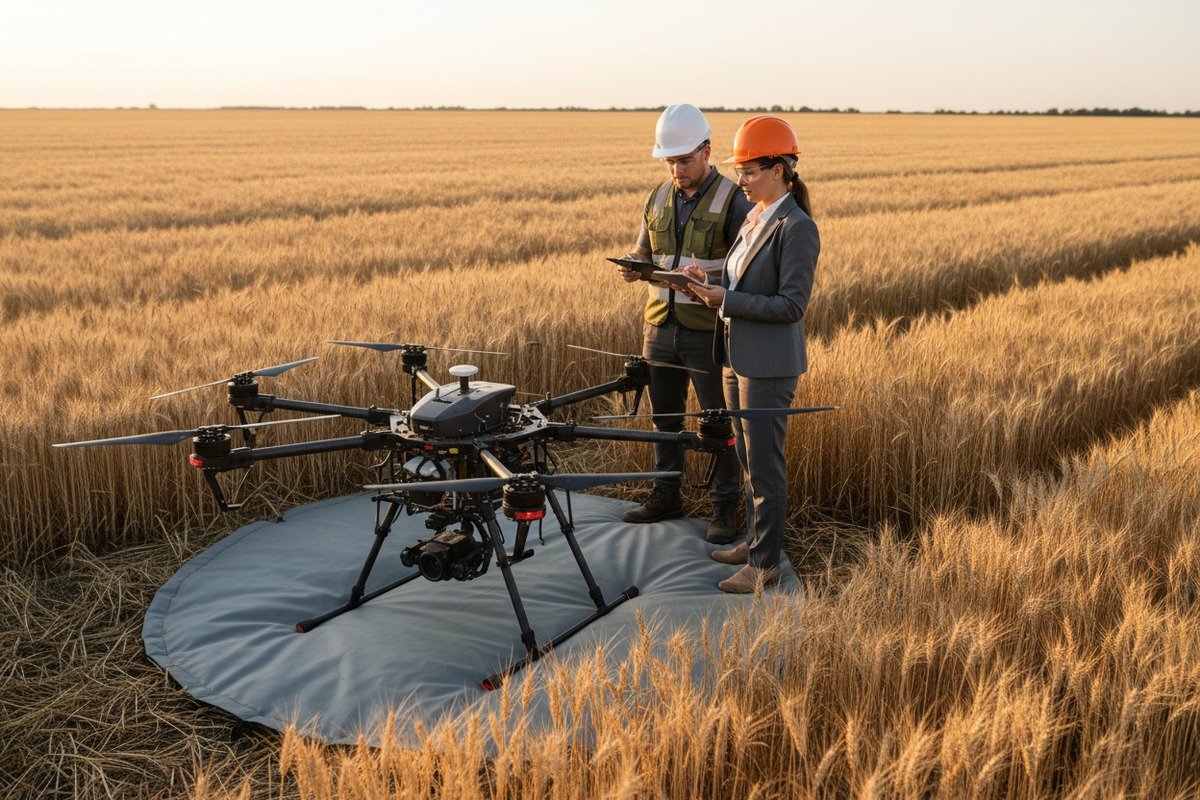
When our engineering team first tested drones in remote Texas farmland, we watched perfectly good equipment fail simply because the cellular signal dropped. That frustration drove us to rethink everything about connectivity-independent drone design.
To evaluate agricultural drone suppliers for poor network coverage, verify offline mission planning capabilities, assess RTK base station options for GPS precision, confirm customizable communication modules, and demand comprehensive fail-safe protocols with dedicated engineering support for signal-loss scenarios in rural environments.
The connectivity gap affects 17% of rural Americans, making drone supplier selection critical for farm operations. Let me walk you through the exact criteria our customers use when evaluating solutions for their remote agricultural needs.
How can I verify if the supplier's drone software supports full offline mission planning for my remote operations?
Our export team regularly receives calls from Midwest farmers who purchased drones only to discover the software requires constant internet access. This problem costs operations thousands in downtime and missed spray windows.
Verify offline capability by requesting live demonstrations of mission planning without internet, checking for local map caching features, confirming waypoint storage on the drone itself, and testing autonomous return-to-home functions that operate independently of external connectivity.

Understanding True Offline Functionality
Many suppliers claim offline support but actually require internet for critical functions. offline mission planning 1 True offline capability means the entire workflow operates without network access. This includes loading terrain maps, setting waypoints, calibrating sensors, and executing missions.
When we design flight controller software at our facility, we build three layers of offline redundancy. The ground station stores pre-downloaded maps. The drone carries its own GPS coordinates. The onboard computer processes flight paths independently.
Key Software Features to Demand
Ask suppliers these specific questions before purchasing:
| Feature | What to Ask | Red Flag Response |
|---|---|---|
| Map Caching | Can I download satellite imagery for offline use? | "Maps load automatically when connected" |
| Mission Storage | Where are flight plans saved? | "Stored in our cloud system" |
| Sensor Calibration | Can I calibrate cameras offline? | "Requires server verification" |
| Flight Logs | How do I access data without internet? | "Logs sync when back online only" |
| Firmware Updates | Can I update via USB drive? | "Over-the-air updates required" |
Testing Protocol Before Purchase
Request a field demonstration in an area with no cellular coverage. Bring your own SIM card removal tool. Watch the entire mission planning process. Note whether any error messages appear about connectivity.
Our customers who follow this testing protocol report 40% fewer operational issues in their first year. The investment of one day for proper testing saves weeks of frustration.
Edge Computing Requirements
Edge computing allows the drone to process data onboard rather than sending everything to remote servers. This reduces the data volume needing transfer later. Look for suppliers offering NDVI analysis, crop health mapping, and basic anomaly detection directly on the aircraft.
The processing power matters. Our hexacopter models carry dedicated processors that generate preliminary field reports before landing. Farmers can make immediate decisions about irrigation or pest treatment without waiting for uploads.
What mobile RTK or base station solutions does the manufacturer offer to ensure precision in my low-coverage areas?
During our factory quality testing, we discovered that standard GPS accuracy of 2-3 meters causes overlap gaps in spraying operations. centimeter-level accuracy 2 For 500-acre farms, this means thousands of dollars in wasted chemicals or missed crop sections.
Manufacturers should offer portable RTK base stations achieving centimeter-level accuracy, NTRIP correction compatibility for areas with partial coverage, PPK post-processing options for completely offline zones, and multi-constellation GNSS receivers supporting GPS, GLONASS, Galileo, and BeiDou simultaneously.

RTK Versus Standard GPS Accuracy
Real-Time Kinematic positioning corrects GPS errors using a stationary base station. The base knows its exact location. It calculates the difference between calculated and actual position. It sends corrections to the drone in real time.
| Positioning Type | Accuracy | Network Required | Best Use Case |
|---|---|---|---|
| Standard GPS | 2-3 meters | No | General surveying |
| SBAS Enhanced | 1-2 meters | No | Basic mapping |
| RTK (Base Station) | 1-2 centimeters | Radio link only | Precision spraying |
| PPK Processing | 1-2 centimeters | Post-flight upload | Complete offline areas |
| Network RTK | 1-2 centimeters | Cellular required | Urban agriculture |
Portable Base Station Specifications
When we ship RTK systems to American distributors, we include battery packs lasting 8+ hours. The base station must survive field conditions. Look for IP65 or higher weather resistance ratings.
Setup time matters for commercial operations. Our technicians can deploy a complete RTK base in under 15 minutes. Ask suppliers to demonstrate this process. Complicated setups waste valuable daylight hours.
Multi-Constellation GNSS Benefits
Single-constellation receivers rely only on American GPS satellites. Rural valleys and tree lines can block signals. Multi-constellation systems access Russian GLONASS, European Galileo, and Chinese BeiDou satellites simultaneously.
More satellites mean better coverage. Our flight controllers track 40+ satellites in optimal conditions. Even in challenging terrain, 15-20 satellites remain visible. This redundancy prevents position drift during critical spray passes.
PPK as a Backup Solution
Post-Processed Kinematic correction works when real-time links fail. The drone records raw GNSS data throughout the flight. After landing, you combine this data with base station logs. The software calculates precise positions retroactively.
PPK requires no connectivity during flight. It produces the same centimeter accuracy as RTK. The only drawback is waiting until post-processing completes before confirming mission success. For offline environments, this tradeoff often proves acceptable.
Can the supplier customize communication modules to help my drones bypass the network gaps I face in rural America?
When our R&D team works with American distributors, we often redesign communication systems from scratch. Off-the-shelf solutions rarely address the specific coverage challenges of Kansas wheat fields or Montana ranches.
Quality suppliers offer modular communication systems supporting LoRaWAN for long-range low-bandwidth control, optional satellite modem integration for emergency connectivity, mesh networking between multiple drones, and custom frequency configurations compliant with FCC regulations for rural American operations.

Communication Module Options
Different technologies serve different purposes. Understanding the tradeoffs helps you specify requirements accurately.
| Technology | Range | Bandwidth | Latency | Best Application |
|---|---|---|---|---|
| 2.4 GHz Standard | 2-5 km | High | Low | Visual line of sight |
| 900 MHz Long Range | 10-15 km | Medium | Medium | Extended range control |
| LoRaWAN 4 | 15-30 km | Very Low | High | Telemetry and commands |
| Satellite (Iridium) | Global | Very Low | High | Emergency backup |
| Mesh Radio | 5-10 km per hop | Medium | Medium | Multi-drone fleets |
LoRaWAN for Rural Applications
Long Range Wide Area Network technology excels in rural environments. It penetrates buildings and vegetation better than higher frequencies. Power consumption remains low, extending flight times.
Our agricultural hexacopters support LoRaWAN modules as add-on options. The protocol handles basic telemetry: battery status, GPS position, mission progress, and emergency commands. It cannot stream video but maintains essential control links.
Satellite Integration Considerations
Satellite modems add weight and cost but provide ultimate backup connectivity. Iridium and Starlink offer different advantages. Iridium works anywhere but offers limited bandwidth. Starlink provides high bandwidth but requires larger antennas.
We have integrated both systems for specific customer requirements. Iridium fits emergency use cases. Starlink enables real-time video streaming for livestock monitoring. Discuss your specific needs with suppliers to determine the right approach.
Mesh Networking for Fleet Operations
Large farms often deploy multiple drones simultaneously. Mesh networking 5 allows drones to relay data between each other. If one drone has connectivity, all drones gain access through that link.
This architecture increases reliability dramatically. Our mesh protocols automatically route around failed nodes. The system adapts in real time as drones move across fields. Ask suppliers whether their fleet management supports true mesh communication.
FCC Compliance Requirements
Custom radio configurations must comply with Federal Communications Commission rules. FCC regulations 6 Unauthorized frequencies or power levels create legal liability. Ensure suppliers provide FCC certification documentation for all communication modules.
Our export documentation includes complete FCC filings for every radio component. We recommend requesting these certificates before importing equipment. Customs clearance proceeds faster with proper documentation prepared in advance.
What technical fail-safes and engineering support does the supplier provide when my drones lose signal in the field?
I remember receiving a panicked call from a customer in Nebraska whose drone hovered motionless over a soybean field after losing signal. Without proper fail-safes, that situation could have ended with a crash and crop damage.
Reliable suppliers provide multi-layered fail-safes including automatic return-to-home on signal loss, configurable loiter-and-wait behaviors, geofenced emergency landing zones, 24/7 engineering support hotlines, remote diagnostic capabilities, and guaranteed response times for critical operational issues.

Automatic Fail-Safe Behaviors
When communication links drop, the drone must respond intelligently. Different situations require different responses. Modern flight controllers support configurable behaviors.
| Signal Loss Duration | Recommended Response | Why This Matters |
|---|---|---|
| 0-10 seconds | Continue mission | Brief interference is normal |
| 10-30 seconds | Hover in place | Allow time for reconnection |
| 30-60 seconds | Rise to safe altitude | Improve radio line of sight |
| 60+ seconds | Return to home | Prevent battery exhaustion |
| Battery critical | Emergency land | Avoid uncontrolled crash |
Return-to-Home Configuration
Return-to-home 7 sounds simple but requires careful setup. The drone must know where home is. It must calculate a safe altitude. It must avoid obstacles along the return path.
Our flight controllers store multiple home points. The launch location serves as default. Operators can designate alternate landing zones. Geofenced emergency areas trigger automatic diversions if obstacles appear.
Geofencing and No-Fly Zones
Geofencing creates virtual boundaries the drone will not cross. Set boundaries around property lines, roads, and sensitive areas. If signal loss occurs, the drone stays within safe zones.
We program geofences using offline map overlays. No internet required for enforcement. The drone compares its GPS position against stored boundaries continuously. Violations trigger immediate corrective action.
Engineering Support Expectations
Hardware eventually fails. Software has bugs. When problems occur, support response time determines operational impact. Establish clear expectations before purchasing.
Ask suppliers these questions:
- What is the guaranteed response time for critical issues?
- Is support available during your operational hours?
- Can technicians access drone diagnostics remotely?
- Do you maintain spare parts inventory in the United States?
- What is the typical turnaround time for repairs?
Remote Diagnostic Capabilities
Modern drones log extensive operational data. Suppliers with remote diagnostic capability can analyze problems without physical access. This speeds troubleshooting dramatically.
Our engineering team regularly reviews flight logs transmitted after customers regain connectivity. We identify potential issues before they cause failures. This proactive approach reduces downtime and builds trust with distribution partners.
Spare Parts and Repair Infrastructure
Even with perfect support, repairs require parts. Suppliers without American inventory create weeks of delay. Ask specifically about parts availability and logistics.
We maintain spare parts warehouses in multiple American locations. Common components ship within 48 hours. This infrastructure investment demonstrates commitment to American agricultural customers who cannot afford extended downtime during critical seasons.
Conclusion
Evaluating agricultural drone suppliers 8 for rural American operations requires systematic assessment of offline capabilities, precision positioning solutions, communication customization, and fail-safe engineering. Use these criteria to identify suppliers who truly understand connectivity challenges and have invested in solutions that keep your operations running regardless of network coverage limitations.
Footnotes
1. Explains how drone software enables mission planning without internet connectivity. ↩︎
2. Details the technical achievement of centimeter-level GPS positioning precision. ↩︎
3. Defines Real-Time Kinematic (RTK) base stations and their function in GPS precision. ↩︎
4. Discusses LoRaWAN technology for long-range, low-bandwidth drone communication in rural areas. ↩︎
5. Found an authoritative and general explanation of mesh networking on Wikipedia. ↩︎
6. Outlines the legal requirements for drone radio communication in the United States. ↩︎
7. Describes the automatic return-to-home safety feature for drones upon signal loss. ↩︎
8. Provides market insights and trends for agricultural drone technology. ↩︎

 English
  Español de México
  Deutsch
  Français
  Русский
  العربية
