
Every week on our production floor, we watch test pilots struggle with drones that look perfect on paper but fly like wounded birds. The culprit? Poor center of gravity 1 design. This invisible factor separates reliable farm workhorses from expensive lawn ornaments.
Center of gravity determines how your agricultural drone balances during flight, affecting stability, control response, and payload handling. A properly positioned CoG keeps your drone level under wind stress and shifting spray loads, while a misaligned CoG causes drifting, motor strain, and potential crashes that destroy your investment.
Let me walk you through what our engineering team has learned from building thousands of agricultural drones 2. This knowledge will help you make a smarter purchase decision.
How do I assess the center of gravity design when comparing different agricultural drones for my business?
When our sales team visits trade shows, buyers often compare drones by horsepower and flight time alone. They miss the hidden factor that actually determines field performance. Bad CoG design has grounded more agricultural operations than any motor failure.
To assess CoG design, examine the drone's frame symmetry, ask for payload balance specifications, check if adjustable mounting systems exist, and request ESC diagnostic data showing motor speed variance during hover tests. Quality manufacturers provide CoG documentation and demonstrate stable flight with full payload.
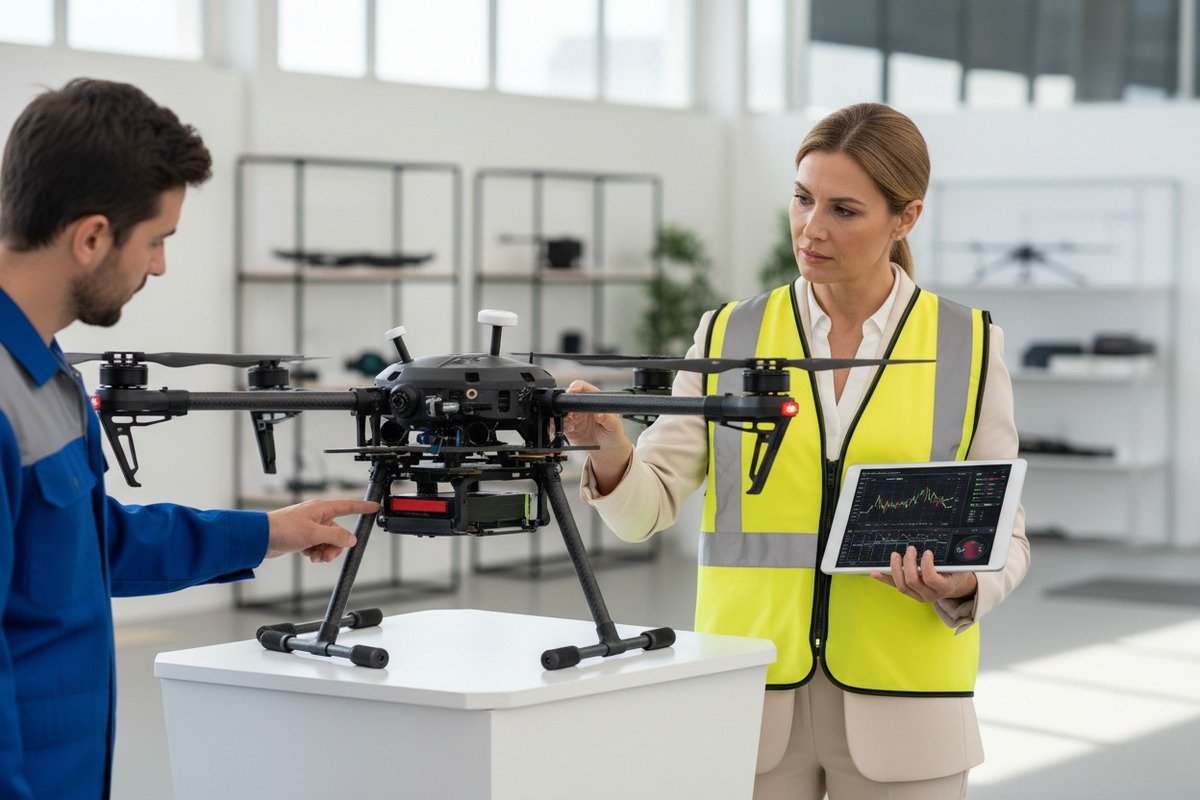
Understanding What CoG Actually Means
Center of gravity is the single point where your drone's entire weight balances. Think of it as the pivot point for all movement. Your drone rotates around this point when it pitches forward, rolls sideways, or yaws left and right.
When CoG sits at the geometric center 3 of your drone, all motors share the load equally. The flight controller 4 sends identical power signals. Your drone hovers flat and responds predictably to commands.
When CoG shifts off-center, problems multiply. Motors on one side work harder to compensate. Battery drain becomes uneven. The flight controller constantly fights to maintain level flight. In gusty field conditions, this struggle becomes dangerous.
Key Specifications to Request
| Specification | What to Ask For | Why It Matters |
|---|---|---|
| Frame Symmetry | Planar symmetry documentation | Ensures equal weight distribution |
| Arm Displacement | <2mm tolerance rating | Prevents vibration-induced drift |
| Body Mass Fraction | <30% of total weight | Leaves room for payload without CoG shift |
| Navigation Area Tolerance | <0.1mm displacement | Protects sensors from vibration damage |
| Adjustable Mounts | Yes/No with range specs | Allows payload customization |
Red Flags to Watch For
Some manufacturers cut corners on frame design. They use asymmetric battery placements or mount electronics off-center. These drones require constant correction inputs from the flight controller.
Ask potential suppliers for hover test videos with full payload. A well-designed drone holds position without visible wobble. Motor sounds remain consistent across all arms. Any whining or speed variation indicates CoG problems.
Our quality control team rejects frames with arm length variations exceeding 2mm. This tight tolerance keeps CoG predictable across production batches. Ask if your potential supplier maintains similar standards.
Comparing Fixed vs. Adjustable Systems
Fixed-frame designs work well when you always carry the same payload. They cost less and have fewer mechanical failure points. Topology-optimized uni-body frames fall into this category.
Adjustable systems suit operations with variable payloads. Some days you spray liquids. Other days you mount multispectral camera 5s. Rotatable mounting platforms and sliding battery trays let you reposition weight as needed.
Neither approach is universally better. Match the design to your operation's needs.
Will the shifting weight of my liquid spray tank affect the flight stability of the drone I purchase?
During field testing in Shaanxi province last summer, we watched a competitor's drone tumble during a sharp turn. The pilot blamed wind. Our engineers knew better. Liquid slosh in a half-empty tank threw the CoG beyond recoverable limits.
Yes, liquid payload shifting significantly affects stability. As spray tanks empty unevenly or liquid sloshes during maneuvers, the CoG moves dynamically. Quality agricultural drones include baffled tank designs, adaptive flight controllers, and real-time compensation systems to maintain stable flight throughout the spray mission.
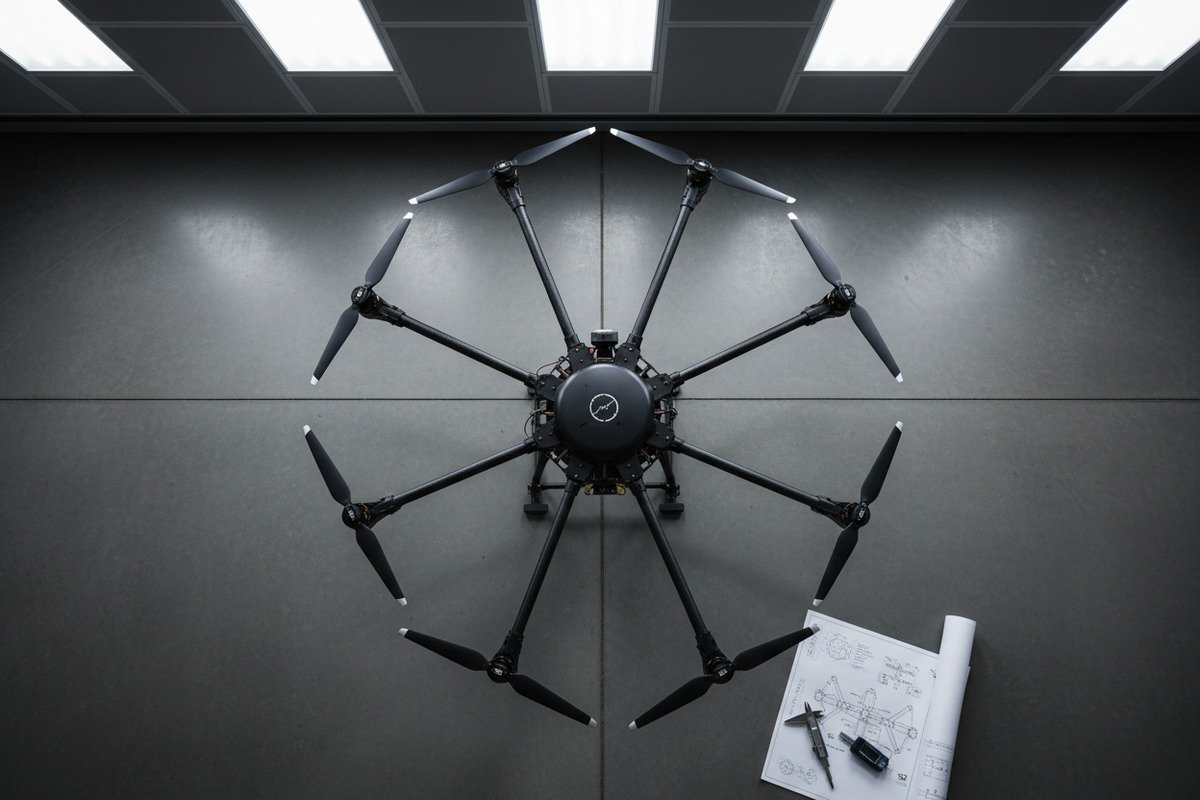
The Physics of Liquid Slosh
Liquid in a tank does not stay still. When your drone accelerates, liquid rushes backward. During turns, it shifts sideways. Hard stops send it forward. Each movement relocates mass and changes the CoG position.
This creates forces the flight controller must counteract. Small tanks cause minor shifts. Large 50kg spray tanks create dramatic CoG movements that challenge even advanced stabilization systems.
The problem compounds as you spray. A full tank has predictable weight distribution. A half-empty tank has more room for liquid movement. The CoG becomes increasingly unpredictable as your mission progresses.
Tank Design Features That Help
| Feature | Function | Effectiveness |
|---|---|---|
| Internal Baffles 6 | Limit liquid movement distance | Reduces slosh by 60-70% |
| Cellular Compartments | Divide tank into small sections | Minimizes mass transfer |
| Low-Profile Shape | Reduces vertical CoG movement | Improves roll stability |
| Center-Mounted Position | Keeps weight near geometric center | Maintains balance throughout emptying |
| Graduated Emptying | Drains from center outward | Preserves symmetrical weight |
Flight Controller Compensation
Modern agricultural drones use adaptive flight control systems 7. These systems detect CoG shifts through accelerometer data and motor load changes. They adjust power distribution in real-time to maintain level flight.
When we calibrate our flight controllers at the factory, we run simulations with varying fill levels. The controller learns expected CoG ranges and responds faster to actual shifts in the field.
Ask potential suppliers about their compensation algorithms. Quality systems anticipate CoG changes based on spray rate and mission time. They adjust proactively rather than reactively.
Practical Mission Planning
Smart mission planning reduces liquid slosh effects. Gentle acceleration profiles give liquid time to settle. Gradual turns prevent dramatic sideways shifts. Consistent spray patterns empty the tank evenly.
Our customer training materials include optimal flight speed recommendations for different fill levels. Full tanks tolerate more aggressive maneuvers. Half-empty tanks require gentler handling.
Some operators prefer multiple shorter flights with smaller loads over single heavy missions. This approach keeps the tank fuller during operation, reducing slosh severity and improving overall stability.
How can I ensure the drone maintains its balance if I decide to customize the payload for my specific needs?
Our engineering support team fields customization requests weekly. Farmers want specialized nozzle arrays. Researchers need multispectral sensor mounts. Each modification shifts weight and changes flight characteristics. Done wrong, customization creates flying hazards.
To maintain balance with custom payloads, calculate total weight distribution before modification, use adjustable mounting rails positioned near the CoG, add counterweights to offset asymmetric additions, and recalibrate the flight controller after every change. Document each configuration for repeatable, safe operation.

Step-by-Step Customization Process
Before adding any custom equipment, weigh your drone in its stock configuration. Record the empty weight and measure the CoG position using a balance point method. This gives you a baseline for comparison.
Next, weigh your custom payload. Note its intended mounting position. Calculate how this addition will shift the overall CoG. Move the mounting point or add counterweight until the new CoG falls within acceptable limits.
After physical installation, perform a tethered hover test. Watch for any tilt or drift. Listen for uneven motor sounds. Make adjustments until the drone holds level position without pilot input.
Weight Distribution Guidelines
| Payload Type | Typical Weight | Mounting Best Practice |
|---|---|---|
| Multispectral Camera | 0.5-2kg | Center-bottom, below CoG |
| Additional Spray Nozzles | 1-3kg | Symmetrical on boom arms |
| Collision Avoidance Sensors | 0.2-0.5kg | Balanced pairs, front/rear |
| Extended Battery Pack | 2-5kg | Center-top or split sides |
| Seeder Attachment | 5-15kg | Center-rear with counterweight |
Using Adjustable Mounting Systems
Quality agricultural drones include rail systems for payload adjustment. Sliding mounts let you reposition equipment forward or backward. This compensates for different payload weights without permanent modification.
Our heavy-lift models feature grid-based attachment points with 2cm spacing. This granular adjustment allows precise CoG tuning. We include documentation showing optimal positions for common payload combinations.
When mounting asymmetric equipment, use the opposite side for batteries or counterweights. Keep the overall weight distribution as symmetrical as possible. Even small imbalances compound during aggressive maneuvers.
Recalibration Requirements
Every payload change requires flight controller recalibration. The controller uses stored parameters to anticipate drone behavior. Old parameters cause sluggish or oversensitive responses with new weight distributions.
Recalibration typically involves placing the drone on level ground and running an automatic sensor alignment routine. Some systems require manual input of the new total weight. Others detect changes automatically during the first hover.
Document each configuration you use regularly. Record the payload arrangement, total weight, and calibration settings. This allows quick switching between missions without full recalibration each time.
When to Seek Professional Help
Complex customizations involving structural modifications should involve the manufacturer. Drilling new mounting holes can weaken frames. Electrical additions may overload power systems. Improper installations void warranties and create liability issues.
Our engineering team offers remote consultation for custom projects. We review proposed modifications and provide guidance on maintaining CoG compliance. This service has prevented numerous costly mistakes for our customers.
What technical specs should I look for to guarantee my drone stays stable during heavy-duty agricultural operations?
After shipping thousands of units to farms across America and Europe, we have learned which specifications actually predict field success. Marketing sheets emphasize flashy numbers. Experienced buyers look deeper at structural integrity and control system sophistication.
Key stability specs include frame arm displacement under 2mm, navigation sensor area displacement under 0.1mm, landing gear rated for 176N vertical impact, adaptive flight controllers with real-time CoG compensation, and body mass fraction below 30%. These engineering parameters ensure reliable performance under demanding agricultural conditions.

Frame Structural Specifications
| Specification | Minimum Standard | Premium Standard | Why It Matters |
|---|---|---|---|
| Arm Displacement | <3mm | <2mm | Prevents vibration amplification |
| Frame Material | Aluminum alloy | Carbon fiber composite 8 | Weight and rigidity balance |
| Joint Strength | 100N shear load | 150N shear load | Survives hard landings |
| Vibration Dampening | Basic rubber mounts | Tuned dampeners | Protects sensitive electronics |
| Weather Sealing | IP43 | IP54+ | Enables operation in dust and light rain |
Flight Controller Capabilities
The flight controller is your drone's brain. Basic units maintain level flight in calm conditions. Advanced units handle gusty winds, payload shifts, and aggressive maneuvers.
Look for controllers with high-frequency sensor fusion. They combine accelerometer, gyroscope, and barometer data many times per second. Faster processing means quicker response to disturbances.
Adaptive algorithms learn your drone's specific characteristics. They notice when one motor works harder and compensate automatically. This self-tuning improves stability over time and across different payload configurations.
Motor and ESC Requirements
Motors must deliver consistent thrust across all arms. Manufacturing variations cause some motors to spin slightly faster or slower at identical power settings. Quality control testing identifies and matches motors for uniform performance.
Electronic Speed Controllers 9 handle power delivery to motors. High-resolution ESCs adjust motor speed in tiny increments. This precision allows smoother CoG compensation. Cheap ESCs respond in large steps, causing jerky corrections.
Ask suppliers for motor matching documentation. Premium drones use motors tested and grouped by performance characteristics. Budget drones use random motor selection with wider performance variation.
Landing Gear Durability
Agricultural drones land on uneven terrain frequently. Soft soil, crop stubble, and equipment tracks create unpredictable surfaces. Landing gear must absorb impact without transferring shock to the frame and payload.
Modern topology-optimized landing gear uses lattice structures. Our designs reduce weight from 258g to 203g while maintaining 176N impact resistance. Maximum stress stays below 11.2MPa against a 23MPa allowable limit, providing a safety factor of 2.
Inspect landing gear attachment points on any drone you consider. Cracks or flex in this area indicate design weakness. Field failures here often cause expensive damage to motors and electronics.
Sensor Protection Standards
Navigation sensors require extreme stability. Displacement exceeding 0.1mm during vibration degrades GPS accuracy and compass reliability. Mounting systems must isolate sensors from frame vibration.
Collision avoidance sensors face similar challenges. Vibration causes false obstacle detection and erratic flight behavior. Quality drones use dampened mounting plates that filter high-frequency vibration while allowing accurate environmental sensing.
Ask about sensor mounting specifications. Look for documentation of vibration isolation testing. Reliable suppliers provide this data openly.
Environmental Durability
Agricultural environments attack drones constantly. Dust clogs motors. Moisture corrodes electronics. Chemical spray residue accumulates on surfaces. UV radiation degrades plastics.
Over time, these factors change weight distribution. Dust accumulation is rarely symmetrical. Residue builds up more heavily on spray-facing surfaces. Regular cleaning prevents gradual CoG shift that degrades flight performance.
Look for drones with sealed motor housings, conformal-coated electronics, and UV-resistant materials. These features extend service life and maintain factory CoG calibration longer.
Conclusion
Center of gravity determines whether your agricultural drone investment succeeds or fails. Prioritize adjustable mounting systems, adaptive flight controllers, and structural specifications over raw power numbers. A well-balanced drone earns its cost back through reliable operation and reduced crash losses.
Footnotes
1. Explains the fundamental concept of center of gravity in physics. ↩︎
2. Wikipedia provides a comprehensive and authoritative overview of agricultural drones. ↩︎
3. Wikipedia’s ‘Centroid’ page clearly defines it as also known as the geometric center. ↩︎
4. Explains the role of a flight controller as the drone’s central processing unit. ↩︎
5. Details how multispectral cameras are used in agriculture for crop monitoring. ↩︎
6. Describes how internal baffles reduce liquid movement and enhance stability in tanks. ↩︎
7. Explains how adaptive control systems adjust parameters for changing flight conditions. ↩︎
8. Wikipedia provides a comprehensive and authoritative overview of carbon-fiber reinforced polymers. ↩︎
9. Mechtex provides a clear explanation of the role and working principle of Electronic Speed Controllers in drone motors. ↩︎

 English
  Español de México
  Deutsch
  Français
  Русский
  العربية
