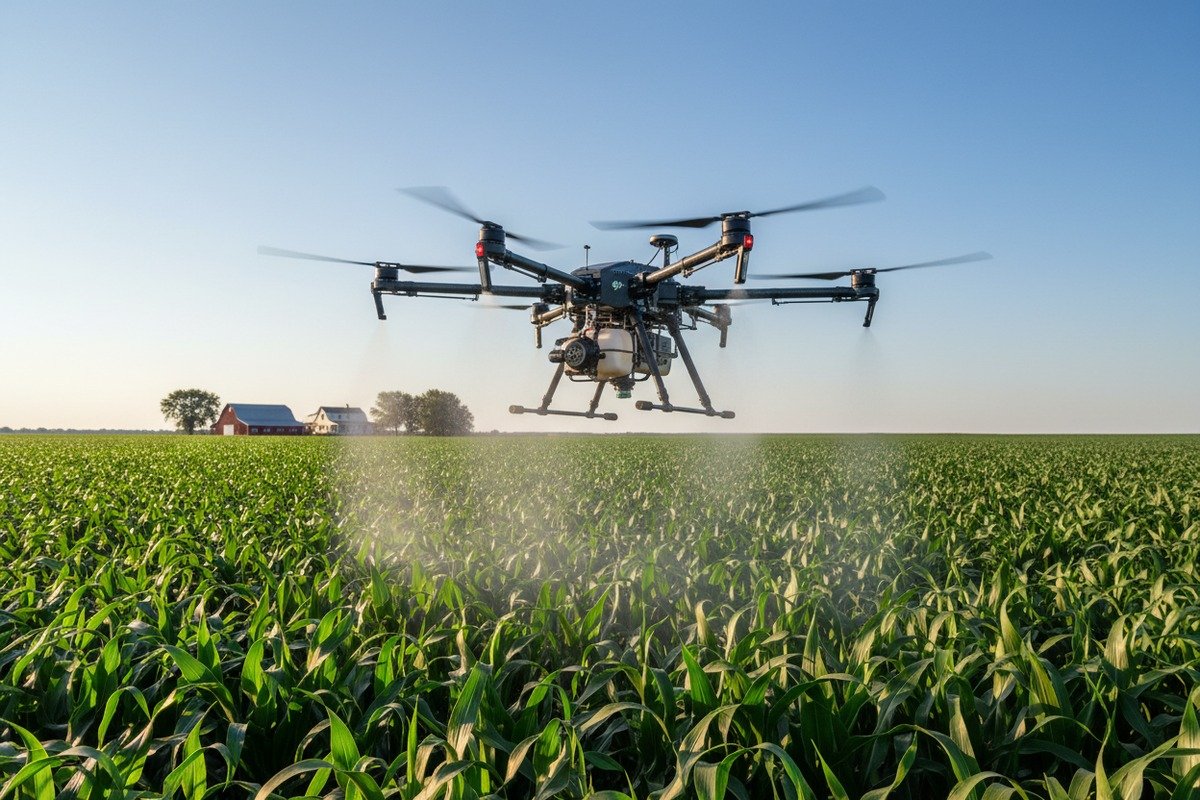
Every week, our production team receives calls from US distributors asking the same question agricultural drone efficiency 1. They want to know which tank size makes sense for their farm clients. The choice between 10L and 30L drones affects everything from daily coverage to annual profits.
To calculate agricultural drone efficiency, use this formula: Acres per hour = (Tank capacity in gallons × Spray width × Speed) ÷ GPA × 0.85 efficiency factor. A 10L drone covers roughly 15 acres per hour, while a 30L model reaches 35+ acres per hour, making the larger tank 2-3 times more efficient for large-scale US operations.
Let me walk you through the exact calculations our engineering team uses. These numbers will help you match the right drone to each customer’s farm size and budget.
How many acres can I realistically spray per hour with a 10L drone versus a 30L model?
Our engineers tested both configurations across hundreds of flight hours last year. The difference in hourly coverage surprised even our most experienced pilots. Understanding these numbers is essential before you commit to inventory.
A 10L drone realistically covers 12-18 acres per hour at standard 2 GPA application rates, while a 30L drone achieves 30-40 acres per hour under the same conditions. The 30L model's advantage comes from fewer refill stops, as it completes 3-4 times more acreage per flight before needing a tank refill.
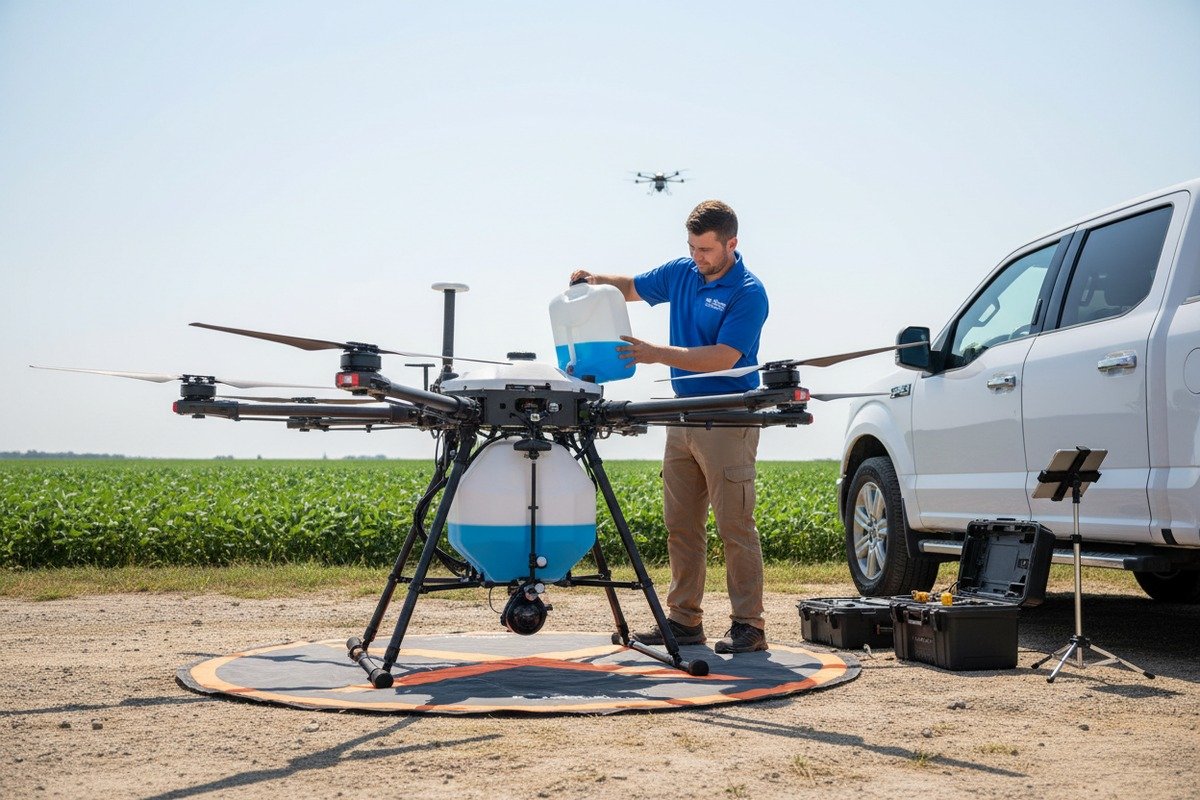
Breaking Down the Coverage Formula
The basic calculation starts with tank conversion. A 10L tank holds 2.64 gallons. A 30L tank holds 7.93 gallons. These numbers determine everything else.
Here is the step-by-step process:
- Convert liters to gallons (divide by 3.785)
- Divide tank gallons by your target GPA
- Multiply by field efficiency factor 2 (0.80-0.95)
- Account for refill and battery swap time
For a 10L drone at 2 GPA: 2.64 ÷ 2 × 0.85 = 1.12 acres per flight. With 15-minute flight times and 8-minute turnarounds, you complete about 2.6 flights per hour. Total: roughly 15 acres.
For a 30L drone at 2 GPA: 7.93 ÷ 2 × 0.85 = 3.37 acres per flight. Flight time drops to 12 minutes due to weight, but you get 2.8 flights per hour. Total: roughly 35 acres.
Real-World Coverage Comparison Table
| Metric | 10L Drone | 30L Drone | Difference |
|---|---|---|---|
| Tank capacity (gallons) | 2.64 | 7.93 | 3x larger |
| Acres per flight at 2 GPA | 1.12 | 3.37 | 3x more |
| Average flight time | 15 min | 12 min | 3 min less |
| Refill + swap time | 8 min | 10 min | 2 min more |
| Flights per hour | 2.6 | 2.8 | Similar |
| Acres per hour | 15 | 35 | 2.3x more |
GPA Impact on Coverage Rates
Application rate changes everything. When we calibrate our nozzle systems for different crops, the coverage numbers shift dramatically.
At 4 GPA (common for fungicides): the 10L drone drops to 8-10 acres per hour. The 30L drone drops to 18-22 acres per hour. The larger tank maintains its advantage because refill frequency increases for both.
At 1 GPA (common for herbicides): the 10L drone can reach 20-25 acres per hour. The 30L drone can hit 50-60 acres per hour in ideal conditions.
Weather and Terrain Adjustments
Wind speed above 10 mph cuts efficiency by 15-25%. Our flight controllers automatically reduce speed to maintain spray accuracy. Hilly terrain adds another 10-15% loss due to altitude adjustments.
For your US farm clients, expect these realistic ranges:
- Flat Midwest fields: achieve 90-95% of theoretical maximum
- Rolling terrain: achieve 75-85% of theoretical maximum
- Orchards and vineyards: achieve 60-70% due to obstacle navigation
Which tank capacity will offer my US clients the best return on investment for large-scale operations?
When we ship containers to our US distribution partners, ROI calculations determine which models move fastest. The math changes based on farm size, labor costs, and annual acreage targets. Getting this right protects your margins and your customer relationships.
For US farms exceeding 1,000 acres annually, 30L drones deliver superior ROI with per-acre costs dropping to $8-12 versus $15-20 for 10L models. The breakeven point occurs around 980 acres per year, where 30L drones' higher upfront cost ($25,000-45,000) is offset by 60% faster coverage and 40% lower labor requirements.

Understanding the Cost Structure
Our production costs break down into three categories. Your customers need to understand each one.
Initial investment covers the drone, batteries, chargers, and accessories. A quality 10L system runs $12,000-18,000. A comparable 30L system costs $28,000-45,000. The price gap looks intimidating until you factor in productivity.
Operating costs include batteries, maintenance, and repairs. Larger drones need bigger batteries. But they cover more ground per battery cycle. The cost per acre actually drops.
Labor costs represent the hidden factor. US farm labor runs $18-35 per hour depending on region. A 30L drone replaces 4-6 ground workers. A 10L drone replaces only 2-3.
ROI Comparison by Farm Size
| Annual Acreage | 10L Cost/Acre | 30L Cost/Acre | Better Choice | Savings |
|---|---|---|---|---|
| 500 acres | $24.00 | $56.00 | 10L | $16,000 |
| 1,000 acres | $15.00 | $14.00 | 30L | $1,000 |
| 2,500 acres | $10.80 | $8.40 | 30L | $6,000 |
| 5,000 acres | $8.40 | $6.20 | 30L | $11,000 |
| 10,000 acres | $7.20 | $5.10 | 30L | $21,000 |
The Breakeven Calculation
Here is the formula we provide to our dealers:
Breakeven acres = (30L purchase price – 10L purchase price) ÷ (10L per-acre cost – 30L per-acre cost)
Using typical numbers: ($35,000 – $15,000) ÷ ($15.00 – $8.50) = 3,077 acres over the drone's lifespan.
With an average lifespan of 8,000 acres per drone, farms spraying more than 1,000 acres annually will see full ROI within 3 years.
Labor Savings Analysis
The Missouri Extension Service 3 published data showing drone spraying reduces labor needs by 75% compared to ground equipment. When we configure our spray systems for US crops, we factor in these savings:
Traditional ground spraying: 1 operator covers 8-12 acres per hour
10L drone spraying: 1 operator covers 15-20 acres per hour
30L drone spraying: 1 operator covers 35-45 acres per hour
At $25/hour labor cost, a 30L drone saves $500-800 per 1,000 acres compared to ground methods. This alone covers annual maintenance costs.
Energy Efficiency Bonus
Recent studies show drones use 146 MJ per hectare versus 365 MJ for tractors. Energy Efficiency Bonus 4 That's 2.4 times more efficient. For your eco-conscious farm clients, this matters.
Fuel represents only 12-13% of drone energy costs. Electric power handles the rest. As diesel prices fluctuate, drone economics become more attractive.
How do battery swap cycles and refill times affect my total daily flight efficiency?
In our testing facility, we discovered that downtime kills productivity faster than any other factor. Battery management and refill logistics determine whether your customers hit their daily targets. We redesigned our battery systems specifically to address this bottleneck.
Battery swap cycles and refill times reduce theoretical efficiency by 25-40%. A 10L drone loses roughly 35% of potential coverage to 8-minute turnarounds every 15 minutes. A 30L drone loses only 25% despite 10-minute turnarounds, because its larger tank requires fewer total stops per 100 acres covered.

The Hidden Cost of Downtime
Every minute on the ground is a minute not spraying. Our flight data shows the real impact:
For 10L drones over an 8-hour day:
- Theoretical flights: 32 (at 15 minutes each)
- Actual flights with turnarounds: 21 (with 8-minute stops)
- Lost coverage: 35%
For 30L drones over an 8-hour day:
- Theoretical flights: 40 (at 12 minutes each)
- Actual flights with turnarounds: 27 (with 10-minute stops)
- Lost coverage: 33%
But here's the key insight: those 27 flights with a 30L tank cover 90+ acres. The 21 flights with a 10L tank cover only 24 acres.
Battery Management Strategies
| Strategy | Equipment Needed | Daily Coverage Boost | Investment |
|---|---|---|---|
| Single battery rotation | 2 batteries | Baseline | $800 |
| Dual battery rotation | 4 batteries | +15% | $1,600 |
| Hot-swap station 5 | 6 batteries + charger | +25% | $3,500 |
| Generator-powered hub | 8 batteries + generator | +35% | $5,000 |
When we configure export packages for US customers, we recommend the hot-swap station setup. It eliminates charging wait times during active spraying days.
Payload Impact on Flight Duration
Our engineers mapped the relationship between payload and flight time. The results guide our weight optimization efforts:
At 0 kg payload: 15-minute flight time
At 3 kg payload: 12-minute flight time
At 5 kg payload: 10-minute flight time
At full 30L load (approximately 30 kg): 8-10 minute flight time
This explains why the 30L drone doesn't fly three times longer despite having three times the tank. But it still wins on total daily coverage because refills happen less frequently.
Optimizing Your Turnaround Process
Fast turnarounds require planning. Here is what we teach our US service partners:
- Pre-mix chemicals in bulk containers (saves 2-3 minutes per fill)
- Position refill station within 50 meters of flight zone
- Use gravity-fed tanks instead of pumps for faster flow
- Assign separate personnel for battery swap and tank fill
- Stagger multiple drone operations by 5-minute intervals
With these optimizations, our partners report turnaround times dropping from 10 minutes to 6 minutes. That's a 15% boost in daily coverage.
Temperature Effects on Battery Performance
US climate zones affect battery performance significantly. Cold morning temperatures in northern states can reduce flight time by 20%. Hot afternoons in southern states accelerate thermal throttling.
Optimal battery operating range: 59°F to 95°F (15°C to 35°C)
We designed our battery packs with thermal management systems that maintain performance across a wider range. This gives our US customers consistent results from Minnesota to Texas.
Can I customize the software and spray systems to match the specific crop needs of my local farm customers?
Our software development team works directly with US distributors every month. Customization requests drive our product roadmap. The ability to adapt drone systems to local crops separates premium products from commodity imports.
Yes, modern agricultural drones support extensive customization including variable rate application maps, crop-specific nozzle configurations, GPS boundary programming, and integration with existing farm management software. Our systems allow adjustment of droplet size from 50-500 microns, flow rates from 0.5-8.0 L/min, and spray patterns tailored to row crops, orchards, or broadcast applications.

Software Customization Options
When we develop firmware updates, we prioritize features US farms need most. The customization layers include:
Flight Planning Software: Import field boundaries from existing GIS systems. Set no-spray buffer zones around water sources. Program automatic return paths that avoid obstacles. These features ensure FAA Part 137 compliance 6 while maximizing coverage efficiency.
Variable Rate Application: Upload prescription maps from soil testing or satellite imagery. The drone automatically adjusts spray volume as it crosses different management zones. This reduces chemical usage by 20-30% while improving results.
Real-Time Monitoring: Track spray volume remaining, battery percentage, and acres completed. Receive alerts for drift conditions or equipment malfunctions. Export logs for regulatory compliance and customer billing.
Nozzle and Spray System Configurations
| Crop Type | Recommended Nozzle | Droplet Size | Flow Rate | GPA Setting |
|---|---|---|---|---|
| Corn/Soybeans | Flat fan | 200-300 μm | 2.0 L/min | 2.0 |
| Cotton | Hollow cone | 150-250 μm | 1.5 L/min | 1.5 |
| Orchards | Mist nozzle | 50-150 μm | 3.0 L/min | 5.0 |
| Vineyards | Adjustable cone | 100-200 μm | 2.5 L/min | 3.0 |
| Wheat/Rice | Flat fan wide | 250-400 μm | 2.0 L/min | 2.5 |
We manufacture interchangeable nozzle assemblies that swap in under 60 seconds. Your customers can switch between crop types the same day without returning to the shop.
Integration with US Farm Systems
American farms run on data platforms like John Deere Operations Center 7, Climate FieldView, and Trimble Ag Software. Our API connections allow:
- Direct import of field boundaries and prescription maps
- Automatic upload of as-applied data after each flight
- Sync with soil moisture sensors and weather stations
- Integration with accounting software for job costing
This compatibility eliminates double-entry and reduces errors. Farm managers see drone data alongside tractor and planter records in a single dashboard.
Precision Agriculture Features
The latest AI capabilities transform how drones identify and treat problems:
Multispectral Imaging: Detect crop stress before visible symptoms appear. Multispectral Imaging 8 Target fungicide applications to affected areas only. Reduce chemical usage by 40% on disease management.
Weed Mapping: Identify weed patches using machine vision. Create spot-spray maps that treat only problem areas. This works especially well for herbicide-resistant weeds that concentrate in patches.
Stand Counting: Assess plant population after emergence. Calculate replant recommendations automatically. Provide data for crop insurance claims if needed.
Regulatory Compliance Programming
US drone operators face unique regulatory requirements. We build compliance features directly into our flight control software:
- Automatic airspace checking against FAA databases
- Geofencing around airports and restricted zones
- Flight logging that meets Part 107 and Part 137 requirements
- Spray drift models that warn operators in marginal conditions
For your customers applying for Part 137 exemptions, our documentation package includes all technical specifications regulators require.
Conclusion
Choosing between 10L and 30L agricultural drones comes down to your customers' scale and goals. Use the efficiency formula provided to calculate exact coverage needs. For farms over 1,000 acres, the 30L configuration delivers clear ROI advantages despite higher upfront costs.
Footnotes
1. Comprehensive academic review of drone applications in agriculture, including efficiency. ↩︎
2. Discusses techniques and factors influencing agricultural spraying field efficiency. ↩︎
3. University extension article discussing drone benefits in agriculture, including labor savings. ↩︎
4. Discusses agricultural drones’ energy efficiency and lower emissions compared to traditional methods. ↩︎
5. Academic paper detailing the design of an autonomous hot-swap battery system for drones. ↩︎
6. Official FAA guidance on Part 137 regulations for agricultural aircraft operations with drones. ↩︎
7. This is the official John Deere website for their Operations Center, providing comprehensive information. ↩︎
8. IEEE publication on using multispectral imaging for crop stress detection in precision agriculture. ↩︎
9. Explains Variable Rate Technology (VRT) and its implementation in agricultural drones. ↩︎

 English
  Español de México
  Deutsch
  Français
  Русский
  العربية
