
When our engineering team first deployed firefighting drones into active wildfire zones, we faced a harsh reality. Units that performed perfectly in lab conditions failed within minutes near real flames. The problem was clear: standard quality checks cannot predict how drones behave when heat, smoke, and debris combine.
To arrange destructive testing for firefighting drone durability, you must define heat and impact thresholds, partner with certified labs using NIST or IEC protocols, design escalating stress tests from thermal shock to structural overload, document all failure points, and iterate designs based on real destruction data.
This guide walks you through every step. We will cover specific tests for extreme heat, how to build custom protocols with your manufacturer, what documentation proves test validity, and how to balance costs against reliability guarantees. Let us start with the most critical factor: heat resistance.
What specific destructive tests should I request to ensure my firefighting drones can withstand extreme heat?
Fire zones push equipment beyond normal limits. Our production team has seen drones return from wildfire operations with melted housings and warped arms. Heat is the silent killer of firefighting drone reliability.
Request thermal shock cycling between -65°C and +150°C, sustained high-temperature exposure at 180°C, direct flame proximity tests at 450°C, battery thermal runaway simulations, and UV aging tests per ASTM D5229 to verify your firefighting drones survive extreme heat conditions.

Understanding Thermal Shock Testing
Thermal shock tests reveal hidden weaknesses. When drones fly from cool staging areas into fire zones, temperatures change rapidly. This transition stresses every component.
Our engineers use environmental chambers that shift from -65°C to +150°C in under 10 seconds. This simulates the worst-case scenario: a drone ascending from shaded terrain into direct fire proximity. IEC 60068-2-14 1 governs this test protocol.
During these tests, we look for micro-cracks in carbon fiber frames, solder joint failures on circuit boards, and seal degradation around waterproof housings. The table below shows typical failure points:
| Component | Failure Temperature | Common Failure Mode |
|---|---|---|
| LiPo Battery | Above 60°C | Thermal runaway, capacity loss |
| Carbon Fiber Frame | Above 200°C | Delamination, micro-cracks |
| Motor Bearings | Above 120°C | Lubricant breakdown |
| Camera Sensors | Above 85°C | Image drift, pixel damage |
| Wiring Insulation | Above 150°C | Melting, short circuits |
Sustained High-Temperature Exposure
Thermal shock is one challenge. Sustained heat is another. When our drones hover near active fires for 15 to 20 minutes, components soak in heat.
We run tests at 180°C for extended periods. This reveals slow-developing failures that shock tests miss. Battery performance drops significantly. Flight times can decrease by 40% when ambient temperatures exceed 50°C. We create derating charts based on these results so operators know exactly what to expect.
Direct Flame Proximity Testing
Some clients demand extreme validation. We offer direct flame proximity tests where drones operate within 2 meters of controlled fires reaching 450°C. These tests destroy units but provide invaluable data.
The goal is not survival. The goal is understanding exactly when and how failure occurs. Does the drone maintain flight control for 30 seconds? 60 seconds? This data helps firefighters plan safe operating distances.
UV and Environmental Aging
Fire zones expose drones to intense UV radiation. Over time, this degrades composite materials. ASTM D5229 2 guides our UV aging tests. We accelerate months of sun exposure into days using UV chambers. Combined with thermal cycling per GB/T 14522 3, these tests predict long-term durability.
How can I collaborate with my manufacturer to design a custom stress test protocol for my drone fleet?
Off-the-shelf test protocols rarely match real firefighting conditions. When we work with fire departments and distributors, they describe scenarios our standard tests never considered. Custom protocols bridge this gap.
Collaborate with your manufacturer by sharing operational data from field deployments, defining specific environmental thresholds from your fire zones, co-designing test sequences that combine heat, water, vibration, and impact, and establishing clear pass/fail criteria tied to your mission requirements.
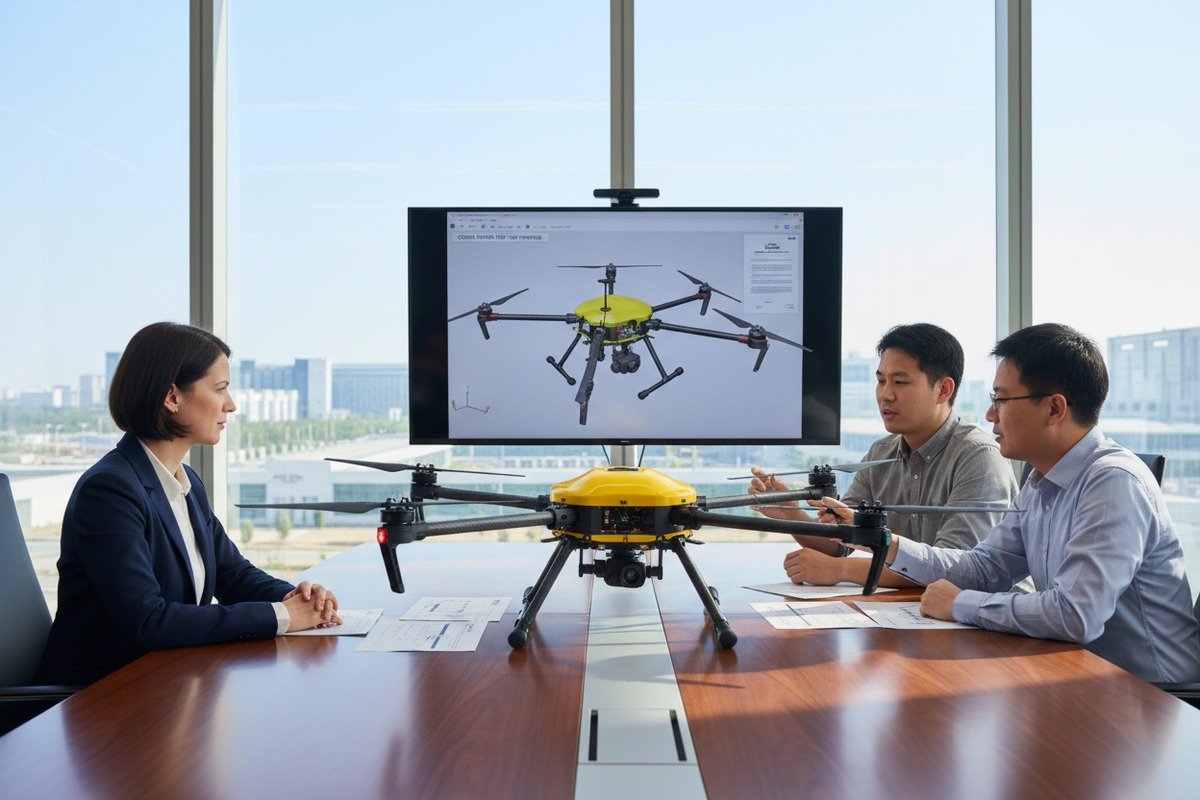
Starting with Operational Data
The best custom protocols begin with real-world data. We ask clients to share flight logs, maintenance records, and failure reports from their existing fleets. This information reveals patterns.
One distributor discovered their drones failed most often after exposure to fire retardant chemicals 4, not heat. Without this data, we would have focused testing on the wrong stressor. Field data guides lab design.
Defining Environmental Thresholds
Different fire environments demand different thresholds. A California wildfire differs from a European forest fire. Our engineering team works with clients to define exact parameters:
| Parameter | Typical Range | Custom Threshold Example |
|---|---|---|
| Operating Temperature | -20°C to 50°C | -10°C to 65°C for desert fires |
| Wind Resistance | Up to 12 m/s | Up to 15 m/s for canyon operations |
| Humidity | 20% to 80% RH | 10% to 98% RH for coastal regions |
| Altitude | 0 to 3000m | Up to 4500m for mountain fires |
| Particulate Exposure | Light dust | Heavy ash and ember bombardment |
Combining Multiple Stressors
Single-variable tests miss real-world complexity. Fires create heat, smoke, wind, and debris simultaneously. Our advanced chambers combine temperature, humidity, and vibration in one test cycle.
We use Sanwood environmental chambers capable of running from -70°C to +180°C while adding humidity variations from 20% to 98% RH and mechanical vibration. This multi-stressor approach replicates actual fire conditions far better than sequential single-variable tests.
Establishing Pass/Fail Criteria
Custom protocols need clear outcomes. We work with clients to define what success looks like. For firefighting drones, common criteria include:
- Maintain flight stability for minimum 20 minutes at 50°C ambient
- Complete payload release within 2 seconds under all tested conditions
- Return telemetry data without interruption during thermal cycling
- Survive 5 drop tests from 2 meters onto concrete
- Maintain IP55 water resistance after thermal shock exposure
Iterative Protocol Refinement
The first protocol version is never final. After initial testing, we analyze results with clients and adjust parameters. Perhaps the original heat threshold was too conservative. Perhaps wind resistance needs more emphasis. This collaboration produces protocols that truly match operational needs.
What documentation should I demand from the factory to prove the destructive testing results are valid for my clients?
Documentation separates legitimate testing from marketing claims. When our sales team talks with distributors, they often mention past suppliers who provided impressive test numbers without proof. Your clients will ask questions. You need answers backed by evidence.
Demand original test lab certificates with accreditation numbers, raw data logs including timestamps and sensor readings, photographic and video evidence of test procedures, failure analysis reports with metallurgical or materials examination, and traceability documentation linking tested units to production batches.

Third-Party Lab Certification
Independent verification matters most. When we conduct destructive testing, we use accredited third-party labs whenever possible. These labs hold certifications like ISO 17025 5, which ensures their testing methods meet international standards.
Request the lab's accreditation certificate. Verify it covers the specific test types performed. A lab accredited for electrical testing may not be accredited for thermal analysis. Match the accreditation scope to the tests conducted.
Raw Data Requirements
Summary reports can hide problems. We provide clients with complete raw data from test runs. This includes:
| Data Type | What It Shows | Red Flags |
|---|---|---|
| Temperature Logs | Actual vs. target temperatures | Deviations >5% from spec |
| Time Stamps | Test duration accuracy | Missing or inconsistent intervals |
| Sensor Readings | Real-time component status | Gaps or impossible values |
| Chamber Calibration | Equipment accuracy | Expired calibration dates |
| Environmental Conditions | Ambient lab conditions | Uncontrolled variables |
Visual Evidence Standards
Photos and videos prove procedures were followed correctly. We document every destructive test with:
- Pre-test unit condition photos with serial numbers visible
- Video of the complete test procedure without cuts
- Post-test photos showing failure points
- Close-up images of damaged components
- Comparison photos of tested vs. untested units
This visual record protects both parties. Clients can verify our methods. We can prove we followed agreed protocols.
Failure Analysis Reports
When components fail during destructive testing, detailed analysis explains why. Our materials engineers examine failed parts using microscopy, X-ray imaging, and chemical analysis where appropriate.
A proper failure analysis report 6 includes the failure mechanism, contributing factors, and recommendations for design improvements. This information helps your clients understand not just that a unit failed, but why it failed and how future units avoid the same fate.
Batch Traceability
Testing one unit proves nothing about the entire production run. We maintain traceability documentation linking every tested unit to specific production batches. Serial numbers, production dates, component lot numbers, and assembly records all connect.
This traceability allows you to tell clients exactly which production batches were validated by destructive testing. If a client receives units from batch 2024-03-15, they can verify that samples from that batch underwent the documented tests.
How do I balance the cost of destroying units against the need to guarantee long-term reliability for my firefighting customers?
Every unit we destroy for testing is revenue we cannot recover. But every unit that fails in the field costs far more in reputation, liability, and customer trust. Our finance team and engineering team debate this balance constantly.
Balance destructive testing costs by using simulation and FEA analysis first to reduce physical test quantities, implementing statistical sampling plans like AQL inspection, reserving full destructive sequences for certification milestones, and calculating total cost of quality including warranty claims and liability exposure.

The True Cost of Field Failures
Before calculating testing costs, calculate failure costs. A firefighting drone that fails during an operation can cause:
| Failure Consequence | Estimated Cost |
|---|---|
| Unit replacement | $5,000 – $50,000 |
| Emergency crew evacuation | $10,000 – $100,000 |
| Reputation damage | Difficult to quantify |
| Liability claims | $100,000 – $1,000,000+ |
| Lost future contracts | $50,000 – $500,000 |
| Regulatory investigation | $25,000 – $250,000 |
Against these numbers, destroying $50,000 worth of test units looks reasonable.
Simulation Before Destruction
Our engineering team uses Ansys finite element analysis 7 before physical testing. FEA predicts stress concentrations, deformation patterns, and likely failure points. When we ran FEA on a hexacopter prototype, it predicted 5mm arm deformation under 0.5kg payload stress. Physical testing confirmed this prediction.
Simulation does not replace physical destruction. But it reduces the number of physical tests needed. We can eliminate obvious design flaws before wasting units on tests they would clearly fail.
Statistical Sampling Plans
We do not destroy every unit. Statistical sampling 8 provides confidence without complete destruction. Acceptable Quality Level inspection plans define how many samples to test from each batch.
For critical firefighting applications, we recommend:
- 3 units per 100-unit batch for thermal shock
- 2 units per 100-unit batch for structural impact
- 1 unit per 100-unit batch for full destructive sequence
These ratios balance cost against statistical confidence. Clients can adjust based on risk tolerance and contract requirements.
Certification Milestone Testing
Full destructive test sequences cost $10,000 to $50,000 depending on complexity. We reserve these comprehensive sequences for key milestones:
- Initial design validation
- Major design changes
- New production facility qualification
- Annual certification renewal
- Customer-specific compliance requirements
Between milestones, we run abbreviated tests that verify consistency without full destruction.
AI-Driven Predictive Models
Our newest approach uses machine learning 9. We train models on destructive test data to predict component degradation. These models analyze flight data from operational drones and forecast remaining useful life.
This predictive capability allows proactive maintenance. Components get replaced before failure, not after. The initial investment in destructive testing data pays dividends through reduced field failures.
Communicating Value to Customers
Your firefighting customers need to understand why prices include testing costs. We help distributors explain the value proposition: higher upfront cost equals lower total ownership cost. Units that survive destructive testing protocols arrive ready for the harshest conditions.
Conclusion
Arranging destructive testing for firefighting drone durability requires systematic planning, manufacturer collaboration, rigorous documentation, and smart cost management. Our experience shows that investment in proper testing prevents far greater losses from field failures and builds lasting customer trust.
Footnotes
1. Standard for environmental testing, specifically change of temperature. ↩︎
2. Standard for moisture absorption properties of polymer matrix composites. ↩︎
3. Chinese national standard for artificial weathering tests using UV lamps. ↩︎
4. Explains the composition and types of substances used to slow fire spread. ↩︎
5. International standard for the competence of testing and calibration laboratories. ↩︎
6. Replaced 404 link with a general, authoritative explanation of failure analysis from Wikipedia. ↩︎
7. Explains the process of predicting object behavior using the finite element method. ↩︎
8. Describes methods for assessing product quality by examining a representative subset. ↩︎
9. Replaced 404 link with an authoritative explanation of machine learning from MIT Sloan. ↩︎

 English
  Español de México
  Deutsch
  Français
  Русский
  العربية
