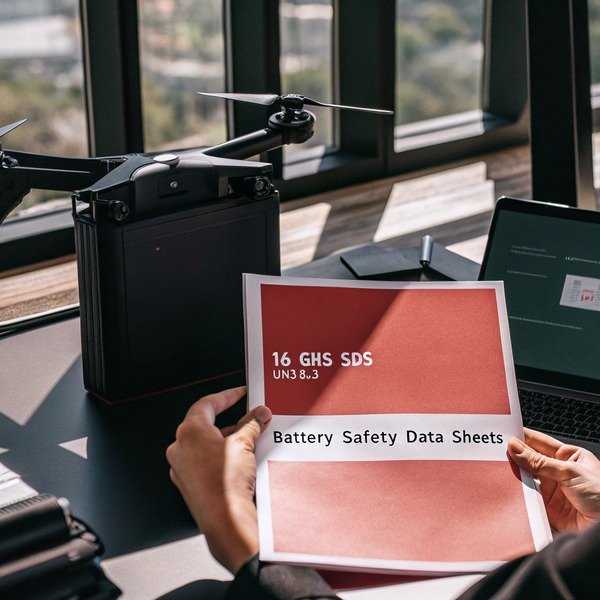
Seeing a high-capacity lithium battery catch fire is a nightmare, but seeing your urgent shipment detained at customs because of bad paperwork is a business disaster. In our factory, we prioritize the safety of the power systems we build, knowing that firefighting drones rely on massive energy reserves to lift thermal cameras and extinguishing agents. If you are importing these high-performance machines, you cannot afford to overlook the specific documentation required for dangerous goods.
To ensure compliance, you must request a current, 16-section GHS-compliant Safety Data Sheet (SDS) and a separate UN38.3 Test Summary Report. Additionally, you need proof of the battery’s Watt-hour rating and a document verifying its classification under UN3480 or UN3481 to determine the correct Class 9 Dangerous Goods packing instructions.
Navigating the regulations for lithium batteries can be confusing regulations for lithium batteries 1, but getting it right is the only way to guarantee your equipment arrives on time.
Besides the standard MSDS, do I also need UN38.3 test reports for shipping lithium drone batteries?
When we prepare our heavy-lift drones for export to the US or Europe, we often encounter clients who assume the MSDS is the only document they need. This misconception frequently leads to shipment rejections by air carriers. The MSDS describes the chemical hazards, but it does not prove the battery can survive the physical stress of an intercontinental flight.
Yes, the UN38.3 test report is legally mandatory for transport and is distinct from the MSDS. While the MSDS covers chemical safety and handling, the UN38.3 certifies that the specific battery pack has passed eight critical stress tests, including altitude, thermal shock, and vibration, ensuring it will not rupture during transit.

The distinction between these two documents is critical for any procurement manager. The Safety Data Sheet (SDS) is primarily a hazard communication document Safety Data Sheet (SDS) 2 intended for workers handling the batteries or emergency responders dealing with a spill or fire. However, the UN38.3 Test Summary Report is a transport-specific requirement derived from the UN Manual of Tests and Criteria UN Manual of Tests and Criteria 3. Without this, no reputable airline or shipping line will accept lithium batteries that exceed the very small limits found in consumer electronics.
The Eight Critical Tests (T1-T8)
Firefighting drones require batteries with high energy density, often pushing the limits of lithium-polymer (LiPo) technology. At our testing facility, we subject our battery packs to the T1 through T8 test sequence before they are ever certified for mass production. These tests simulate the extreme environments a package might encounter in the belly of a cargo plane or a container ship.
If a supplier says they have an MSDS but "don't have the UN38.3 report handy," that is a major red flag. It implies the battery has not been proven safe for transport. The UN38.3 report verifies that the battery management system (BMS) prevents short circuits battery management system (BMS) 4 and that the casing can withstand pressure changes.
Comparison of Testing Standards
To help you understand what you are asking for, we have broken down the specific tests included in the UN38.3 report versus what you find in a standard MSDS.
| Test Code | Test Name | Purpose of Test | Covered in MSDS? |
|---|---|---|---|
| T1 | Altitude Simulation | Simulates low pressure at 15,000 meters altitude. | Non |
| T2 | Thermal Test | Checks resistance to rapid temperature changes (-40°C to +75°C). | Non |
| T3 | Vibrations | Simulates vibration during transport (air/truck). | Non |
| T4 | Shock | Simulates impact during handling or rough landing. | Non |
| T5 | External Short Circuit | Verifies BMS prevents fire during a short circuit. | Non |
| T6 | Impact/Crush | Simulates physical damage to the cell. | Non |
| T7 | Overcharge | Ensures rechargeable batteries don't explode if overcharged. | Non |
| T8 | Forced Discharge | Tests cell safety during forced discharge conditions. | Non |
Why This Matters for Firefighting Drones
Firefighting drones operate in hostile environments. They face heat, water, and rapid movement. A battery that passes UN38.3 is not just safe for shipping; it indicates a baseline of mechanical ruggedness. When we source cells for our packs, we look for those that pass these tests with high margins. If you skip this request, you are not just risking a customs hold; you are potentially buying a battery that hasn't been verified against internal short circuits or vibration damage—flaws that could be catastrophic during a rescue mission.
How does the MSDS classification affect air freight options for my urgent firefighting drone orders?
Our logistics team spends a significant amount of time optimizing packaging to meet IATA regulations, especially for urgent orders going to California or other wildfire-prone regions. The way a battery is classified in the MSDS—specifically regarding its Watt-hour (Wh) rating and packing method—dictates whether your goods can fly on a passenger plane, must go on a cargo-only aircraft, or are stuck on a slow boat.
Classification dictates whether your batteries fly on passenger or cargo-only aircraft. Batteries over 100Wh generally require Class 9 handling and must be shipped at a 30% State of Charge (SoC). Misclassification under UN3480 or UN3481 can lead to immediate rejection by air carriers for urgent emergency shipments.

Understanding the difference between UN3480 and UN3481 is vital UN3480 and UN3481 5 for planning your lead times. UN3480 refers to lithium-ion batteries shipped on their own (loose batteries), while UN3481 covers batteries contained in equipment or packed with equipment. For firefighting drones, which almost always use large batteries exceeding 100Wh, the regulations are incredibly strict.
The Watt-Hour Threshold and Class 9 Designation
Most consumer drones have small batteries, but the heavy-lift units we manufacture for firefighting use batteries that range from 150Wh to over 400Wh per pack.
- <100Wh: These are easier to ship and have fewer restrictions.
- >100Wh: These are fully regulated Class 9 Dangerous Goods.
If your MSDS does not clearly state the Watt-hour rating, carriers will assume the worst. For loose batteries (UN3480) over 100Wh, they are strictly forbidden on passenger aircraft. They must travel on Cargo Aircraft Only (CAO). This significantly reduces the number of available flights and increases the shipping cost.
The 30% State of Charge (SoC) Rule
Since 2016, IATA has enforced a rule that standalone lithium-ion batteries (UN3480) must be shipped at a State of Charge (SoC) not exceeding 30% État de charge (SoC) 6. This is a critical safety measure to prevent thermal runaway propagation in the cargo hold. When we ship spare batteries to our distributors, we discharge them to this level before packaging.
If your supplier sends you an MSDS that lists the SoC at 50% or "fully charged," the shipment is non-compliant for air freight. You must ensure Section 14 of the MSDS or the accompanying transport declaration confirms compliance with the 30% limit.
Packing Instructions (PI) Breakdown
Here is how the classification in the MSDS directly impacts how we pack your order.
| Classification | Description | Packing Instruction (IATA) | Restrictions |
|---|---|---|---|
| UN3480 | Li-ion Batteries (Loose) | PI 965 | Strict. SoC ≤ 30%. Cargo Aircraft Only if >2.7Wh. Class 9 label required. |
| UN3481 | Packed avec Equipment | PI 966 | Batteries are loose in the box but with the drone. Limits on battery quantity per box. |
| UN3481 | Contained in Equipment | PI 967 | Batteries installed inside the drone. Often easier to ship but still subject to Wh limits. |
For a standard firefighting drone order, we usually ship the drone with batteries packed separately in the same carton (UN3481, PI 966) or install one set and pack extras separately. However, if you are ordering only replacement batteries, you are stuck with UN3480, PI 965, which is the most difficult and expensive method. Knowing this helps you plan: it is often smarter to bundle batteries with drone bodies to utilize the slightly more lenient UN3481 regulations.
How can I verify that the battery MSDS provided by my supplier is valid and internationally recognized?
We often see potential clients come to us after being burned by traders who provided "photoshop-engineered" documents. It is unfortunately common for some sellers to copy an MSDS from a major brand like DJI or LG and simply paste their own logo on top. Using these fake documents is a liability that falls on you as the importer of record.
To verify validity, check for GHS compliance with 16 standardized sections and ensure the issuance date is recent. You must cross-reference the battery model number on the physical label with the document and confirm Section 14 cites current IATA, IMDG, and UN Model Regulations for dangerous goods transport.

A valid MSDS (now technically referred to simply as SDS under GHS standards) acts as the passport for your products. If the passport is fake or expired, you are not going anywhere. The Global Harmonized System (GHS) mandates a specific 16-section format Global Harmonized System (GHS) 7. If the document you receive has only 4 or 8 sections, it is obsolete and will be rejected by US and European customs.
Key Sections to Audit
When our quality control team reviews documentation from our cell suppliers, we focus on specific areas that are often falsified or erroneous. You should do the same.
- Section 1 (Identification): Does the "Product Name" and "Model Number" match exactly what is printed on the battery casing? A mismatch of even one digit can cause a customs hold.
- Section 3 (Composition): Does it list the correct chemical components for the battery type? Firefighting drones typically use Lithium Polymer or high-density Lithium Ion. The chemical abstract service (CAS) numbers should match these chemistries chemical abstract service (CAS) numbers 8.
- Section 5 (Fire-Fighting Measures): This is crucial for your safety protocols. Does it specify the correct extinguisher? For lithium batteries, it should usually reference Class D extinguishers or copious amounts of water for cooling, rather than standard dry chemical agents which might be ineffective against a metal fire or electrolyte burn.
- Section 14 (Transport Information): This is where the rubber meets the road. It must reference the current year's edition of the IATA Dangerous Goods Regulations (DGR) IATA Dangerous Goods Regulations (DGR) 9. If it references a regulation from three years ago, the document is invalid.
Requesting the "Damaged/Defective" Protocol
One specific insight we have gained from years of exporting is the importance of the "Damaged/Defective" clause. Standard SDS documents cover new batteries. However, firefighting drones are rough-service tools. You should ask if the supplier has a protocol or specific documentation regarding Special Provision A154. This provision prohibits the air transport of batteries identified as damaged or defective. While this isn't standard in every basic MSDS, a top-tier supplier will provide a supplementary sheet or clear warning in Section 14 about A154, showing they understand the full lifecycle of the product.
Validation Checklist
Use this simple table to grade the documents your supplier sends you.
| Étape de vérification | Ce qu'il faut rechercher | Pass/Fail Indicator |
|---|---|---|
| GHS Format | Document has exactly 16 numbered sections. | If <16, FAIL. |
| Date Check | Issuance date is within the last 1-2 years. | If >3 years, FAIL. |
| Model Match | Model # on SDS matches Model # on Battery Label. | Any mismatch, FAIL. |
| Regulation Year | Section 14 cites current IATA/IMDG codes. | Old codes, FAIL. |
| Laboratory Stamp | Includes stamp/ID of an accredited 3rd party lab (e.g., CNAS). | No lab info, RISK. |
What happens to my shipment if the MSDS for the drone batteries is outdated or incomplete during customs clearance?
We have had to rescue shipments for new clients who previously bought from inexperienced sources, and the cleanup process is painful. When a shipment containing dangerous goods like high-capacity lithium batteries hits customs with bad paperwork, it doesn't just sit there—it enters a regulatory black hole.
If documentation is outdated or incomplete, customs will likely detain your shipment indefinitely, leading to exorbitant storage fees or forced destruction. Carriers may blacklist your company for non-compliance, and you risk heavy fines for undeclared dangerous goods, causing mission-critical delays for your firefighting operations.
The consequences of non-compliance extend far beyond a simple delay. In the world of dangerous goods (DG) logistics, safety is paramount. Customs officers and airline safety inspectors have zero tolerance for ambiguity because a battery fire on a plane is a life-threatening event.
The Financial Impact of "Seizure and Destruction"
If your MSDS is missing critical information—such as the emergency telephone number in Section 1 emergency telephone number 10 or the correct UN number in Section 14—the airline will refuse to lift the cargo. If this happens at the origin (in China), we can usually retrieve it, fix the paperwork, and reship. This costs time and money but is manageable.
However, if the error is caught at the destination (e.g., US Customs), the situation is dire. The authorities may deem the batteries as "undeclared dangerous goods." You cannot simply "mail in" a new PDF. The shipment is flagged. You will face:
- Frais de stockage : Warehouses charge high daily rates for DG storage.
- Fines: Civil penalties for DG violations can run into tens of thousands of dollars.
- Destruction Costs: You cannot ship the batteries back because the airline won't accept them. You are forced to pay a hazmat disposal company to destroy the brand-new batteries you just bought.
Long-Term Reputation Damage
Perhaps the most damaging aspect is the blow to your reputation. Importers are tracked by their tax ID. If you have a record of importing non-compliant dangerous goods, your future shipments will be subject to more rigorous inspections. For a procurement manager responsible for supplying emergency services, this unpredictability is unacceptable.
Mitigating the Risk
At our company, we mitigate this by "pre-clearing" documents. Before the goods leave our factory floor, we send digital copies of the SDS, UN38.3, and the Shipper's Declaration for Dangerous Goods to the freight forwarder. They validate everything against the carrier's specific rules (e.g., FedEx and DHL have stricter rules than the general IATA baseline). We strongly advise you to do the same: demand the documents avant you pay the final balance. If the supplier hesitates, it is better to delay the shipment than to risk a seizure.
Conclusion
Purchasing firefighting drones is an investment in public safety, but that investment is worthless if the equipment is stuck in a customs warehouse due to battery compliance issues. As a manufacturer, we see that the difference between a smooth delivery and a logistical nightmare often comes down to the quality of the paperwork. Always demand a recent 16-section MSDS/SDS, a valid UN38.3 Test Summary, and proof of proper classification. By verifying these documents upfront, you ensure that your team gets the tools they need to save lives, without being grounded by red tape.
Notes de bas de page
1. Official government guidance on lithium battery transport safety and regulations. ︎
2. Government standard defining the requirements and purpose of Safety Data Sheets. ︎
3. Official source for the international testing standards referenced in the article. ︎
4. Major manufacturer documentation explaining BMS technology and safety functions. ︎
5. Major logistics company guide detailing shipping differences between these classifications. ︎
6. Educational resource defining State of Charge in the context of battery engineering. ︎
7. General background information on the international system for chemical classification. ︎
8. Official organization managing the CAS registry for chemical substance identification. ︎
9. Official industry body setting the global standards for air transport of dangerous goods. ︎
10. Leading industry service provider for emergency response information in hazmat transport. ︎

 English
  Spanish
  German
  French
  Dutch
Dutch  Arabic
