
Seeing procurement budgets explode due to overlooked specifications is painful. When we finalize designs at our Xi’an facility, we often warn clients that small customization requests can drive up final prices significantly.
Critical details increasing OEM costs include upgrading payload capacity for heavy fire suppression systems, integrating thermal sensors with custom avionics, and developing proprietary ground station software. Additionally, requesting IP67-rated waterproofing and encrypted communication modules for long-range operations will significantly raise your manufacturing and certification expenses.
Let’s break down the specific cost drivers we see daily on our factory floor to help you plan your budget effectively.
How do higher payload capacity and extended flight time requirements impact my final OEM price?
Balancing weight and power is a nightmare for inexperienced buyers. In our testing lab, pushing payload limits often forces a complete redesign of the propulsion system, not just a simple motor swap.
Increasing payload capacity requires reinforcing the airframe structure and upgrading to high-torque motors, which directly raises material costs. Furthermore, extending flight time demands higher energy-density batteries and advanced power management systems, often doubling the price of the propulsion unit compared to standard models.
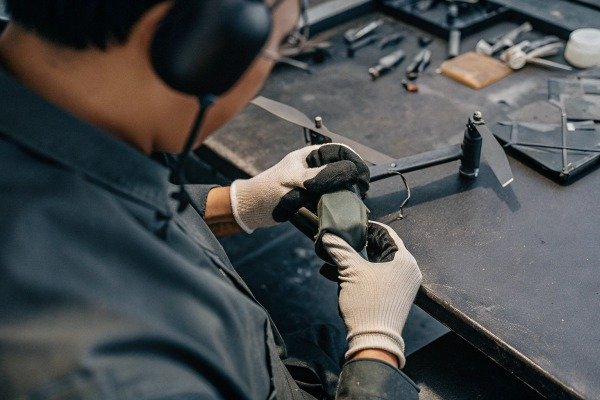
When we configure our SkyRover industrial drones for heavy-duty operations, the relationship between payload and cost is never linear—it is exponential. Many clients approach us requesting a drone that can carry 50kg of fire extinguishing balls while maintaining a 40-minute flight time. While technically feasible, achieving this balance requires a massive leap in component quality and cost.
The Ripple Effect of Structural Reinforcement
To support a heavy payload, such as a 62kg full load for fire suppression, we cannot simply use a standard carbon fiber frame. cadre en fibre de carbone 1 The arms must be thickened, and the central chassis—often featuring our signature bright orange housing—needs internal alloy bracing to prevent structural fatigue.
If you require a payload capacity increase from 20kg to 50kg, we must upgrade the motors payload capacity increase 2 to heavy-lift industrial versions. These motors use higher-grade magnets and heat-resistant coils, which cost significantly more than standard propulsion systems. Additionally, larger electronic speed controllers (ESCs) are needed to handle the increased amperage electronic speed controllers (ESCs) 3, further driving up the bill of materials.
The Battery Density Dilemma
Flight endurance is the most expensive metric to improve. A standard LiPo battery offers a cost-effective solution for short missions. However, if you demand extended flight times (over 30 minutes) while carrying a heavy payload, we must source high-voltage, high-energy-density high-energy-density batteries 4 batteries. These batteries are not only more expensive to manufacture but also require specialized charging infrastructure, which you must purchase as part of the package.
Below is a breakdown of how payload and endurance specifications typically impact the OEM cost structure for a standard quadcopter platform.
| Requirement Level | Payload Capacity | Flight Time (Loaded) | Structural Impact | Estimated Cost Increase |
|---|---|---|---|---|
| Standard | 10kg – 15kg | 15 - 20 minutes | Standard Carbon Fiber | Base Price |
| Mid-Range | 20kg – 35kg | 20 – 25 mins | Reinforced Arms & Joints | +30% – 45% |
| Heavy-Duty | 50kg – 100kg+ | 10 - 15 minutes | Custom Alloy/Composite Frame | +80% – 120% |
| Long-Endurance | 10kg – 20kg | 40+ mins | Hybrid Power / High-Density Cells | +60% – 90% |
Prioritizing a "do-it-all" drone often leads to diminishing returns. We advise clients to assess their actual mission profile: does the drone need to extinguish the fire directly, or is it primarily for spotting? A scouting drone does not need the heavy-lift expensive motors, saving you substantial capital.
Will requesting custom software integration or proprietary ground station features increase my development costs?
Generic software fails in high-stakes fires. When our software team integrates AI hotspot detection for US clients, we see development hours skyrocket compared to using standard flight applications.
Custom software integration significantly increases costs due to the need for dedicated engineering teams to code, test, and debug proprietary protocols. Developing unique ground station features, such as multi-drone coordination or AI-driven fire analysis, involves substantial R&D fees and ongoing maintenance charges for firmware updates.

Hardware is often a one-time cost, but software is where development budgets can spiral if not managed carefully. In our interactions with US procurement managers like yourself, we often see requests for "simple" software tweaks that actually require rebuilding the entire flight control architecture.
The Hidden Costs of SDK and API Integration
Many fire departments require their drones to integrate with existing command center software. To achieve this, we must open our SDK (Software Development Kit) or customize the API (Application Programming Interface). API (Application Programming Interface) 5 This isn't just about flipping a switch. It involves rigorous testing to ensure that our flight controller talks perfectly to your proprietary systems without latency.
If you require features like automated hotspot detection using thermal cameras, our engineers must write custom algorithms that process video feeds in real-time. This requires upgrading the onboard computer to a more powerful processor (like an NVIDIA Jetson module NVIDIA Jetson module 6), which adds hardware cost on top of the software development fees.
Ground Control Station (GCS) Customization
A standard GCS allows for manual flight and basic waypoints. However, if you request features such as:
- Swarm Control: One pilot controlling multiple drones.
- Encrypted Data Links: AES-256 encryption for secure video transmission.
- 3D Mapping Overlay: Real-time fire line mapping on a topographical map.
These features move the product from a standard tool to a specialized military-grade system. We have to license specific communication protocols and pay our software developers for hundreds of hours of coding and UI/UX design.
Impact of Software Customization on Timeline and Budget
Unlike hardware, where we can estimate material costs easily, software development is time-intensive. A fully custom GCS can delay delivery by 3-6 months and add tens of thousands of dollars to the NRE (Non-Recurring Engineering) fees.
| Fonctionnalité du logiciel | Complexité | Hardware Impact | Development Cost Impact |
|---|---|---|---|
| Standard Flight App | Faible | Aucun | Included in Base Price |
| Custom Branding (Logo) | Faible | Aucun | Minimal ($500 – $1,000) |
| Encrypted Video Link | Moyen | Specialized Radio Modules | Moderate (+$2k – $5k per unit) |
| AI Fire Detection | Haut | AI Processor (e.g., Jetson) | High (+$10k+ NRE + Hardware) |
| Multi-Agent Swarm | Très élevé | Advanced Comms & Processors | Very High (Custom Quote) |
For most distributors, we recommend starting with our standard professional software and paying only for the specific API modules you truly need, rather than building a new system from scratch.
Do I need to budget extra for heat-resistant materials and ruggedized components specific to firefighting?
Standard plastic melts near wildfires. We strictly advise our partners that using consumer-grade materials for industrial heat exposure is a liability that ultimately costs more in failed missions.
You must budget extra for specialized heat-resistant composites and active cooling systems to prevent electronic failure in high-temperature zones. Ruggedized components, including IP-rated ingress protection against water and dust, utilize expensive sealing materials and rigorous testing procedures that add a 20-50% premium to the base unit price.
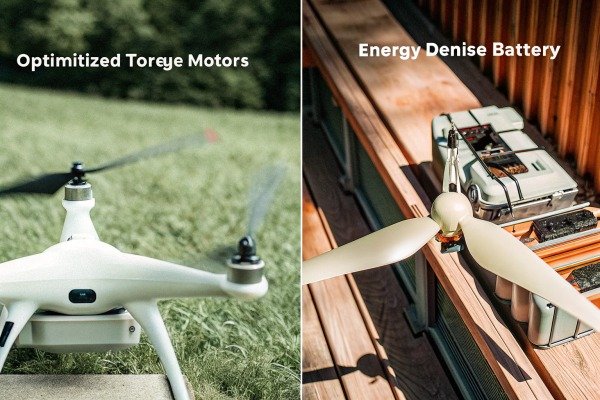
When a drone hovers near a blaze to deploy a fire extinguishing ball, the ambient temperature can spike rapidly. A standard agricultural or photography drone is not built for this environment. To ensure reliability, we have to swap out standard materials for specialized industrial alternatives.
High-Temperature Composite Materials
For the frame and propellers, standard carbon fiber is generally sufficient, but the resin used to bind the fibers matters. Cheap resins soften at high temperatures. We use high-TG (glass transition temperature) resins for our firefighting lines. Furthermore, the bright orange housing on our units isn't just painted plastic; it is often molded from high-impact, fire-retardant polycarbonate or specialized fiberglass composites that resist warping under radiant heat. This material upgrade affects the raw material cost and the molding process.
Active Cooling for Avionics
The flight controller and ESCs (Electronic Speed Controllers) generate their own heat. When you add high external temperatures, these components can overheat and shut down mid-flight—a catastrophic failure mode.
- Standard Drones: Rely on passive airflow.
- Firefighting Drones: Require active cooling systems, such as internal fans with filtered intakes or heat sinks integrated directly into the aluminum chassis.
Designing these airflow channels while maintaining water resistance is an engineering challenge that drives up design costs.
Ingress Protection (IP Rating) Cost Drivers
Firefighting involves water, foam, and ash. A drone with open vents will die quickly. Achieving an IP65 or IP67 rating IP65 or IP67 rating 7 (dust tight and water resistant) requires:
- Conformal Coating: Dipping all circuit boards in protective chemicals.
- Sealed Connectors: Using expensive, waterproof aviation plugs instead of standard USB or pin headers.
- Gaskets and Seals: Every seam in the body must be lined with custom silicone gaskets.
Each of these steps adds manual labor time to the assembly line. Testing for IP certification is also a separate cost; we must pay third-party labs IP certification 8 to blast the drone with water jets to prove it survives, a cost we must pass on to the OEM buyer.
Does modifying the airframe structure for unique branding or deployment needs drive up the manufacturing expense?
A unique look builds your brand, but molds are expensive. Whenever we open a new mold for a client’s custom orange housing, the initial tooling fees become a major line item.
Modifying the airframe for unique branding or deployment mechanisms drives up expenses by requiring new injection molds and structural re-engineering. Customizing the chassis for specific mounting points or folding designs incurs high non-recurring engineering (NRE) costs and extends the prototyping phase before mass production begins.
Many of our US clients want their drones to look unique to differentiate themselves from competitors. They might ask for a sleek, aerodynamic fuselage or a specific folding mechanism to fit into fire trucks. While we love innovation, structural changes are the fastest way to burn through a budget.
The Reality of Mold Costs
If you are happy with our existing cross-shaped frame and orange housing, branding is cheap—we just apply a decal or change the paint color. However, if you want to change the shape of the central body or the arms:
- Injection Molds: A new steel mold for a plastic housing can cost between $5,000 and $20,000 depending on complexity.
- Carbon Fiber Molds: Creating custom-shaped carbon fiber tubes or plates requires precision aluminum molds, which are also costly. precision aluminum molds 9
Unless you are ordering 500+ units, these tooling costs amortized over a small batch will make the per-unit price unfeasible.
Modular Deployment Systems
Firefighting drones often need to swap payloads: a camera for scouting, a drop mechanism for fire balls, or a nozzle for hoses.
Designing a quick-release interface that carries both power and data is complex.
- A fixed mount is cheap (screws and cables).
- A generic rail system is moderate.
- A proprietary "click-and-fly" system requires custom machining and PCB design for the connector interface.
Durability vs. Foldability
Firefighters need drones that deploy in seconds. Making a large 1500mm wheelbase drone fold down into a compact box requires complex hinges. These hinges are structural weak points. To make them durable enough for industrial use, we use CNC-machined aviation aluminum CNC-machined aviation aluminum 10 rather than cast metal or plastic. The machining time for these custom joints significantly adds to the manufacturing cost.
Below is a comparison of customization levels regarding airframe structure.
| Niveau de personnalisation | Description | Tooling Cost (NRE) | Unit Cost Impact | Lead Time Impact |
|---|---|---|---|---|
| Level 1: Cosmetic | Paint, Logo, Stickers | Low (<$500) | Négligeable | +1 Week |
| Level 2: Minor Mod | Mounting holes, Landing gear height | Moderate ($1k-$3k) | Low (+5%) | +2-3 Weeks |
| Level 3: Major Mod | Custom Housing Shape, Folding Arms | High ($10k-$30k) | High (+20%) | +2-3 Months |
| Level 4: Full Custom | Complete Airframe Redesign | Very High ($50k+) | Very High (+50%+) | +6 Months |
For a procurement manager like yourself, the sweet spot is usually Level 2: using our proven airframe but modifying the mounting points to fit your specific payload equipment.
Conclusion
Successful OEM projects balance technical ambition with strict budget realities. By identifying these cost drivers early—specifically payload upgrades, software R&D, and structural molds—you ensure your fleet is mission-ready without suffering unexpected financial setbacks.
Notes de bas de page
1. ISO standard for the determination of tensile properties of carbon-fiber-reinforced plastics. ︎
2. Official FAA guidelines for commercial drone operations and weight classifications. ︎
3. Academic research on the thermal performance and efficiency of electronic speed controllers in multirotor drones. ︎
4. Authoritative government resource explaining energy density in battery materials. ︎
5. General overview of how APIs facilitate communication between different software systems. ︎
6. Official manufacturer documentation for the specific AI processor mentioned. ︎
7. Official international standards body defining Ingress Protection (IP) codes. ︎
8. International standard for ingress protection ratings for electronic equipment. ︎
9. General information on different types of industrial molds used in manufacturing. ︎
10. Industry association detailing aluminum applications in aerospace manufacturing. ︎

 English
  Spanish
  German
  French
  Dutch
Dutch  Arabic
