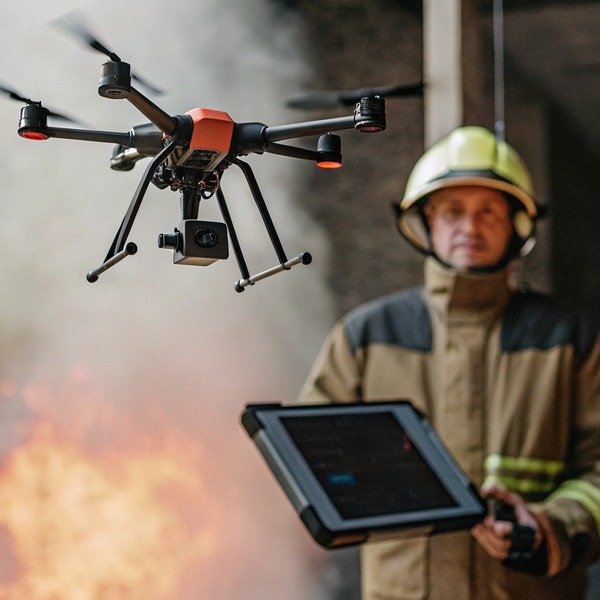
Firefighters often struggle to interpret raw thermal data during active blazes, leading to costly delays in critical decision-making. Firefighters often struggle 1 When we design our flight systems at the factory, we see firsthand how confusion arises when operators must mentally combine two separate video feeds.
To confirm dual-light fusion, verify the datasheet lists “Bi-spectrum” or “Multi-sensor” payloads with simultaneous 640×512 thermal and high-resolution optical sensors. Check for software features like “Picture-in-Picture” or “MSX” that explicitly mention edge-blending or real-time overlay, rather than just switching between separate video feeds.
Here is exactly how to verify these critical features before you invest in your fleet.
What technical specifications on the datasheet confirm the presence of dual-light fusion?
Reading complex spec sheets can feel frustrating when suppliers hide details behind vague marketing terms. Our engineering team ensures transparency in our documentation to prevent mismatched expectations for buyers who need precise situational awareness.
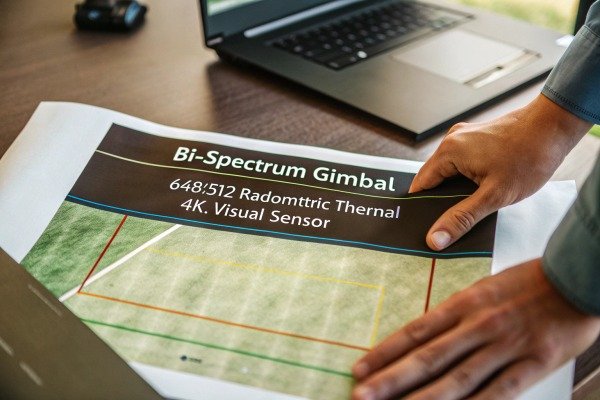
Look for terms like “Hybrid Payload,” “Bi-spectrum Gimbal,” or “Intelligent Mix” in the camera section. True fusion requires two distinct sensor resolutions, such as a 640×512 radiometric thermal core paired with a 4K visual sensor, processing both streams simultaneously for edge-blended output.
Decoding the Language of Specifications
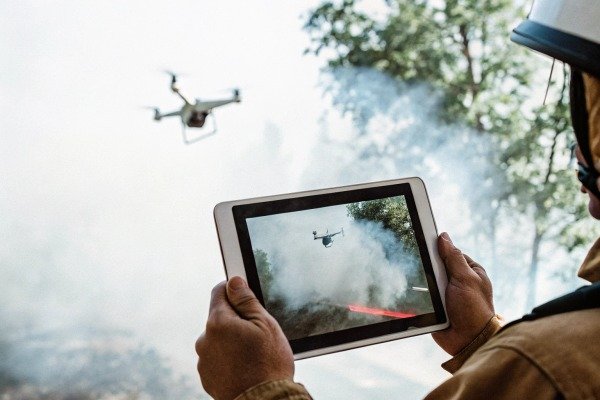
When reviewing datasheets from various suppliers, the terminology can often be misleading. In our experience exporting to the US and Europe, we have noticed that many lower-end manufacturers use the term "dual-camera" to simply mean that the drone carries two lenses. However, this does not guarantee fusion. Fusion is a computational process, not just a hardware configuration.
To ensure you are getting true dual-light fusion, you must look for indications of simultaneous image processing. The datasheet should list a high-performance image signal processor (ISP) or specific output modes. image signal processor 2 If the specification sheet only lists "Switching Mechanism" or "Single Video Stream Selection," the drone likely does not support fusion. True fusion requires the system to take the edge details from the visible light camera (the RGB outlines of doors, windows, and bodies) and imprint them onto the thermal layer.
Critical Resolution Ratios
Another technical indicator is the resolution pairing. Effective fusion requires a high-fidelity visual source to provide the "skeleton" for the thermal "flesh." If the visual camera resolution is too low, the overlay will look blurry and useless. Conversely, if the thermal resolution is below 320×256, the heat map will be too pixelated to align correctly with the sharp 4K visual lines.
We recommend looking for a specific ratio in the specs. A 640×512 thermal sensor paired with a 12MP or higher optical sensor creates the most effective fusion. This density allows the software to align pixels accurately. Below is a breakdown of terms we often see and what they actually mean for your mission capability.
Table 1: Spec Sheet Keywords vs. Real Functionality
| Marketing Term | What It Often Means | Does It Support Fusion? |
|---|---|---|
| Bi-spectrum / Hybrid Payload | The hardware has two sensors and usually supports simultaneous data streams. | Likely Yes |
| Dual-Lens Camera | Two lenses exist physically, but you may only be able to view one at a time. | Uncertain (Check Software) |
| MSX (imagerie dynamique multispectrale) | A specific FLIR technology that embosses visible edges onto thermal video. | Yes (High Quality) |
| PiP (Picture-in-Picture) | One view is a small box inside the other; they are not overlaid or fused. | Non |
| IR-Cut Filter | Refers to night vision capabilities of the RGB lens, not thermal fusion. | Non |
processing Power and Transmission
Finally, check the video transmission specs. video transmission 3 Fusing two 4K and thermal streams requires significant onboard processing power before the image is sent to your controller. If the datasheet mentions "FPGA-based processing" or "AI-ISP," it is a good sign that the drone handles the fusion onboard. Systems that rely on the remote controller (tablet) to do the fusion often suffer from lag, which is dangerous in a fire.
Why is the overlay of visible light and thermal imaging critical for my firefighting missions?
Missing a victim because of thermal wash-out is a nightmare scenario that keeps incident commanders awake at night. incident commanders 4 We build our drones to eliminate this risk by combining visual context with heat data, ensuring no detail is lost in the smoke.
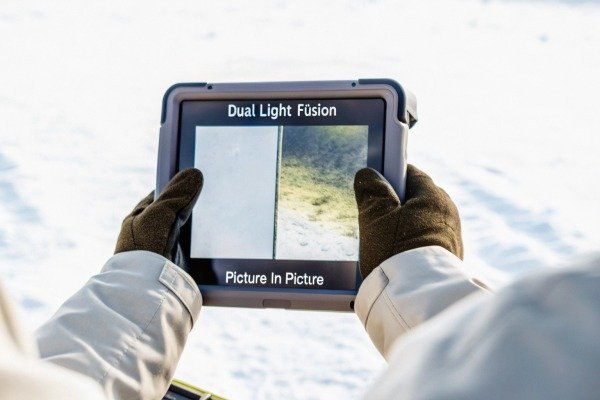
Overlay technology, or fusion, superimposes high-contrast edge details from the visible camera onto the thermal heat map. This allows operators to read signage, identify structural obstacles, and locate victims instantly without mentally switching between two different video feeds during high-stress operations.
The Danger of Context Loss
In our testing facilities in Xi'an, we simulate dense smoke environments to calibrate our sensors. imagerie thermique 5 We have found that raw thermal imaging, while excellent for detecting heat, is terrible for context. A thermal image shows a bright blob that could be a victim, a burning chair, or a sun-heated rock. Without visual context, a pilot cannot tell if that heat source is in a bedroom or a hallway.
Dual-light fusion solves this by overlaying the "lines" of the real world onto the "colors" of the heat world. You can see the outline of the door frame (visible light) and the intense heat seeping from underneath it (thermal). This allows firefighters to navigate complex structures. For example, in an attic fire, the thermal feed might show the entire roof is hot. The fusion display, however, will show the rafters and structural beams, allowing the commander to see exactly which part of the roof is about to collapse.
Enhancing Pilot Orientation
Spatial disorientation is a major cause of drone crashes in firefighting. Spatial disorientation 6 When a pilot switches from a standard RGB view to a thermal view, the screen often turns into a wash of oranges and purples. It takes the human brain several seconds to re-orient. In a fast-moving fire, those seconds matter.
Fusion display maintains the visual horizon and recognized landmarks. If you are flying near power lines, the thermal sensor might not pick up the thin cables if they are at ambient temperature. The visual sensor will see them. By fusing these views, the pilot avoids the hazard while still tracking the fire's hotspot. This safety layer is why we prioritize fusion algorithms in our flight controllers.
Operational Efficiency and Evidence
Beyond safety, fusion provides better evidence for post-incident analysis. A raw thermal video is often hard to interpret later ("Is this the north or south wall?"). A fused video clearly shows the building number or street sign alongside the heat signature.
Table 2: Operational Risks Without Fusion
| Scenario | Raw Thermal View Only | Dual-Light Fusion View |
|---|---|---|
| victim Search | Shows a heat signature but cannot confirm if it is a person or an appliance. | Shows the outline of limbs or clothing over the heat signature. |
| Structural Integrity | Shows general heat spread; cold structural beams disappear in the dark. | Shows cracks, beams, and debris clearly defined against the heat. |
| Évitement des obstacles | Thin wires, fences, or glass windows are invisible if they match air temp. | Visual camera captures wires/glass; pilot avoids crashing. |
| Signage Reading | Cannot read hazmat placards or room numbers. | Can read text on doors/signs while monitoring temperature. |
How can I test the accuracy of the fusion display during a supplier demonstration?
Demos often look perfect in controlled rooms but fail in the field where precision is non-negotiable. When we host clients at our flight base, we encourage rigorous stress testing to reveal any misalignment between sensors.
Request a live flight demonstration where you adjust the “blending ratio” or transparency of the overlay. Test the “Isotherm” settings on heat sources and check for parallax errors by flying close to objects; the thermal and visual lines must align perfectly without significant lag.
The Parallax Alignment Test
One of the most common issues we address during our assembly process is parallax error. parallax error 7 Because the thermal lens and the visual lens are physically separated by a few centimeters on the payload, the images they capture are from slightly different angles. At long distances (over 50 meters), this doesn't matter. But for firefighting drones flying close to a window (5-10 meters), the images can become misaligned.
During a demo, ask the supplier to fly the drone within 5 meters of a distinct object, like a vehicle or a person. Watch the screen. Does the thermal "ghost" of the person float next to their visual body? If the thermal overlay is shifted to the left or right, the fusion is inaccurate. High-quality systems use software algorithms to automatically correct this parallax based on the focus distance. If you see "ghosting" or misalignment, the drone will be difficult to trust in a tight crawl space or attic inspection.
Testing Latency and Lag
Fusion requires the drone's processor to stitch two 4K/HD video streams together in real-time. This is computationally heavy. We often see competitors' drones freeze or stutter when Fusion Mode is activated.
To test this, ask the pilot to yaw (spin) the drone quickly while in Fusion Mode. Does the video feed stutter? Does the thermal overlay "trail" behind the visual image? In a real fire, you need smooth 30Hz or 60Hz feedback. If the overlay lags, you might steer into an obstacle you thought was clear. Real-time processing must be truly real-time.
Verifying Isotherm Functionality
A good fusion display should allow you to interact with the data, not just watch it. Ask the supplier to enable "Isotherms" (highlighting specific temperature ranges) while in Fusion Mode. You should be able to set the drone to only colorize temperatures above 500°F (fire) while keeping the rest of the image in black-and-white visual detail.
This feature is critical for spotting hotspots without the screen becoming a chaotic rainbow of colors. If enabling Isotherms forces the camera out of Fusion Mode and back into raw thermal, the system is not advanced enough for professional firefighting.
Table 3: Supplier Demo Checklist for Fusion Verification
| Test Action | Ce qu'il faut rechercher | Red Flag (Do Not Buy) |
|---|---|---|
| Parallax Check | Fly close (5m) to a target. | Thermal image is offset/misaligned from the visual object. |
| Rapid Yaw/Pan | Spin the drone quickly. | Video stutters, freezes, or thermal layer lags behind visual. |
| Transparency Slider | Adjust the mix of Thermal vs. Visual. | Feature missing; only "On/Off" toggle available. |
| Smoke/Fog Test | Fly through smoke (if safe/permitted). | Visual camera washes out completely, ruining the thermal view. |
| Zoom Synchronization | Zoom in 10x. | Thermal and Visual cameras zoom at different rates or lose alignment. |
Which camera payloads or sensor modules should I look for to ensure high-quality image fusion?
Choosing the wrong payload renders the drone useless for rescue, regardless of how well the aircraft flies. Our assembly line integrates specific high-end modules to guarantee reliable data fusion for our export markets.
Prioritize payloads like the DJI Zenmuse H20T or FLIR-based modules that support MSX technology. Ensure the thermal sensor offers at least 640×512 resolution and radiometric capabilities, while the visual camera should feature low-light performance to maintain edge detail in smoky or dark environments.
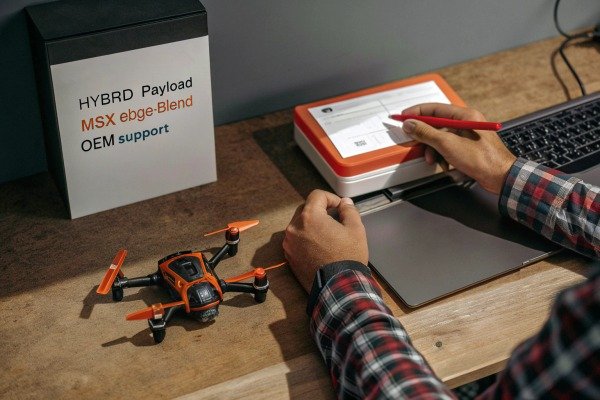
The Gold Standard: Radiometric 640×512 Sensors
In our manufacturing experience, cost-cutting often happens in the thermal core. Some suppliers will offer a 320×256 resolution sensor or even smaller. While these are cheaper, they lack the pixel density to support effective fusion. When you stretch a small 320p thermal image over a 4K visual image, the alignment is impossible to get perfect.
You should insist on a 640×512 radiometric thermal sensor. The term "radiometric" means that every pixel in the image contains temperature data. This allows the fusion software to be smart—it can choose to only overlay the visual edges on parts of the image that are "cold," leaving the "hot" parts fully thermal. This intelligent masking is only possible with high-resolution, radiometric data.
The Role of the Visual Sensor
Many buyers focus solely on the thermal specs and forget the visual camera. thermal specs 8 However, fusion is a partnership. If the visual camera cannot see in low light, there are no edges to overlay. Firefighting often happens at night or in smoke-choked rooms where light is scarce.
We recommend looking for visual sensors with large pixel sizes (like those found in 1-inch CMOS sensors) or dedicated "Starlight" or "Night Scene" modes. If the visual camera has a high ISO sensitivity (e.g., ISO 12,800 or higher), it can pick up the faint outlines of walls and furniture even in near-total darkness. This visual data is then fed into the fusion engine. If the visual camera is just a standard daytime camera, your fusion display will go black as soon as the sun sets.
Integrated Gimbals vs. Modular Payloads
There is a debate between integrated cameras (built into the drone body) and detachable gimbals. H20T style 9 For firefighting, we strongly recommend detachable, multi-sensor gimbals (like the H20T style).
The reason is upgradability and repair. If the fusion sensor is damaged by intense heat (which happens), you can replace just the gimbal. Furthermore, high-end gimbals often have their own dedicated processors for image fusion, relieving the drone's main CPU of the burden. This results in smoother video and lower latency. Integrated cameras often share the drone's main processor, leading to the lag issues we discussed earlier.
Key Components to Look For
When scanning the component list, look for these specific attributes:
- Laser Rangefinder: Often included in top-tier fusion payloads. It adds distance data to the fusion view, helping pinpoint exact coordinates of a fire.
- Global Shutter: For the visual camera. It prevents "jello" effects during fast flight, keeping the edges sharp for the overlay.
- IP Rating on the Gimbal: Ensure the camera module itself is IP44 or IP45 rated. Fusion fails if water gets between the lenses or fogs up the internal glass.
Conclusion
Purchasing a firefighting drone is an investment in safety, not just technology. firefighting drone 10 To ensure your equipment truly features dual-light fusion, verify the datasheet for simultaneous processing specs, demand a parallax demonstration, and prioritize high-resolution radiometric sensors. True fusion clarity saves lives.
Notes de bas de page
1. Official research on fire safety technology and operational standards. ︎
2. Technical standards for image signal processing in multi-sensor systems. ︎
3. International standards for wireless video transmission protocols and frequencies. ︎
4. Official guidance for incident commanders on emergency operations and technology. ︎
5. General background on thermal imaging and data interpretation principles. ︎
6. Research on drone technology assisting firefighters with spatial awareness in smoke. ︎
7. Scientific explanation of optical parallax in multi-lens camera systems. ︎
8. Manufacturer documentation for professional thermal imaging and radiometric equipment. ︎
9. Technical specifications for industry-standard multi-sensor drone payloads. ︎
10. News report on the global adoption of drones in firefighting. ︎

 English
  Spanish
  German
  French
  Dutch
Dutch  Arabic
