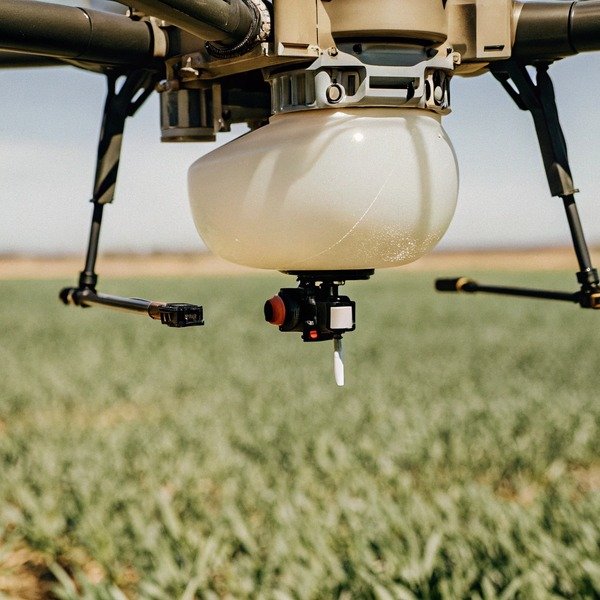
When we design our flight control systems at SkyRover, we constantly battle against competitors who publish impossible performance numbers. It is frustrating for buyers like you who need reliable tools for the farm, not marketing fluff that fails in the field.
To identify exaggerated claims, cross-reference the advertised flight time with the battery capacity and full payload weight. Compare the motor KV rating against propeller size to ensure sufficient torque, and verify that flow rates match the pump capacity rather than just the nozzle maximums.
Let's break down the specific technical data you need to analyze to verify a supplier's promises before you sign a contract.
How can I determine if the flight time listed in the brochure is realistic for a fully loaded drone?
Testing in our Chengdu facility reveals that real-world battery drain during spray operations is vastly different from laboratory hover results. You cannot afford operational downtime based on false endurance promises.
Calculate realistic flight time by subtracting 40% to 50% from the "no-load" hover time listed in the manual. True operational endurance includes the energy cost of lifting a full tank, maneuvering against wind, and maintaining a 20% battery safety margin for return and landing.

When you look at a brochure, the flight time is often the first number that catches your eye. However, in our industry, this number is frequently the most manipulated. Suppliers often measure flight time in a windless indoor room with an empty tank. This is not how you use the machine. To find the truth, you must look at the physics of the drone under load.
The Physics of Payload and Power
A drone carrying 40 liters of liquid fights gravity much harder than an empty one. To keep that weight in the air, the motors must spin faster. This increases the amperage draw from the battery significantly. If a supplier claims a 20-minute flight time with a full payload, you should immediately check the battery capacity (measured in mAh) and voltage.
For example, a standard 30,000 mAh battery simply cannot support a heavy-lift drone for 20 minutes while spraying. The math does not work. You should ask the supplier for the "hover current" at MTOW Poids maximal au décollage 1 (Maximum Takeoff Weight). If they cannot provide this, or if the number seems surprisingly low, they are likely exaggerating.
The Hidden Impact of Logistics
Real-world spraying involves more than just flying in a straight line. You have to take off, fly to the start point, turn at the end of every row, and fly back to home. Turning consumes more power than hovering because the motors must ramp up to change the drone's momentum.
Furthermore, you can never fly a battery down to 0%. For safety, you must land with about 20% to 25% power remaining. This "unusable" capacity is often included in the brochure's total flight time. By subtracting the safety margin and the energy cost of a full load, you get the actual productive time.
Realistic Flight Time Estimates
Use this table to benchmark claims you see in brochures. If a number is significantly higher than these ranges, treat it as a red flag.
| Drone Class (Tank Size) | Typical Battery Setup | Realistic Flight Time (Full Load) | Exaggerated Claim (Red Flag) |
|---|---|---|---|
| Small (10 Liters) | 12S 16,000 mAh | 10–12 minutes | > 18 minutes |
| Medium (30 Liters) | 14S 28,000 mAh | 12–14 minutes | > 22 minutes |
| Large (50 Liters) | 14S 30,000 mAh (Dual) | 13–15 minutes | > 25 minutes |
What motor and propeller data should I analyze to confirm the drone can actually handle the advertised payload?
Our engineers often find competitors using undersized motors to cut manufacturing costs, which risks overheating during heavy lifts in hot weather. You need hardware that is built to last, not just barely fly.
Analyze the thrust-to-weight ratio; a fully loaded agricultural drone requires a ratio of at least 1.8 to 2.0 to fly safely. Also, check that low KV motors (80-120KV) are paired with large propellers, as high KV motors lack the torque needed for heavy lifting.
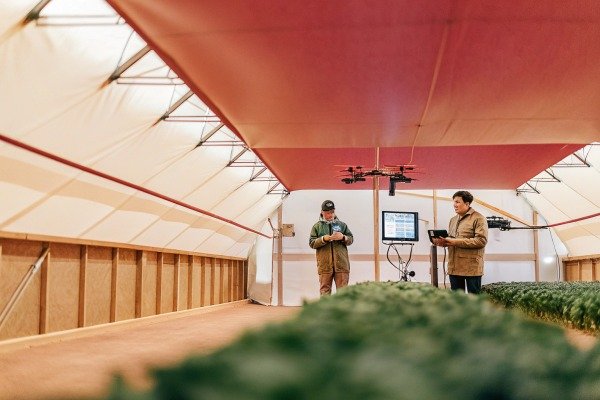
The propulsion system is the heart of any agricultural drone. If the motors are too weak, the drone will feel sluggish and may crash if a sudden gust of wind hits it. To verify a supplier's payload claim, you need to look at the motor KV rating and the propeller size. These two numbers tell you if the drone has enough torque.
Understanding KV Ratings
The "KV" rating on a motor indicates how many revolutions per minute (RPM) it turns per volt. In the drone world, a lower KV number means higher torque, while a higher KV number means higher speed. Agricultural drones are heavy lifters, like tractors in the sky. They do not need to fly fast; they need to lift heavy tanks.
Therefore, you should look for low KV motors. A drone carrying 40kg should typically use motors in the 80KV to 120KV range. If you see a heavy-lift drone listing 300KV or 400KV motors, be very careful. Those motors will have to spin incredibly fast to generate lift, which generates excess heat and reduces efficiency. This often leads to motor burnout after just a few months of operation.
The Role of Propeller Size
Propellers work in tandem with the motor. To lift a heavy load efficiently, you need to move a large volume of air. This requires large propellers. A common mismatch we see in cheap drones is a high-payload claim paired with small propellers.
Small propellers (under 28 inches for a 30kg payload) have to spin furiously to keep the drone airborne. This creates instability. Large propellers (30 inches to 40 inches) bite into the air better and provide a stable platform for spraying. If a brochure shows a 50kg payload but the propellers look small compared to the body, ask for the propeller diameter specifications immediately.
Thrust-to-Weight Ratio (TWR) Benchmarks
The Thrust-to-Weight Ratio is the most critical safety metric. Thrust-to-Weight Ratio 2 It compares the maximum thrust of all motors combined to the total weight of the drone when fully loaded.
| Composant | Pourquoi c'est important | Ideal Spec for Heavy Lift | Panneau d'avertissement |
|---|---|---|---|
| KV Rating | Determines torque vs. speed. | 85 KV – 120 KV | > 180 KV for large drones |
| Propeller Size | Affects lift efficiency. | 30 inches – 48 inches | < 28 inches for 30L+ tanks |
| TWR | Determines maneuverability. | 1.8 – 2.2 | < 1.6 (Dangerous in wind) |
Which specific battery parameters help me expose inflated power endurance figures in the datasheet?
We source high-discharge lithium cells for our packs because standard batteries overheat and degrade rapidly under spray loads. Do not let cheap battery cells ruin your operation with unexpected power failures.
Examine the continuous discharge rate (C-rating) and the voltage sag under load. Inflated endurance figures often rely on low-discharge tests that do not reflect the high-current demands of spraying, which causes voltage to drop quickly and triggers early low-battery warnings.

Batteries are the most expensive consumable in your drone operation. Suppliers often manipulate two specific areas regarding batteries: the lifespan (cycle life) and the power delivery. Understanding these can save you thousands of dollars in replacement costs.
The C-Rating Myth
The C-rating measures how fast a battery can discharge energy safely. C-rating 3 Agricultural drones demand massive bursts of power, especially during takeoff or when braking at the end of a spray line. If a battery has a low C-rating (e.g., 5C or 10C), it cannot release energy fast enough.
When this happens, the voltage "sags" or drops temporarily. The flight controller sees this voltage drop and thinks the battery is empty, triggering an automatic landing return and landing 4 even if the battery still has 40% capacity left. Suppliers often quote flight times based on gentle, low-amp hovering where voltage sag doesn't happen. In the real world, a low C-rating battery will force you to land much sooner than the brochure promises. low C-rating battery 5
Cycle Life vs. Charging Speed
Everyone wants fast charging. Suppliers now advertise "Ultra-Fast 9-Minute Charging." While this is technically possible, they often hide the impact this has on the battery's lifespan.
Charging a lithium battery at extreme speeds generates immense heat. lithium battery 6 Heat is the enemy of battery life. A supplier might claim their battery lasts for 1,000 cycles. However, there is usually a footnote: those 1,000 cycles are only achieved if you charge it slowly (standard charge). If you use their "Ultra-Fast" charger every time, the battery might only last 400 cycles before it swells and fails.
Interpreting Battery Data
You should ask for the warranty terms on the battery cycles specifically under fast-charging conditions. Many warranties become void if you exclusively use fast charging, yet the sales team will use the fast charge speed as a main selling point.
| Spécifications | Marketing Claim | Technical Reality Check |
|---|---|---|
| Charging Speed | "Fully charged in 9 minutes" | Often reduces total lifespan by 40-50%. |
| Cycle Life | "Guaranteed 1,000 cycles" | Ask: "Is this at 1C charge rate or 5C charge rate?" |
| Capacity | "High Capacity 30,000 mAh" | Check weight. If it's too light, energy density claims may be false. |
What are the most common red flags in technical charts that suggest a supplier is overpromising on performance?
When we analyze market trends for our export partners, we spot subtle tricks in data presentation that mask serious product flaws. You must recognize these warning signs immediately to avoid purchasing inadequate equipment.
Watch for spray width claims that ignore flight height or droplet size consistency. Another red flag is an IP67 rating without warranty coverage for water damage, or flow rate specifications that exceed the physical capacity of the installed pump system.
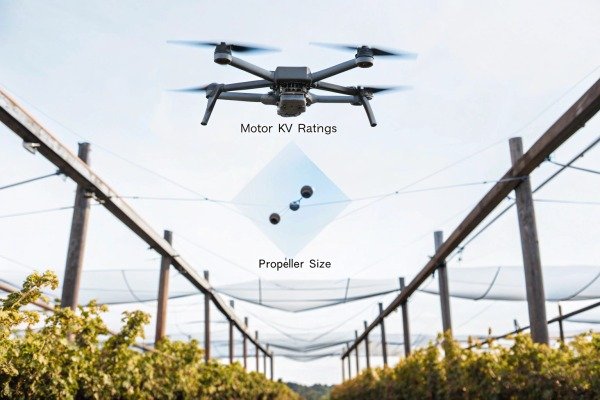
Sometimes, the deception isn't in the battery or motor, but in the operational capabilities of the spraying system itself. These figures determine your actual productivity in hectares per hour.
The Flow Rate Bottleneck
One of the easiest ways to spot a dishonest spec sheet is to look at the flow rate. Suppliers often list the maximum Poids maximal au décollage 7 flow rate of the nozzles, not the pump.
For example, a drone might use four centrifugal nozzles, each rated centrifugal nozzles 8 for 3 liters per minute. The supplier puts "Max Flow Rate: 12L/min" on the brochure. However, if the drone only has a single pump capable of pushing 5 liters per minute, those nozzles will never reach their potential. You are buying a 5L/min system disguised as a 12L/min system. Always ask for the pump flow rate specification separately from the nozzle rating.
The "Effective" Spray Width
"Spray width" is a vague term. A drone flying at 5 meters high will have a wider spray pattern than one flying at 2 meters. Some suppliers quote the spray width at a very high altitude to make the number look big (e.g., "10-meter swath").
However, at that height, the wind will drift the chemicals away, and the application will be ineffective. You need to know the effective spray width at a standard operating height (usually 2 to 3 meters). If the brochure claims a massive spray width but doesn't mention the flight height or the droplet size (VMD) droplet size (VMD) 9, be skeptical. Wide spray often means thin coverage at the edges.
Waterproofing Warranties
Agricultural drones get dirty. You need to wash them. Many suppliers stamp "IP67 Waterproof" on their machines. IP67 Waterproof 10 This suggests you can submerge them in water.
However, read the warranty fine print. We frequently see competitors deny warranty claims for water damage despite the IP67 label. They claim high-pressure washing forces water past the seals, which technically exceeds IP67 static testing. If a supplier claims the drone is washable but the warranty explicitly excludes "water ingress," they do not have confidence in their own seals.
Summary of Red Flags
- RTK Precision: Claims of "Centimeter Accuracy" without mentioning "re-convergence time." If the signal is lost, how long until it is accurate again?
- Obstacle Avoidance: Radar specs that don't mention "wire detection." Detecting a wall is easy; detecting a power line is hard.
- Terrain Following: Claims that work on "all terrains" usually fail on slopes greater than 20 degrees.
Conclusion
By scrutinizing these four technical areas—flight time physics, propulsion torque, battery discharge rates, and pump capacities—you can filter out unreliable suppliers. This ensures your investment delivers genuine productivity on the farm rather than empty marketing promises.
Notes de bas de page
1. Official US government source for unmanned aircraft systems regulations and definitions. ︎
2. Authoritative NASA educational resource explaining the physics of thrust and weight. ︎
3. Academic overview of battery discharge rates and performance metrics. ︎
4. Official FAA guidelines for commercial UAS operations and safety protocols. ︎
5. Technical paper discussing battery discharge rates and performance in unmanned aerial vehicles. ︎
6. Overview of the chemistry and characteristics of batteries used in high-power drones. ︎
7. Official definition and regulatory importance of Maximum Takeoff Weight in drone operations. ︎
8. Educational resource from Penn State Extension detailing agricultural nozzle types. ︎
9. FAO guidelines on pesticide application equipment and droplet size standards. ︎
10. The International Electrotechnical Commission is the official body defining IP standards. ︎

 English
  Spanish
  German
  French
  Dutch
Dutch  Arabic
