
When our engineers first tested caméras thermiques 1 in simulated fire conditions, we quickly realized that thick smoke creates unpredictable challenges for drone operations.
To test firefighting drone thermal imaging in thick smoke, you need controlled smoke chamber tests, field simulations with prescribed burns, and comparative imaging between RGB and infrared sensors. Measure penetration depth, hotspot detection accuracy, and sensor sensitivity at varying smoke densities to validate real-world performance.
This guide walks you through everything from setting up reliable tests to evaluating supplier specifications. Let’s dive into the practical steps that matter most.
How do I set up a reliable test to verify my drone's thermal imaging performance in thick smoke?
Our team spent months developing testing protocols after clients asked us to prove our thermal cameras work in real fire scenarios. The challenge is creating conditions that match actual firefighting environments.
Set up reliable thermal imaging tests by building a controlled smoke chamber with measured fuel loads, calibrating your drone's thermal sensitivity below 100 mK, and running field tests during prescribed burns. Document penetration distance, detection accuracy, and image clarity at multiple smoke density levels.
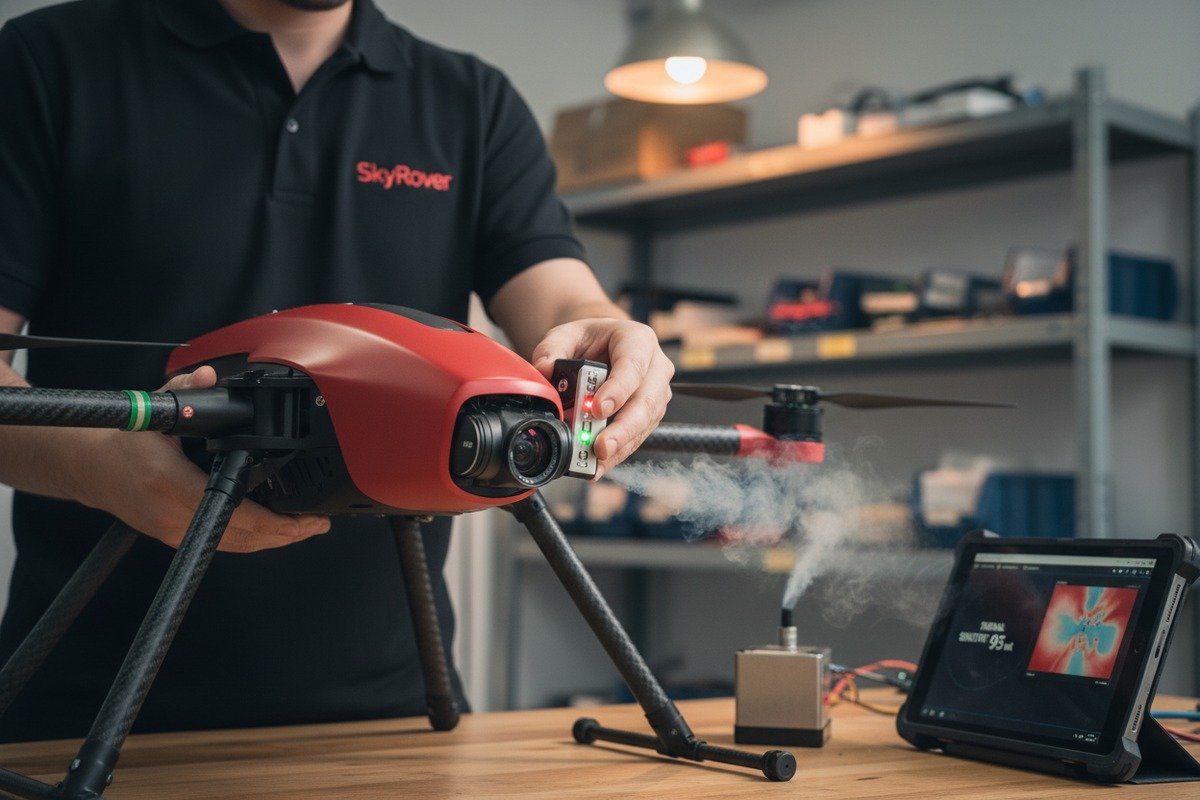
Building Your Smoke Chamber
A proper smoke chamber gives you repeatable conditions. We recommend a minimum size of 3x3x3 meters with adjustable ventilation. Use standardized fuel materials like wood chips or commercial smoke generators.
Control these variables:
- Smoke density measured in grams per cubic meter
- Temperature inside the chamber
- Les niveaux d'humidité
- Air circulation speed
Calibration Before Testing
Before any smoke test, calibrate your thermal sensor. Set the emissivity value to match your target materials. Most firefighting targets have emissivity between 0.85 and 0.95.
| Calibration Parameter | Paramètre recommandé | Objectif |
|---|---|---|
| Emissivity | 0.85-0.95 | Match common fire materials |
| Plage de température | -20°C to 650°C | Cover all fire scenarios |
| Focus Distance | 3-50 meters | Match operational ranges |
| Fréquence d'images | 30 fps minimum | Ensure smooth video |
Protocole de test sur le terrain
Chamber tests give you baseline data. Field tests prove real-world performance. Partner with local fire departments for prescribed burn access.
During field tests, fly at multiple altitudes. Start at 30 meters and increase to 100 meters. Record thermal footage alongside standard RGB video for direct comparison.
Track these metrics:
- Detection range for hotspots above 100°C
- False positive rate from reflective surfaces
- Time to identify human-sized heat signatures
- Image degradation at maximum smoke density
Data Analysis Methods
After testing, compare thermal images against known heat source locations. Calculate detection accuracy as a percentage. Industry standard requires 90% or higher detection rate for firefighting applications.
Use thermal analysis software to measure temperature readings at specific points. Compare these against thermocouple readings placed in the test area.
What technical specifications should I prioritize to ensure my drone penetrates dense smoke effectively?
When we design thermal payloads at our facility, we focus on specifications that actually matter in smoke conditions. Many spec sheets look impressive but hide limitations.
Prioritize thermal sensitivity below 100 mK, long-wave infrared sensors operating in the 8-14 μm range, resolution of 640×480 pixels minimum, and field of view between 60-70 degrees. These specifications ensure your drone captures clear thermal images through moderate to thick smoke.
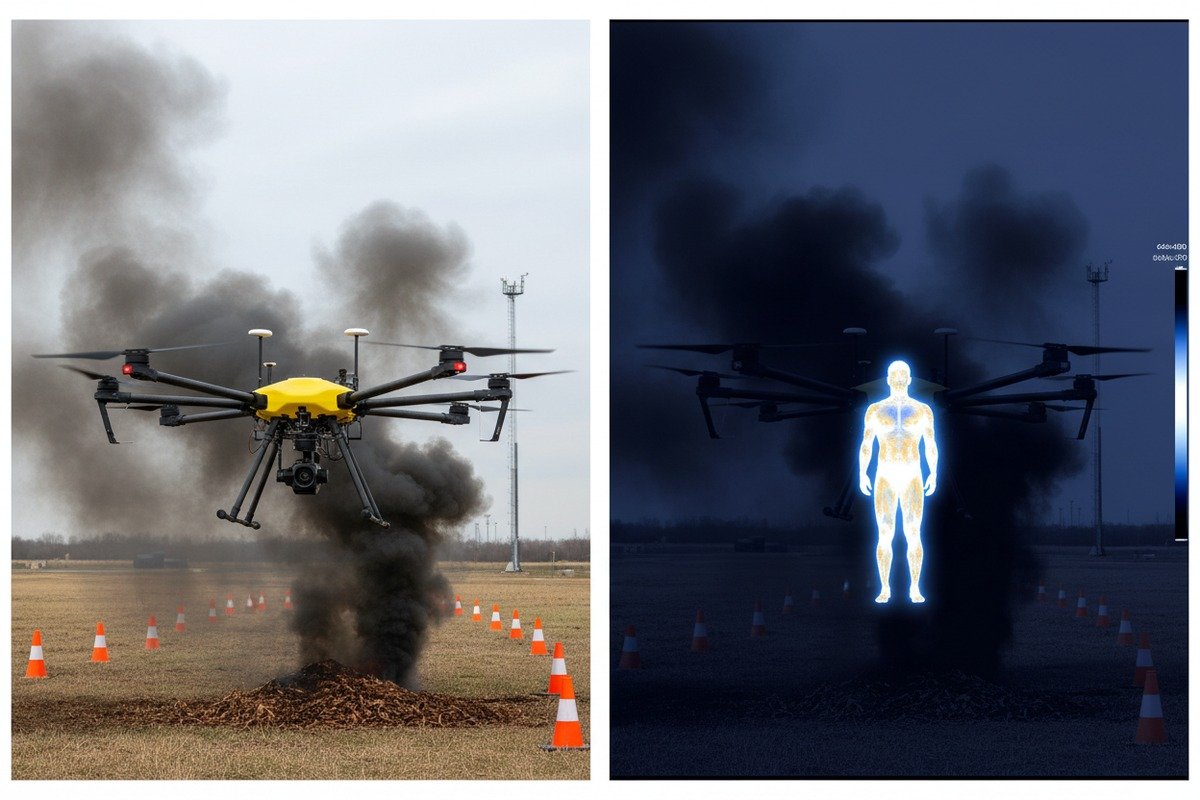
Understanding Thermal Sensitivity
Sensibilité thermique 3, measured in millikelvin (mK), determines the smallest temperature difference your camera can detect. For firefighting, you need sensitivity below 100 mK.
Our high-end models achieve sensitivity below 50 mK. This allows detection of small hotspots that could reignite.
| Sensitivity Level | Capacité de détection | Meilleur cas d'utilisation |
|---|---|---|
| <50 mK | Detects 1°C differences | Post-fire monitoring |
| 50-100 mK | Detects 2-3°C differences | Active fire response |
| 100-150 mK | Detects 5°C differences | General surveillance |
| >150 mK | Limited precision | Non recommandé |
Why Long-Wave Infrared Matters
Thermal cameras capture infrared radiation in different wavelength bands. For smoke penetration, long-wave infrared 4 (LWIR) in the 8-14 μm range works best.
Smoke particles scatter visible light and short-wave infrared. But LWIR passes through most smoke because the wavelengths are longer than typical particle sizes.
However, very dense smoke still absorbs some LWIR energy. This is why no thermal camera offers perfect smoke penetration.
Resolution and Field of View
Higher resolution means more detail in your thermal image. The 640×480 pixel standard balances image quality with real-time transmission needs. 640×480 pixels 5
Field of view affects how much area you see in one frame. Wider angles cover more ground but reduce detail per pixel. For firefighting, 60-70 degrees offers good balance.
Dual-Sensor Configurations
Modern firefighting drones pair thermal with visible cameras. This gives operators context. The thermal shows heat. The visible shows structure.
Our dual-sensor kits include automatic alignment. The thermal overlay matches the visible image precisely. This helps ground crews understand exactly where hotspots are located.
Digital Enhancement Features
FSX and similar digital processing sharpens thermal images in smoke. The software combines thermal data with edge detection to create clearer pictures.
These features help, but they cannot create data that sensors did not capture. Think of them as polish, not magic.
How can I evaluate if my supplier's thermal sensors meet the durability standards required for my firefighting operations?
In our experience exporting to the US and Europe, we have learned that durability questions matter most to serious buyers. Paper specifications mean nothing if components fail after three deployments.
Evaluate supplier durability by requesting IP ratings of IP54 or higher, temperature operating ranges from -20°C to 50°C, vibration resistance certifications, and documented mean time between failures (MTBF) data. Ask for references from existing firefighting customers who have used the equipment in real conditions.

Exigences de l'indice de protection IP
Indices IP 6 tell you how well components resist dust and water. For firefighting drones, IP54 is the minimum standard.
| Indice IP | Protection contre la poussière | Protection contre l'eau | Aptitude à la lutte contre les incendies |
|---|---|---|---|
| IP54 | Poussière limitée | Résistant aux éclaboussures | Minimum acceptable |
| IP55 | Poussière limitée | Jets à basse pression | Good for most operations |
| IP67 | Étanche à la poussière | Submersion to 1m | Excellent protection |
| IP68 | Étanche à la poussière | Extended submersion | Protection maximale |
Temperature Operating Range
Firefighting environments swing between extremes. Thermal sensors must operate reliably in cold morning air and near flame heat.
We test our sensors from -40°C to 85°C for storage and -20°C to 50°C for operation. This covers most real-world firefighting conditions.
Ask suppliers for thermal shock test results. Rapid temperature changes stress components more than steady extremes.
Tests de vibration et de choc
Drones vibrate constantly from rotor motors. This stress can loosen connections and damage sensitive thermal sensors over time.
Demande MIL-STD-810G 7 or equivalent vibration test documentation. This military standard confirms equipment survives sustained vibration exposure.
Étapes de vérification du fournisseur
Do not rely only on specification sheets. Take these verification steps:
- Request third-party test reports from accredited labs
- Ask for customer references in firefighting applications
- Order sample units for your own testing
- Check warranty terms for firefighting use cases
- Verify spare parts availability and lead times
Drapeaux rouges à surveiller
Soyez prudent si les fournisseurs :
- Refuse to provide test documentation
- Have no firefighting customer references
- Offer warranties that exclude "extreme conditions"
- Cannot specify component origins
- Have unusually low prices compared to market
When we work with international clients, we provide full documentation packages. Legitimate suppliers do the same.
Long-Term Support Assessment
Durability extends beyond initial quality. Evaluate supplier support capabilities:
Does the supplier offer remote technical assistance? Can they ship replacement parts quickly? Do they maintain firmware updates for software improvements?
Our team provides 24-hour remote support and maintains regional spare parts inventory. This matters when equipment fails during critical operations.
Can I work with my OEM partner to customize the thermal imaging software for my specific search and rescue needs?
When we collaborate with clients on design and development, software customization often delivers the biggest operational improvements. Hardware sets limits. Software determines how you use capabilities.
Yes, reputable OEM partners can customize thermal imaging software for search and rescue. Request modifications to detection algorithms, user interface layouts, data output formats, and integration APIs. Ensure your partner has in-house software engineering and provides source code access or long-term maintenance agreements.

Demandes de personnalisation courantes
Our clients typically request these software modifications:
Detection Algorithm Tuning: Adjust sensitivity thresholds for human body temperatures versus fire hotspots. Search and rescue needs different parameters than fire suppression.
User Interface Changes: Simplify screens for specific operator roles. Field crews need different views than command center staff.
Data Export Formats: Match your existing systems. Some clients need standard video files. Others require specialized GIS data formats.
Alert Systems: Configure automatic notifications when thermal signatures match search criteria. Set thresholds for size, temperature, and movement patterns.
Options d'intégration IA
Modern thermal software includes AI-powered detection. These systems automatically identify:
- Human shapes through smoke
- Vehicle heat signatures
- Animal versus human differentiation
- Fire spread direction prediction
We can train AI models on your specific use cases. This improves accuracy compared to generic detection algorithms 8.
Exigences d'intégration
Before customization begins, document your integration needs:
| Integration Point | Exigences techniques | Objectif |
|---|---|---|
| Logiciel de contrôle au sol | MAVLink or custom API | Flight coordination |
| Système de commandement des incidents | Data streaming protocol | Surveillance en temps réel |
| Mapping Software | GeoTIFF export | Post-mission analysis |
| Radio Network | Bandwidth-optimized encoding | Remote area operations |
Évaluation des capacités logicielles des OEM
Not all OEM partners have equal software capabilities. Ask these questions:
- Do you have in-house software engineers or outsource development?
- Can you provide source code access under NDA?
- What is your typical timeline for custom feature development?
- How do you handle ongoing maintenance and updates?
- Can existing customers speak about their customization experience?
Protéger votre investissement
Software customization requires investment. Protect yourself with:
Escrow Agreements: Place source code in escrow so you maintain access if the supplier relationship ends.
Maintenance Contracts: Establish long-term support agreements before development begins.
Exigences en matière de documentation: Require complete technical documentation as part of deliverables.
Testing Acceptance Criteria: Define specific performance requirements before approving final delivery.
Realistic Timeline Expectations
Simple interface changes take 2-4 weeks. Algorithm modifications need 2-3 months. Full custom feature development may require 6-12 months.
Rush timelines increase costs and reduce quality. Plan ahead for major customization projects.
Our engineering team works directly with clients throughout development. Regular progress reviews ensure the final product matches operational needs.
Conclusion
Testing firefighting drone thermal imaging requires controlled environments, clear specifications, verified durability, and customized software. Work with OEM partners who provide documentation, support, and engineering collaboration for your specific operational needs.
Notes de bas de page
1. Explains how thermal cameras work and their use in firefighting. ︎
2. Describes a method for evaluating smoke generation in a controlled chamber. ︎
3. Defines thermal sensitivity (NETD) and its importance for image quality. ︎
4. Replaced HTTP 403 with an authoritative Wikipedia page on Infrared, which includes a section on long-wave infrared. ︎
5. Explains thermal camera resolution and lists 640×480 as a high-resolution standard. ︎
6. Explains the IP code, its digits, and what they signify for protection. ︎
7. Explains the military standard for environmental engineering and testing, including vibration. ︎
8. Explains how AI and algorithms improve thermal image analysis and detection. ︎

 English
  Español de México
  Deutsch
  Français
  Русский
  العربية
