
When our production team first developed heavy-payload spraying drones 1, we quickly discovered that stopping power matters just as much as lifting capacity. A 70kg drone flying at 5 meters per second carries serious momentum. One wrong calculation near power lines or field edges can mean disaster.
To test emergency braking distance, fly your fully loaded drone at operational speed (5-7m/s) in an open area, trigger the emergency stop function, and measure the distance from trigger point to full stop using GPS logs. Expect at least 10 meters for heavy agricultural drones. Repeat tests under different wind and altitude conditions for accurate results.
This guide walks you through every step of testing braking performance before you commit to buying. Let’s start with the practical field test methods.
How can I safely conduct a field test to measure the emergency braking distance of my fully loaded agricultural drone?
Our engineers run braking tests on every drone model before shipping to overseas distributors. We learned early that controlled testing prevents costly field accidents. Getting this right protects both operators and investments.
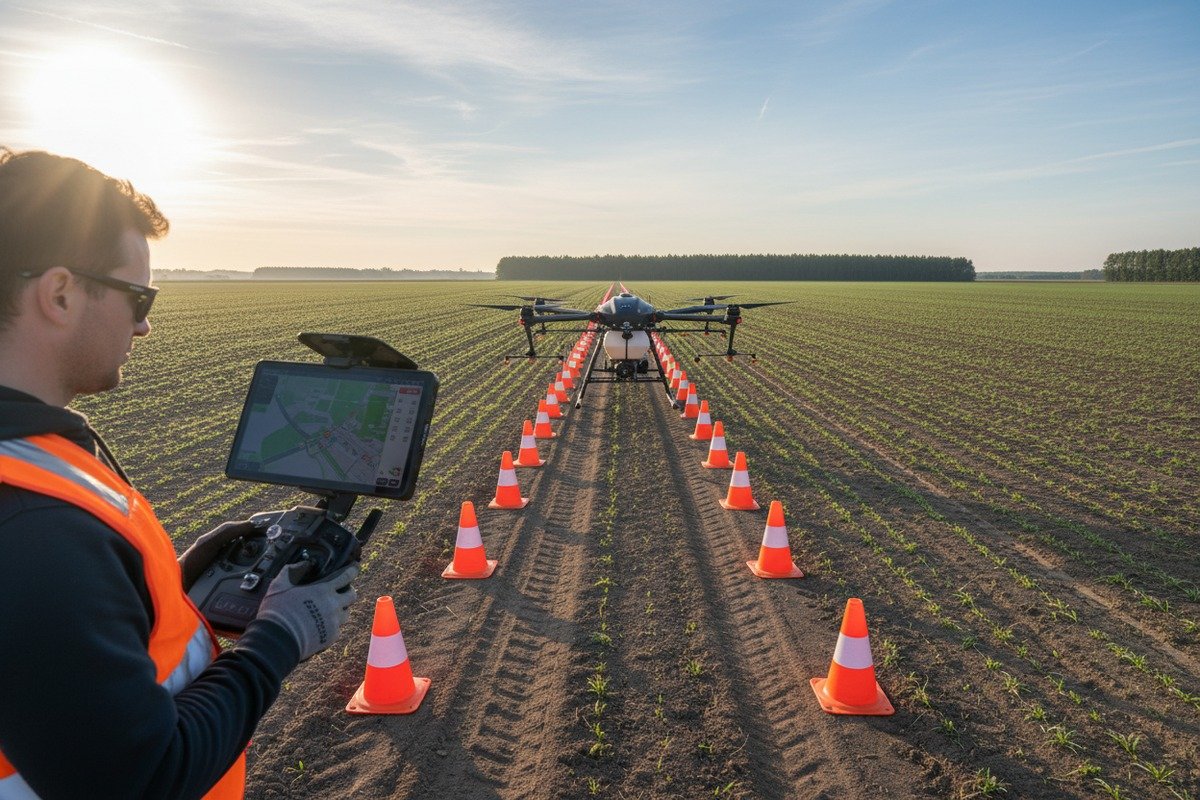
To safely test braking distance, select a flat open area at least 100 meters long, load the drone to full payload capacity, fly at 5-7m/s speed, and trigger the emergency stop via your controller app. Mark the trigger point and measure to where the drone fully stops. Use RTK-GPS flight logs for precision within 0.5 meters.
Preparing Your Test Environment
Choose an open agricultural field away from obstacles. The area needs at least 100 meters of clear space in your flight direction. Remove any hazards like irrigation equipment or loose debris.
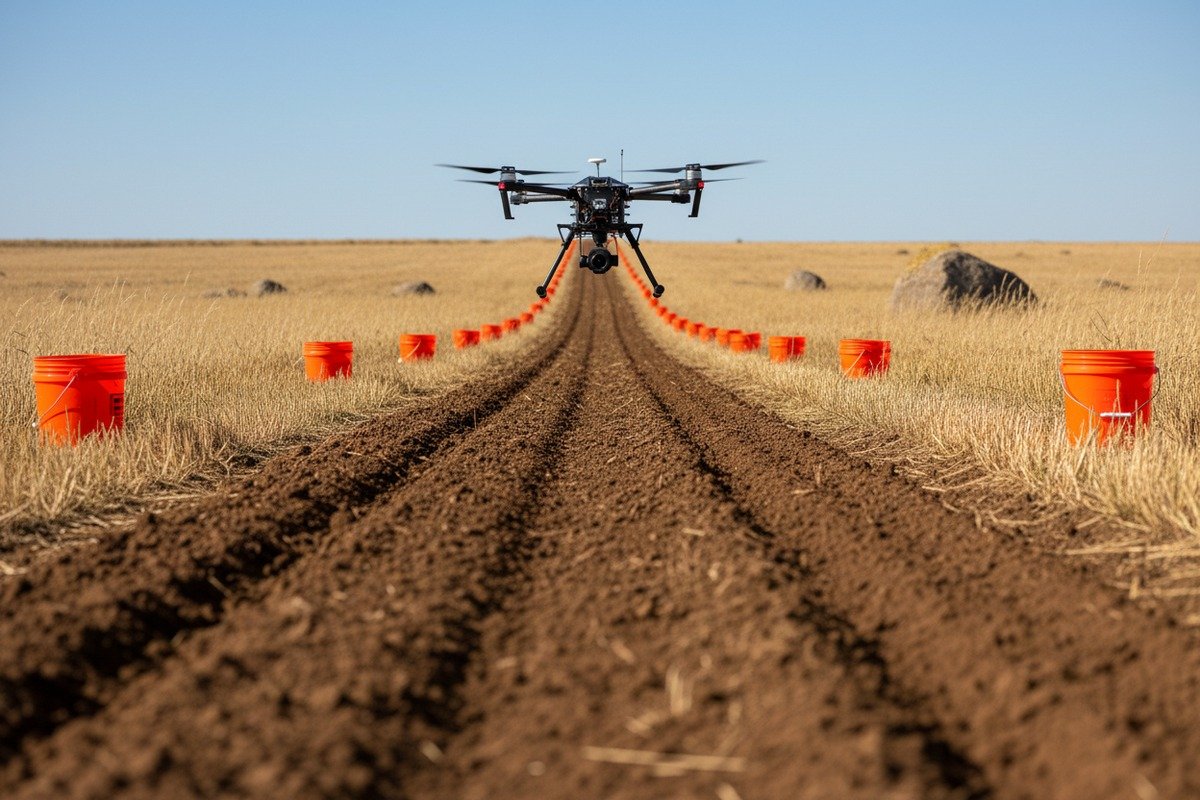
Mark your test zones clearly. We use bright buckets or cones every 5 meters. This visual reference helps you estimate braking distance in real-time before checking precise GPS data.
Check weather conditions. Wind speed under 5m/s gives the most consistent baseline results. Record wind direction since crosswinds affect braking differently than headwinds.
Step-by-Step Test Procedure
| Step | Action | Objectif |
|---|---|---|
| 1 | Fill tank to maximum payload | Simulates real operating weight |
| 2 | Take off and hover at 4m altitude | Standard spraying height |
| 3 | Accelerate to 5m/s in straight line | Typical operational speed |
| 4 | Trigger emergency stop at marked point | Tests system response |
| 5 | Observe and record stop position | Measures actual braking distance |
| 6 | Download flight log data | Provides precise measurements |
Run at least five tests in each direction. Average the results to account for wind variation. Our testing shows that fully loaded drones typically need 10-15 meters to stop completely from 5m/s.
Using Flight Logs for Accurate Measurement
Modern flight controllers record position data every fraction of a second. After your test, download the log file through your ground station software.
Look for the velocity curve. The moment velocity hits zero marks your actual stop point. Calculate the distance from your trigger point using the GPS coordinates.
RTK-equipped drones 2 provide accuracy within 0.5 meters. Standard GPS units may show 2-3 meter variance. For critical safety decisions, RTK data gives reliable numbers.
What specific performance metrics should I use to evaluate the stopping power of my heavy-payload drone?
In our experience exporting to the US market, procurement managers always ask for concrete numbers. Vague claims about "good braking" don't satisfy professional buyers. You need specific metrics to compare drones objectively.
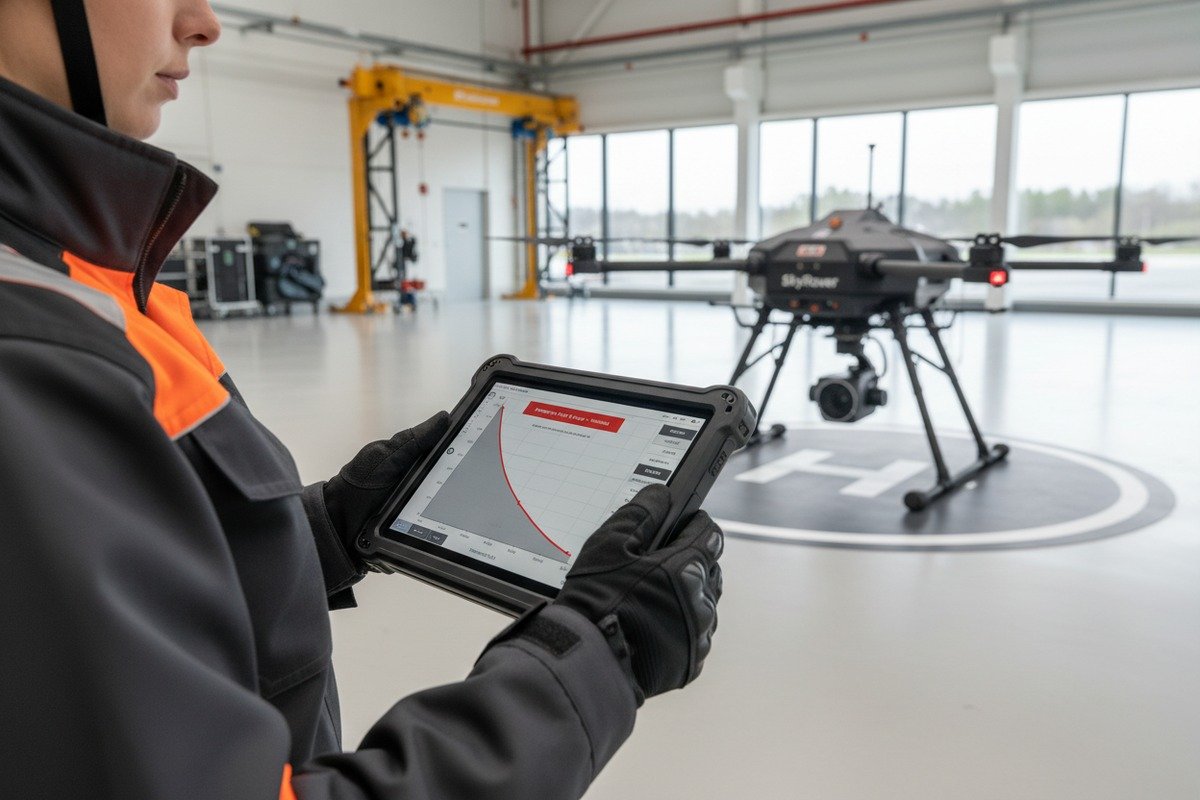
Evaluate stopping power using these key metrics: braking distance in meters from set speeds, deceleration rate (m/s²), response time from trigger to brake initiation, and position accuracy at full stop. Compare results against a 10-meter benchmark for drones above 50kg payload capacity.
Critical Braking Metrics Explained
Braking distance is your primary concern. This measures the horizontal distance traveled from emergency stop trigger to complete halt. Shorter distances mean more safety margin near field boundaries.
Deceleration rate 3 shows how aggressively the drone can slow down. Higher rates mean faster stops but may stress mechanical components. Most agricultural drones achieve 2-4 m/s² deceleration.
Response time captures the delay between your command and the drone's reaction. This includes signal transmission, flight controller processing, and motor response. Aim for under 0.5 seconds total delay.
| Métrique | Good Performance | Acceptable | Pauvre |
|---|---|---|---|
| Braking Distance (5m/s) | Under 8m | 8-12m | Over 12m |
| Deceleration Rate | Over 3 m/s² | 2-3 m/s² | Under 2 m/s² |
| Temps de réponse | Under 0.3s | 0.3-0.5s | Over 0.5s |
| Position Accuracy | Within 0.5m | 0.5-1m | Over 1m |
Understanding Payload Impact on Braking
Physics determines that heavier drones need more force to stop. A drone carrying 50kg of liquid requires significantly more braking power than the same drone flying empty.
When we calibrate flight controllers at our facility, we program different braking parameters for various payload levels. Smart systems automatically adjust based on current weight.
Ask your supplier if the drone's autopilot compensates for payload weight. Basic systems use fixed braking parameters. Advanced systems measure actual weight and adjust motor response accordingly.
Sensor Integration for Emergency Response
Capteurs LiDAR 4 detect obstacles at ranges up to 150 meters. When integrated properly, they trigger automatic braking before collision. Check if obstacle detection connects directly to the braking system.
Radar provides reliable detection in dusty field conditions where cameras struggle. Millimeter-wave radar 5 combined with visual sensors offers the most robust obstacle avoidance.
Request sensor specifications including detection range, field of view, and response protocols. Does the system brake, hover, or attempt to navigate around obstacles? For agricultural applications, hovering and alerting the operator is often safer than autonomous maneuvering.
How do different flight altitudes and speeds affect the braking results I get during my pre-purchase inspection?
Our testing data from hundreds of export units shows that altitude and speed dramatically change braking behavior. A drone stopping at 2 meters height behaves differently than one at 5 meters. Understanding these variables helps you test realistically.
Higher speeds increase braking distance proportionally—doubling speed roughly doubles stopping distance. Lower altitudes near crops can create ground effect, slightly improving braking. Wind impact increases at higher altitudes where ground friction doesn't buffer airflow. Test at your actual planned operating parameters for relevant results.
Speed's Impact on Stopping Distance
Kinetic energy increases with the square of velocity. This physics principle means small speed increases cause large braking distance changes.
At 3m/s, a typical heavy agricultural drone stops in about 6 meters. At 7m/s, that same drone needs 15 or more meters. The relationship isn't perfectly linear due to air resistance, but higher speeds always mean longer stops.
Test at your planned operational speeds. If you intend to spray at 7m/s for efficiency, don't accept test results from 4m/s demonstrations. The difference matters for safety margins.
Altitude Considerations
Ground effect 7 occurs below approximately 1.5 times rotor diameter height. The compressed air cushion between drone and ground can slightly enhance braking by providing additional resistance.
Standard spraying altitude of 3-4 meters sits above significant ground effect. Your braking tests at this height reflect real operational performance.
Higher altitudes (8-10 meters) expose the drone to stronger, less predictable wind. Braking distance varies more at height. If your operations require altitude changes, test braking at multiple levels.
| Flight Altitude | Ground Effect | Wind Exposure | Braking Consistency |
|---|---|---|---|
| 1-2 meters | Strong | Minime | Haut |
| 3-4 meters | Minime | Modéré | Moderate-High |
| 5-7 meters | Aucun | Important | Modéré |
| 8+ meters | Aucun | Haut | Variable |
Wind Conditions and Braking Performance
Headwinds actually assist braking by adding air resistance against forward motion. A 5m/s headwind can reduce braking distance by 15-20%.
Tailwinds work against braking. The same 5m/s wind pushing from behind can extend braking distance by 20-30%. Plan your field operations to avoid tailwind approaches to obstacles.
Crosswinds create lateral drift during braking. The drone may stop forward motion but slide sideways. Test in crosswind conditions to understand lateral control during emergency stops.
Creating a Comprehensive Test Matrix
When evaluating a drone before purchase, request tests across multiple conditions. A single demonstration under perfect conditions doesn't reveal real-world limits.
Ask the supplier to demonstrate emergency stops at low speed (3m/s), medium speed (5m/s), and high speed (7m/s). Compare results. The ratios between speeds tell you about the braking system's capability across your operational range.
Document everything. Video recordings with timestamps, GPS logs, and weather data create a complete picture. This documentation also proves useful if performance disputes arise later.
What engineering support or technical data should my supplier provide to guarantee the braking safety of my customized drone?
When we work with distributors on custom drone configurations, documentation and support separate professional manufacturers from assemblers. Your supplier should provide concrete data, not just marketing claims.
Request these from your supplier: documented braking test reports for your specific payload configuration, sensor specifications including detection ranges, flight controller parameter settings for emergency response, spare parts availability for brake-critical components, and technical support contacts for field troubleshooting. Professional suppliers provide engineering data sheets upon request.

Essential Documentation Package
Professional suppliers maintain test records for their drone models. Ask for braking distance data at various speeds and payloads. This documentation should include test methodology, conditions, and results.
Sensor specification sheets detail detection range, field of view, response time, and environmental limitations. Know whether your LiDAR works in dusty conditions or if rain affects radar performance.
Flight controller parameters control braking behavior. Advanced suppliers can share or adjust these settings for your specific application. Maximum deceleration limits, response curves, and safety margins all live in these parameters.
| Type de document | Objectif | Request Priority |
|---|---|---|
| Braking Test Report | Verifies stopping performance | Essential |
| Sensor Specifications | Confirms detection capability | Essential |
| Flight Controller Settings | Shows configurable parameters | Important |
| Maintenance Schedule | Plans brake system upkeep | Important |
| Parts Availability List | Ensures repair capability | Essential |
Technical Support Capabilities
Remote diagnostics capability matters for overseas buyers. When issues arise, can your supplier access flight logs remotely? Can they update firmware to address problems?
On-site support availability varies. Some manufacturers offer training visits. Others provide detailed video tutorials. Understand what support model works for your operation.
Response time expectations should be clear. Emergency technical questions need faster answers than general inquiries. Establish communication channels and expected response times before purchase.
Spare Parts and Maintenance
Motors generate braking force. When motors degrade, braking performance suffers. Ask about motor lifespan expectations and replacement availability.
ESCs (electronic speed controllers) interpret braking commands. Faulty ESCs can cause inconsistent braking. Confirm spare ESC availability and replacement procedures.
Propellers in good condition provide maximum braking efficiency. Damaged or worn propellers reduce stopping power. Stock spare propellers and establish inspection intervals.
Certification and Compliance
Safety certifications provide baseline assurance. Ask whether the drone meets relevant aviation safety standards 8 in your target market.
Import documentation requirements vary by country. Your supplier should understand export procedures and provide necessary paperwork for your customs clearance.
Warranty coverage for brake-related components demonstrates manufacturer confidence. Compare warranty terms between suppliers. Longer coverage periods suggest more durable designs.
Red Flags in Supplier Responses
Vague answers about braking performance suggest inadequate testing. Professional manufacturers know their numbers.
Reluctance to share technical documentation indicates potential quality concerns. Transparent suppliers provide data readily.
Lack of spare parts inventory means extended downtime when repairs are needed. Confirm parts availability before committing.
Conclusion
Testing emergency braking distance before buying protects your investment and your operations. Use controlled field tests, demand specific performance metrics, and require proper documentation from your supplier. The effort you invest in evaluation prevents costly problems in the field.
Notes de bas de page
1. Replaced 404 DJI agriculture page with a specific DJI heavy-payload agricultural drone product page. ︎
2. Trimble is a major provider of RTK GNSS technology for precise positioning. ︎
3. Britannica provides a clear and authoritative definition of deceleration. ︎
4. Replaced 525 Velodyne LiDAR page with an authoritative explanation of LiDAR from a government source (NOAA). ︎
5. Analog Devices provides technical insights into millimeter-wave radar for drones. ︎
6. Replaced 404 energy.gov page with an authoritative definition of kinetic energy from Britannica. ︎
7. Wikipedia offers a comprehensive explanation of ground effect in aerodynamics. ︎
8. The FAA sets aviation safety standards for unmanned aircraft systems in the US. ︎

 English
  Spanish
  German
  French
  Dutch
Dutch  Arabic
