
Receiving a notification about rising costs during a critical procurement cycle is stressful. We see this pressure firsthand on our assembly lines in Xi’an when raw material prices fluctuate, affecting our ability to deliver SkyRover units to partners like you.
To negotiate effectively, demand a detailed cost breakdown isolating specific drivers like lithium or sensors. Leverage total Total Cost of Ownership (TCO) 1 cost of ownership (TCO) by requesting extended warranties or training instead of unit price drops. Always benchmark against market indices and propose tiered implementation to protect current budgets.
Here is a step-by-step guide to turning a price hike notice into a strategic conversation.
How do I verify if the supplier's reasons for the firefighting drone price hike are legitimate?
When we source components for our heavy-lift quadcopters heavy-lift quadcopters 2, we often receive vague price hike emails from upstream vendors. We know that responding with data, rather than emotion, is the only way to validate these claims effectively.
Request a line-item breakdown showing raw material, labor, and logistics costs separately. Compare their claims against public market indices for commodities like aluminum or lithium. If they cannot provide data to support the specific percentage increase, the hike is likely unjustified padding.

To truly verify a supplier's claim, you must move beyond the surface-level explanation. Suppliers often send what industry experts call "foo-foo" letters—vague notifications blaming "global global supply chain issues 3 supply chain issues" or "inflation" without providing evidence. Your first step is to reject this ambiguity.
The "Anti-Foo-Foo" Strategy
You should respond with a standardized template that requires the supplier to justify their request. In our dealings with component vendors, we find that requiring a detailed cost breakdown filters out opportunistic hikes cost breakdown 4. Studies show that up to 80% of unjustified price increase requests are withdrawn when the buyer simply demands a granular breakdown. You are not refusing to pay; you are refusing to pay without proof.
Ask your supplier to fill out a cost structure table. If they claim the price of the drone must go up by 12% because "materials are expensive," force them to show the math. If the aluminum frame only accounts for 5% of the total drone cost, a 10% rise in aluminum prices should only increase aluminum prices 5 the final product price by 0.5%, not 12%.
Benchmarking Against Market Indices
Once you have their breakdown, cross-reference it with public data. For firefighting drones, the critical cost drivers are typically:
- Lithium: For high-capacity flight batteries.
- Semiconductors: For flight controllers and ESCs.
- Logistics: Shipping heavy industrial units from manufacturing hubs.
If a supplier cites rising battery costs, check the lithium index. If the index is flat or falling, their argument collapses. Below is a template you can use to request this data.
Cost Breakdown Verification Table
| Élément de coût | Supplier Claimed Increase (%) | Impact on Total Unit Cost | Public Index Benchmark | Verdict |
|---|---|---|---|---|
| Raw Materials | e.g., +20% (Lithium) | High (Battery is ~30% of BOM) | Check LME Lithium Index | Valid/Invalid |
| Labor | e.g., +10% | Moyen | Local Wage Inflation inflation 6 Data | Valid/Invalid |
| Logistique | e.g., +15% | Low (per unit basis) | Freightos Baltic Index | Valid/Invalid |
| Overheads | e.g., +8% | Faible | Producer Price Index (PPI) | Valid/Invalid |
By using this table, you shift the dynamic. You are no longer asking for a favor; you are auditing their logic. If they cannot fill this out, their price increase is likely an attempt to expand their profit margins rather than cover costs.
What negotiation strategies can I use to delay the price increase or reduce the percentage?
We value partners who approach us with collaborative solutions rather than rigid demands. Our sales team often works with long-term clients to find a middle ground that keeps our production stable and their budgets intact.
Propose a temporary surcharge tied to specific indices rather than a permanent base price increase. You can also offer volume commitments or longer contract terms in exchange for price protection. Alternatively, ask to delay the increase until the next fiscal year or after current orders are fulfilled.

If the data shows that the supplier's costs have indeed risen, your goal shifts from rejection to mitigation. You do not have to accept a permanent price hike. There are several structural ways to handle this that protect your long-term budget.
Propose Temporary Surcharges
A permanent increase to the base price of a firefighting drone firefighting drone 7 is dangerous because it compounds over time. Instead, negotiate a "Temporary Surcharge." If the cost of the thermal camera sensor has spiked thermal camera sensor 8 due to a chip shortage, agree to pay a separate line item fee for that specific component.
Make this surcharge conditional. Set a review date (e.g., quarterly). If the index for that component falls back down, the surcharge is removed. This shows the supplier you are willing to share the burden of actual costs but will not accept a permanent inflation of the product price.
Volume and Timing Leverage
Suppliers love predictability. In our factory, knowing that a client will order 50 units over the next 12 months allows us to buy materials in bulk and lower our own costs. You can trade this certainty for price protection.
- Grandfathering: Insist that the new price only applies to orders placed après a certain date (e.g., 90 days from now). This allows you to clear your current pending orders at the old rate.
- Budget Cycle Constraints: Leverage your status as a public sector or organizational buyer. Explain that your budget is fixed for the fiscal year. Tell them: "We have an approved budget for these drones. If the price goes up, we are legally required to reduce the quantity or re-tender the contract." This often forces the supplier to honor the old price to avoid losing the volume.
Strategic Negotiation Levers
| Stratégie | Mechanism | Benefit to Buyer | Benefit to Supplier |
|---|---|---|---|
| Index-Linked Surcharge | Separate fee tied to commodity index | Price drops when market stabilizes | Immediate cost recovery |
| Volume Tiering | Lock price for purchasing X units | Avoids unit price increase | Guaranteed revenue/production planning |
| Early Payment | Net 15 instead of Net 60 | 2-3% discount offsets hike | Improved cash flow |
| Delivery Flexibility | Allow longer lead times | Lower logistics costs | Optimized production scheduling |
The "Not Now" Tactic
Sometimes, the best negotiation is simply a delay. Propose a tiered implementation. For example, agree to 0% increase for the first 3 months, 50% of the requested increase for the next 3 months, and the full increase only after 6 months. This gives you time to find alternative suppliers or adjust your budget, while showing the supplier you are working towards a solution.
Can I request free spare parts or technical support to offset the higher unit cost?
In our experience supporting deployments in Europe and the US, we know that hardware is just the beginning of the expense. The real value often lies in the support ecosystem, which we have more flexibility to discount than the physical goods.
Yes, shifting focus to non-monetary value is a powerful strategy. If the supplier refuses to lower the unit price, negotiate for “soft” concessions like extended warranties, free spare parts kits, or on-site pilot training, which often cost them less than a direct price reduction.

When a supplier is adamant about a unit price increase—perhaps because their raw material costs leave them no choice—you must pivot your strategy. You need to look at the Total Cost of Ownership (TCO). Even if the invoice price of the drone goes up, you can lower your overall operational costs by negotiating for value-added services.
The Value of "Soft" Costs
For a manufacturer, giving away a service or a spare part often costs less than the perceived value to the buyer. For example, sending a trainer to your site might cost us travel expenses and time, but it doesn't require purchasing expensive new raw materials. Similarly, extending a warranty involves risk calculation but no immediate cash outlay.
You should aggressively request these concessions. If they want a 10% price hike, ask for a value package that equates to 15% of the contract value.
Specific Concessions to Request
- Kits de pièces détachées : Firefighting drones are rugged tools, but propellers, landing gear, and motors wear out. Ask for a "Critical Spares Kit" (worth $2,000–$5,000) to be included with every unit at no extra charge.
- Extended Warranty: Standard warranties are usually 12 months. Negotiate for a 24 or 36-month comprehensive warranty. This saves you the cost of future repairs and insurance.
- Training and Onboarding: Professional pilot training is expensive. Demand free certification courses for your fire department staff.
- Software Upgrades: Industrial drones often have paid software modules for thermal mapping or AI fire detection. Ask for lifetime licenses or free upgrades for these modules.
Value Engineering the Product
Another angle is to review the specs. If the price hike is driven by a specific feature you don't need, ask to remove it. Does your drone need the 8K cinema-grade camera, or is the thermal sensor sufficient for firefighting?
- Downgrade non-critical components: Switch from carbon fiber carrying cases to hard plastic.
- Remove accessories: Exclude the extra remote controller if you already have compatible ones.
Negotiation Trade-Off Matrix
| Request Type | What You Ask For | Why It Works for the Supplier | TCO Impact |
|---|---|---|---|
| Maintenance | 2-Year Free Annual Service | Utilizes existing labor, low marginal cost | High (saves ~$1k/year per drone) |
| Logistique | Free Air Freight / DDP | They have bulk shipping rates | Medium (saves shipping fees) |
| Formation | Virtual or On-Site Training | scalable knowledge transfer | High (reduces pilot error crashes) |
By securing these items, you effectively neutralize the price increase. You might pay $1,000 more for the drone, but you save $2,000 in future parts and training.
Should I consider signing a long-term framework agreement to lock in the current price?
We prefer stability in our production planning, just as buyers prefer stability in pricing. When partners commit to long-term agreements, it allows us to pre-order materials and hedge against market volatility, savings we can pass back to you.
Signing a multi-year framework agreement is highly recommended to stabilize costs. It provides the supplier with guaranteed revenue, allowing them to hedge raw material purchases. In return, you secure a fixed price or a capped escalation clause, protecting your budget from market volatility for 12 to 24 months.
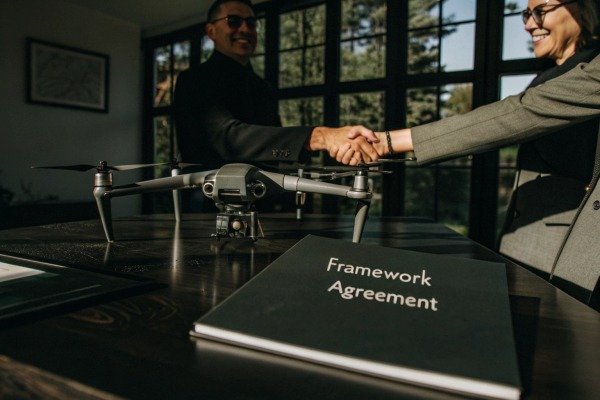
In a volatile market, certainty is a currency. A long-term framework agreement (LTFA) is one of the most effective tools to immunize your procurement against future price shocks. It changes the relationship from a transactional series of purchases to a strategic partnership.
The Benefits of Locking In
When you sign a 2-year agreement, you are essentially buying an insurance policy against inflation. For the supplier, this contract represents guaranteed cash flow and volume, which is incredibly valuable for their bank financing and production planning.
In exchange for this commitment, you can demand:
- Price Freezes: A guarantee that prices will not change for the first 12 months.
- Capped Escalation: A clause stating that after the first year, prices can increase by no more than a specific percentage (e.g., 3%) or the rate of CPI, whichever is lower.
- Priority Allocation: In the event of a supply shortage chip shortage 9 (common with drone chips), your orders get filled first.
Clauses essentielles pour votre accord
If you decide to go this route, you must include specific protective clauses to ensure the agreement doesn't become a trap.
1. Most Favored Customer (MFC) Clause
This is a critical leverage point. The MFC clause states that if the supplier sells MFC clause 10 the same drone to another government agency or distributor at a lower price than what you are paying, they must lower your price to match it. This ensures you are never paying a premium while others get a discount.
2. Technology Refresh / Future-Proofing
Drone technology evolves rapidly. A 2-year contract is risky if the tech becomes obsolete. Include a "Technology Refresh" clause that allows you to upgrade to the newer model (e.g., SkyRover X2 to X3) at a pre-agreed discount or for the same price as the legacy model. This ensures you aren't stuck buying outdated gear just to keep the price low.
3. Exit Clauses
Ensure you have an "off-ramp." If the supplier's quality drops or they miss delivery windows, you should have the right to terminate the agreement without penalty.
Framework Agreement Checklist
| Clause | Objectif | Buyer Benefit |
|---|---|---|
| Fixed Price Period | Locks rate for 12-24 months | Budget certainty |
| Escalation Cap | Limits future hikes to max % | Prevents runaway costs |
| MFC Clause | Matches lowest market price | Ensures competitiveness |
| Tech Upgrade | Allows swap to new models | Prevents obsolescence |
By offering a long-term commitment, you give the supplier the security they crave, and in return, you demand the price stability your organization needs. It is a classic "win-win" that removes the friction of constant re-negotiation.
Conclusion
Negotiating a price increase for specialized equipment like firefighting drones requires a shift from defensive reaction to proactive data management. By verifying cost drivers, leveraging volume for stability, and expanding the conversation to include non-monetary value like support and warranties, you can protect your budget. Remember, suppliers prioritize consistent, logical partners; use data to hold your ground and secure a deal that ensures both fair pricing and mission readiness.
Notes de bas de page
1. Educational definition from the Chartered Institute of Procurement & Supply. ︎
2. Example of a heavy-lift drone product relevant to the text. ︎
3. Official US government resources on supply chain resilience. ︎
4. US Federal Acquisition Regulation regarding proposal analysis and cost breakdowns. ︎
5. London Metal Exchange is the world standard for aluminum pricing. ︎
6. Bureau of Labor Statistics data on inflation and consumer prices. ︎
7. NFPA 2400 is the standard for drones in public safety. ︎
8. Teledyne FLIR is the industry leader for thermal drone sensors. ︎
9. Background information on the global semiconductor shortage event. ︎
10. Explanation of the Most Favored Nation/Customer legal concept. ︎

 English
  Spanish
  German
  French
  Dutch
Dutch  Arabic
