
Every week, our export team fields calls from European distributors facing the same headache. They bought agricultural drones from suppliers who promised “full EU compliance.” Then customs holds the shipment. The missing piece? A valid EU Declaration of Conformity that actually matches the product.
To request an EU Declaration of Conformity for agricultural drones, contact your supplier directly and reference EU Regulation 2019/945. Ask for a signed DoC that lists all applicable directives, the drone’s class identification (C0-C4), harmonized standards met, and manufacturer details. Verify the document includes CE marking confirmation and matches your specific model and serial number.
This guide walks you through each step. We cover why the DoC matters, how to request one properly, how to verify its authenticity, and what happens when you choose OEM customization. Let us start with the basics.
Why is an EU Declaration of Conformity essential for my agricultural drone imports?
Our engineers spent two years adapting our sprayer drones for European fields. The biggest lesson? Technical excellence means nothing without proper documentation. A single missing DoC can ground your entire fleet and expose you to serious legal risks.
The EU Declaration of Conformity is essential because it serves as legal proof that your agricultural drone meets all EU safety and technical standards under Regulation 2019/945. Without it, your drone cannot carry the CE marking, cannot legally enter the EU market, and cannot receive operational permits from National Aviation Authorities for agricultural work.

The Legal Foundation You Cannot Ignore
The DoC is not just paperwork. It is a binding legal statement. The manufacturer signs it and takes full responsibility for compliance. If something goes wrong, regulators trace liability back to that signature.
For agricultural drones, this matters even more. These machines spray chemicals over farmland. They fly beyond visual line of sight. They operate near workers and livestock. EU regulators take safety seriously here.
Key Regulations Affecting Agricultural Drones
Two main regulations govern your imports:
| Regulation | Focus | Exigences clés |
|---|---|---|
| EU 2019/945 | Product Design & Manufacturing | CE marking 1, class labels (C0-C4), DoC, technical standards |
| EU 2019/947 | Operations | Operator registration, remote ID, NAA permits for specific category |
Agricultural drones typically fall into the "specific" operational category. This means extra scrutiny. Your National Aviation Authority 2 will demand proof of product conformity before approving spray operations or BVLOS flights.
What Happens Without a DoC
We have seen customers lose significant money here. Without a valid DoC:
- Customs can seize your shipment at the border
- You cannot apply for PDRA (Predefined Risk Assessment) authorization 3
- Insurance companies may refuse coverage
- You face fines under market surveillance rules
- Your drones sit in warehouses while competitors work the fields
The 2026 Deadline Is Real
Transitional rules allowed older drones to operate temporarily. Those windows are closing. From January 1, 2026, full enforcement of Regulation 2019/945 begins. Every drone on the EU market needs a DoC. No exceptions for agricultural equipment.
The smart move? Get compliant now. Our distribution partners who prepared early avoided the rush and secured their market position.
What steps should I follow to request a valid Declaration of Conformity from my drone manufacturer?
When we prepare export documentation at our facility, the DoC request process follows a clear pattern. Buyers who know exactly what to ask get their documents faster. Vague requests create delays and confusion.
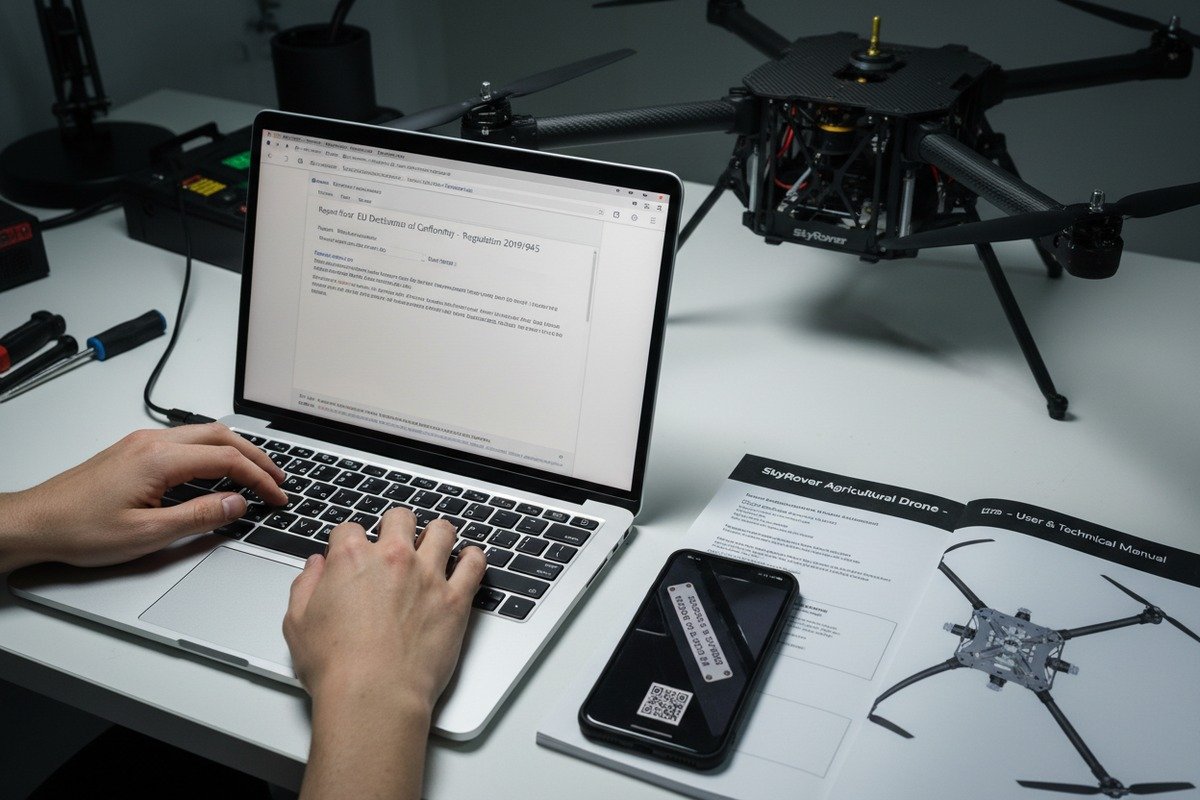
Follow these steps to request a valid DoC: First, identify your drone's EU class designation (C0-C4) from product specifications. Second, contact the manufacturer or EU importer directly via email, citing Regulation 2019/945 Article 22. Third, provide your model number, serial number, and purchase proof. Fourth, request a signed DoC listing all applicable directives and harmonized standards. Finally, verify the document matches your specific unit.
Step 1: Know Your Drone's Classification
Before contacting anyone, understand what class your agricultural drone belongs to. EU class designation (C0-C4) 5 This determines which standards apply.
| Classe | Masse maximale au décollage | Utilisation agricole typique |
|---|---|---|
| C0 | Less than 250g | Micro inspection drones |
| C1 | Less than 900g | Light crop monitoring |
| C2 | Less than 4kg | Small-scale mapping |
| C3 | Less than 25kg | Medium sprayers, inspection |
| C4 | Less than 25kg | Basic operations only |
Most serious agricultural drones fall into C3 or require specific category assessment. Heavy sprayers over 25kg need separate certification pathways.
Step 2: Contact the Right Party
For non-EU manufacturers like us, the EU importer often handles DoC responsibilities. Check who is legally responsible:
- If buying from an EU distributor, they must provide the DoC
- If importing directly from a Chinese manufacturer, ask about their EU authorized representative
- Major brands like DJI publish DoCs online for download
Step 3: Write a Clear Request Email
Your email should include:
- Exact product model and variant
- Serial number (if already purchased)
- Purchase order or invoice reference
- Explicit mention of Regulation 2019/945
- Request for all applicable directives covered
We recommend using a formal tone. Reference the legal requirement. Professional suppliers respond better to informed buyers.
Step 4: Verify What You Receive
A complete DoC must contain:
| Required Element | Ce qu'il faut vérifier |
|---|---|
| Manufacturer name and address | Must match official company registration |
| Product identification | Model number, type designation |
| EU directives | RED 2014/53/EU, EMC 2014/30/EU, RoHS 2011/65/EU |
| Harmonized standards 6 | Specific EN standards referenced |
| Notified body number | If third-party assessment required |
| Signature and date | Authorized person, recent date |
| Class identification | C0, C1, C2, C3, or C4 label reference |
Step 5: Escalate When Necessary
Some suppliers delay or refuse. Know your options:
- Contact EASA directly for guidance
- Report to national market surveillance authorities
- Consider alternative suppliers with proven compliance records
- Document all communication for legal protection
Our policy is simple: legitimate buyers get their documentation within 48 hours. Suppliers who delay often have something to hide.
How can I verify that the compliance documents provided by my supplier are authentic?
Our quality control team has seen creative forgeries. Fake CE marks. Fabricated test reports. DoCs listing directives that do not exist. Verification is not paranoia. It is basic due diligence that protects your business.
Verify DoC authenticity by cross-checking several elements: confirm the manufacturer's legal registration matches the document, verify listed harmonized standards exist and apply to drones, check that referenced notified bodies appear in the EU NANDO database, compare technical specifications against actual product features, and request supporting test reports from accredited laboratories.
Red Flags That Signal Fake Documents
Years of export experience taught us what fraudulent documents look like. Watch for these warning signs:
- Generic templates without specific product details
- Missing or incorrect directive references
- Signatures without printed names or titles
- Dates that predate relevant regulations
- Test reports from unknown laboratories
- Inconsistent formatting or obvious copy-paste errors
Using Official EU Databases
The EU maintains public databases for verification:
NANDO Database: Search for notified bodies. If a DoC references a notified body number, verify it at the official NANDO website. The body must be authorized for the specific directive.
EU Type Examination Certificates: Some higher-risk drones require third-party assessment. These certificates have registration numbers you can verify.
Cross-Reference Technical Specifications
A legitimate DoC matches the actual product. Compare:
| DoC Claim | Physical Verification |
|---|---|
| Maximum takeoff mass | Weigh the drone with full payload |
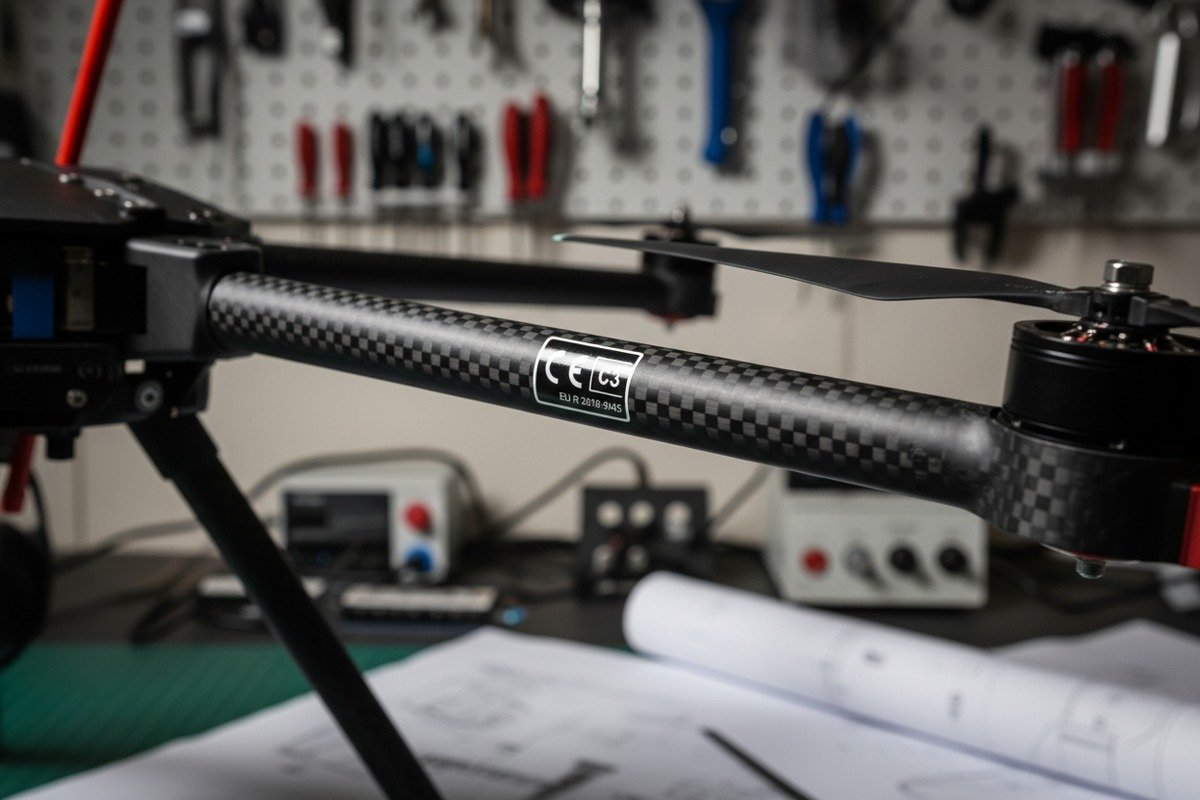
| Class identification | Check label printed on drone body |
| Remote ID capability | Test the transmission function |
| Geo-awareness | Verify software includes EU zone data |
| Frequency bands | Match radio specifications |
Discrepancies between documentation and reality indicate problems. Either the DoC is fake, or the wrong document was provided for your specific unit.
Request Supporting Evidence
A DoC alone is just a declaration. For high-value purchases, request:
- Test reports from recognized laboratories (look for Accréditation ISO 17025 7)
- Technical construction file summaries
- Risk assessment documentation
- Quality management system certificates (ISO 9001) 8
Reputable manufacturers provide these without hesitation. When we ship to European partners, our documentation package includes everything needed for customs and NAA submissions.
Conduct Supplier Background Checks
Beyond documents, investigate the supplier:
- How long have they operated?
- Do they have existing EU customers you can contact?
- Are they registered with relevant trade associations?
- What is their track record with market surveillance issues?
One phone call to an existing customer reveals more than a hundred documents.
Can I obtain a customized Declaration of Conformity if I choose to OEM my agricultural drones?
Our OEM partners often ask this question during initial discussions. They want their brand on the drone. They want custom features. But they also need valid compliance documentation. The good news? This is entirely possible with proper planning.
Yes, you can obtain a customized Declaration of Conformity for OEM agricultural drones. The process requires the original manufacturer to conduct conformity assessment covering your specific configurations, then issue a DoC naming either your company (if you become the legal manufacturer) or maintaining the original manufacturer with your brand as a trade name. Modifications affecting safety or radio characteristics may require reassessment.

Understanding OEM Compliance Responsibilities
When you OEM a drone, legal responsibilities shift. Who signs the DoC determines who faces liability:
| Arrangement | DoC Signatory | Liability Holder |
|---|---|---|
| White-label (your brand, no changes) | Original manufacturer | Original manufacturer |
| Private label with modifications | Varies by contract | Usually shared |
| Full OEM (you become manufacturer) | Your company | Your company |
What Customizations Affect Compliance
Not all changes require new assessment. Here is how modifications typically categorize:
Low Impact (usually no reassessment needed):
- External color changes
- Brand labeling
- Packaging customization
- User manual translations
Medium Impact (may require partial reassessment):
- Payload system changes
- Software feature additions
- Communication protocol modifications
High Impact (full reassessment likely required):
- Structural modifications affecting weight
- Radio frequency changes
- Battery system alterations
- Flight controller firmware changes
The OEM Documentation Process
When our partners request OEM arrangements, we follow this process:
- Scope Definition: Document exactly what customizations are needed
- Compliance Impact Assessment: Our engineers evaluate regulatory effects
- Testing (if required): Conduct additional EMC, radio, or safety tests
- Documentation Update: Revise technical files to reflect changes
- DoC Issuance: Generate customized DoC with agreed party as signatory
- Soutien continu: Provide materials for customs and NAA submissions
Protecting Your Brand Long-Term
OEM compliance is not a one-time transaction. Consider:
- Post-market surveillance obligations
- Incident reporting requirements
- Future regulatory updates
- Spare parts and repair documentation
We advise OEM partners to maintain detailed records. If regulators investigate, you need a clear paper trail showing due diligence.
Cost and Timeline Expectations
OEM compliance adds time and cost. Budget accordingly:
| Service | Calendrier type | Approximate Cost Range |
|---|---|---|
| Documentation review | 1-2 semaines | €500-2,000 |
| Minor modification assessment | 2-4 semaines | €2,000-5,000 |
| Full compliance testing | 4-8 semaines | €5,000-20,000 |
| DoC preparation and legal review | 1-2 semaines | €1,000-3,000 |
These investments protect your market access for years. Compared to the cost of seized shipments or recalled products, proper compliance is cheap insurance.
Conclusion
Getting your EU Declaration of Conformity right protects your agricultural drone business from costly delays and legal exposure. Start by understanding why the DoC matters, then follow clear steps to request and verify authentic documents from your suppliers. For OEM projects, plan compliance into your customization process from the beginning. The 2026 deadline approaches fast. Act now, and your drones will fly legally across European farmland while competitors scramble.
Notes de bas de page
1. Explains the purpose, requirements, and process for CE marking in the EU. ︎
2. Replaced with an active EASA page providing resources for National Aviation Authorities regarding drones. ︎
3. Official EASA explanation of Predefined Risk Assessments for drone operations. ︎
4. Provides the official text and scope of the EU regulation on drones. ︎
5. Describes the different drone classes (C0-C4) and their operational requirements. ︎
6. Explains what harmonized standards are and their role in EU compliance. ︎
7. Replaced with an authoritative page from ANAB (ANSI National Accreditation Board) explaining ISO/IEC 17025 accreditation. ︎
8. Replaced with an authoritative page from BSI (British Standards Institution) on ISO 9001 Quality Management Systems. ︎
9. Official EU resource for finding and verifying notified bodies through the NANDO database. ︎

 English
  Spanish
  German
  French
  Dutch
Dutch  Arabic
