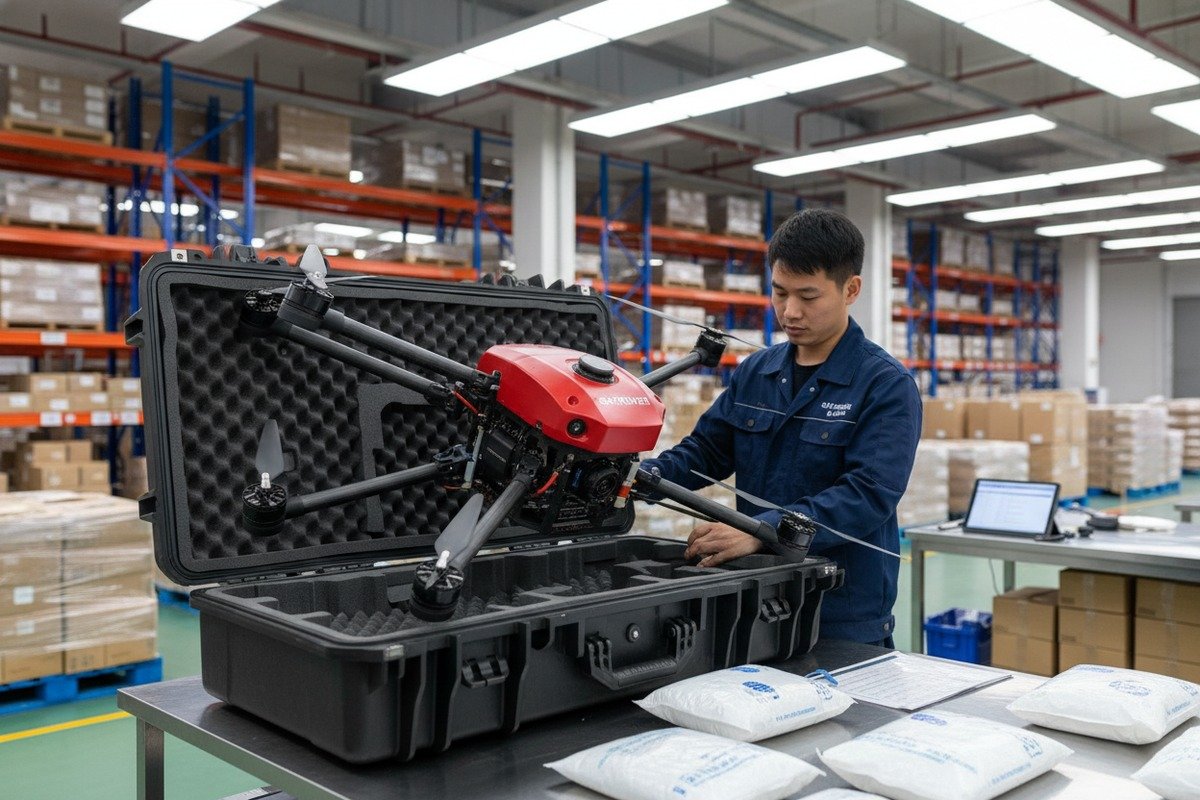
Every year, our production team in Xi’an ships hundreds of firefighting drones to fire departments and distributors across the United States and Europe. The journey by sea takes 20 to 40 days. During this time, containers face humidity levels up to 95%, salt spray, temperature swings, and vibrations reaching 15g. Without proper protection, sensitive electronics 1 fail. Thermal cameras misalign. Lithium batteries swell. Carbon fiber frames crack.
To protect firefighting drones from moisture and shock during sea freight from China, use IP55+ rated drones in custom hard-shell flight cases with EVA foam inserts. Add industrial desiccants to maintain below 40% humidity. Secure cases on pallets with ratchet straps. Include shock indicators to monitor transit conditions.
This guide breaks down the exact steps our engineering team has refined over years of exporting industrial drones. You will learn how to defend against salt spray, prevent sensor damage, verify waterproof casing, and confirm proper cargo securing before shipment leaves the factory.
How can I ensure my firefighting drones are protected from salt spray and humidity during the long sea voyage?
Our experience shipping from Shanghai and Ningbo ports has taught us one hard lesson. The ocean does not care about your drone's IP rating. Containers sitting on deck face salt-laden air that corrodes exposed metal within days. Condensation forms inside sealed packages when temperatures drop at night. These invisible enemies destroy electronics faster than any wildfire.
Protect drones from salt spray and humidity by sealing them in moisture barrier bags with 500g+ silica gel per cubic meter. Apply VCI (vapor corrosion inhibitor) sprays on metal parts. Position containers mid-deck, away from bow waves. Use insulated packaging to prevent condensation during temperature swings.

Understanding the Moisture Threat
Sea freight containers experience humidity levels between 80% and 95% for weeks. This creates a hostile environment for drone electronics. When we calibrate our thermal imaging systems before shipment, they work perfectly. But without moisture protection, those same sensors can fail upon arrival.
The problem has three main sources. First, ambient humidity enters through container ventilation. Second, temperature changes cause condensation inside packaging. Third, salt particles from sea spray 2 penetrate micro-gaps in seals.
Multi-Layer Defense System
Our packaging engineers developed a layered approach that cuts moisture damage by 90%.
| Layer | Material | Fonction | Spécifications |
|---|---|---|---|
| Inner Bag | Moisture Barrier Bag (MBB) | Blocks humid air | Heat-sealed, 6-mil thick |
| Desiccant | Industrial Silica Gel | Absorbs moisture | 500g per cubic meter |
| VCI Protection | Vapor Corrosion Inhibitor | Prevents metal corrosion | Spray or bag format |
| Outer Case | Sealed Flight Case | Physical barrier | IP65+ gasket rating |
Practical Steps for Salt Spray Defense
Start by disassembling non-essential components. Remove propellers and batteries. These go into separate anti-static bags with their own desiccant packs.
Apply hydrophobic nano-coating 3 to exposed circuit boards. This creates a water-repellent layer that survives accidental condensation.
Position your cargo mid-ship. Containers near the bow face direct wave impact. Those near the stern experience engine vibration. The middle offers the calmest environment.
Temperature Stabilization
Condensation forms when warm air meets cold surfaces. During our winter shipments to Europe, we noticed higher damage rates. The solution was phase-change materials 4 inside insulated packaging. These absorb heat during warm periods and release it during cold ones. This keeps internal temperatures between 15°C and 25°C.
Request climate-controlled containers for high-value shipments. They cost more but eliminate temperature-related condensation entirely.
What shock-absorbent packaging standards should I demand to prevent internal damage to my drone sensors?
When our quality control team unpacks returned drones, we see the same pattern. External cases look fine. But inside, gimbal motors are misaligned. Thermal camera lenses have micro-cracks. Flight controller boards show solder joint fractures. The damage happens invisibly during transit.
Demand packaging that reduces shock below 2g for sensitive components. Require custom EVA foam inserts with 50-80 Shore OO hardness. Specify hard-shell cases meeting MIL-STD-810G drop standards. Include ShockWatch indicators that flag impacts exceeding 5g for insurance claims.

The Physics of Transit Damage
Sea freight subjects cargo to complex vibration patterns. Waves create low-frequency oscillations between 1-10 Hz. Engine vibration adds higher frequencies. Port handling introduces sudden shock events up to 15g. Our testing shows that unprotected drones experience cumulative damage from all three.
The most vulnerable components include gimbal stabilization motors 5, thermal imaging sensors, GPS antennas, and lithium battery cells. Each requires specific protection strategies.
Foam Selection Science
Not all foam works equally. Our packaging engineers tested dozens of materials before settling on EVA (ethylene-vinyl acetate) foam 6 with specific density characteristics.
| Foam Type | Shore Hardness | Absorption des chocs | Best Use |
|---|---|---|---|
| Low-Density PE | 20-30 OO | Pauvre | Light padding only |
| EVA | 50-80 OO | Excellent | Primary cushioning |
| PU Memory Foam | 40-60 OO | Bon | Secondary layers |
| Sorbothane | 30-50 OO | Superior | High-value payloads |
The key is matching foam density to component weight. Heavier items need firmer foam. Lighter sensors need softer material. We cut custom molds for each drone model to ensure perfect fit.
Case Construction Standards
Hard-shell cases form the outer defense. Look for these specifications when evaluating manufacturers:
- Material: Aluminum or polycarbonate with minimum 3mm wall thickness
- Latches: Stainless steel with positive-locking mechanisms
- Hinges: Continuous piano-style or heavy-duty box hinges
- Gaskets: Neoprene or EPDM rubber for dust and moisture sealing
- Pressure Relief: Automatic equalization valve for air transport compatibility
Brands like Pelican and Nanuk meet these standards. We also work with Chinese case manufacturers who match quality at lower cost.
Layered Cushioning Architecture
Build protection from the bottom up. Start with a 4-inch foam base. Add side bumpers that prevent lateral movement. Create suspended cradles for the drone body. Use dividers to separate batteries and accessories.
The goal is zero movement inside the case. When you shake a properly packed case, nothing shifts. Every component stays locked in position.
Monitoring and Documentation
ShockWatch indicators provide proof of mishandling. These small devices change color permanently when exposed to impacts above their threshold. Place them at multiple points inside each case.
For high-value shipments, use data loggers. These record G-force, humidity, and temperature throughout transit. The data supports insurance claims and helps identify problematic shipping routes.
How do I verify that my Chinese manufacturer uses export-grade waterproof casing for my industrial drone shipment?
Trust but verify. That principle guides every export relationship we build with our overseas partners. When procurement managers visit our Xi'an facility, we encourage them to inspect everything. Watch the sealing process. Test the gaskets. Review the certification documents. A reliable manufacturer welcomes this scrutiny.
Verify export-grade waterproof casing by requesting IP certification documents from accredited testing labs. Conduct visual inspections of gasket seals and closure mechanisms. Ask for photos or videos of sealing processes. Arrange third-party pre-shipment inspections through agencies like SGS or Bureau Veritas.

Understanding IP Ratings
IP (Ingress Protection) ratings 7 define exactly what "waterproof" means. The rating consists of two numbers. The first indicates dust protection (0-6). The second indicates water protection (0-9K).
| Indice IP | Water Protection Level | Suitable For |
|---|---|---|
| IP43 | Light spray, any direction | Indoor use only |
| IP55 | Low-pressure water jets | Rain operations |
| IP65 | High-pressure water jets | Storm conditions |
| IP67 | Immersion up to 1m for 30 min | Water rescue |
For firefighting drones, we recommend minimum IP55 for the aircraft body. Payload components like thermal cameras may have separate ratings.
Exigences en matière de documentation
Request these specific documents from your manufacturer:
- IP Test Report: Must come from accredited laboratory, not self-certification
- Test Standard Reference: Should cite IEC 60529 or equivalent
- Component-Level Ratings: Separate ratings for body, camera, battery compartment
- Date of Testing: Certificates older than two years may not reflect current production
Our quality assurance team maintains current certifications for all product lines. We provide these documents proactively during the quotation process.
Liste de contrôle pour l'inspection visuelle
When you cannot visit the factory, request detailed photos of:
- Gasket sealing surfaces (look for continuous, uniform material)
- Closure mechanisms (latches should engage firmly)
- O-ring grooves (no debris or damage)
- Drainage ports (properly sealed or valved)
- Cable entry points (grommets or sealed connectors)
Any gaps, cuts, or inconsistencies in sealing surfaces compromise waterproof performance.
Third-Party Inspection Services
Independent inspection agencies 8 provide objective verification. Before shipment leaves China, an inspector visits the factory. They check packaging, documentation, and product condition.
Common services include:
- Pre-Production Inspection: Verify materials and components
- During Production Inspection: Check assembly quality
- Pre-Shipment Inspection: Final quality and packaging review
- Container Loading Supervision: Confirm proper cargo securing
These services cost $300-500 per inspection but prevent much larger losses from defective shipments.
Red Flags to Watch
Be cautious if a manufacturer:
- Cannot provide third-party test reports
- Claims IP ratings without documentation
- Uses vague terms like "water-resistant" instead of specific ratings
- Refuses factory visits or video calls showing production
- Offers prices significantly below market average
Quality waterproofing requires investment in materials, tooling, and testing. Manufacturers cutting corners on price likely cut corners on protection too.
What steps can I take to confirm my cargo is properly secured against rough handling before it leaves the factory?
The last 100 meters matter most. Our production floor has excellent quality control. But the journey from factory to container involves forklifts, trucks, and dock workers. Each handoff creates risk. We learned this after a shipment arrived in Los Angeles with crushed cases. The problem was not our packaging. It was unsecured loading.
Confirm proper cargo securing by requesting container loading photos showing pallet placement, strapping, and bracing. Require compliance with CTU (Cargo Transport Unit) packing guidelines. Specify edge protectors and non-slip mats. Include GPS tracking with shock sensors for real-time monitoring throughout transit.

Container Loading Best Practices
Proper container loading follows specific principles. Weight distribution comes first. Heavy items go on the bottom. Lighter packages stack on top. Nothing should shift when the container tilts during ship movement.
Our shipping team follows a standardized process:
- Inspect container for cleanliness and structural damage
- Lay moisture-barrier sheeting on floor
- Position anti-vibration rubber mats
- Place palletized cargo with heaviest items against container walls
- Apply ratchet straps every 2 meters
- Insert airbag dunnage to fill gaps
- Photograph each stage before closing doors
Pallet Configuration Standards
Wooden pallets form the foundation. They must meet ISPM-15 standards 9 for heat treatment to prevent pest contamination. Use four-way entry pallets for flexible handling.
| Pallet Specification | Requirement | Objectif |
|---|---|---|
| Material | Heat-treated wood or plastic | Pest compliance |
| Entry Points | Four-way | Forklift accessibility |
| Load Capacity | Minimum 1000kg | Safety margin |
| Dimensions | Standard Euro or US sizes | Stacking compatibility |
| Marking | ISPM-15 stamp visible | Customs clearance |
Stack cases no more than three high on each pallet. Use corner protectors where straps contact case edges.
Strapping and Bracing Techniques
Steel or polyester strapping secures cargo to pallets. Polyester offers better shock absorption for electronics. Apply straps vertically and horizontally, creating a grid pattern.
Bracing prevents forward-backward movement. Use wooden blocks or inflatable dunnage bags between cargo rows. Fill every gap larger than 15 centimeters.
Documentation for Loading Verification
Request the following documentation before shipment:
- Container Loading Photos: Minimum 10 images showing progression
- Liste de colisage: Detailed inventory with case numbers and positions
- Weight Distribution Diagram: Showing load placement
- Strapping Certification: Confirming strap tension and placement
- Seal Numbers: Container security seal verification
We provide all documentation within 24 hours of container loading. This allows time for corrections if problems appear in photos.
Real-Time Tracking Options
Modern tracking devices monitor more than location. Look for units that record:
- GPS coordinates at 1-hour intervals
- Internal temperature and humidity
- Shock events above configurable thresholds
- Door opening alerts
- Light exposure (indicates tampering)
Some devices transmit data via satellite, providing coverage even mid-ocean. The cost runs $50-150 per tracker plus monthly fees. For high-value shipments, this investment prevents much larger losses.
Pre-Shipment Inspection Protocol
Before the container leaves our facility, our quality team completes a final checklist:
- All cases sealed and latched
- Shock indicators armed and visible
- Desiccants fresh and positioned
- Straps tensioned to specification
- Photos uploaded to customer portal
- Tracking device activated and transmitting
- Insurance documentation confirmed
This systematic approach ensures nothing gets overlooked. When issues arise during transit, we have complete records for investigation.
Conclusion
Protecting firefighting drones during sea freight from China requires systematic attention to moisture control, shock absorption, quality verification, and cargo securing. By implementing these strategies, you ensure your investment arrives ready for deployment. Our team at SkyRover remains available to answer questions and customize protection protocols for your specific requirements.
Notes de bas de page
1. Provides information on acceptability standards for electronic assemblies, crucial for protecting sensitive components. ︎
2. Explains the mechanisms and impact of corrosion in electronic devices, including salt-induced damage. ︎
3. Replaced with the authoritative Wikipedia page for ‘Superhydrophobic coating’, which is a type of hydrophobic nano-coating, providing comprehensive information on the topic. ︎
4. Explains phase-change materials and their use in thermal energy storage and temperature regulation. ︎
5. Provides a comprehensive overview of gimbals, their function, and applications in various devices. ︎
6. Describes ethylene-vinyl acetate (EVA) copolymer, its properties, and various applications. ︎
7. Official website of the International Electrotechnical Commission, which defines the IEC 60529 standard for IP ratings. ︎
8. Details third-party inspection services for verifying product quality and compliance with standards. ︎
9. Official source for the International Standards for Phytosanitary Measures No. 15, regulating wood packaging material. ︎

 English
  Spanish
  German
  French
  Dutch
Dutch  Arabic
