
Every week, our sales team receives the same question from distributors: “Where is the proof that your drones actually work in real fires?” Without hard data, even the best firefighting drone 1 sits unsold in a warehouse. This gap between product quality and market trust costs businesses millions annually.
To obtain real-world firefighting drone data, partner directly with your OEM manufacturer for field test reports, request technical flight logs and certifications, collaborate with fire departments for operational feedback, access government wildfire response records, and leverage academic research studies that document metrics like response time and accuracy improvements.
In the sections below, we break down each data source step by step simulated payload missions 2. You will learn exactly how to collect, verify, and present this information for maximum marketing impact.
How can I work with my drone manufacturer to access documented field test results?
When we ship units to our distribution partners, we often hear frustration about missing performance documentation. Dealers want to show buyers proof. Yet many never ask their OEM 3 for the test data that already exists. This creates an unnecessary barrier to sales.
Work with your drone manufacturer by requesting pre-shipment test reports, factory quality control logs, environmental stress test data, and field trial documentation. Most OEM partners maintain detailed records of flight performance, payload capacity, and thermal imaging accuracy from controlled testing scenarios.

What Data Your Manufacturer Already Has
Our engineering team runs every firefighting drone through extensive testing before shipping. This includes thermal chamber tests 4, motor stress cycles, and simulated payload missions. These records exist. You just need to ask for them.
Here is what you can typically request:
| Type de document | What It Contains | Marketing Use |
|---|---|---|
| Pre-shipment Test Report | Flight time, GPS accuracy, camera resolution checks | Spec sheet verification |
| Environmental Stress Log | Performance at extreme temperatures (-20°C to 60°C) | Durability claims |
| Payload Capacity Test | Maximum lift, stable hover time with full load | Firefighting equipment compatibility |
| Motor Cycle Report | Hours of continuous operation before maintenance | Reliability statements |
| Thermal Imaging Calibration | Accuracy of heat detection at various distances | Hotspot detection marketing |
How to Request This Documentation
Start with a formal email to your OEM contact. Be specific. Ask for "the environmental stress test report for model X, batch Y." Vague requests get vague answers.
At our facility in Xi'an, we provide these documents within 5-7 business days when partners request them. We recommend asking during the order negotiation phase. Include documentation requirements in your purchase contract.
Building a Long-Term Data Sharing Agreement
One-time requests work. But systematic data sharing works better. Propose a quarterly reporting structure with your manufacturer. This keeps your marketing materials current.
Consider including:
- Monthly flight test summaries
- Firmware update performance comparisons
- Customer complaint and resolution logs
- New certification achievements
This approach turns your manufacturer into a marketing partner, not just a supplier.
Where can I find real-world performance data on flight endurance and payload during actual fire missions?
Our customers in the United States frequently ask for "real fire" data, not laboratory results. They need proof that drones perform when smoke fills the air and temperatures spike. This data exists, but finding it requires knowing where to look.
Find real-world flight endurance and payload data through published fire department case studies, government wildfire response reports, NASA research projects, vendor demonstration recordings, and academic publications. California wildfire operations, for example, have documented drones providing heat-mapping that improved firefighting prioritization by over 40%.

Public Fire Department Reports
Many fire departments publish annual reports that include drone deployment statistics. These are free and publicly accessible.
Look for:
- After-action reports from major wildfire responses
- Municipal fire department technology assessments
- Regional fire authority budget justifications (often include equipment performance data)
The SafeScout drone case study documented a multi-building fire response where drone deployment led to faster suppression, zero injuries, and 25% property loss reduction compared to past incidents. This type of specific data transforms marketing claims into verifiable facts.
Government and Research Sources
| Source Type | Where to Find It | Data Available |
|---|---|---|
| FEMA Reports | fema.gov public documents | Response time improvements, cost analyses |
| NASA Fire Research | nasa.gov science publications | AI swarm performance, fire mapping accuracy |
| USDA Forest Service | fs.usda.gov | Wildland fire drone deployments, flight hours |
| State Fire Marshal Reports | Individual state government websites | Equipment performance evaluations |
| Academic Journals | Google Scholar, ResearchGate | Peer-reviewed performance studies |
Vendor Demonstration Data
Attend industry trade shows like FDIC International or Wildfire Technology Summit. Vendors demonstrate products and share performance metrics. Record these demonstrations. Request written specifications.
When we showcase our octocopter at exhibitions, we provide detailed flight logs from the demonstration. Ask other vendors to do the same.
Extracting Marketing Metrics
Raw data needs translation. Convert technical specifications into customer benefits.
Example conversions:
- "45-minute l'endurance en vol 5 at full payload" becomes "Monitor an entire apartment fire from ignition to suppression without battery swap"
- "Thermal camera detects 0.5°C variations" becomes "Find hidden hotspots that human eyes miss"
- "IP54 weather resistance" becomes "Operates in rain, smoke, and dust conditions"
Document the source for each claim. Marketing teams need this for legal compliance.
Can my OEM partner provide the technical logs and certifications I need to prove product reliability?
When we calibrate our contrôleurs de vol 6, every adjustment gets logged. When our drones pass CE or FCC certification 7, we receive documented proof. This information directly supports your reliability marketing. Yet many distributors never ask for it.
Yes, OEM partners can provide technical flight logs, quality assurance records, and certifications including FAA compliance documentation, CE marking, FCC approval, and IP ratings. These documents prove regulatory compliance, manufacturing quality, and product durability for marketing claims.
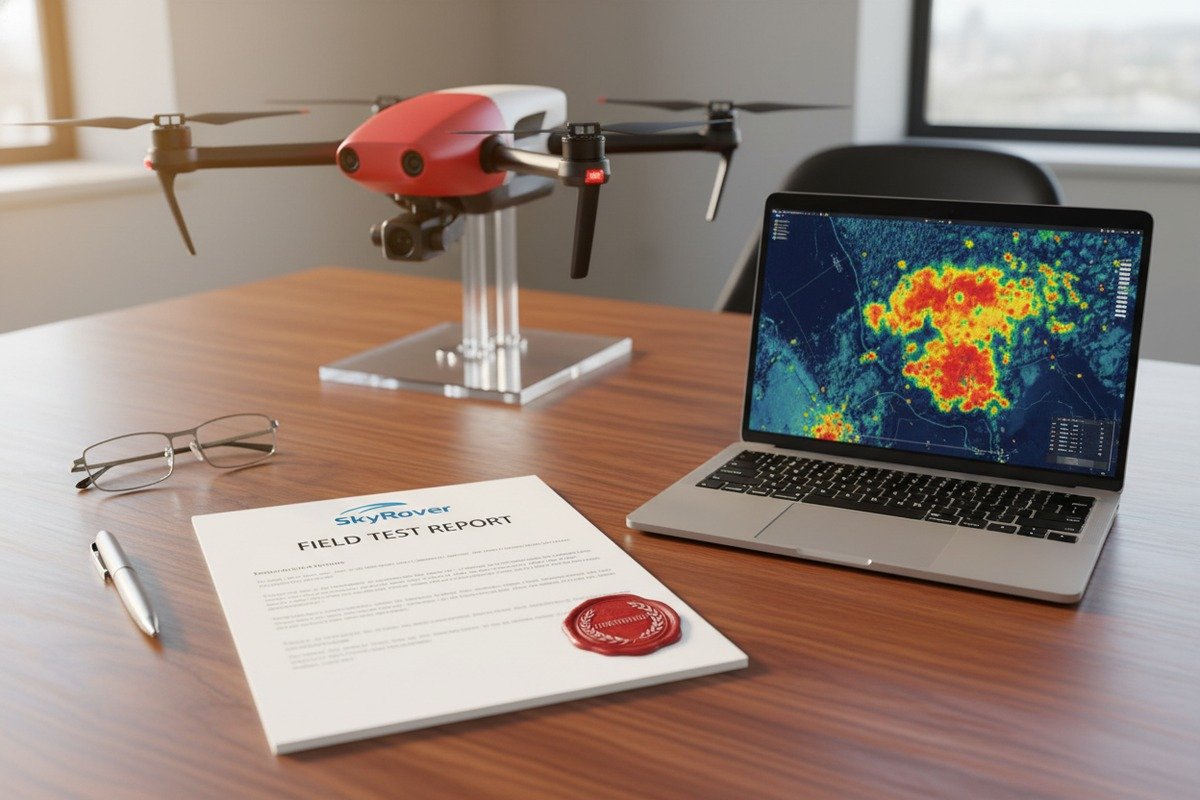
Essential Certifications for Firefighting Drones
Different markets require different certifications. Know what your customers need.
| Certification | Region | Ce qu'il prouve | Marketing Value |
|---|---|---|---|
| Conformité à la partie 107 de la FAA | États-Unis | Legal for commercial operation | Required for US fire department sales |
| Marquage CE | Union européenne | Meets EU safety standards | Entry to European markets |
| FCC Certification | États-Unis | Conformité aux radiofréquences | No interference with emergency communications |
| IP Rating (IP54+) | Mondial | Résistance à la poussière et à l'eau | Operational in harsh fire conditions |
| DO-160G (if applicable) | Aviation | Environmental qualification | Professional-grade credibility |
| ISO 9001 | Mondial | Système de gestion de la qualité | Manufacturing consistency |
Technical Logs That Support Reliability Claims
Our production facility maintains comprehensive logs. These include:
Flight Controller Calibration Records
Every drone's flight controller undergoes calibration. The logs show date, technician, parameters adjusted, and test flight results. This proves consistent manufacturing quality.
Battery Cycle Testing
We test battery packs through charge-discharge cycles. Logs document capacity retention over time. This data supports flight endurance claims.
Motor Hour Tracking
Each motor runs for specified hours during quality control. Logs prove components meet durability standards before shipping.
Firmware Version History
Software updates are documented with change logs. This shows ongoing product improvement and bug fixes.
How to Request These Documents
Structure your request clearly. Here is a template:
"Please provide the following documentation for [Model Number], [Batch/Serial Number]:
- CE/FCC certification copies
- Pre-shipment inspection report
- Flight controller calibration log
- Battery capacity test results
- IP rating test report"
Professional OEM partners respond to specific requests efficiently. Vague requests create delays.
Using Certifications in Marketing
Display certification logos on product pages. Include certification numbers where required. Create a "Compliance" section on your website listing all relevant approvals.
For fire department sales, emphasize FAA compliance 8 and any NFPA-relevant standards. Government procurement officers look for these specifically.
How do I collect authentic operational feedback from fire departments to strengthen my marketing claims?
Our distribution partners who sell the most drones share one habit: they collect and use customer feedback systematically. Fire departments provide the most credible testimonials. Their endorsements carry weight that no specification sheet can match.
Collect authentic fire department feedback by establishing pilot programs, conducting post-deployment surveys, attending firefighter conferences, joining industry associations, and building direct relationships with fire chiefs. Document specific metrics like response time improvements, safety outcomes, and cost savings for compelling marketing testimonials.

Establishing Pilot Programs
Offer select fire departments trial periods with your drones. This creates opportunities for documented feedback.
Structure pilot programs carefully:
- Define trial duration (typically 60-90 days)
- Establish reporting requirements
- Provide training and technical support
- Request permission to use feedback in marketing
During pilots, departments generate real operational data. They document flight hours, mission types, and outcomes. This becomes your marketing content.
Post-Deployment Survey Framework
Create standardized surveys for customers. Consistent questions generate comparable data.
| Survey Category | Example Questions | Data Use |
|---|---|---|
| Performance | "Did flight time meet expectations? Rate 1-10." | Spec verification |
| Fiabilité | "How many unplanned maintenance events occurred?" | Durability claims |
| Facilité d'utilisation | "How long did operator training take?" | Training requirements |
| Mission Success | "Did the drone help locate hotspots? Yes/No" | Effectiveness claims |
| Recommandation | "Would you recommend this drone? Yes/No/Maybe" | Testimonial eligibility |
| Specific Metrics | "Estimate time saved per incident using drone data." | ROI calculations |
Building Fire Department Relationships
Attend conferences where fire professionals gather. FDIC International, Firehouse Expo, and regional fire chief associations provide networking opportunities.
At these events:
- Demonstrate products
- Collect business cards
- Follow up within one week
- Offer training sessions at their facilities
- Ask for referrals to other departments
Fire departments share information with each other. One strong relationship can open multiple doors.
Converting Feedback to Marketing Content
Raw feedback needs professional presentation. Work with fire departments to create:
Case Studies
Document specific incidents where your drone made a measurable difference. Include:
- Incident description
- Drone deployment details
- Outcomes (time saved, injuries prevented, property preserved)
- Direct quotes from fire personnel
Video Testimonials
Record fire chiefs or drone operators describing their experience. Video builds trust faster than text.
Quantified Metrics
Turn general feedback into specific numbers. "The drone helped a lot" becomes "Drone deployment reduced scene assessment time from 15 minutes to 3 minutes."
Handling Negative Feedback
Not all feedback will be positive. Negative feedback is still valuable.
Use it to:
- Improve products (forward to your OEM partner)
- Identify training gaps
- Set realistic customer expectations
- Demonstrate commitment to improvement
Never hide negative feedback from your manufacturer. Our engineering team at SkyRover uses field complaints to prioritize firmware updates and design improvements.
Conclusion
Obtaining real-world firefighting drone data requires systematic effort across multiple sources. Partner with your OEM for test documentation. Access public government and research reports. Collect certifications that prove compliance. Build relationships with fire departments for authentic testimonials. This data transforms marketing claims into credible selling points.
Notes de bas de page
1. Authoritative source on drones in wildfire management. ︎
2. Explores control methods for drone payload missions, enhancing precision and execution. ︎
3. Authoritative definition of Original Equipment Manufacturer. ︎
4. Explains the purpose and benefits of thermal chamber testing for product reliability. ︎
5. Discusses technological innovations aimed at extending drone flight times and capabilities. ︎
6. Describes the function and importance of flight controllers in drone stability and operation. ︎
7. Explains the official requirements and significance of CE marking for products in the EU. ︎
8. Provides official information on FAA regulations for commercial drone operations (Part 107). ︎

 English
  Spanish
  German
  French
  Dutch
Dutch  Arabic
