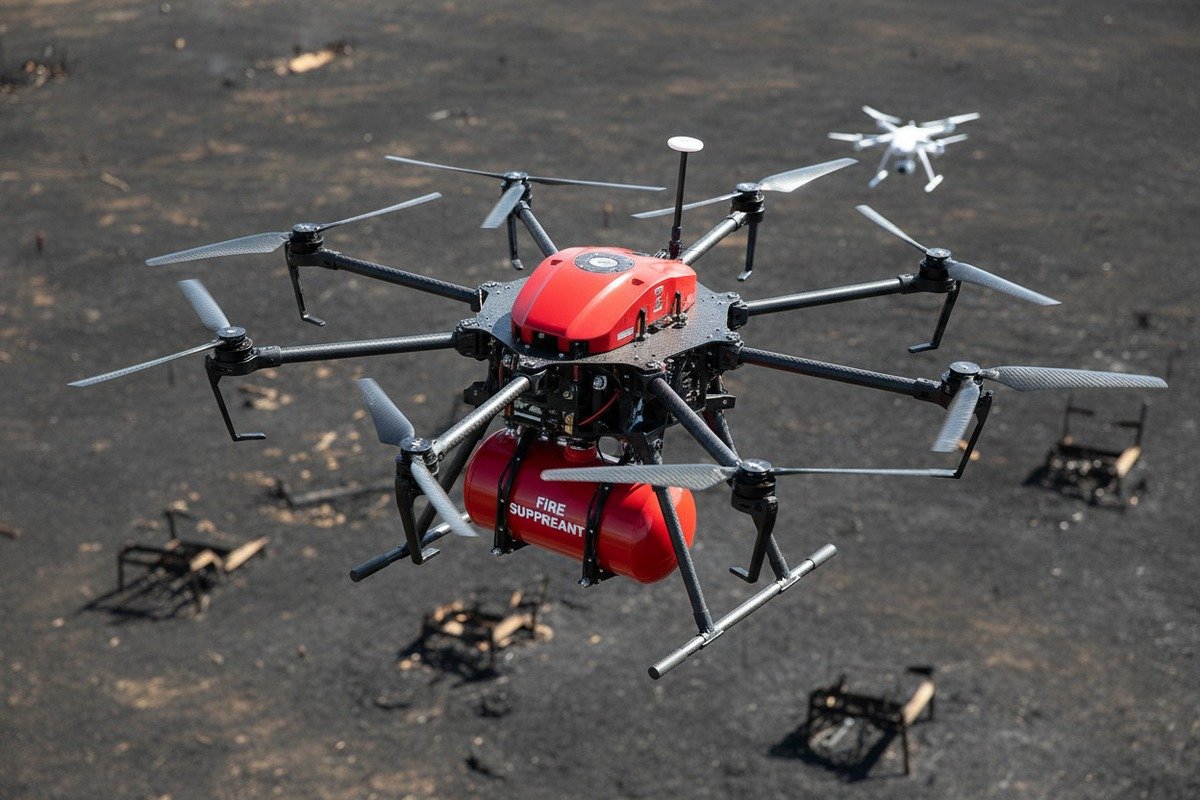
Lorsque notre équipe d'ingénierie a commencé à exporter drones de lutte contre les incendies 1 vers les services d'incendie américains il y a trois ans, nous avons été confrontés à une question difficile de la part de chaque acheteur : pourquoi devrions-nous importer de Chine alors que Skydio et Draganfly sont juste ici ? Le problème est clair. De nombreux drones fabriqués aux États-Unis excellent dans la surveillance mais sont insuffisants pour la suppression directe des incendies. Cet écart crée un risque réel pour les pompiers qui ont besoin d'une capacité de levage lourd 2 maintenant.
Pour identifier les USP des drones de lutte contre les incendies par rapport aux concurrents américains, évaluez la capacité de charge utile pour la livraison de produits extincteurs, l'autonomie de vol pour les missions prolongées, l'autonomie pilotée par l'IA pour la navigation dangereuse et les capacités de levage lourd dépassant 20 kg. Les marques américaines se concentrent généralement sur l'imagerie thermique et la surveillance, tandis que les drones de lutte contre les incendies supérieurs doivent démontrer des capacités de suppression directe que les options nationales n'ont souvent pas.
Ce guide vous présente les critères exacts que nos distributeurs américains utilisent pour comparer les drones importés aux options nationales. Examinons ce qui distingue vraiment un drone de lutte contre les incendies sur le marché actuel.
Comment évaluer l'autonomie de vol et la capacité de charge utile de ces drones par rapport aux marques américaines ?
Chaque responsable des achats avec qui nous travaillons pose d'abord des questions sur le temps de vol. Pourtant, nos tests sur le terrain révèlent que la capacité de charge utile 3 la charge utile compte plus que les spécifications annoncées. Le véritable défi est de trouver des drones qui maintiennent leurs performances lorsqu'ils transportent 20 kg de ignifuge 4 dans la fumée et la chaleur.
Évaluez l'autonomie de vol en testant les temps de vol réels avec charge, et non les affirmations du fabricant. Comparez la capacité de charge utile au poids maximum au décollage, en vous concentrant sur les drones transportant 20 kg ou plus pour la livraison d'agents extincteurs. Les marques américaines comme Skydio et Draganfly atteignent généralement des charges utiles de 5 à 10 kg, tandis que les importations à forte charge utile peuvent livrer 25 à 50 kg de retardateur de flamme par mission.

Comprendre les métriques d'endurance en conditions réelles
Endurance de vol 5 les chiffres sur les fiches techniques correspondent rarement aux performances sur le terrain. Lorsque notre équipe de production teste chaque drone avant l'expédition, nous mesurons l'endurance dans trois conditions : poids à vide, charge utile à moitié et charge utile maximale. La plupart des drones de surveillance américains annoncent 30 à 40 minutes de temps de vol. Cependant, ces chiffres s'appliquent à des appareils vides ou légèrement chargés.
Les drones de lutte contre les incendies à levage lourd sont soumis à des exigences différentes. Un drone transportant 25 kg de concentré de mousse verra son endurance chuter de 40 à 50 %. C'est de la physique, pas un défaut de conception. La question clé est de savoir si le temps de vol restant permet des opérations de suppression d'incendie significatives.
Catégories de charge utile et réalité de la suppression des incendies
| Catégorie de charge utile | Plage de poids | Utilisation principale | Exemples de marques américaines | Alternatives d'importation |
|---|---|---|---|---|
| Micro | Moins de 2 kg | Surveillance thermique | Autel EVO, Parrot ANAFI | Valeur de suppression limitée |
| Léger | 2-10kg | Surveillance, petits kits de secours | Skydio X10, Draganfly Commander | Largages de retardant basiques |
| Moyen | 10-20kg | Distribution de produit extincteur ciblé | AeroVironment (limité) | La plupart des drones de lutte contre les incendies OEM |
| Lourd | 20-50kg | Opérations de suppression complètes | Aucun sur le marché américain | SkyRover et importations similaires |
Le tableau ci-dessus montre une lacune critique. Les fabricants américains dominent les catégories micro et légères. Ils construisent d'excellentes plateformes de surveillance. Mais les services d'incendie ayant besoin d'une capacité de suppression réelle doivent se tourner vers les catégories moyennes et lourdes, où les importations sont en tête.
Protocole de test pour les équipes d'approvisionnement
Lorsque nous formons les distributeurs américains, nous recommandons une évaluation en trois phases :
Premièrement, demandez des données de test en vol avec charge utile, pas seulement des fiches techniques. Tout fabricant devrait fournir une vidéo de son drone volant à 80% de charge utile maximale pendant au moins 20 minutes.
Deuxièmement, comparez les systèmes d'alimentation. Systèmes de propulsion hybrides 6 étendent la portée de 30 à 40% par rapport aux drones purement à batterie. Ceci est important pour les opérations de lutte contre les incendies de forêt où les stations de recharge sont à des kilomètres.
Troisièmement, calculez le coût par minute de vol effective. Un drone moins cher avec une capacité de charge utile deux fois moindre peut coûter plus cher par kilogramme de retardant livré.
Puis-je exploiter les fonctionnalités OEM personnalisées pour obtenir un avantage concurrentiel sur les fournisseurs nationaux de drones de lutte contre les incendies ?
Nos partenariats OEM avec les distributeurs américains ont commencé parce que les produits standard ne pouvaient pas répondre aux besoins des services d'incendie régionaux. Les conditions des incendies de forêt en Californie diffèrent des incendies industriels au Texas. Les drones universels ne conviennent pas. Les fonctionnalités personnalisées vous permettent de résoudre des problèmes spécifiques que vos concurrents nationaux ne peuvent pas aborder.
Les fonctionnalités OEM personnalisées offrent des avantages concurrentiels significatifs grâce à des systèmes de charge utile sur mesure, une intégration logicielle propriétaire et des certifications spécialisées. Travaillez avec des fabricants proposant un développement collaboratif pour créer des mécanismes de distribution de suppresseurs uniques, des ensembles de capteurs personnalisés et des logiciels qui s'intègrent aux plateformes d'intervention d'urgence existantes de vos clients.

Ce que signifie réellement la personnalisation OEM
Lorsque les responsables des achats entendent "OEM", ils pensent souvent à l'emplacement du logo. Un véritable partenariat OEM va beaucoup plus loin. Dans nos installations, nous collaborons avec des clients américains sur trois niveaux de personnalisation.
Les modifications matérielles comprennent des mécanismes de largage de charge utile personnalisés, des supports de caméra spécialisés et des cellules modifiées pour des conditions d'exploitation spécifiques. Un distributeur texan a demandé un compartiment électronique blindé contre la chaleur pour les applications d'incendie de raffinerie. Cette modification a nécessité huit semaines de développement et de test.
La personnalisation logicielle couvre les paramètres de contrôle de vol, la planification de mission autonome et les API d'intégration. Les services d'incendie utilisant des systèmes de répartition spécifiques ont besoin de drones qui communiquent avec l'infrastructure existante. Notre équipe d'ingénierie a construit des ponts de données personnalisés pour cinq plateformes différentes de gestion des urgences aux États-Unis.
Le support de certification signifie la préparation de la documentation pour les dérogations à la partie 107 de la FAA 7, la conformité NFPA et les exigences spécifiques à l'État. Ces formalités administratives prennent du temps mais créent des obstacles pour les concurrents qui manquent de soutien du fabricant.
Avantages concurrentiels grâce à la personnalisation
| Type de personnalisation | Temps de développement | Avantage concurrentiel | Exemple d'application |
|---|---|---|---|
| Mécanisme de charge utile | 6-10 semaines | Haut | Buse de dispersion de mousse personnalisée |
| Logiciel de vol | 4-8 semaines | Très élevé | Navigation autonome dans la fumée |
| Intégration de capteurs | 3-6 semaines | Moyen | Détection d'incendie multispectrale |
| Modification de la cellule | 8-12 semaines | Haut | Composants homologués pour l'Arctique |
| Dossier de certification | 4-6 semaines | Moyen | Approbation de l'autorité de lutte contre les incendies de l'État |
Chaque personnalisation crée des coûts de changement pour vos clients. Une fois qu'un service d'incendie s'est formé sur votre système personnalisé, passer à un concurrent signifie une nouvelle formation et une nouvelle certification.
Working with Overseas Manufacturers on Custom Projects
Time zone differences and communication barriers concern many US buyers. Here's how we structure OEM projects to minimize risk.
Phase one involves detailed specification documents with drawings, not just descriptions. Visual communication crosses language barriers better than text.
Phase two requires prototype approval before production. Our team ships single units for US-side testing before committing to batch production.
Phase three establishes ongoing engineering support channels. We maintain a US-hours support team specifically for OEM partners who need real-time troubleshooting.
The 70% faster deployment advantage cited in market research comes partly from custom solutions. Standard drones require field adaptation. Custom OEM units arrive ready for specific mission profiles.
Que dois-je rechercher en termes de qualité de fabrication et de durabilité pour justifier l'importation plutôt que l'achat local ?
Durability questions came up in every conversation when we first entered the US market. Buyers worried that imported drones would fail after a few missions. Fair concern. Our response was simple: test our products against any US alternative in real fire conditions. Build quality shows in performance, not marketing claims.
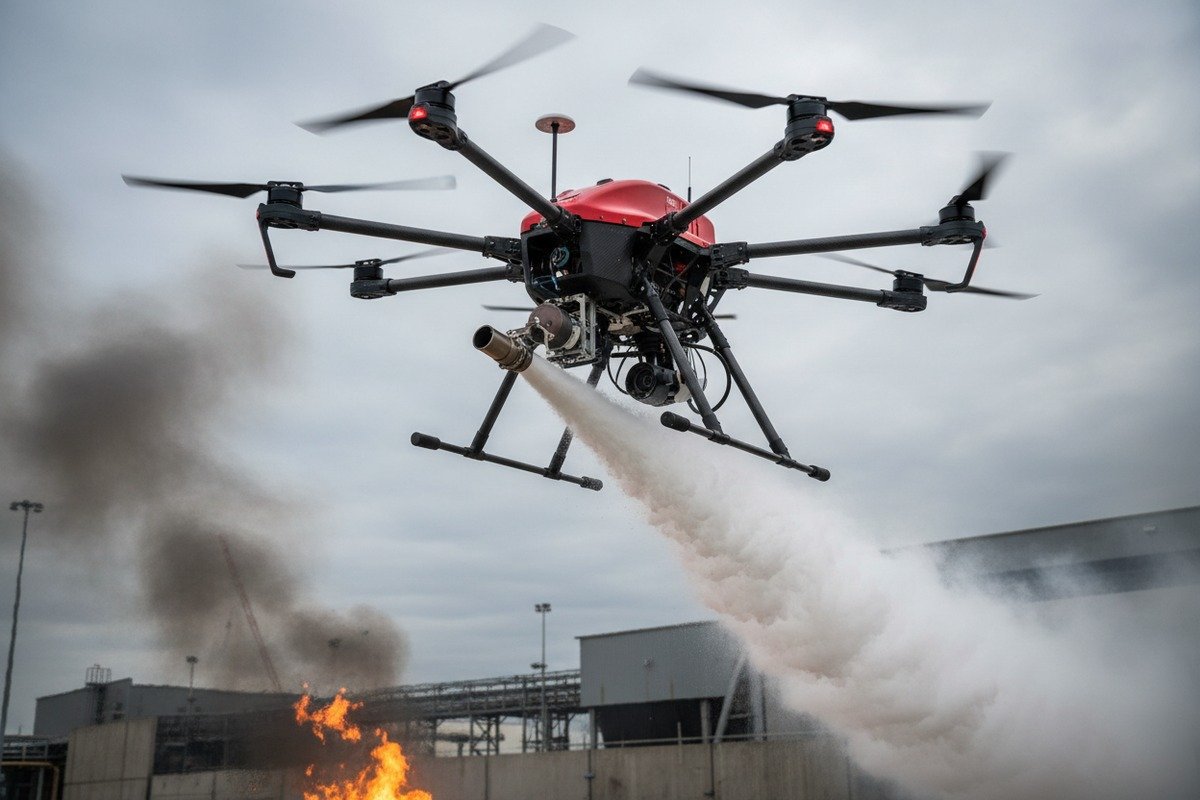
Justifiez l'importation par rapport à l'achat local en examinant la construction du cadre en fibre de carbone, le boîtier électronique certifié IP, la qualité du moteur sous contrainte thermique et les données documentées de MTBF (temps moyen entre les pannes). Les importations de qualité utilisent des matériaux de qualité aérospatiale avec des indices IP54 ou supérieurs, tandis que certaines options nationales privilégient les conceptions de surveillance légères qui sacrifient la durabilité pour l'agilité.
Indicateurs de qualité des matériaux
Frame construction tells you most of what you need to know about durability. Our production line uses woven carbon fiber with specific resin systems rated for temperature extremes. carbon fiber frame construction 8 This differs from consumer drone carbon fiber, which may delaminate under heat stress.
Look for these specific quality markers:
Motor housings should be machined aluminum, not plastic. Firefighting drones operate near heat sources that deform polymer components.
Les systèmes de fixation d'hélice nécessitent un contact métal sur métal. Les adaptateurs d'hélice en plastique se fissurent sous la contrainte des vibrations au fil du temps.
Les faisceaux de câbles nécessitent des connecteurs de qualité aéronautique avec des mécanismes de verrouillage positifs. Les connecteurs de qualité grand public se desserrent lors des cycles thermiques répétés.
Les boîtiers électroniques nécessitent des indices IP documentés. IP54 minimum pour la résistance à la poussière et aux éclaboussures. IP67 pour les opérations impliquant des gouttes d'eau ou des projections de mousse. Boîtier électronique avec indice IP 9
Normes de test de durabilité
| Catégorie de test | Exigence standard | Exigence Premium | Méthode d'essai |
|---|---|---|---|
| Température de fonctionnement | -10°C à +40°C | -20°C à +55°C | Chambre climatique |
| Résistance aux vibrations | Vibration aléatoire 2G | Vibration aléatoire 5G | Test sur table vibrante |
| Impact de chute | Survie à une chute de 1m | Survie à une chute de 2m | Test de chute contrôlée |
| Pénétration de poussière | IP5X | IP6X | Exposition en chambre à poussière |
| Résistance à l'eau | IPX4 | IPX7 | Pulvérisation d'eau/immersion |
| Thermique moteur | 30 min à 80% charge | 60 min à 100% charge | Essais dynamométriques |
Demandez des certificats de test réels, pas seulement des puissances revendiquées. Tout fabricant sérieux conserve la documentation de test des laboratoires tiers.
Perspective du coût total de possession
Les droits d'importation et l'expédition ajoutent 15-25% au coût rendu. Cependant, la durabilité affecte l'économie à long terme plus que le prix d'achat.
Un drone nécessitant une maintenance majeure toutes les 50 heures de vol coûte plus cher sur trois ans qu'une unité haut de gamme d'une durée de 200 heures entre les révisions. Nos partenaires américains suivent attentivement les données de maintenance. Les 45% d'économies opérationnelles citées dans la recherche industrielle proviennent en grande partie de la réduction de la fréquence de maintenance.
La disponibilité des pièces de rechange est également importante. Nous maintenons un inventaire de pièces basé aux États-Unis pour les articles d'usure courants. Attendre six semaines pour des remplacements de moteur venant de l'étranger détruit l'argument économique des importations.
Vérification de la durabilité sur le terrain
Avant de vous engager dans des achats en volume, demandez des unités d'essai sur le terrain. Faites-les fonctionner intensivement pendant 30 jours. Documentez toute défaillance. Les fabricants de qualité accueillent ces tests car ils renforcent la confiance à long terme.
Notre accord d'essai standard comprend un support technique complet pendant les tests et le remplacement de toute unité défaillante dans les paramètres de fonctionnement normaux. Cette confiance vient de la connaissance que nos normes de qualité de fabrication dépassent ce que les tests révéleront.
Comment puis-je vérifier qu'un fabricant chinois peut fournir le support technique dont mes clients américains ont besoin ?
La capacité de support nous a plus inquiétés que la qualité du produit lorsque nous avons lancé nos opérations aux États-Unis. Un excellent drone ne signifie rien si les acheteurs ne peuvent pas obtenir d'aide lorsque des problèmes surviennent. Nous avons construit notre infrastructure de support avant de développer les ventes car cette préoccupation est légitime. La vérification nécessite des preuves spécifiques, pas des promesses.
Vérifiez la capacité de support technique en demandant des garanties de temps de réponse documentées, en confirmant la disponibilité du personnel technique dans le fuseau horaire américain, en examinant des études de cas de tickets de support passés et en testant les canaux de support avant l'achat. Les fabricants de qualité fournissent des engagements de réponse initiale de 24 heures, des ingénieurs dédiés parlant anglais et des capacités de diagnostic à distance qui éliminent la plupart des retards de support.

Exigences en matière d'infrastructure de support
Le support technique pour les drones de lutte contre les incendies diffère du support pour les produits de consommation. Les pompiers ont besoin de réponses rapides. Un drone immobilisé pendant la saison des feux de forêt coûte des vies, pas seulement de l'argent.
Évaluez ces éléments de support spécifiques :
Les garanties de temps de réponse doivent être contractuelles, pas aspirations. Notre accord standard promet une réponse initiale dans les quatre heures pendant les heures de bureau américaines, avec des voies d'escalade clairement définies.
Les qualifications du personnel technique sont importantes. Demandez les références des ingénieurs qui géreront votre compte. Le dépannage de drones nécessite une expertise en contrôleur de vol, une connaissance de la chimie des batteries et une compréhension simultanée du système de charge utile.
Les capacités de diagnostic à distance réduisent considérablement le temps de résolution. Nos drones transmettent automatiquement les journaux de vol après chaque mission. Lorsque des tickets de support arrivent, nos ingénieurs disposent déjà des données de diagnostic avant le premier appel.
Liste de contrôle de vérification du support
| Étape de vérification | Ce qu'il faut demander | Drapeaux rouges |
|---|---|---|
| Temps de réponse | SLA écrit avec pénalités | Langage vague de "meilleur effort" |
| Personnel technique | Références et certifications des ingénieurs | Personnel de vente gérant les problèmes techniques |
| Capacité linguistique | Communication directe avec les ingénieurs en anglais | Communication par traduction uniquement |
| Diagnostics à distance | Démonstration du système de diagnostic | Soumission manuelle des journaux requise |
| Disponibilité des pièces | Liste des stocks américains avec quantités | Toutes les pièces sont expédiées depuis l'étranger |
| Soutien sur place | Option de visite technique et tarifs | Aucune capacité de service sur le terrain |
| Ressources de formation | Bibliothèque vidéo et documentation | Matériel de formation uniquement en chinois |
Support de test avant engagement de volume
Effectuez un test de support avant de signer des accords d'achat majeurs. Soumettez une question technique par les canaux normaux. Chronométrez la réponse. Évaluez la qualité de la réponse.
Nos partenaires américains testent régulièrement notre équipe de support avec des scénarios de plus en plus complexes. Cela nous maintient alertes et leur donne confiance en nos capacités.
Un distributeur nous a posé une question délibérément obscure sur un contrôleur de vol à 16h00, heure du Pacifique. Notre équipe de Xi'an a fourni une réponse avec des étapes de diagnostic en moins de trois heures, malgré la différence horaire de 15 heures. Ce test les a convaincus d'augmenter leur commande.
Documentation et support de formation
Le support d'ingénierie va au-delà du dépannage. Les services d'incendie ont besoin de matériel de formation, de guides de maintenance et de procédures opérationnelles.
Les fabricants de qualité fournissent une documentation complète en anglais, pas du texte traduit automatiquement. Notre équipe de rédaction technique comprend des locuteurs natifs anglais qui examinent toute la documentation destinée aux États-Unis.
Les bibliothèques de formation vidéo réduisent la charge de support et améliorent la compétence des opérateurs. Nous maintenons plus de 40 heures de contenu de formation couvrant l'inspection avant vol, la planification de mission, l'opération de charge utile et les procédures de maintenance.
La documentation de support de certification aide les services d'incendie à obtenir les autorisations de la FAA et les approbations au niveau de l'État. Cette paperasse est fastidieuse mais essentielle. Les fabricants qui soutiennent le processus de certification démontrent un engagement de partenariat à long terme.
Conclusion
L'identification des USP des drones de lutte contre les incendies nécessite une évaluation systématique de la capacité de charge utile, de l'endurance, de la qualité de fabrication et de l'infrastructure de support. Les concurrents américains excellent dans la surveillance mais sont à la traîne en matière de capacité d'extinction à forte charge. Les étapes de vérification décrites ici aident les responsables des achats à prendre des décisions d'importation éclairées qui servent efficacement leurs clients pompiers.
Notes de bas de page
1. Explique comment les drones profitent aux services d'incendie, y compris la surveillance en temps réel et l'imagerie thermique. ︎
2. Détaille les capacités et les applications des drones à forte charge utile dans diverses industries. ︎
3. Définit la capacité de charge utile des drones et les facteurs qui l'influencent, y compris la poussée du moteur et la puissance de la batterie. ︎
4. Fournit des informations sur les produits chimiques ignifuges, leurs utilisations et les préoccupations associées. ︎
5. Discute des facteurs affectant l'endurance de vol des drones, tels que l'efficacité aérodynamique et la propulsion. ︎
6. Explique les systèmes de propulsion hybrides pour les drones, soulignant l'augmentation de l'endurance de mission et l'efficacité énergétique. ︎
7. Instructions officielles de la FAA pour demander des dérogations opérationnelles en vertu des réglementations de la partie 107. ︎
8. Discute de l'utilisation de la fibre de carbone dans la fabrication de cadres de drones pour des conceptions légères et durables. ︎
9. Informations officielles de la CEI sur les codes de protection d'entrée (IP) pour les boîtiers électriques contre la poussière et l'eau. ︎

 English
  Español de México
  Deutsch
  Français
  Русский
  العربية
