Every week, our production team receives calls from frustrated buyers who purchased drones with hidden pesticide residue 1 problems. These contamination issues lead to crop rejections, regulatory fines, and equipment failures. The problem is real, and it costs farmers thousands of dollars.
When buying agricultural drones, evaluate tank cleaning by checking tank design for complete drainage, verifying material compatibility with chemicals, inspecting internal plumbing for dead spots, and confirming the supplier offers cleaning protocols and technical support. Request cleaning certificates and consider independent lab testing for used equipment.
This guide walks you through everything you need to know about tank cleaning evaluation high-density polyethylene (HDPE) 2. We will cover design features, material selection, plumbing systems, and supplier support.
How do I evaluate if the drone's tank design allows for complete residue removal?
Our engineering team spends months perfecting tank geometry 3 before any drone leaves the factory. Poor tank design traps pesticide residue in corners and crevices. This trapped residue contaminates your next application and damages crops LC-MS/MS analysis 4.
A well-designed drone tank features smooth internal surfaces, sloped bottoms for complete drainage, accessible inspection ports, and no sharp corners where residue accumulates. Look for tanks with drain valves at the lowest point and wide openings that allow manual cleaning access.

Understanding Tank Geometry
Tank shape matters more than most buyers realize. When we test new tank designs, we use colored dye to track residue patterns. Flat-bottomed tanks retain up to 15% more liquid than properly sloped designs.
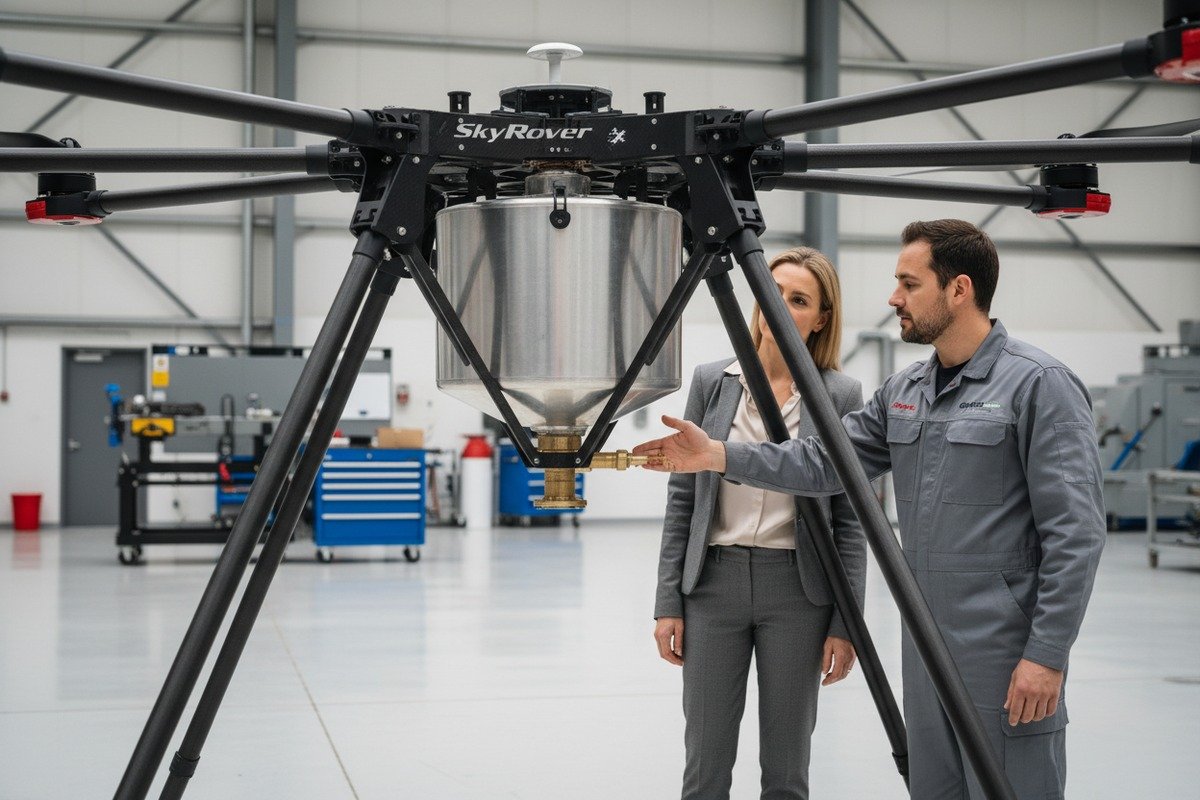
The ideal tank has a conical or V-shaped bottom. This shape directs all liquid toward a central drain point. Our hexacopter models use this geometry to achieve 99% drainage efficiency.
Critical Design Features to Check
Before purchasing, examine these specific features:
| Fonctionnalité | Good Design | Poor Design |
|---|---|---|
| Bottom Shape | Sloped or conical | Flat |
| Internal Corners | Rounded | Sharp 90-degree angles |
| Drain Location | Lowest point | Side or elevated |
| Access Ports | Wide, multiple | Small, single |
| Surface Finish | Smooth, polished | Rough, textured |
Inspection Port Accessibility
You cannot clean what you cannot reach. Many cheap drones have small fill openings that prevent proper inspection. We recommend tanks with openings of at least 10 centimeters diameter.
Ask the seller to demonstrate tank access. Can you see all internal surfaces? Can you reach every corner with a brush or rinse wand? If not, residue will build up in hidden areas.
The Dead Spot Problem
Dead spots 5 are areas where liquid stagnates during rinsing. They form in corners, behind baffles, and in recessed areas. During our quality control process, we identify and eliminate dead spots through flow testing.
Request flow test data from your supplier. Reputable manufacturers document drainage patterns and cleaning validation. If the seller cannot provide this information, consider it a warning sign.
Practical Testing Methods
When evaluating a drone in person, perform these simple tests:
- Fill the tank with clean water
- Drain completely and measure remaining liquid
- Check for wet spots indicating poor drainage
- Smell for chemical odors from previous use
- Inspect for discoloration or staining
A well-designed tank drains almost completely within 30 seconds. Remaining puddles indicate design flaws that will cause contamination problems.
What tank materials should I look for to prevent chemical absorption in my agricultural drones?
When we select materials for our tanks, chemical compatibility 6 is the first consideration. The wrong material absorbs pesticides like a sponge. This contamination releases slowly over time, poisoning crops months after the original application.
Choose tanks made from high-density polyethylene (HDPE), stainless steel, or specialized chemical-resistant polymers. Avoid standard plastics, aluminum, and carbon fiber composites for fluid-contact surfaces. HDPE offers the best balance of chemical resistance, durability, and cost for most agricultural applications.

Material Compatibility Basics
Different pesticides attack different materials. Solvents dissolve certain plastics. Acids corrode metals. Alkaline solutions damage composites. Your tank must resist the full range of chemicals you plan to spray.
We test our tank materials against over 200 common agricultural chemicals. This testing reveals which materials perform best for specific applications.
Material Comparison Guide
| Material | Chemical Resistance | Poids | Coût | Meilleur pour |
|---|---|---|---|---|
| HDPE | Excellent | Light | Faible | General use |
| Stainless Steel 316 | Excellent | Heavy | Haut | Corrosive chemicals |
| Polypropylene | Bon | Light | Faible | Mild chemicals |
| PTFE-lined | Superior | Moyen | Très élevé | Aggressive solvents |
| Aluminium | Pauvre | Light | Moyen | Avoid for pesticides |
| Standard Plastic | Pauvre | Light | Très faible | Avoid entirely |
The Absorption Problem
Some materials absorb chemicals at the molecular level. This absorption is invisible but dangerous. The chemical slowly releases during future applications, contaminating unrelated crops.
We tested a competitor's plastic tank after six months of herbicide use. Even after thorough cleaning, the tank released detectable herbicide residue into clean water. The farmer lost an entire organic crop certification.
Checking Material Specifications
Request material data sheets from your supplier. These documents list:
- Chemical resistance ratings
- Temperature limits
- UV stability
- Expected lifespan
- Absorption characteristics
If the seller cannot provide material specifications, assume the worst. Quality manufacturers document everything.
Seals, Gaskets, and Fittings
The tank itself is only part of the equation. Every seal, gasket, and fitting contacts pesticides. These components often use different materials than the main tank.
Our designs use Viton or EPDM seals 7 throughout. These elastomers resist most agricultural chemicals. Cheap drones use standard rubber that degrades quickly and absorbs chemicals.
Long-Term Material Degradation
Even resistant materials degrade over time. UV exposure, temperature cycling, and repeated chemical contact weaken all materials. We recommend tank replacement every 5-7 years for heavy commercial use.
Inspect used drones carefully for material degradation signs:
- Surface crazing or cracking
- Color changes or staining
- Soft spots or brittleness
- Cloudy appearance in clear materials
How can I verify that the internal plumbing system won't cause pesticide cross-contamination?
Our service technicians often discover contamination sources in plumbing, not tanks. Pumps, hoses, filters, and nozzles all trap residue. One clogged filter can contaminate hundreds of acres before detection.
Verify plumbing cleanliness by inspecting filter screens, checking hose interiors for discoloration, running clean water through the system and testing the output, and examining nozzle spray patterns for irregularities. Request documentation of the flushing protocol and ask about component accessibility for manual cleaning.

Mapping the Fluid Path
Understanding where chemicals travel helps you identify contamination risks. A typical agricultural drone has this fluid path 8:
- Tank
- Inlet filter
- Primary pump
- Pressure regulator
- Distribution manifold
- Secondary filters
- Nozzles or atomizers
Each component can trap residue. Each connection point can leak or accumulate deposits.
Critical Components to Inspect
| Composant | Contamination Risk | Inspection Method | Cleaning Difficulty |
|---|---|---|---|
| Inline Filters 9 | Très élevé | Visual, remove and check | Easy if accessible |
| Pompes | Haut | Run test water, check output | Modéré |
| Hoses | Moyen | Cut section, inspect interior | Easy to replace |
| Manifolds | Haut | Flush and test | Difficile |
| Nozzles | Très élevé | Pattern test, visual check | Easy |
| Pressure Regulators | Moyen | Pressure consistency test | Difficile |
The Filter Problem
Filters protect nozzles from clogs but trap pesticide residue. We design our systems with easily accessible filters that can be removed without tools. Many competitors hide filters inside sealed housings.
Ask to see the filter removal process. If it requires special tools or significant disassembly, cleaning will be neglected in practice. Neglected filters become contamination reservoirs.
Hose Material and Routing
Hose material matters as much as tank material. Our systems use chemically resistant tubing rated for agricultural chemicals. We also minimize hose length and avoid low points where liquid pools.
Check hose routing for:
- Low spots that trap liquid
- Sharp bends that restrict flow
- Connections that cannot be disassembled
- Damaged or aged sections
Nozzle Inspection Techniques
Nozzles are the final contamination checkpoint. Rotating disc atomizers, common on modern agricultural drones, require thorough cleaning between pesticide types.
Test spray patterns by running clean water through the system. Uneven patterns, spitting, or reduced flow indicate residue buildup. Compare the pattern to manufacturer specifications.
Flushing Protocol Verification
Every drone should have a documented flushing protocol. This protocol specifies:
- Water volume required
- Flushing duration
- Cleaning agent recommendations
- Component-specific procedures
- Verification methods
We provide detailed flushing protocols with every drone. Sellers who cannot provide this documentation likely have not tested their cleaning procedures.
Automated Cleaning Systems
Advanced drones include automated flushing cycles. These systems circulate cleaning solution through all plumbing components with the push of a button. While not a substitute for manual cleaning, automation improves consistency.
Ask about automated cleaning features. Our premium models include programmable flush cycles that can be customized for different chemical types.
What technical support should I expect from my supplier to ensure long-term tank hygiene?
Our customer support team handles more cleaning questions than flight questions. Proper tank hygiene requires ongoing guidance, not just a user manual. The right supplier becomes a long-term partner in residue management.
Expect suppliers to provide detailed cleaning protocols for each pesticide class, material compatibility charts, replacement part availability, remote technical support for cleaning issues, and training resources. Quality suppliers also offer cleaning verification services, inspection schedules, and regulatory compliance documentation.

Essential Documentation Package
Before purchase, verify that the supplier provides:
| Type de document | Objectif | Pourquoi c'est important |
|---|---|---|
| Cleaning Protocol Manual | Step-by-step cleaning procedures | Ensures proper technique |
| Material Compatibility Chart | Chemical/material interactions | Prevents damage |
| Maintenance Schedule | Recommended inspection intervals | Catches problems early |
| Parts Catalog | Replacement component specifications | Enables repairs |
| Regulatory Compliance Guide | Regional requirements | Avoids legal issues |
| Warranty Terms | Coverage for cleaning-related damage | Protects investment |
Training and Education Support
Equipment without training is useless. We provide comprehensive training that covers:
- Daily cleaning procedures
- Weekly maintenance tasks
- Seasonal deep cleaning
- Emergency contamination response
- Record-keeping requirements
Ask potential suppliers about their training programs. Video tutorials, live webinars, and on-site training all add value. Suppliers who sell and disappear leave you solving problems alone.
Remote Technical Support
Contamination problems require expert diagnosis. Our technical support team can review photos and videos to identify residue sources. We guide customers through testing procedures over video calls.
Evaluate support responsiveness before purchase. Send a technical question to the sales team. Fast, knowledgeable responses indicate good post-purchase support. Slow or vague answers predict future frustration.
Parts Availability and Lead Times
Cleaning-related wear is normal. Seals degrade. Filters require replacement. Hoses age. Your supplier must provide replacement parts quickly.
We maintain inventory of all wear parts with guaranteed shipping within 48 hours. Some competitors require 4-6 week lead times for basic components. This delay forces you to operate contaminated equipment or ground your drone entirely.
Third-Party Testing Support
Sometimes professional testing is necessary. Quality suppliers maintain relationships with testing laboratories and can facilitate sample submission.
Lab testing options include:
- LC-MS/MS analysis: Highly accurate, detects trace residues, takes 3-5 days
- Swab testing: Fast results, moderate sensitivity, good for spot checks
- Rinse water analysis: Tests entire system, moderate cost
- Hyperspectral imaging: Non-destructive, fast, emerging technology
We partner with SGS laboratories to offer discounted testing for our customers. This partnership demonstrates our commitment to cleaning efficacy.
Regulatory Compliance Support
EPA and PMRA regulations require documented cleaning procedures for certain pesticide applications. Your supplier should help you meet these requirements.
We provide compliance documentation packages that include:
- Cleaning log templates
- Inspection checklists
- Calibration records
- Residue test result storage
- Audit preparation guides
Valeur du partenariat à long terme
The best suppliers view each sale as the beginning of a relationship. We track customer cleaning histories and proactively recommend maintenance. Our engineers continuously improve cleaning protocols based on field feedback.
Ask potential suppliers about their customer retention rate. High retention indicates satisfied customers receiving ongoing value. Low retention suggests a sell-and-forget approach that leaves you vulnerable.
Conclusion
Evaluating tank cleaning capability protects your investment and your crops. Check tank design, verify material compatibility, inspect plumbing systems, and confirm supplier support before purchase. These steps prevent costly contamination problems and ensure reliable performance for years.
Notes de bas de page
1. WHO provides authoritative information on pesticide residues in food and their health implications. ︎
2. Shell Polymers, an industry leader, details the chemical resistance properties and applications of HDPE. ︎
3. ASME offers an engineering perspective on how tank geometry affects fluid dynamics and sloshing. ︎
4. Anacon Laboratories details the use of LC-MS/MS technology for effective pesticide residue detection. ︎
5. This academic paper defines dead zones in fluid flow and discusses their impact on water quality. ︎
6. Greene Tweed explains the importance of evaluating chemical resistance and fluid compatibility for materials. ︎
7. This industry source provides a direct chemical compatibility comparison between Viton and EPDM seals. ︎
8. Elementary Engineering explains the concept of a flow path in fluid mechanics and its representation. ︎
9. PoreFiltration provides a comprehensive overview of inline filters and their use in process industries. ︎

 English
  Spanish
  German
  French
  Dutch
Dutch  Arabic
