
When our engineering team first developed diagnostic systems for firefighting drones, we quickly learned that raw data means nothing if operators cannot interpret it under pressure. Many procurement managers struggle with the same challenge: they invest in advanced drone fleets only to discover that complex diagnostic interfaces slow down emergency response times 1.
To evaluate diagnostic tool ease of use, request hands-on demo access, test real-time data clarity under simulated smoke conditions, assess operator training requirements, verify integration with your existing command systems, and confirm the manufacturer provides comprehensive remote technical support for field repairs.
This guide walks you through practical evaluation methods we have refined through years of manufacturing and exporting firefighting drones to fire departments across the United States and Europe. Let us explore each critical aspect step by step.
How can I test the drone's diagnostic software for ease of use before I place a bulk order?
Before committing to a large purchase, procurement teams often feel uncertain about whether a diagnostic system will actually work for their personnel. In our experience shipping to US fire departments, we have seen buyers regret orders because they skipped proper testing phases.
Request a full trial period with your actual operators, not just a sales demo. Test the software under realistic conditions including smoke simulation, night operations, and multi-drone coordination. Evaluate how quickly non-specialist staff can learn the interface and make tactical decisions independently.

Demand Real-World Trial Access
Never rely solely on polished sales demonstrations. When we prepare evaluation units for potential clients, we encourage them to put the drones through genuine stress tests 2. A controlled showroom environment does not reflect the chaos of an actual wildfire or structure fire.
Ask the manufacturer for a 14-30 day trial period. During this time, assign your least experienced operators to learn the system. Track how many hours they need before they can independently interpret thermal hotspot data 3, switch between autonomous and manual control modes, and communicate findings to ground crews.
Create Structured Testing Scenarios
Develop specific test cases that match your operational reality. Here is a framework we recommend:
| Scénario de test | What to Evaluate | Pass Criteria |
|---|---|---|
| Heavy smoke simulation | Thermal image clarity, data transmission stability | Clear hotspot detection through simulated smoke |
| Night operation | Interface visibility, screen glare management | Operators can read all critical data without external lighting |
| Multi-drone coordination | Dashboard layout, switching between drone feeds | Commanders can monitor 3+ drones without confusion |
| Manual override | Transition speed from autonomous to manual mode | Under 3 seconds with continuous data display |
| Communication interruption | System behavior during signal loss | Graceful degradation with clear status indicators |
Assess Training Time Requirements
Our factory has shipped drones to departments with varying technical backgrounds. Some teams become proficient within hours. Others struggle for weeks. The difference usually lies in interface design, not operator intelligence.
Document the exact training hours needed for three proficiency levels: basic operation, intermediate tactical use, and advanced troubleshooting. If a manufacturer cannot provide clear training timelines, consider this a warning sign. Our standard training protocol for the SkyRover firefighting series targets 8 hours for basic proficiency and 24 hours for full tactical competence.
Verify Intuitive Design Principles
Check whether the diagnostic interface follows standard conventions. Icons should be universally recognizable. Menu hierarchies should be logical. Critical information—thermal hotspots, GPS coordinates, battery status, communication strength—should appear without requiring multiple screen taps.
When we design our control interfaces, we follow the "gloved hand" principle. Firefighters wear protective gear. Touchscreens must respond to gloved fingers. Buttons must be large enough for quick selection under stress.
What specific diagnostic features will help my team reduce maintenance downtime for firefighting drones?
Maintenance downtime directly affects mission readiness. When our production team analyzes customer feedback, equipment sitting idle for repairs consistently ranks as a top frustration. The right diagnostic features can cut downtime dramatically.
Prioritize predictive maintenance alerts, component-level health monitoring, automated flight log analysis, and clear error code explanations. These features help technicians identify problems before failures occur and reduce diagnostic guesswork during repairs, keeping your fleet mission-ready.
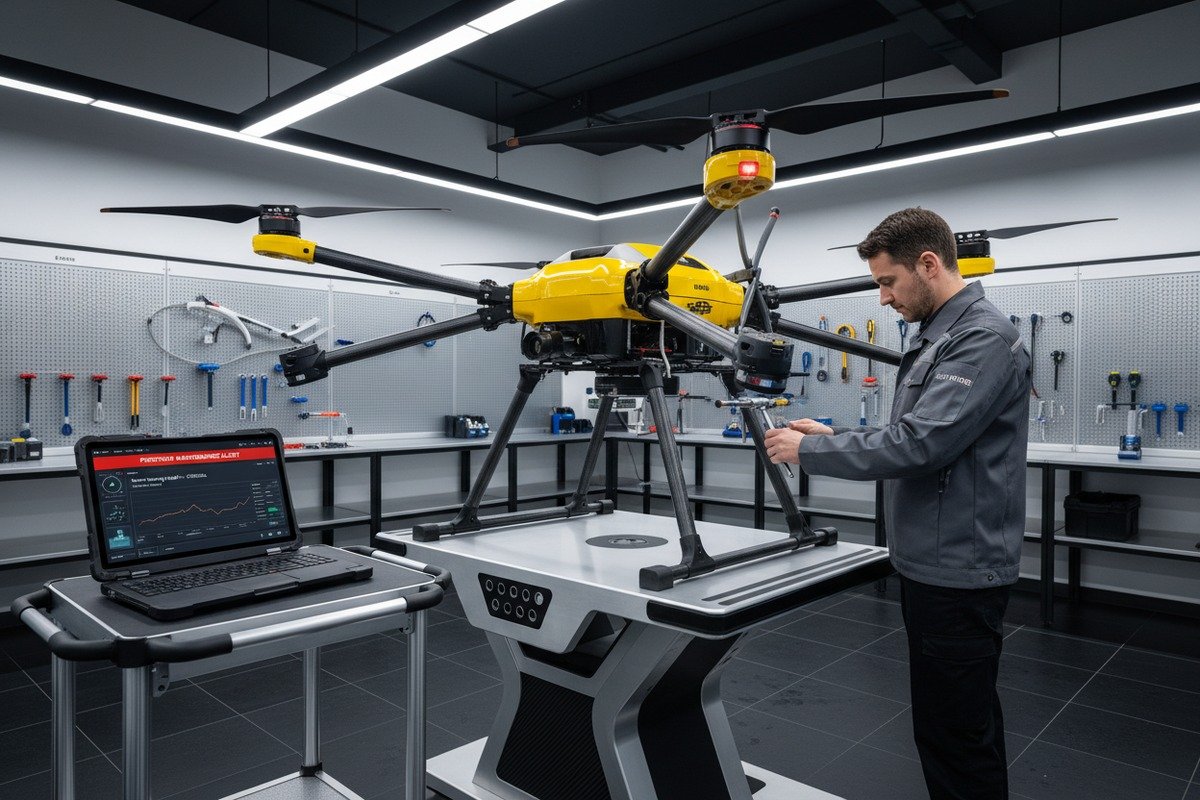
Predictive Maintenance Alerts
Modern diagnostic systems should not just report current status. They should predict future problems. When we calibrate our flight controllers, we build in algorithms that track motor performance degradation over time.
Look for systems that monitor:
- Motor temperature trends across flights
- Battery cycle count 4 and capacity degradation
- Propeller balance and vibration patterns
- Gimbal calibration drift
- Communication module signal strength history
A good predictive system warns you days or weeks before a component fails. This allows scheduled maintenance rather than emergency repairs.
Component-Level Health Dashboards
Vague "system healthy" or "system error" messages waste technician time. Effective diagnostics provide component-level detail.
| Composant | Key Health Metrics | Acceptable Range |
|---|---|---|
| Moteurs | Temperature, RPM consistency, current draw | <80°C operating, <2% RPM variance |
| Battery | Voltage per cell, internal resistance, cycle count | >3.7V per cell, <50mΩ resistance |
| Thermal camera | Sensor calibration status, pixel defect count | Calibrated within 30 days, <5 dead pixels |
| GPS module | Satellite lock count, position accuracy | >12 satellites, <1m accuracy |
| Communication | Signal strength, packet loss rate | >-70dBm, <1% packet loss |
Our diagnostic dashboard displays these metrics in real-time during flight and logs them for post-flight review. Technicians can quickly identify which specific component needs attention.
Automated Flight Log Analysis
After each mission, diagnostic tools should automatically analyze flight logs and flag anomalies. Automated Flight Log Analysis 5 Manual log review is time-consuming and error-prone.
When we developed our analysis algorithms, we focused on detecting subtle patterns human reviewers often miss: gradual motor efficiency loss, intermittent sensor glitches, and communication dropouts that last only milliseconds but indicate developing problems.
The system should generate plain-language summaries: "Motor 3 showed 7% higher current draw than average over last 5 flights. Recommend inspection within 10 flight hours."
Clear Error Code Documentation
Nothing frustrates technicians more than cryptic error codes with no explanation. Demand comprehensive error code documentation before purchase.
Our error code library includes:
- Plain-language description of each error
- Probable causes ranked by likelihood
- Step-by-step troubleshooting procedures
- Required tools and replacement parts
- Estimated repair time
If a manufacturer cannot provide this documentation during the evaluation phase, expect support headaches after purchase.
Capacités de diagnostic à distance
Some problems require manufacturer expertise. Remote diagnostic access allows our engineers to examine your drone's data without shipping equipment back and forth. Capacités de diagnostic à distance 6
When we support US clients, time zone differences make phone troubleshooting difficult. Remote diagnostic access lets our team review flight logs, sensor data, and system configurations asynchronously. We can often identify issues and recommend solutions within hours rather than days.
How do I ensure the manufacturer's diagnostic tools provide the remote support I need for field repairs?
Field repairs during active operations require immediate technical support. When our export team onboards new distributors, we emphasize that hardware quality means nothing without accessible support infrastructure.
Verify 24/7 technical support availability across your time zone, confirm remote diagnostic access capabilities, test response times before purchase, and ensure the manufacturer provides video-guided repair procedures. These elements determine whether field issues become minor delays or mission-ending failures.

Evaluate Support Infrastructure Before Purchase
Do not assume support quality. Test it during the evaluation phase. Submit technical questions at inconvenient hours. Measure response times. Assess answer quality.
When we structured our support system for US clients, we recognized that California operates 15-16 hours behind our Xi'an headquarters. We established dedicated support windows and asynchronous communication protocols to bridge this gap.
| Support Element | Questions to Ask | Drapeaux rouges |
|---|---|---|
| Response time | What is guaranteed response time for critical issues? | No SLA or vague "as soon as possible" answers |
| Disponibilité | What hours is live support available in my time zone? | Support hours that miss your operational windows |
| Communication channels | Do you offer video calls for complex troubleshooting? | Email-only support for technical issues |
| Language capability | Are support staff fluent in English? | Reliance on translation tools for technical discussions |
| Remote access | Can you remotely access diagnostic data from my drones? | No remote diagnostic capability |
Demand Remote Diagnostic Access Capabilities
Remote access transforms support interactions. Instead of describing symptoms over the phone, technicians can share their screen. Our engineers can view the same diagnostic data your team sees.
Our remote diagnostic protocol allows us to:
- Review real-time sensor readings
- Examine flight log history
- Run automated diagnostic routines
- Update firmware remotely when appropriate
- Guide local technicians through repairs via video
Ensure the manufacturer's diagnostic tools include secure remote access features. Ask about data privacy protections and access authorization procedures.
Test Video-Guided Repair Procedures
Complex repairs require visual guidance. Written instructions often fail to convey spatial relationships and assembly sequences.
Before finalizing your order, ask the manufacturer for sample repair procedure videos. Evaluate their quality:
- Are camera angles clear and steady?
- Does narration explain each step adequately?
- Are required tools and parts clearly identified?
- Is the procedure organized in logical sequence?
Our video library covers every common repair procedure for the SkyRover firefighting series. We update these videos whenever we modify component designs.
Establish Escalation Pathways
Not every issue can be resolved remotely. Establish clear escalation procedures:
What happens when remote troubleshooting fails? Does the manufacturer offer:
- Advance replacement of defective units?
- On-site technical visits for critical situations?
- Expedited shipping for replacement parts?
- Loaner equipment during extended repairs?
When we support critical infrastructure clients, we maintain regional parts inventory and can often ship replacements within 48-72 hours to US destinations.
Verify Parts Availability and Pricing
Remote support becomes meaningless if replacement parts are unavailable or prohibitively expensive. Request a complete spare parts catalog with pricing before purchase.
Our standard practice includes providing clients with recommended spare parts inventory lists based on fleet size and expected utilization rates. We also guarantee parts availability for minimum five years after purchase.
Can I easily interpret the diagnostic data to ensure my fleet remains mission-ready at all times?
Data interpretation separates useful diagnostic tools from overwhelming ones. When our interface designers work on new systems, they constantly ask: "Will an incident commander understand this information in three seconds or less?"
Effective diagnostic data interpretation requires unified dashboards displaying multi-sensor data coherently, automatic anomaly highlighting with AI-powered detection, standardized data export formats for integration with existing systems, and fleet-wide health overviews that identify which units need attention immediately.
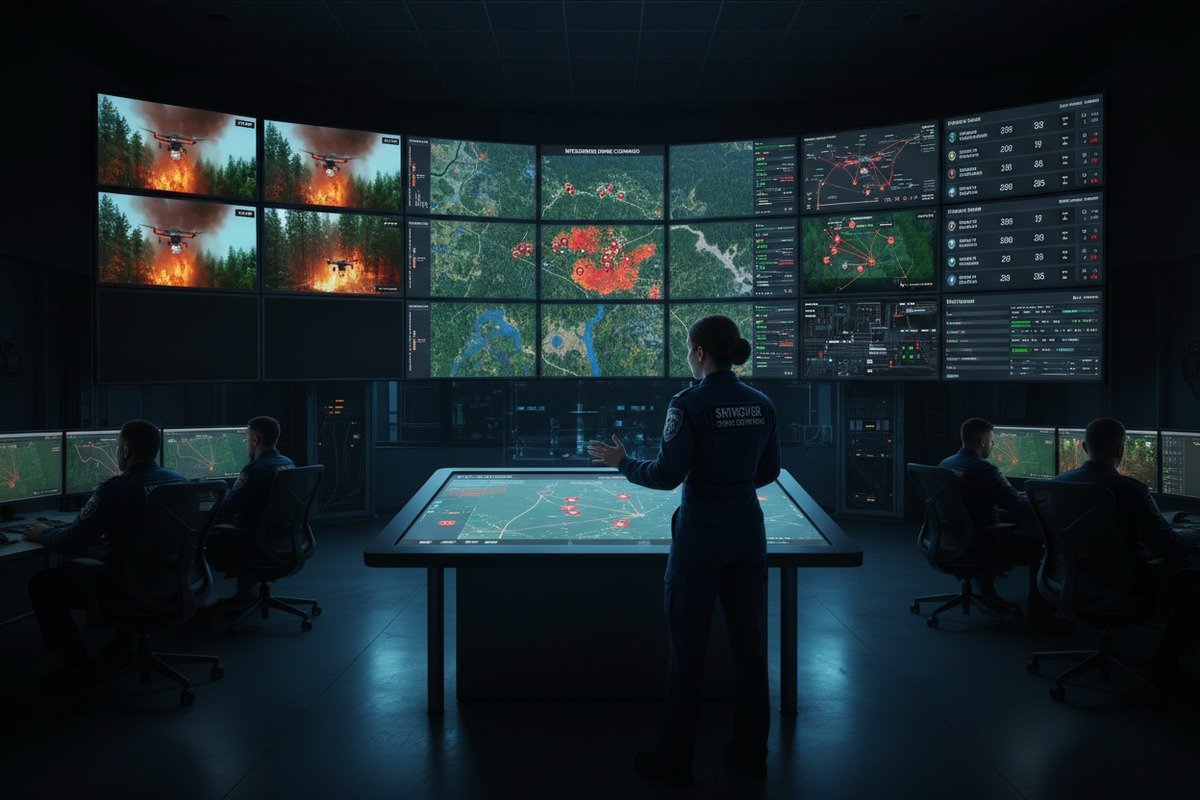
Unified Multi-Sensor Dashboards
Firefighting drones generate diverse data streams: thermal imagery, optical video, GPS coordinates, altitude, battery status, communication strength, and potentially gas detection readings. Effective interpretation requires unified presentation.
Toggling between multiple screens during active operations wastes precious seconds and increases cognitive load. Our dashboard design philosophy prioritizes single-screen situational awareness.
| Type de données | Display Priority | Presentation Method |
|---|---|---|
| Thermal hotspots | Critical – always visible | Color-coded overlay on map with temperature values |
| GPS position | Critical – always visible | Real-time marker on unified map |
| Battery remaining | High – persistent indicator | Percentage bar with estimated flight time |
| Communication status | High – persistent indicator | Signal strength icon with warning threshold |
| Altitude/speed | Medium – available on demand | Numerical display in corner widget |
| Detailed sensor logs | Low – post-flight review | Exportable reports and graphs |
AI-Powered Anomaly Detection
Human operators cannot continuously monitor every data stream. AI assistance becomes essential for catching critical anomalies.
When we implemented our hotspot detection algorithm, we trained it on thousands of thermal images from actual fire scenarios. The system automatically identifies temperature spikes that exceed configurable thresholds and highlights them with visual and audible alerts.
However, AI detection 8 must include explainability. Operators need to understand why the system flagged something. Our alerts include confidence scores and brief explanations: "Hotspot detected: 287°C, exceeds 200°C threshold, located at coordinates X, Y."
False positives erode operator trust. Ask manufacturers about their false-positive rates and how the system handles uncertain detections. Our approach presents uncertain detections differently from high-confidence alerts, allowing operators to make informed decisions about whether to investigate.
Fleet-Wide Health Monitoring
Individual drone diagnostics matter, but fleet managers need aggregate views. Which drones are mission-ready right now? Which need maintenance before next deployment?
Our fleet management dashboard provides:
- At-a-glance status for all registered units
- Maintenance schedule tracking with overdue alerts
- Flight hour accumulation by unit
- Historical reliability metrics per drone
- Recommended maintenance priorities based on upcoming mission requirements
Standardized Data Export and Integration
Diagnostic data becomes more valuable when integrated with existing systems. Fire departments often use established incident command software, GIS platforms, and evidence management systems.
Ask manufacturers about data export formats and API availability. Our systems support:
- Standard video formats (MP4, MOV) for thermal and optical footage
- KML/KMZ export 9 for GPS tracks compatible with Google Earth and GIS platforms
- JSON/XML data feeds for custom integration
- Direct integration with common evidence management platforms
Proprietary formats that lock data inside the manufacturer's ecosystem create long-term problems. Insist on open standards.
Training for Data Interpretation
Even well-designed interfaces require training. Ensure the manufacturer provides interpretation training, not just flight operation training.
Our training curriculum includes dedicated modules on:
- Reading thermal imagery accurately
- Understanding confidence levels in AI-generated alerts
- Correlating multiple data sources for tactical decisions
- Generating reports for post-incident documentation
- Identifying data patterns that indicate equipment issues
Incident commanders who do not pilot drones still need diagnostic data interpretation skills. Include command staff in training programs, not just flight operators.
Conclusion
Evaluating diagnostic tool ease of use requires hands-on testing, clear support commitments, and verification of data interpretation capabilities. Partner with manufacturers who understand that advanced features only matter when operators can use them effectively under pressure.
Notes de bas de page
1. NIST authority on public safety communication and response metrics ︎
2. NIST standard methods for testing response robots ︎
3. Explains how thermal imaging is used for hotspot detection in firefighting. ︎
4. Definition of battery charge cycles and lifespan ︎
5. Provides information on drone data analysis from a regulatory authority. ︎
6. Describes remote diagnostics technology and its applications in industrial settings. ︎
7. Defines and explains the concept of predictive maintenance and its benefits. ︎
8. NIST authority on AI standards and terminology ︎
9. Official OGC standard specification for KML ︎

 English
  Spanish
  German
  French
  Dutch
Dutch  Arabic
