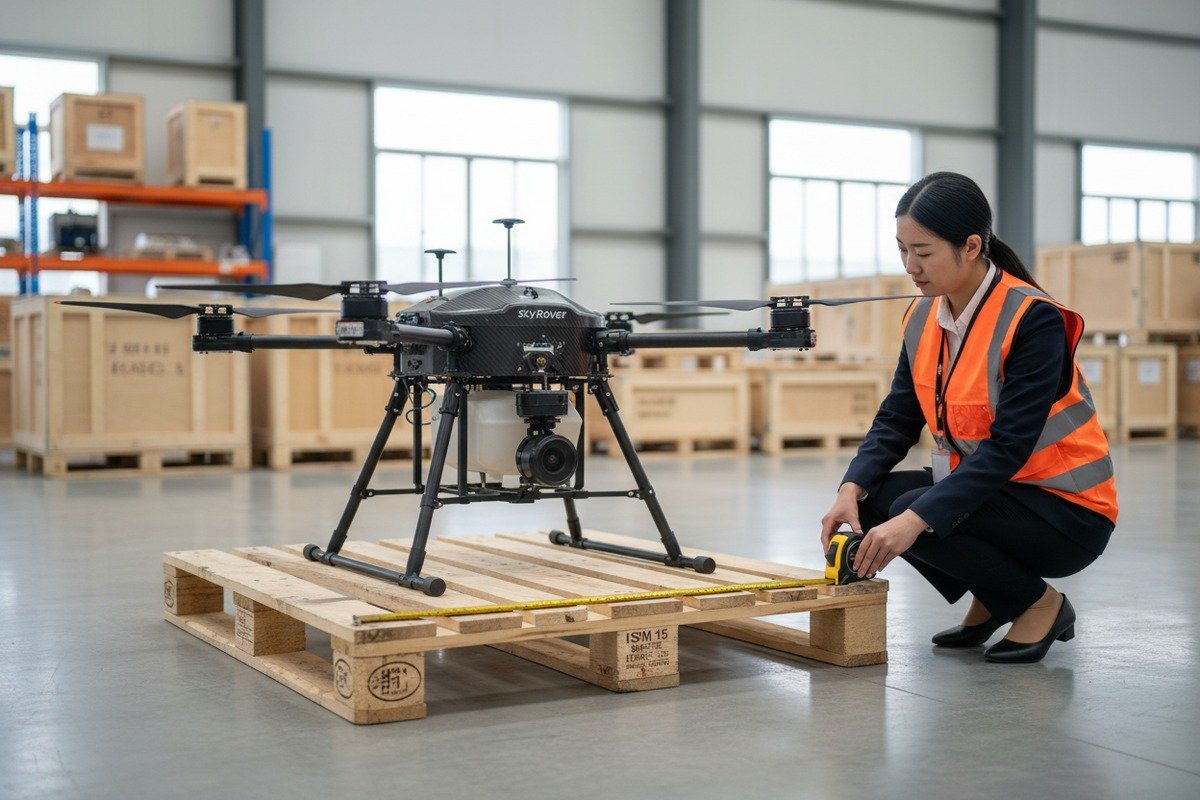
Last year, our logistics team watched a US distributor lose $47,000 when their forklift tines punched through drone pallets that looked standard but weren’t Heat Treatment (HT) 1. The hexacopters inside—months of careful assembly—became scrap metal in seconds. This pain point drives every packaging decision we make at our Xi’an facility today.
To ensure Chinese agricultural drone pallets meet US forklift standards, verify 48×40-inch GMA dimensions, request four-way entry notches with 2500+ lbs capacity, demand ISPM 15 heat-treated wood with proper stamps, and test fork compatibility at 24-inch load centers before shipping.
Getting pallets right isn’t glamorous, but it’s the difference between a smooth warehouse reception and costly damage claims Methyl Bromide (MB) 2. Let’s break down exactly what you need to check, request, and verify.
How can I verify that my drone pallet dimensions are compatible with standard US forklift tines?
When our production floor started shipping to Texas warehouses, we learned that "close enough" doesn't work with American forklifts. A 47-inch pallet instead of 48 inches caused jams that delayed three container loads.
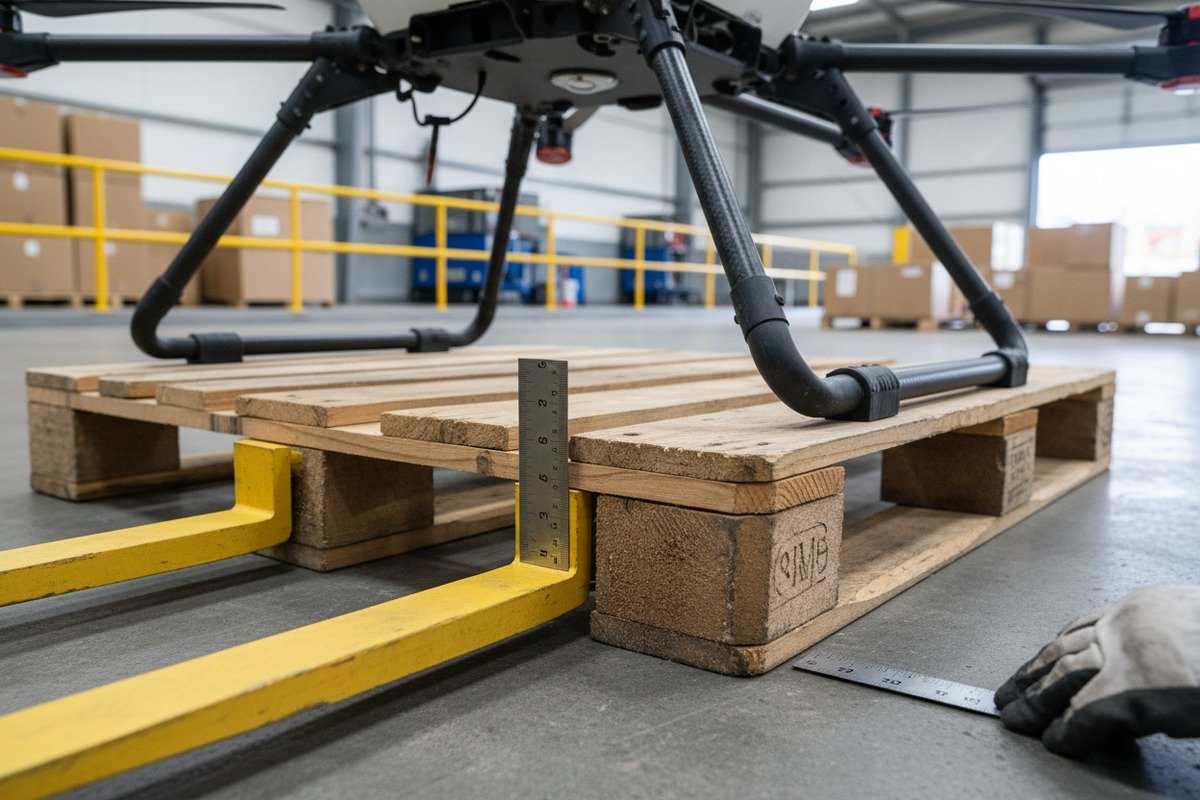
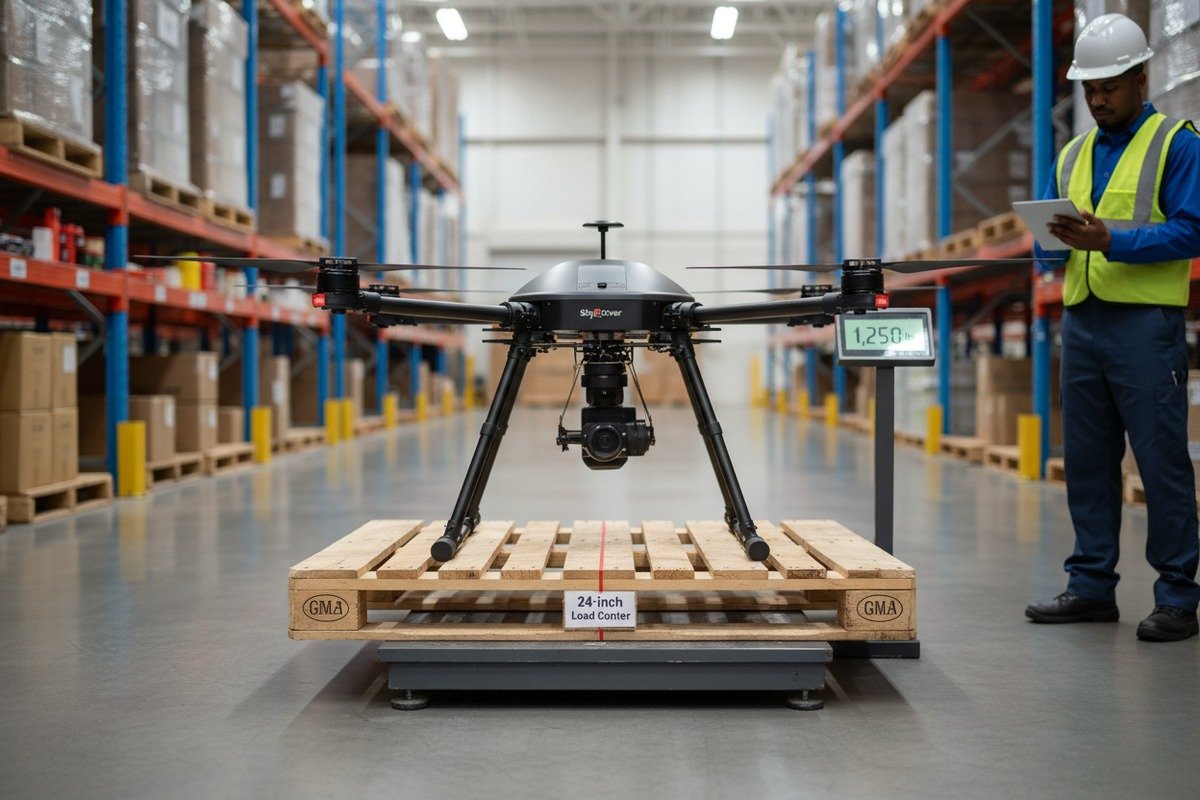
Verify compatibility by measuring overall dimensions (must be 48"x40"), checking four-way entry notch depth (minimum 3.5 inches), confirming fork spread fits 20-27 inches, and ensuring the load center sits at 24 inches from the pallet face for standard US forklift capacity ratings.
Understanding GMA Pallet Specifications
The Grocery Manufacturers Association (GMA) pallet is the gold standard in North American warehouses. This 48×40-inch footprint accounts for nearly 30% of all pallets used in the US. Your Chinese supplier likely defaults to Euro pallets 3 (1200x800mm or 47.2×31.5 inches), which creates immediate problems.
Here's what happens with dimension mismatches: US forklifts have fork spreads between 20-27 inches. Euro pallets often have narrower entry points. The forklift operator either can't insert the tines or damages the pallet trying.
Critical Measurements to Request
| Measurement | US GMA Standard | Common Chinese Default | Risk If Wrong |
|---|---|---|---|
| Length | 48 inches (1219mm) | 47.2 inches (1200mm) | Racking gaps, instability |
| Width | 40 inches (1016mm) | 31.5 inches (800mm) | Falls through racking |
| Height | 6.5 inches (165mm) | 5.7 inches (144mm) | Forklift sensor errors |
| Top Deck Boards | 7 boards, ½" thick | 5 boards, thinner | Board breakage |
| Bottom Boards | 5 boards minimum | 3 boards common | Structural failure |
Load Center Calculations
Le load center 4 is where most importers make expensive mistakes. US forklifts rate capacity at a 24-inch load center. This means the center of your load's weight sits 24 inches from the forklift's vertical face.
Use this formula when your pallet differs: (Known capacity × Known LC) ÷ New LC = Adjusted capacity.
For example, if your forklift handles 3800 lbs at 24 inches, but your drone pallet places the load center at 30 inches, your actual safe capacity drops to about 3040 lbs. Agricultural drones with batteries and spray tanks can easily exceed this.
Practical Verification Steps
Before approving any pallet shipment, request these from your supplier:
- Dimensioned drawings showing entry notch depth and spacing
- Photos of tine entry points from all four sides
- Board spacing measurements (should be under 4.5 inches)
- Weight certification for both empty pallet and rated capacity
Our quality control team photographs every pallet batch against a measurement grid. This simple step has prevented dozens of rejected shipments.
What specific pallet materials should I request from my Chinese supplier to prevent damage during warehouse handling?
Our engineers tested seven different pallet materials before settling on our current specification. The hexacopter frames we build use carbon fiber that costs thousands—putting them on cheap pallets is like shipping diamonds in cardboard boxes.
Request heat-treated hardwood pallets with minimum 2500 lbs static capacity, or HDPE plastic pallets for repeated use. For agricultural drones with lithium batteries, specify non-conductive materials. Avoid untreated softwood, which splinters under forklift tines and fails ISPM 15 requirements.
Wood Pallet Specifications
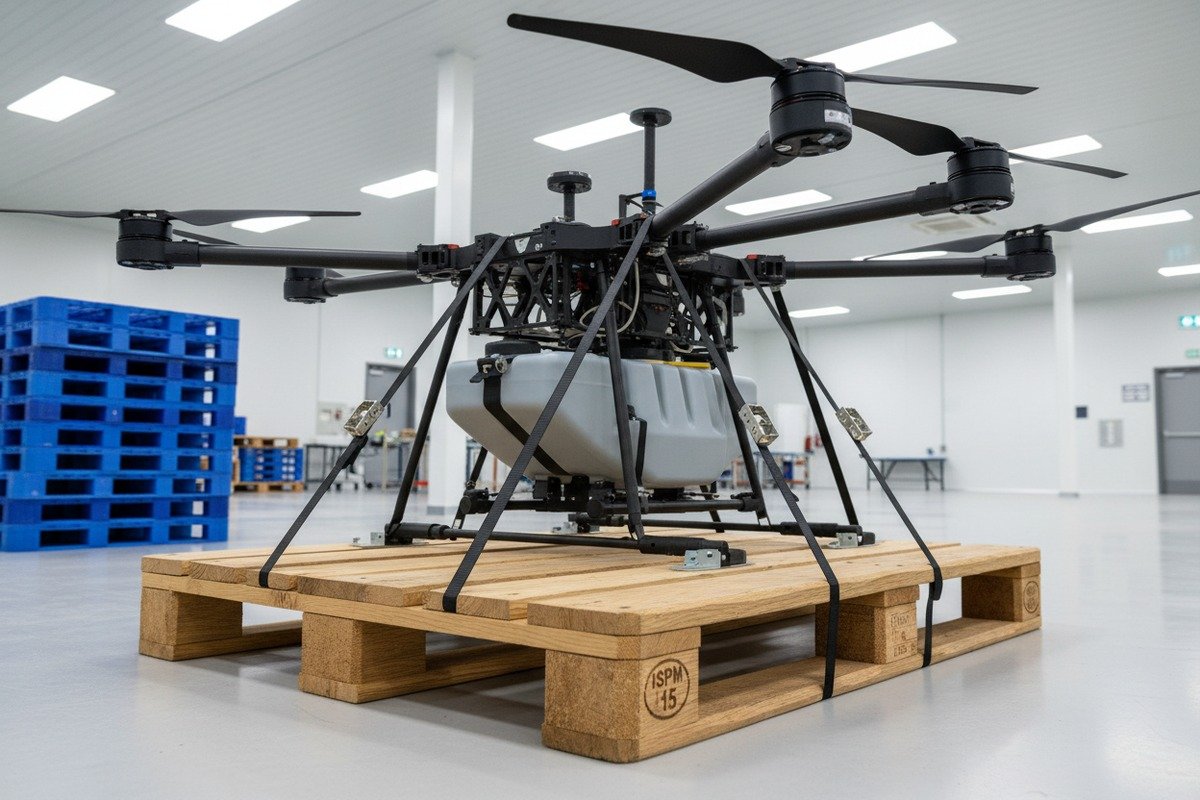
Hardwood pallets remain the most cost-effective choice for one-way shipping. However, "hardwood" means different things in China versus the US. Specify species like oak, maple, or certified tropical hardwoods. Avoid poplar and pine, which Chinese suppliers often substitute.
Key wood requirements:
- Moisture content below 20%
- No visible knots larger than 1 inch
- Heat treated to 56°C core temperature for 30 minutes minimum
- Board thickness at least ½ inch for top deck
Material Comparison for Agricultural Drones
| Material | Poids | Load Capacity | Meilleur pour | Drawbacks |
|---|---|---|---|---|
| Hardwood (HT) | 37 lbs | 2500-4600 lbs | One-way shipping | Requires ISPM 15 6, absorbs moisture |
| HDPE Plastic | 25-35 lbs | 2000-3000 lbs | Repeated use, hygiene | Higher upfront cost, UV degradation |
| Steel | 50-70 lbs | 5000-8000 lbs | Heavy equipment | Causes forklift tine wear |
| Composite | 20-30 lbs | 1500-2500 lbs | Lightweight drones | Lower capacity limits |
Considerations for Battery-Equipped Drones
Agricultural drones typically contain lithium-ion batteries 7 weighing 5-15 kg each. These batteries create specific pallet requirements:
Non-conductive surfaces: Metal pallets or those with exposed nails risk short-circuiting battery terminals during rough handling.
Fire resistance: Some plastic pallets meet UL fire ratings, which matters for insurance purposes when shipping HazMat-classified lithium batteries.
Secure mounting points: Request pallets with pre-drilled holes or integrated strapping channels. Our packaging team installs custom cradles that bolt directly to the pallet deck, preventing any drone movement during transit.
Avoiding Common Material Failures
Chinese suppliers sometimes use recycled wood that appears sound but fails under load. Signs of substandard material include:
- Visible repairs with different wood species
- Staples instead of spiral nails
- Paper-thin bottom deck boards
- Missing corner blocks on block-style pallets
When our purchasing team visits supplier facilities, they bring a moisture meter and a 5-pound hammer. Tap the boards—solid wood sounds different from punky, compromised lumber.
Can I collaborate with SkyRover to design custom drone packaging that integrates seamlessly with my existing logistics equipment?
Three years ago, a California distributor asked us to redesign our entire packaging system around their automated warehouse. That single request changed how our engineering team approaches every export project now.
Yes, SkyRover offers full OEM packaging collaboration. Our engineering team works with your logistics specifications to design custom pallet dimensions, cradle systems, and securement points that match your existing forklifts, racking, and conveyors—including CAD drawings for approval before production.
Our Collaborative Design Process
Custom packaging isn't just about dimensions. Our 70-person team includes packaging engineers who understand both drone fragility and warehouse realities. Here's how we typically work with distributors:
Phase 1: Specification Collection
We request your warehouse layout drawings, forklift specifications, racking dimensions, and any automated handling equipment details. This includes truck and container size constraints.
Phase 2: Prototype Development
Our engineers create 3D models showing the drone, cradle, pallet, and outer packaging as an integrated system. We share these files for your logistics team's review.
Phase 3: Testing
Before committing to production quantities, we build physical prototypes and conduct drop tests, compression tests, and forklift handling simulations.
Integration Points We Address
| Your Equipment | Our Design Response | Benefit |
|---|---|---|
| Standard 48" forks | GMA-compliant pallet footprint | Immediate compatibility |
| 60" high racking | Total package height under 58" | Safe stacking clearance |
| Narrow aisle forklifts | Chamfered pallet corners | Easier entry in tight spaces |
| Conveyor systems | Consistent weight distribution | No belt jams |
| RFID scanning | Integrated tag placement | Automated tracking |
Addressing Irregular Drone Shapes
Agricultural hexacopters create packaging challenges that standard boxes can't solve. The rotor arms extend 3-4 feet from the center body. Spray tanks add uneven weight distribution. Battery packs require accessible compartments for inspection.
Our solution uses modular cradle systems. Each drone sits in a custom-molded base that distributes weight evenly across the pallet surface. Foam inserts secure rotor arms without creating pressure points on carbon fiber tubes.
For your specific logistics setup, we can modify cradle dimensions to match your shelf heights, design quick-release strapping systems that your warehouse staff can operate in under 30 seconds, and include handling instruction labels in English and Spanish.
Documentation We Provide
Every custom packaging project includes:
- Detailed assembly instructions with photos
- Maximum stacking height specifications
- Forklift approach diagrams
- Compliance certificates for ISPM 15 and HazMat requirements
- Spare part lists for cradle components
This documentation helps your customs broker and warehouse managers understand exactly what they're receiving before containers arrive.
How do I ensure the heat treatment and certification of my drone pallets comply with US customs and ISPM 15 standards?
When US Customs seized one of our competitor's shipments at Long Beach for improper pallet stamps, the drones sat in quarantine for 47 days. The distributor lost their peak season. That story motivates every quality check we perform on outbound wood packaging.
Ensure ISPM 15 compliance by verifying the IPPC stamp shows correct format (country code-facility number-HT or MB treatment code), requesting heat treatment certificates with temperature logs, inspecting all wood components including dunnage, and confirming your supplier's treatment facility holds current accreditation.

Understanding ISPM 15 Requirements
The International Standards for Phytosanitary Measures No. 15 exists to prevent wood-boring pests from crossing borders. Every piece of wood packaging material (WPM) entering the US must be treated and marked.
Two treatment methods are accepted:
Heat Treatment (HT): Wood core temperature reaches 56°C for minimum 30 minutes. This is the standard method and what we use exclusively.
Methyl Bromide (MB): Chemical fumigation. Being phased out in many countries due to environmental concerns. We recommend avoiding MB-treated pallets.
Reading the IPPC Stamp
The stamp must be permanent, legible, and located on at least two opposite sides of the pallet. Here's how to decode it:
| Stamp Element | Meaning | Example |
|---|---|---|
| IPPC logo | International Plant Protection Convention symbol | Wheat/leaf graphic |
| Country code | Two-letter ISO code | CN for China |
| Producer number | Registered facility identifier | 123456 |
| Treatment code | HT (heat) or MB (methyl bromide) | HT |
| DB mark (optional) | Debarked indicator | DB |
A valid stamp looks like: [IPPC logo] CN-123456-HT-DB
Verification Steps Before Shipping
Our quality assurance process includes:
- Supplier Audit: We visit treatment facilities annually to verify equipment and processes.
- Certificate Review: Each pallet batch includes heat treatment certificates showing date, duration, and temperature readings.
- Inspection physique: Stamps must be branded (burned) or permanently stenciled—ink stamps that can wash off are not acceptable.
- Documentation Package: We provide copies of treatment certificates with every shipment for your customs broker.
Common Compliance Failures
Based on 2024-2025 US customs data, these issues cause most pallet rejections:
- Stamps applied with temporary ink
- Missing stamps on blocking or bracing wood
- Stamps showing expired or invalid facility numbers
- Mixed treated and untreated wood in same shipment
- Illegible stamps due to poor branding
Alternative: ISPM 15 Exempt Materials
If wood compliance creates too much complexity, consider these alternatives that don't require treatment:
- Plastic pallets (HDPE or polypropylene)
- Metal pallets or skids
- Plywood thinner than 6mm
- Oriented Strand Board (OSB)
- Processed wood materials like particle board
For agricultural drones with lithium batteries already requiring HazMat documentation, switching to plastic pallets can simplify your total compliance burden.
Conclusion
Getting agricultural drone pallets right requires attention to dimensions, materials, customization options, and compliance certifications. By verifying GMA specifications, requesting proper materials, collaborating on custom designs, and ensuring ISPM 15 compliance, you protect both your investment and your warehouse operations.
Notes de bas de page
1. Details ISPM 15 heat treatment requirements, including temperature and duration. ︎
2. The EPA website provides an overview of methyl bromide, its uses in agriculture and shipping, and its regulatory status. ︎
3. Provides standard dimensions, specifications, and history of Euro pallets. ︎
4. Defines forklift load center, its impact on capacity, and calculation methods. ︎
5. Explains GMA pallet origin, dimensions, and importance in North American supply chains. ︎
6. Official IPPC page describing ISPM 15, the international standard for regulating wood packaging material in international trade. ︎
7. IATA’s official page on lithium battery regulations for air transport. ︎
8. Explains what an IPPC stamp means, its components, and its significance for international shipping. ︎

 English
  Spanish
  German
  French
  Dutch
Dutch  Arabic
