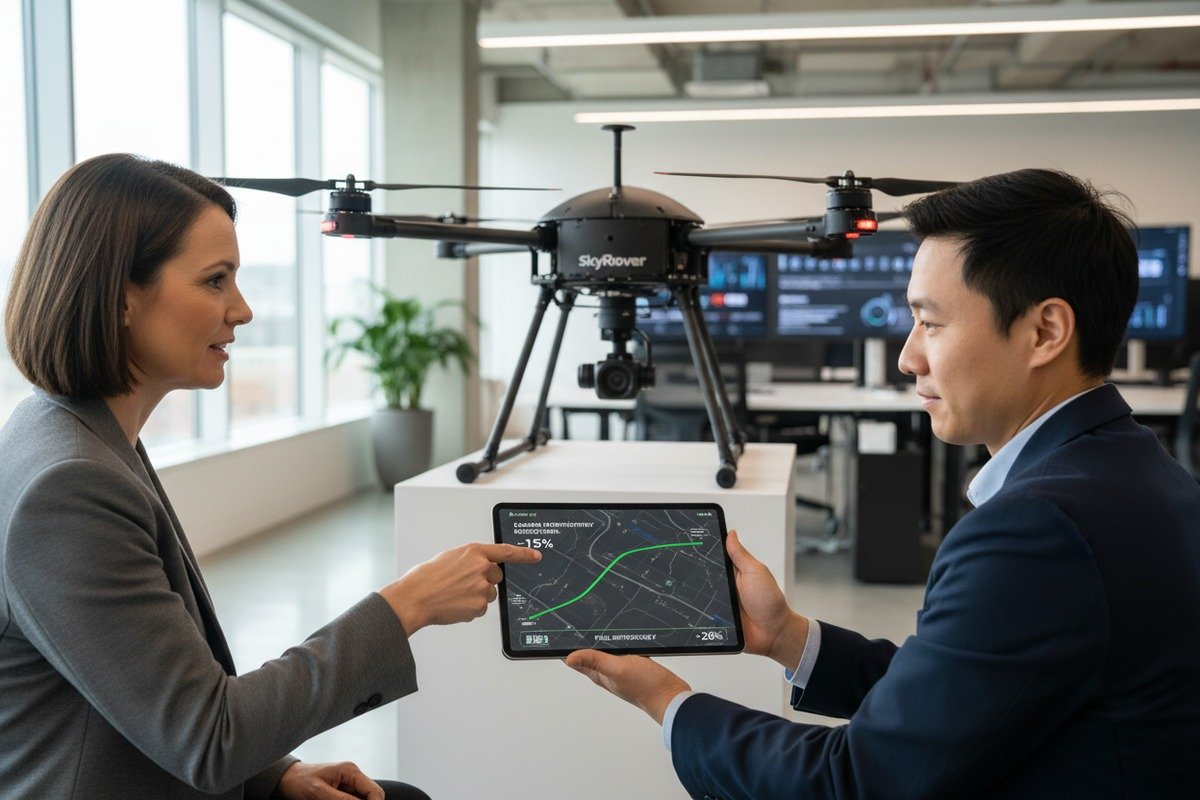
When our production team first started receiving inquiries about carbon footprint data 1 for our agricultural drones, we realized the conversation had shifted. Buyers no longer just wanted flight time specs and payload capacity factory energy sources 2. They wanted proof of environmental impact.
To discuss carbon neutral advantages with suppliers, request lifecycle emissions data, energy efficiency metrics, and sustainability certifications. Ask about battery recycling programs, renewable energy use in manufacturing, and custom software options that optimize flight paths to reduce energy consumption and operational emissions.
This guide will walk you through the exact questions to ask, data to request, and strategies to ensure your drone supplier aligns with your carbon-neutral goals. Let’s break it down step by step.
How can I evaluate if a supplier's manufacturing process supports my company's carbon-neutral commitments?
Many procurement managers struggle to verify supplier sustainability claims. The challenge is real. Without clear metrics, you risk partnering with suppliers who talk green but operate dirty.
To evaluate a supplier's manufacturing process, request documentation on factory energy sources, waste management protocols, material sourcing practices, and third-party environmental audits. Look for ISO 14001 certification, renewable energy usage percentages, and transparent carbon footprint reports covering production, assembly, and shipping phases.

Start With Energy Source Questions
The first thing we tell visiting procurement teams is simple: ask where the power comes from. At our Xi'an facility, we track energy consumption by production stage. This level of detail matters.
A supplier using 80% coal-powered electricity will have a vastly different carbon profile than one using solar or wind. Request a breakdown. Ask for utility bills or renewable energy certificates if available.
Examine Material Sourcing Practices
Carbon fiber frames, lithium batteries, and electronic components all carry embodied carbon 3. The extraction, processing, and transportation of these materials contribute significantly to total emissions.
Demandez à votre fournisseur :
- Where do you source carbon fiber?
- Do you use recycled aluminum in frame components?
- What is the origin of your lithium-ion cells?
| Evaluation Criteria | Questions to Ask | Drapeaux rouges |
|---|---|---|
| Energy Sources | What percentage of factory power comes from renewables? | No data available or evasive answers |
| Waste Management | How do you handle manufacturing waste and defective batteries? | No recycling program in place |
| Approvisionnement en matériaux | Do you track embodied carbon in raw materials? | Single-source suppliers with no transparency |
| Transportation | What shipping methods do you use for export? | Exclusive air freight with no alternatives |
| Certifications | Do you hold ISO 14001 or equivalent? | No third-party environmental audits |
Request Third-Party Verification
Self-reported data has limits. Ask if your supplier undergoes independent environmental audits. Certification ISO 14001 4 demonstrates a commitment to environmental management systems. Some suppliers also participate in carbon disclosure projects 5.
During our recent factory upgrade, we invested in solar panels covering 40% of our rooftop. This decision came directly from customer feedback. Your questions drive supplier behavior.
Consider the Full Production Lifecycle
Manufacturing is just one piece. Packaging materials, testing procedures, and quality control all consume resources. Ask about:
- Packaging recyclability
- Test flight energy consumption
- Defect rates and waste from failed units
A 5% defect rate means 5% more materials, energy, and emissions wasted. Suppliers with tight quality control inherently produce fewer emissions per delivered unit.
What energy-efficiency data should I request from my supplier to demonstrate the carbon-saving potential of my agricultural drones?
Numbers matter when presenting sustainability initiatives to stakeholders. Vague claims about "green technology" won't satisfy board members or regulatory bodies. You need hard data.
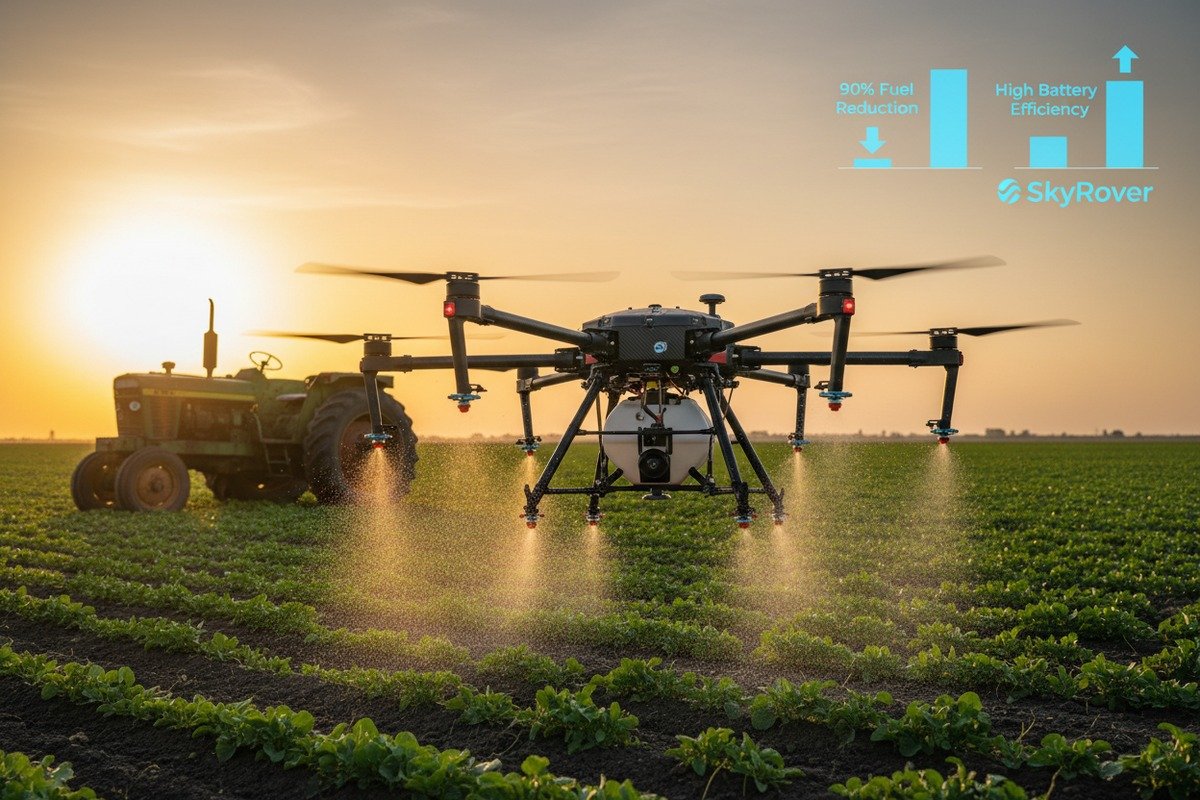
Request specific energy-efficiency metrics including watt-hours per hectare covered, battery cycle life, charging energy consumption, motor efficiency ratings, and comparative fuel savings versus traditional equipment. Australian studies show agricultural drones achieve up to 90% fuel reduction compared to tractors for pesticide application.
Key Metrics That Matter
When our engineering team develops efficiency reports for export customers, we focus on actionable numbers. Here's what you should request:
| Métrique | Pourquoi c'est important | Benchmark Range |
|---|---|---|
| Wh per Hectare | Measures energy consumed per area covered | 15-30 Wh/ha for spraying operations |
| Battery Cycle Life | Indicates total operational lifespan before replacement | 500-1000 cycles for quality cells |
| Charge Efficiency | Energy lost during charging process | 85-95% efficiency is standard |
| Motor Efficiency | Percentage of electrical energy converted to thrust | 80-88% for brushless motors |
| Payload-to-Weight Ratio | Higher ratios mean less energy wasted moving the drone itself | 0.4-0.6 for spraying drones |
Compare Against Traditional Methods
The real story emerges when comparing drone operations to conventional farming equipment. A diesel tractor 6 spraying pesticides consumes approximately 15-20 liters of fuel per 100 hectares. An electric drone performing the same task uses roughly 3-5 kWh of electricity.
Converting these figures to CO2 equivalents 7:
- Diesel tractor: 40-50 kg CO2 per 100 hectares
- Electric drone: 1.5-3 kg CO2 per 100 hectares (depending on grid carbon intensity)
This represents an 90-95% emissions reduction for the application phase alone.
Request Real-World Performance Data
Laboratory specifications differ from field performance. Ask your supplier for:
- Case studies from similar climates and crop types
- Customer testimonials with quantified savings
- GPS flight logs showing actual coverage efficiency
Our customers in California almond orchards report covering 3,000 acres with precision spot-treatment, reducing chemical usage by 35% compared to blanket spraying methods.
Factor in Charging Infrastructure
Battery charging location affects total carbon footprint. Drones charged from a solar-powered farm building have near-zero operational emissions. Those charged from a coal-heavy grid still produce indirect emissions.
Renseignez-vous auprès des fournisseurs :
- Compatibility with portable solar charging systems
- Fast-charging capabilities to maximize solar window utilization
- Battery swap systems for continuous operation
Long-Term Efficiency Degradation
Batteries lose capacity over time. A drone that achieves 45 minutes flight time when new might only manage 35 minutes after 300 cycles. This degradation affects your energy-efficiency calculations.
Request degradation curves from your supplier. Quality manufacturers test battery performance across hundreds of cycles and can provide realistic longevity projections.
How do I ensure my drone supplier provides the certifications needed to validate my green procurement strategy?
Procurement policies increasingly require documented proof of environmental compliance. Without proper certifications, your sustainability claims remain vulnerable to audit challenges and greenwashing accusations.
Ensure your drone supplier provides ISO 14001 environmental management certification, CE marking with RoHS compliance for hazardous substance restrictions, battery certifications like UN38.3 for safe transport, and ideally carbon footprint verification from recognized bodies. Request copies of all certificates and verify their validity with issuing organizations.

Liste de contrôle des certifications essentielles
Our export documentation team maintains current certifications for all major markets. Here's what you should verify:
| Certification | Objectif | Relevance to Carbon Neutrality |
|---|---|---|
| ISO 14001 | Systèmes de gestion de l'environnement | Demonstrates systematic approach to reducing environmental impact |
| Marquage CE | European conformity | Includes RoHS compliance 8 restricting hazardous materials |
| UN38.3 | Sécurité des piles au lithium | Ensures proper battery handling and disposal protocols exist |
| FCC Part 107 | US radio frequency compliance | Required for legal US operation |
| Carbon Trust Certification | Third-party carbon footprint verification | Provides independent validation of emissions claims |
| MSDS Documentation | Material safety data sheets | Details chemical composition for end-of-life recycling |
Verify Certificate Authenticity
Unfortunately, fraudulent certifications exist in the drone industry. Protect yourself by:
- Requesting certificate numbers and checking issuing body databases
- Contacting certification organizations directly
- Asking for audit reports, not just certificates
When we renewed our ISO 14001 certification last year, the audit process took three days and covered every aspect of our operations. Legitimate certifications require ongoing compliance, not one-time payments.
Match Certifications to Your Market Requirements
Different markets have different requirements. European buyers need CE marking. US customers require FCC compliance. Some government contracts mandate specific environmental certifications.
Demandez à votre fournisseur :
- Which markets are you currently certified for?
- Can you provide market-specific documentation packages?
- How quickly can you obtain additional certifications if needed?
Look for Voluntary Environmental Commitments
Beyond mandatory certifications, progressive suppliers pursue voluntary standards. These include:
- Carbon Disclosure Project participation
- Science-Based Targets initiative alignment
- Membership in sustainable business coalitions
These commitments signal genuine environmental priorities rather than minimum compliance.
Document Everything for Audit Trails
Your procurement files should include:
- Certificate copies with validity dates
- Supplier environmental policy statements
- Correspondence confirming sustainability practices
- Any third-party verification reports
When auditors examine your green procurement claims, complete documentation demonstrates due diligence. We provide all export customers with comprehensive certification packages specifically for this purpose.
Can I collaborate with my supplier on custom software features that reduce my drone fleet's overall carbon footprint?
Off-the-shelf drones work for basic operations. But serious carbon reduction requires optimization at the software level. Flight paths, sensor integration, and fleet coordination all offer efficiency gains that hardware alone cannot achieve.
Yes, you can collaborate with suppliers on custom software features including optimized flight path algorithms, precision application mapping based on real-time sensor data, battery management systems that extend cycle life, and fleet coordination software that minimizes redundant coverage. These customizations can reduce energy consumption by 15-30% compared to standard configurations.

Flight Path Optimization
The shortest path between two points isn't always the most efficient. Wind patterns, elevation changes, and obstacle avoidance all affect energy consumption.
When our software team works with customers on custom flight planning, we consider:
- Prevailing wind direction to minimize motor strain
- Terrain following that maintains optimal spray height
- Return-to-base routing that accounts for remaining battery capacity
Smart routing can reduce flight time by 20% for the same coverage area. That translates directly to energy savings.
Precision Application Integration
Generic spraying patterns waste chemicals and energy. Custom software that integrates with soil sensors, NDVI cameras, and moisture monitors enables targeted application.
Consider this comparison:
| Application Method | Coverage Approach | Resource Usage | Energy per Hectare |
|---|---|---|---|
| Blanket Spraying | Uniform application across entire field | 100% baseline | 100% baseline |
| Zone-Based | Different rates for mapped zones | 70-85% of baseline | 85-90% of baseline |
| Real-Time Variable Rate | Continuous adjustment based on live sensor data | 50-65% of baseline | 70-80% of baseline |
We've developed custom integration modules for several US agricultural service companies. Their feedback drives continuous improvement.
Battery Management Software
Software controls charging cycles, discharge rates, and cell balancing. Optimized battery management 9 extends usable life and maintains efficiency.
Ask your supplier about:
- Temperature-compensated charging algorithms
- Cell-level monitoring and balancing
- Predictive maintenance alerts before performance degradation
Our battery management system includes cloud-based monitoring that alerts operators when cells begin degrading unevenly, preventing premature pack replacement.
Fleet Coordination Systems
Large operations running multiple drones benefit enormously from coordination software. Without it, drones waste energy duplicating coverage or traveling unnecessarily.
Fleet management features to request:
- Automatic task allocation based on battery status
- Collision avoidance with minimal path deviation
- Synchronized charging schedules to match solar generation peaks
Data Analytics for Continuous Improvement
Every flight generates data. Custom analytics dashboards can identify:
- Routes that consistently consume more energy
- Operators whose techniques waste battery capacity
- Weather conditions that reduce efficiency
Over time, this data enables iterative improvements. One customer reduced average energy consumption per hectare by 22% over two growing seasons simply by acting on flight data insights.
Development Collaboration Models
Not every buyer wants the same level of customization. We offer several collaboration models:
- Standard Plus: Minor parameter adjustments to existing software
- Custom Integration: Connecting our drones with your existing farm management systems
- Full Development: Ground-up feature development for unique operational requirements
The right model depends on your technical capabilities, budget, and specific carbon reduction targets.
Conclusion
Discussing carbon neutral advantages with your agricultural drone supplier requires preparation, specific questions, and clear documentation requirements. Focus on manufacturing processes, energy efficiency data, certifications, and custom software opportunities. The suppliers who respond with detailed, verifiable information are the partners worth building relationships with. Start with one conversation, track the results, and scale your green procurement strategy from there.
Notes de bas de page
1. Replaced with an authoritative EPA calculator that also explains carbon footprint. ︎
2. Explains types of energy sources used in industrial sectors and their consumption. ︎
3. Replaced with an authoritative government source (California Air Resources Board) defining embodied carbon. ︎
4. Replaced with an authoritative EPA page explaining Environmental Management Systems under ISO 14001. ︎
5. Official site of CDP, detailing its role in environmental disclosure for companies and cities. ︎
6. Discusses EPA regulations and environmental impact of diesel engines in agricultural equipment. ︎
7. Defines CO2 equivalents (CO2e) as a metric for comparing greenhouse gas emissions. ︎
8. Official EU directive restricting hazardous substances in electronic equipment for environmental protection. ︎
9. Explains how battery management systems monitor and optimize battery performance and lifespan. ︎

 English
  Spanish
  German
  French
  Dutch
Dutch  Arabic
