
When our engineering team tests new GNSS receivers 1 on our production line, we see firsthand how GPS acquisition times vary dramatically depending on where in the world the drone operates. Buyers often overlook this critical factor until their machines sit idle in the field, waiting for satellite lock.
To ask suppliers about GPS acquisition speed at different latitudes, request specific Time-To-First-Fix data for cold and hot starts at your location, inquire about multi-constellation support (GPS, GLONASS, Galileo, BeiDou), and demand localized flight test reports showing actual performance at high, mid, and equatorial latitudes.
This guide walks you through exactly what questions to ask, what data to demand, and how to verify claims before you commit to a purchase. Let’s dive into the specifics.
How can I verify if the drone's GPS acquisition speed remains fast at my specific latitude?
Our factory receives calls every month from distributors in Canada and Scandinavia asking why their drones take longer to achieve satellite lock than units sold to customers in Texas or Spain. The problem is real, and the solution starts with asking the right verification questions before you buy.
To verify GPS acquisition speed at your latitude, request documented Time-To-First-Fix benchmarks tested at coordinates similar to yours, ask for satellite visibility data showing how many satellites the receiver can track overhead, and insist on demo flights or rental units for on-site testing before bulk orders.
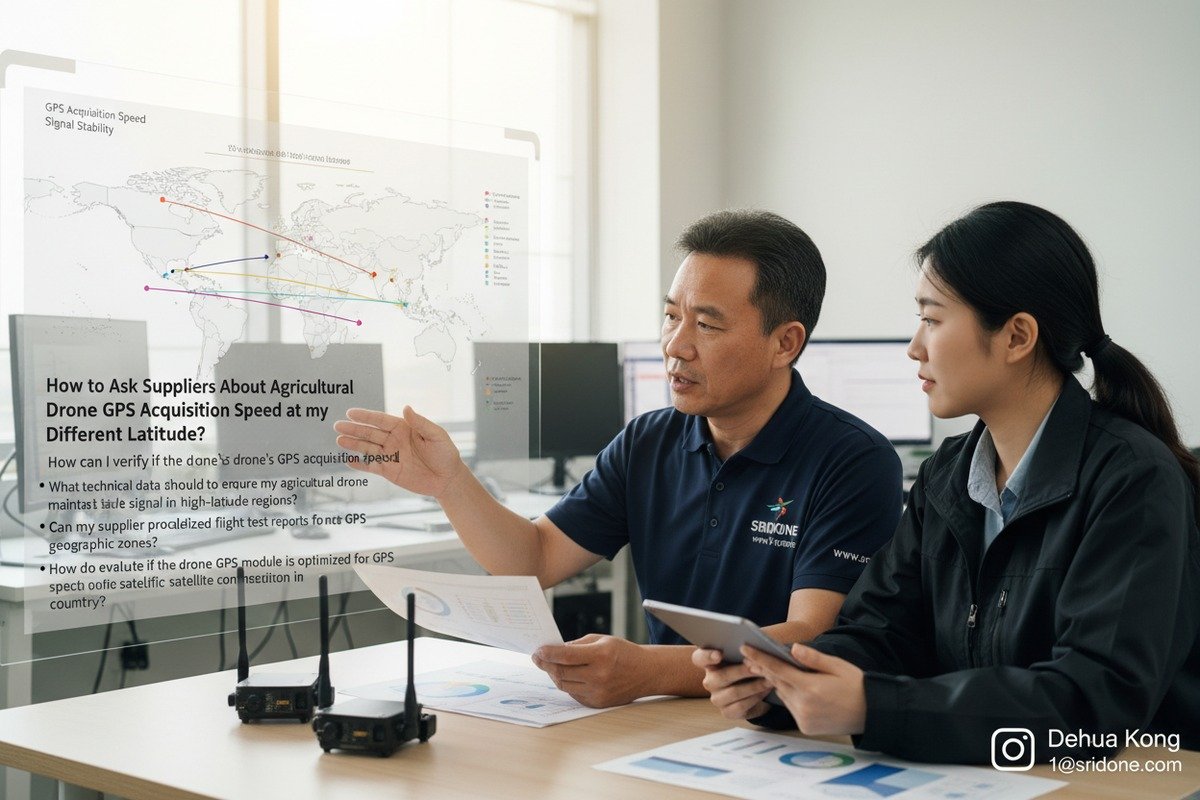
Understanding Time-To-First-Fix at Your Location
Time-To-First-Fix (TTFF) 2 measures how many seconds pass from power-on until the GPS receiver locks onto enough satellites for accurate positioning. This number changes based on your latitude.
At the equator, drones typically achieve a cold start fix in 20 to 45 seconds. Move north to 60°N latitude, and that same drone may need 45 to 90 seconds. Hot starts (when the receiver retains recent satellite data) show similar patterns: 1 to 5 seconds near the equator versus 5 to 15 seconds in polar regions.
Satellite Visibility by Latitude
The number of satellites visible overhead directly affects acquisition speed. Here is what to expect:
| Latitude Zone | Typical Visible Satellites | Average PDOP Value | Expected Cold Start TTFF |
|---|---|---|---|
| Equatorial (0-15°) | 10-14 satellites | 1.2-1.8 | 20-35 seconds |
| Mid-latitude (30-45°) | 8-12 satellites | 1.5-2.5 | 30-50 seconds |
| High-latitude (55-70°) | 6-10 satellites | 2.5-4.0 | 45-75 seconds |
| Polar (>70°) | 4-8 satellites | 3.5-6.0 | 60-90+ seconds |
PDOP (Position Dilution of Precision) 3 measures satellite geometry quality. Lower numbers mean better accuracy. Notice how PDOP increases as latitude increases.
Practical Verification Steps
First, ask your supplier for TTFF data tested at latitudes within 5 degrees of your operating location. Generic spec sheets showing "30-second acquisition" mean nothing if that number came from testing in Singapore while you farm in Manitoba.
Second, request raw test logs. Reputable manufacturers keep detailed records of satellite counts, fix times, and error rates during quality control. Our facility stores this data for every batch we produce.
Third, arrange a demo flight. If you plan to order 50 units for a fleet, insisting on testing one unit at your actual farm costs far less than discovering problems after delivery.
What technical data should I request to ensure my agricultural drone maintains a stable signal in high-latitude regions?
When we calibrate flight controllers for export to Nordic countries, our engineers spend extra hours optimizing GNSS settings that customers in warmer climates never need to worry about. High-latitude operations demand specific technical specifications that separate professional equipment from consumer toys.
Request multi-constellation support documentation (GPS, GLONASS, Galileo, BeiDou), antenna gain specifications, receiver sensitivity ratings, and RTK convergence time data. Also demand ionospheric correction capabilities and signal reacquisition time after brief obstructions, as these metrics directly impact high-latitude reliability.

Multi-Constellation Support Explained
A drone that only uses GPS satellites will struggle in northern regions. GPS satellites orbit in a pattern that leaves gaps at high latitudes. Adding GLONASS (Russian system) 4 fills many of these gaps because GLONASS satellites have higher orbital inclination.
Modern agricultural drones should support at least three constellations 5. Here is what each adds:
| Constellation | Number of Satellites | Orbital Inclination | High-Latitude Benefit |
|---|---|---|---|
| GPS (USA) | 31 active | 55° | Baseline coverage, fewer overhead at poles |
| GLONASS (Russia) | 24 active | 64.8° | Better polar coverage, essential above 55°N |
| Galileo (EU) | 28 active | 56° | Strong signal, good northern Europe coverage |
| BeiDou (China) | 44 active | 55° (MEO) | Densest constellation, excellent redundancy |
When you combine all four, you can track 15 or more satellites even at 70°N latitude. This dramatically improves PDOP and cuts acquisition time.
Antenna and Receiver Specifications
Antenna quality matters more than most buyers realize. Ask your supplier for:
- Antenna gain: Measured in dBi. Higher gain means better weak signal reception. Look for +3 dBi minimum for high-latitude use.
- Receiver sensitivity: Measured in dBm. Lower (more negative) numbers are better. Professional receivers achieve -160 dBm or better.
- Multi-frequency support: L1/L2/L5 bands reduce multipath errors and speed acquisition by 30-40% compared to L1-only receivers.
RTK Convergence at High Latitudes
RTK (Real-Time Kinematic) systems 6 deliver centimeter-level accuracy, but they need an initial fix before corrections work. At high latitudes, RTK convergence may take 10 to 30 seconds instead of the 2 to 10 seconds typical at mid-latitudes.
Ask your supplier specifically: "What is your RTK convergence time at 65°N with 50% sky view?" Vague answers like "very fast" indicate they have not tested in real conditions.
Ionospheric Interference Considerations
Aurora borealis causes ionospheric scintillation that degrades GPS signals. Professional receivers include ionospheric correction models 7. Ask if the drone supports SBAS corrections (WAAS in North America, EGNOS in Europe) or if it uses dual-frequency measurements to cancel ionospheric errors directly.
Can my supplier provide localized flight test reports for GPS performance across different geographic zones?
During a recent shipment to a large agricultural cooperative in Alaska, we included complete flight test documentation from trials we conducted at 64°N. The buyer later told us this data saved them weeks of troubleshooting because they knew exactly what to expect. Not all suppliers offer this level of transparency.
Yes, reputable suppliers can and should provide localized flight test reports. Request documentation showing TTFF measurements, satellite counts, PDOP values, and RTK convergence times from tests conducted at latitudes similar to your operating location. If suppliers cannot provide this data, consider it a red flag.

What Localized Test Reports Should Include
A comprehensive flight test report for GPS performance should contain specific data points. When evaluating supplier documentation, look for these elements:
| Report Element | What It Shows | Pourquoi c'est important |
|---|---|---|
| Test coordinates | Exact latitude/longitude of trials | Confirms relevance to your location |
| Date and time | When tests occurred | Satellite positions change; recent data more reliable |
| Cold start TTFF | Seconds to first fix from power-off | Worst-case scenario performance |
| Hot start TTFF | Seconds to reacquire after brief loss | Typical operational performance |
| Satellite count | Number tracked during test | Directly affects accuracy and speed |
| PDOP range | Geometry quality during flight | Lower values indicate better precision |
| RTK convergence | Time to achieve cm-level accuracy | Critical for precision agriculture |
| Fix failures | Number of times lock was lost | Reliability indicator |
How to Request This Documentation
Be specific in your request. Instead of asking "Do you have test data?", try this approach:
"Please provide GPS performance test reports from flights conducted at latitudes between 58°N and 68°N within the past 12 months. Include cold start TTFF, hot start TTFF, average satellite count, and PDOP values. If RTK was used, include convergence time data."
At our facility, we maintain test databases sorted by latitude bands. When customers ask, we can pull relevant reports within 24 hours. Suppliers who cannot do this either lack proper testing protocols or have something to hide.
Evaluating Third-Party vs. Manufacturer Testing
Some suppliers provide independent testing from universities or agricultural research stations. This third-party data often carries more credibility than manufacturer claims.
However, verify the testing conditions match your needs. A university test in California (38°N) tells you nothing about performance in Saskatchewan (52°N). Look for testing organizations in regions climatically similar to yours.
Red Flags in Supplier Responses
Watch for these warning signs:
- Generic spec sheets only: "TTFF: <30 seconds" without location context is meaningless.
- Testing from equatorial regions only: Many manufacturers test in Southeast Asia where conditions are ideal.
- Refusal to share raw data: Professional suppliers document everything. Reluctance suggests poor quality control.
- Outdated reports: GPS constellations change. Reports older than 18 months may not reflect current performance.
How do I evaluate if the drone's GPS module is optimized for the specific satellite constellations in my country?
Our engineers recently optimized firmware for a European distributor whose end customers were experiencing 40% longer acquisition times than spec sheets promised. The problem was not hardware but software—the default settings prioritized GPS and BeiDou while underutilizing Galileo, the strongest constellation over Europe.
Evaluate GPS module optimization by checking which constellations are enabled by default, verifying regional SBAS compatibility (WAAS, EGNOS, MSAS), and confirming the receiver firmware includes ionospheric correction models calibrated for your hemisphere. Ask if the supplier offers region-specific firmware variants.
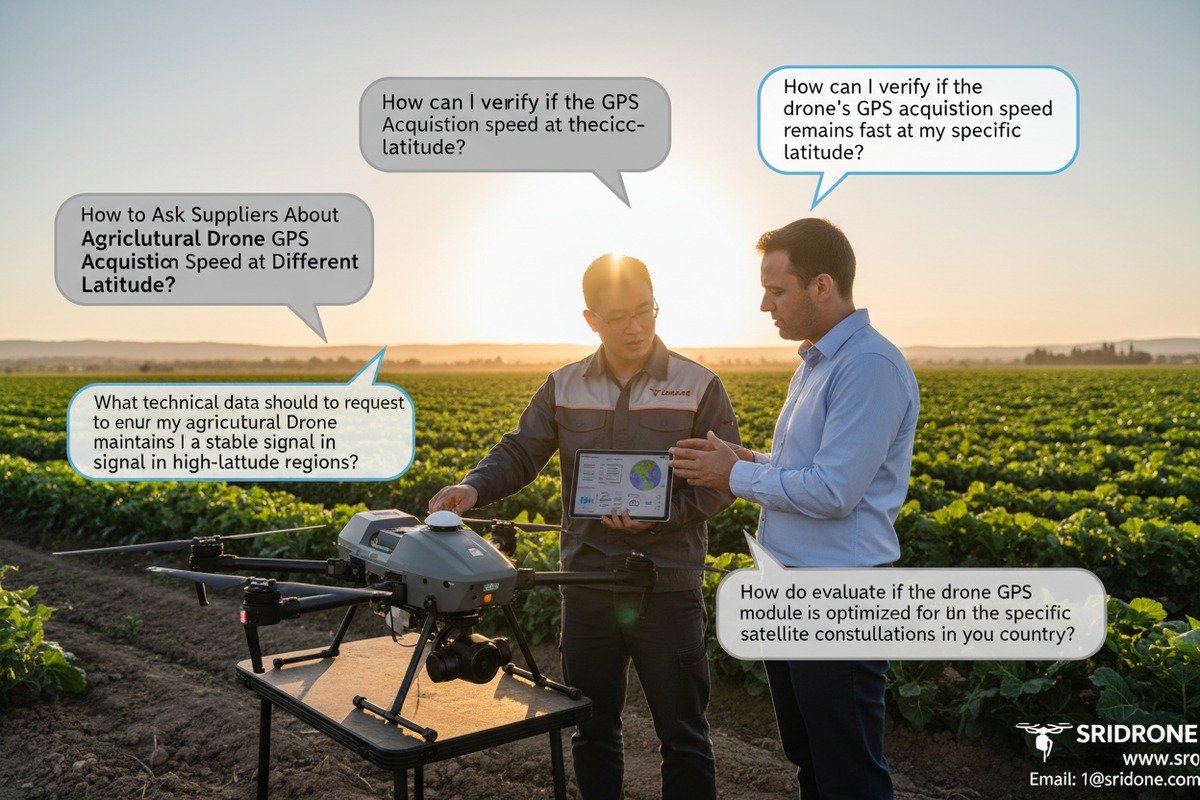
Constellation Priority by Region
Different satellite systems provide better coverage in different parts of the world. Here is a guide for optimizing constellation selection:
| Operating Region | Primary Constellation | Secondary | Tertiary | SBAS System |
|---|---|---|---|---|
| North America | GPS | GLONASS | Galileo | WAAS |
| Western Europe | Galileo | GPS | GLONASS | EGNOS |
| Eastern Europe/Russia | GLONASS | GPS | Galileo | SDCM |
| East Asia | BeiDou | GPS | GLONASS | MSAS |
| Australia | GPS | Galileo | BeiDou | None (PPP) |
| South America | GPS | Galileo | GLONASS | Aucun |
Many receivers allow manual constellation priority settings. If yours does not, ask if the manufacturer can provide custom firmware with optimized defaults.
SBAS Compatibility Matters
Satellite-Based Augmentation Systems 8 broadcast correction signals that improve GPS accuracy from meters to sub-meter levels. These systems are regionally specific:
- WAAS covers North America
- EGNOS covers Europe
- MSAS covers Japan
- GAGAN covers India
If your drone receiver does not support your regional SBAS, you lose a free accuracy improvement. During procurement, ask: "Does this receiver support EGNOS?" (or whichever system covers your region).
Firmware and Algorithm Considerations
Hardware is only half the equation. The receiver firmware contains algorithms that determine:
- How quickly the receiver searches for satellites
- Which signals to prioritize when multiple are available
- How aggressively to filter noisy measurements
- When to declare a fix valid versus suspect
Ask your supplier if firmware updates have been released for your region. Some manufacturers push annual updates that incorporate new satellite launches and improved correction models.
Testing for Regional Optimization
Even with proper specifications, real-world testing confirms true performance. Consider these steps:
- Request a demo unit configured for your region
- Test during different times of day (satellite geometry changes hourly)
- Compare advertised TTFF to actual measurements across at least 10 cold starts
- Note signal strength variations using the drone's telemetry display
If actual performance falls more than 20% below specifications, the receiver may not be properly optimized for your location.
Future-Proofing Your Investment
New satellites launch regularly. GPS III satellites 9 now broadcasting L5 signals improve acquisition speed by 30-40%. BeiDou completed its full constellation in 2020. Galileo reached full operational capability in 2024.
Ask suppliers: "Will this receiver benefit from new satellite launches, or does it require hardware upgrades?" Receivers with multi-frequency capability (L1/L2/L5) can leverage improvements without replacement.
Conclusion
GPS acquisition speed varies dramatically by latitude, and the questions you ask before purchasing determine whether your agricultural drone fleet performs reliably or sits idle waiting for satellite lock. Demand specific TTFF data, multi-constellation support documentation, localized test reports, and region-optimized firmware. Taking these steps now prevents costly operational delays in your fields later.
Notes de bas de page
1. Explains the fundamental technology of satellite navigation receivers. ︎
2. Defines a critical metric for GPS performance and its various starting conditions. ︎
3. Replaced with a comprehensive Wikipedia article on Dilution of Precision, which includes PDOP, as an authoritative source. ︎
4. Replaced with the main Wikipedia article for GLONASS, providing a detailed and authoritative overview. ︎
5. Highlights the importance of using multiple satellite systems for improved performance. ︎
6. Describes a high-precision GPS technology used for centimeter-level accuracy. ︎
7. Explains how GPS receivers mitigate atmospheric interference for better accuracy. ︎
8. Replaced with the Wikipedia article on GNSS augmentation, specifically linking to the section on Satellite-Based Augmentation Systems, as an authoritative and comprehensive source. ︎
9. Provides information on the latest generation of GPS satellites and their capabilities. ︎

 English
  Spanish
  German
  French
  Dutch
Dutch  Arabic
