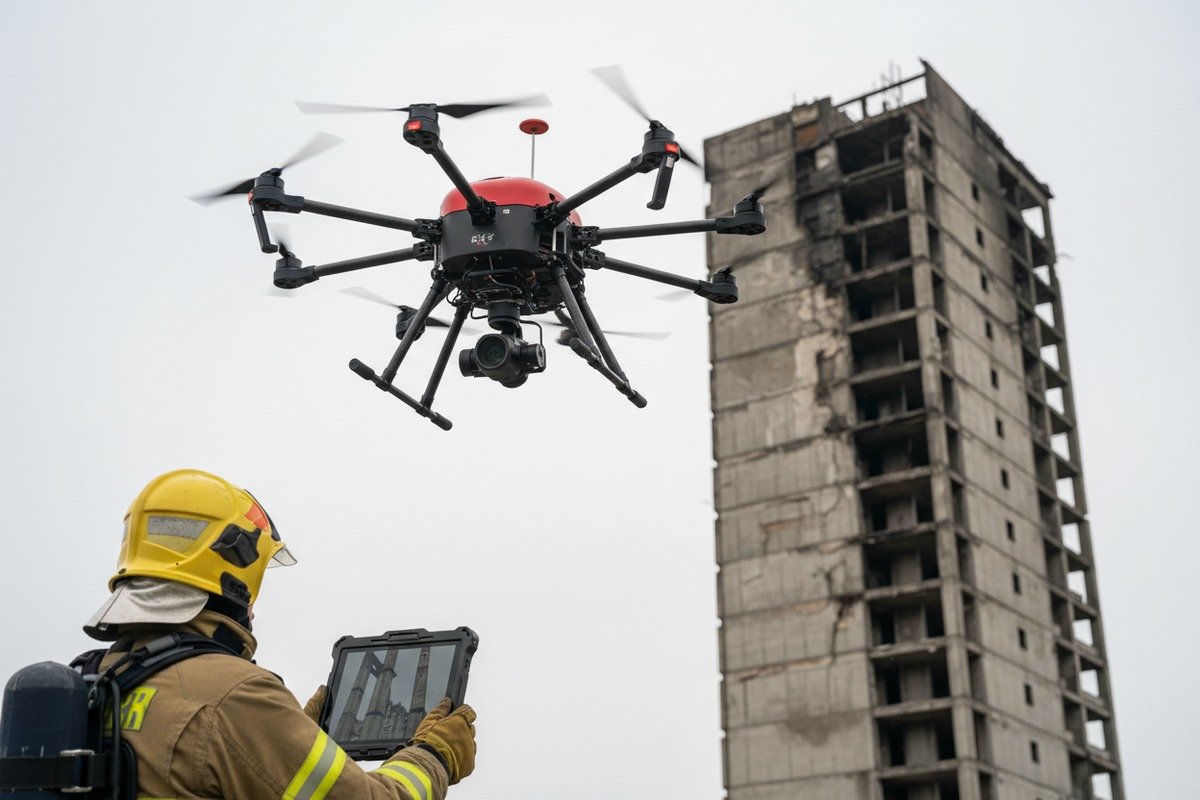
When our engineering team first tested 30x optical zoom 1 on firefighting drones, we faced a tough question from fire departments worldwide. They wanted to know if our cameras could spot hairline cracks on damaged buildings from a safe distance.
Firefighting drone zoom lenses can capture structural details from 100-1000 meters, but detecting sub-millimeter cracks remains challenging. Current 12-48MP sensors with 30x optical zoom achieve ground sampling distances of 2-10cm per pixel, which is too coarse for tiny fissures without close-range flight or AI enhancement.
This question matters for every fire department and industrial inspection team drones de lutte contre les incendies 2. Let me walk you through what our drones can and cannot do, and how to maximize your inspection results.
How can I verify that the drone's optical zoom provides enough detail for structural fire inspections?
Our quality control team runs this verification process daily before shipping drones to clients in the US and Europe OEM partnerships 3. Many buyers struggle to understand the gap between marketing claims and real-world performance.
To verify optical zoom detail for structural inspections, test at your target distance using resolution charts. Calculate ground sampling distance with this formula: GSD = (altitude × pixel size) ÷ focal length. A 30x zoom with 12MP sensor typically yields 2-5cm GSD at 100 meters—sufficient for cracks larger than 5cm but not hairline fissures.

Understanding Ground Sampling Distance
Ground Sampling Distance 4 (GSD) tells you how much real-world area one pixel covers. This number determines what your camera can actually see. When we calibrate our flight controllers and camera systems, GSD is the first metric we check.
A smaller GSD means more detail. At our Xi'an facility, we test every zoom lens against standardized targets. Here is how different configurations perform:
| Drone Model | Optical Zoom | Sensor Resolution | GSD at 100m | Smallest Detectable Feature |
|---|---|---|---|---|
| 30x Zoom System | 30x | 12MP | 2-3cm | 5-6cm cracks |
| 20x Zoom System | 20x | 48MP | 1.5-2cm | 3-4cm cracks |
| 14x Zoom System | 14x | 12MP | 4-5cm | 10cm cracks |
| 200x Hybrid | 20x optical + digital | 48MP | 0.5-1cm | 2-3cm cracks |
The Optical vs Digital Zoom Truth
Many drone manufacturers advertise impressive zoom numbers. But there is a critical difference between optical and digital zoom. Our engineers always explain this to new distributors.
Optical zoom uses physical lens movement. It maintains full image quality. Digital zoom crops and enlarges pixels. This adds artifacts and blur. A 150x hybrid zoom sounds impressive. But only the optical portion delivers true resolution.
When you test a drone, zoom to maximum optical level first. Check sharpness. Then engage digital zoom. You will see quality drop immediately. For crack detection, only optical zoom matters.
Practical Verification Steps
Before deploying any drone for structural inspections, run these tests:
- Print a resolution chart with lines of known width
- Mount it on a wall at your target inspection distance
- Capture images at various zoom levels
- Measure which line widths remain visible
- Document results for your quality records
This process takes about 30 minutes. It gives you hard data instead of manufacturer promises. Our US clients appreciate this approach because it matches their documentation standards.
What is the maximum distance my team can maintain while still spotting hairline cracks on a building?
During our export work with European fire departments, this question comes up constantly. Safety officers want to keep crews far from unstable structures. But they also need detailed damage assessment.
For hairline cracks under 1mm, current drone technology requires flight distances under 20 meters with high-resolution sensors. For cracks between 1-5cm, distances of 50-100 meters are achievable with 30x optical zoom. Thermal imaging can detect heat-propagating cracks from 200+ meters but cannot resolve non-thermal micro-fractures.

Physics Sets the Limits
No amount of marketing can overcome physics. Light diffraction, atmospheric interference, and sensor limitations create hard boundaries. Our R&D team in Xi'an has tested these limits extensively.
At 100 meters altitude with a 30x zoom lens, each pixel covers roughly 2-5cm of the building surface. A crack must span multiple pixels to be clearly identified. Single-pixel anomalies could be noise, dust, or shadows.
Le Rayleigh criterion 5 from optics tells us the minimum resolvable detail. For typical drone cameras, this limit sits around 1-2cm at 100 meters in perfect conditions. Fire scenes rarely offer perfect conditions.
Distance Guidelines by Crack Type
| Crack Category | Width | Recommended Distance | Success Rate |
|---|---|---|---|
| Hairline | <1mm | 5-15m | Low (30-40%) |
| Fine | 1-5mm | 15-30m | Medium (50-60%) |
| Modéré | 5-20mm | 30-80m | High (70-80%) |
| Important | >20mm | 80-200m | Very High (90%+) |
| Heat-propagating | Any | 100-300m (thermal) | High for active |
Environmental Factors
Real fire scenes create additional challenges. Smoke reduces visibility. Heat creates air shimmer. Debris floats in updrafts. These factors degrade image quality significantly.
When we test drones in simulated fire conditions, we see 30-50% reduction in effective resolution. A camera that resolves 2cm cracks in clear air might only see 4cm cracks through smoke.
Wind also matters. Our gimbal systems compensate for movement, but extreme conditions cause motion blur. Stabilization works best under 15 m/s wind speeds.
Practical Recommendations
Based on our field experience with fire departments:
For safety assessment of unstable structures, maintain 50-100 meters and look for major damage patterns. Do not rely on single hairline crack detection at this range.
For detailed post-fire inspection when the scene is safe, fly closer. Distances of 10-30 meters with 30x zoom can reveal cracks down to 5mm width.
Combine thermal and optical imaging. Caméras thermiques 6 at 200+ meters can identify hot spots and active structural issues that optical cameras miss.
Can I request a customized high-resolution lens for my specific industrial drone applications?
Our OEM team handles customization requests weekly from distributors and government contractors. When standard configurations do not meet specialized needs, we work directly with clients on design modifications.
Yes, customized high-resolution lenses are available through OEM partnerships. We collaborate with clients on sensor upgrades, focal length modifications, and specialized optical coatings. Development typically takes 3-6 months with minimum order quantities. Custom payloads can achieve 100MP+ resolution or specialized spectral sensitivity for crack detection.

What Customization Options Exist
Our production line in Xi'an supports several modification paths. Each has different timelines, costs, and minimum orders. Here is what we typically offer:
| Type de personnalisation | Chronologie | Minimum Order | Impact sur les coûts |
|---|---|---|---|
| Sensor upgrade (higher MP) | 2-3 months | 50 units | +15-25% |
| Extended focal length | 3-4 months | 100 units | +20-30% |
| Specialized filters/coatings | 1-2 months | 25 units | +5-10% |
| Full custom optical design | 6-12 mois | 200 units | +40-60% |
| AI crack detection software | 2-4 months | License-based | Variable |
Sensor Technology Advances
Higher megapixel sensors improve crack detection potential. But sensor size matters too. A 48MP sensor in a small package has tiny pixels. These tiny pixels collect less light and produce more noise.
Our engineers recommend balanced approaches. A 20MP sensor with larger pixels often outperforms a 48MP sensor with small pixels in low-light fire conditions. We help clients understand these tradeoffs.
New back-illuminated sensor designs improve performance. They capture more light per pixel. This technology is now standard in our mid to high-end configurations.
Specialized Lens Coatings
For harsh environments, lens coatings matter enormously. Fire scenes expose cameras to heat, ash, and corrosive gases. Standard optical coatings degrade quickly.
We offer hydrophobic coatings 7 that repel water and light debris. Anti-reflective coatings reduce flare from flames. Protective sapphire glass covers resist scratches and thermal shock.
These modifications extend operational life from months to years. For government contractors with long-term service requirements, coatings provide significant value.
AI-Enhanced Crack Detection
The most promising customization path involves software rather than hardware. Machine learning algorithms 8 can identify cracks that human eyes miss in standard imagery.
Our software development team has created AI models trained on thousands of crack images. These models analyze texture patterns, shadow characteristics, and edge definitions. They flag potential damage areas for human review.
This approach works within existing hardware limits. A camera that cannot optically resolve a 3mm crack might still detect its presence through pattern analysis. The AI identifies anomalies that suggest cracks exist, even when individual pixels cannot show them clearly.
How does the zoom lens performance hold up in the harsh environments my firefighting drones face?
When we ship drones to US fire departments and European emergency services, durability questions always arise. Our quality control processes specifically address environmental stress because we understand these products face extreme conditions.
Firefighting drone zoom lenses face heat, smoke, moisture, and impact stress that degrade performance over time. High-quality systems use sealed housings, thermal protection, and hardened optics to maintain functionality. Regular maintenance extends service life. Expect 20-30% performance degradation after 100+ fire deployments without proper care.

Environmental Threats to Optical Systems
Fire scenes create multiple hazards for precision optics. Our testing facilities simulate these conditions to validate durability claims.
Heat is the primary enemy. Zoom mechanisms use precisely fitted components. Thermal expansion changes tolerances. At temperatures above 60°C, some lens assemblies lose focus accuracy. Our designs accommodate expansion up to 85°C.
Smoke deposits carbon and particulates on lens surfaces. Without protection, image quality degrades within minutes. Sealed housings with positive air pressure prevent infiltration. Our drones use filtered vents that allow cooling while blocking particles.
Moisture from firefighting water and humidity creates condensation. Internal fogging ruins images instantly. Desiccant packs and sealed designs prevent this problem.
Protection Features in Quality Systems
| Protection Feature | Threat Addressed | Performance Impact |
|---|---|---|
| Sealed housing (IP54+) | Smoke, moisture, dust | Maintains baseline performance |
| Sapphire lens cover | Scratches, thermal shock | Extends optic life 3-5x |
| Thermal shielding | Radiant heat | Allows closer approach to flames |
| Hydrophobic coatings | Water, light debris | Maintains clarity in rain |
| Shock-mounted gimbal | Impact, vibration | Preserves calibration accuracy |
Maintenance Requirements
Even rugged systems need care. Our technical support team provides maintenance guidelines for all clients. Following these procedures dramatically extends equipment life.
After each deployment, clean lens surfaces with approved materials. Check gimbal movement for smoothness. Verify zoom mechanism operates through full range. Document any anomalies.
Monthly maintenance should include internal inspection by trained technicians. Check seals for damage. Replace desiccant packs. Verify electronic connections.
Annual service at authorized facilities ensures continued performance. We offer door-to-door service for US and European clients, minimizing downtime.
Données sur les performances dans le monde réel
Our clients report consistent findings across different deployment scenarios:
Urban structure fires show moderate wear. Smoke exposure is limited by water suppression. Most systems maintain 90%+ performance after 50 deployments.
Wildfire operations are harsher. Extended smoke exposure and ash accumulation accelerate wear. Systems show 70-80% performance after 50 deployments without field cleaning.
Industrial fire inspection causes the most stress. Chemical exposure and extreme heat reduce system life. Specialized protective accessories become essential.
Spare Parts and Support
Long-term operations require parts availability. Our distribution network stocks common replacement components. Lens assemblies, gimbal motors, and protective covers ship within 48 hours to most destinations.
For government contractors with service agreements, we maintain dedicated inventory. This ensures critical equipment stays operational during emergency responses.
Conclusion
Firefighting drone zoom lenses provide valuable structural assessment capabilities, but physics limits tiny crack detection from distance. Our team recommends combining optical zoom, thermal imaging, and AI analysis for comprehensive inspections. Contact us for customized solutions that match your specific requirements.
Notes de bas de page
1. Explains the technology behind optical zoom and its advantages in image quality. ︎
2. Provides information on the use of unmanned aircraft systems (drones) in emergency management by FEMA. ︎
3. Explains the definition, roles, and importance of OEM partnerships in various industries. ︎
4. Defines Ground Sampling Distance (GSD) and explains its importance in drone mapping and surveying. ︎
5. Explains the Rayleigh criterion as the limit of resolution in optics. ︎
6. Describes NASA’s use and development of thermal imaging cameras for various applications. ︎
7. Discusses the properties, applications, and recent advancements in superhydrophobic coatings. ︎
8. Replaced HTTP 404 with an authoritative source from IBM defining and explaining machine learning algorithms. ︎

 English
  Spanish
  German
  French
  Dutch
Dutch  Arabic
