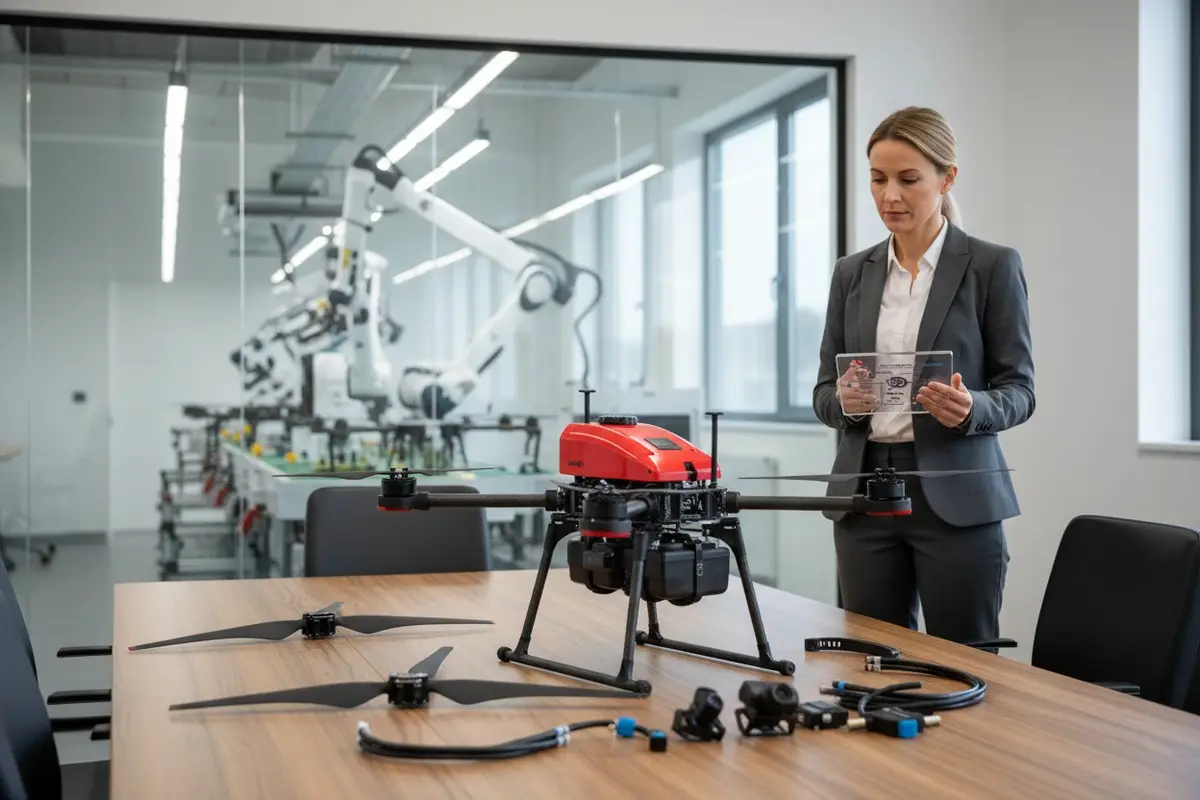

Lors d'une récente série de production dans notre usine de Xi'an, une expédition critique de batteries de notre unique fournisseur a été retardée de trois semaines diligence raisonnable du fournisseur 1. Ce seul goulot d'étranglement a failli faire dérailler les livraisons à cinq départements de pompiers américains. Le problème ? Une dépendance excessive à l'égard d'un seul fournisseur pour un composant essentiel à la mission conceptions de drones modulaires 2. risques d'approvisionnement auprès d'un fournisseur unique 3
Pour atténuer les risques d'approvisionnement auprès d'un fournisseur unique lors de l'acquisition de drones de lutte contre les incendies, mettez en œuvre une stratégie multi-fournisseurs pour les composants critiques, effectuez une diligence raisonnable approfondie des fournisseurs, établissez des contrats complets avec des clauses de résiliation claires, constituez des stocks tampons et privilégiez des conceptions de drones modulaires qui permettent la substitution de composants auprès de plusieurs fabricants qualifiés.
Ce guide vous présente des stratégies éprouvées que notre équipe a développées au fil des années d'exportation de drones industriels vers les États-Unis et l'Europe. Explorons comment protéger votre chaîne d'approvisionnement sans compromettre la qualité.
Comment puis-je diversifier ma chaîne d'approvisionnement en drones de lutte contre les incendies sans sacrifier le support d'ingénierie sur lequel je compte actuellement ?
De nombreux responsables des achats craignent que l'ajout de nouveaux fournisseurs n'implique la perte de l'expertise technique que leur partenaire actuel fournit. Notre équipe d'ingénierie entend cette préoccupation chaque semaine de la part des distributeurs américains qui souhaitent des options de secours mais s'inquiètent des lacunes de support.
Diversifiez votre chaîne d'approvisionnement de drones de lutte contre l'incendie en qualifiant des fournisseurs secondaires qui démontrent des capacités d'ingénierie équivalentes par le biais d'audits techniques, de projets pilotes et de protocoles de support documentés. Exigez que tous les fournisseurs respectent des normes de certification identiques et mettez en place des programmes de formation croisée pour assurer une assistance technique cohérente sur l'ensemble de votre réseau de fournisseurs.

Commencez par une évaluation des risques au niveau des composants
Avant de diversifier, vous devez comprendre quelles parties de votre drone présentent le plus grand risque. Tous les composants ne nécessitent pas de sources multiples. Concentrez vos efforts de diversification sur les éléments qui sont :
- Difficiles à substituer rapidement
- Provenant de régions présentant une instabilité géopolitique
- Produits par des fournisseurs dont la santé financière est faible
- Essentiels à la sécurité de vol et au succès de la mission
Lorsque nous concevons nos drones de lutte contre l'incendie SkyRover, nous classons chaque composant par niveau de risque. Cela aide les équipes d'approvisionnement à prioriser leurs budgets de diversification.
| Catégorie de composants | Niveau de risque | Priorité de diversification | Délai d'exécution type |
|---|---|---|---|
| Batteries lithium-ion 4 | Haut | Immédiate | 8-12 semaines |
| Caméras thermiques | Haut | Immédiate | 6-10 semaines |
| Cadres en fibre de carbone | Moyen | Court terme | 4-6 semaines |
| Moteurs de propulsion | Moyen | Court terme | 3-5 semaines |
| Contrôleurs de vol | Haut | Immédiate | 10-14 semaines |
| Systèmes de charge utile ignifuges | Haut | Immédiate | 8-12 semaines |
Établir des points de référence pour le support technique
Votre fournisseur secondaire doit correspondre aux capacités techniques de votre fournisseur principal. Lorsque nous intégrons de nouveaux partenaires de distribution, nous fournissons des accords de niveau de service détaillés pour le support technique. Vous devriez exiger la même chose de tout nouveau fabricant de drones.
Les principaux points de référence à évaluer comprennent :
- Temps de réponse aux requêtes techniques
- Disponibilité du support de diagnostic à distance
- Capacités de visite d'ingénierie sur site
- Qualité de la documentation et accessibilité linguistique
- Exhaustivité du programme de formation
Créer un protocole de projet pilote
Ne vous engagez jamais sur une commande importante sans avoir testé un nouveau fournisseur au préalable. Notre recommandation est de commencer par une petite commande de 5 à 10 unités. Utilisez ces unités pour :
- Inspection de la qualité par rapport à vos spécifications existantes
- Tests sur le terrain dans des conditions réelles de lutte contre les incendies
- Évaluation de la disponibilité et de la rapidité de livraison des pièces de rechange
- Évaluation de la réactivité de la communication
Cette approche vous permet de vérifier la qualité du support technique avant de prendre un engagement majeur.
Quelles mesures dois-je prendre pour vérifier les qualifications d'exportation d'un nouveau fournisseur afin d'éviter les retards dans mes expéditions de drones ?
D'après notre expérience d'exportation sur le marché américain, nous avons vu d'innombrables expéditions retenues en douane parce que les acheteurs n'avaient pas vérifié la documentation de leur fournisseur au préalable. Une expédition retardée peut vous coûter un contrat avec un service d'incendie qui avait besoin d'équipement avant la saison des feux de forêt.
Pour vérifier les qualifications d'exportation d'un nouveau fournisseur, demandez des copies de ses licences d'exportation, de ses certifications de produits (documentation de conformité CE, FCC, FAA), de son historique de dédouanement et de ses relations avec les transitaires. Confirmez son expérience avec les réglementations d'importation de votre pays de destination et demandez des références de clients existants sur votre marché.

Liste de contrôle essentielle de la documentation d'exportation
Lorsque nous préparons des expéditions pour des clients américains, notre équipe logistique compile un dossier documentaire complet. Votre nouveau fournisseur devrait fournir des documents équivalents sans hésitation.
| Type de document | Objectif | Qui l'émet ? |
|---|---|---|
| Licence d'exportation | Autorise la vente internationale | Gouvernement du fournisseur |
| Certificat d'origine | Vérification du lieu de fabrication | Chambre de Commerce |
| la certification FCC 5 | Confirme la conformité des fréquences radio | Laboratoire d'essai accrédité |
| Marquage CE (pour l'UE) | Conforme aux normes de sécurité européennes | Organisme notifié |
| Facture commerciale | Déclare la valeur et le contenu | Fournisseur |
| Liste de colisage | Details shipment contents | Fournisseur |
| Lettre de transport aérien / Connaissement | Suivi de l'expédition | Transporteur de fret |
Vérifier le bilan de dédouanement
Demandez à votre fournisseur potentiel des exemples spécifiques de livraisons réussies dans votre pays. Les questions à poser comprennent :
- Combien d'expéditions avez-vous envoyées aux États-Unis au cours des 12 derniers mois ?
- Quel pourcentage a été dédouané sans retard ?
- Par quels ports expédiez-vous généralement ?
- Avez-vous une relation établie avec des courtiers en douane dans mon pays ?
Notre équipe entretient des relations avec des courtiers en douane à Los Angeles, New York et Houston spécifiquement parce que ces relations évitent les retards pour nos clients américains.
Comprendre les restrictions à l'exportation de technologie
Les drones de lutte contre l'incendie contiennent souvent des composants soumis aux contrôles à l'exportation. Les caméras thermiques, certains modules GPS et les contrôleurs de vol avancés peuvent nécessiter une licence supplémentaire. Un fournisseur qualifié :
- Savoir quels composants nécessitent des permis d'exportation spéciaux
- Avoir des systèmes en place pour obtenir les approbations nécessaires
- Fournir des certificats d'utilisateur final lorsque requis
- Comprendre les réglementations sur les technologies à double usage 6
Si un fournisseur ne peut pas expliquer clairement ses procédures de conformité à l'exportation, considérez cela comme un signal d'alarme majeur.
Demander des références clients
La vérification la plus fiable provient d'autres acheteurs qui ont importé avec succès auprès du fournisseur. Demandez les coordonnées d'au moins trois clients de votre région. Questions pour les références :
- Did shipments arrive on schedule?
- Tous les documents étaient-ils exacts et complets ?
- Comment le fournisseur a-t-il géré les problèmes douaniers ?
- Commanderiez-vous à nouveau chez eux ?
Comment puis-je m'assurer que mon fabricant secondaire de drones de lutte contre l'incendie offre le même niveau de durabilité et d'autonomie de vol que ma source principale ?
Lorsque nous calibrons nos contrôleurs de vol pour une endurance maximale, chaque paramètre compte. Nos clients font confiance au fait qu'une autonomie de vol nominale de 45 minutes signifie 45 minutes dans des conditions réelles de lutte contre les incendies. Changer de fournisseur sans vérifier des performances équivalentes peut nuire à votre réputation auprès des utilisateurs finaux.
Assurez-vous que votre fabricant secondaire correspond en termes de durabilité et d'autonomie de vol en exigeant des protocoles de test identiques, une vérification des spécifications par des tiers, des essais sur le terrain comparatifs dans des conditions équivalentes et une documentation détaillée de la qualité au niveau des composants. Établissez des contrats basés sur la performance avec des KPI clairs qui tiennent les fournisseurs responsables des mêmes normes.

Définissez vos spécifications de performance avec précision
Des spécifications vagues entraînent des produits incompatibles. Lorsque vous approchez un nouveau fournisseur, fournissez des exigences de performance détaillées qui ne laissent aucune place à l'interprétation.
| Mesure de la performance | Exemple de spécification | Méthode d'essai |
|---|---|---|
| Autonomie de vol maximale | 45 minutes à 20°C, charge utile de 50% | Test de vol stationnaire contrôlé |
| Résistance au vent | Vol stable jusqu'à 35 km/h | Certification en soufflerie |
| Température de fonctionnement | De -10°C à 50°C | Chambre climatique |
| Résistance à l'eau | Indice de protection IP54 minimum | Tests de pulvérisation |
| La capacité de charge utile | 15 kg soutenus | Test d'étalonnage du poids |
| Portée de communication | 5 km en visibilité directe | Tests de portée sur le terrain |
Exiger une vérification par des tests tiers
Ne vous fiez pas uniquement aux spécifications fournies par le fournisseur. Nos produits sont testés dans des laboratoires accrédités et nous fournissons aux clients des rapports de test complets. Votre fournisseur secondaire devrait proposer :
- Certificats de test de laboratoire indépendants
- Documentation vidéo des tests d'endurance
- Accès aux installations de test pour les audits clients
- Données de test historiques des lots de production précédents
Mener des essais sur le terrain côte à côte
La seule façon de vérifier véritablement les performances équivalentes est la comparaison directe. Avant de vous engager dans des commandes en volume, achetez des unités d'échantillons auprès de votre fournisseur secondaire potentiel et testez-les aux côtés de votre équipement existant.
Les scénarios de test devraient inclure :
- Temps de vol maximum dans des conditions météorologiques identiques
- Performances de la charge utile avec votre équipement de lutte contre l'incendie standard
- Exposition à la chaleur lors d'opérations simulées à proximité d'un incendie
- Tests de résistance aux chutes et aux impacts
- Stockage prolongé et fiabilité au redémarrage
Examiner la qualité des composants à la source
La durabilité dépend de la qualité des composants. Lorsque notre équipe d'ingénierie s'approvisionne en batteries, nous auditons directement les processus de fabrication de nos fournisseurs. Vous devriez demander à votre fournisseur potentiel de drones :
- Qui fabrique vos cellules de batterie ?
- Quel grade de fibre de carbone utilisez-vous pour les cadres ?
- Vos moteurs sont-ils conçus pour un fonctionnement continu et intensif ?
- Quelles procédures de contrôle qualité suivez-vous ?
Un fournisseur digne de confiance répondra à ces questions en toute transparence et accueillera les audits d'installations.
Que dois-je rechercher chez un partenaire drone pour garantir un accès immédiat au support technique et à des pièces de rechange abordables ?
Notre équipe de service client reçoit des appels de départements de pompiers américains qui ont acheté des drones auprès de fournisseurs qui ont disparu après la vente. Ils ont besoin d'un moteur de remplacement, mais leur fournisseur met des semaines à répondre ou propose des prix exorbitants. C'est pourquoi l'accessibilité des pièces de rechange devrait être un critère de sélection principal.
Pour garantir une assistance technique immédiate et des pièces de rechange abordables, choisissez des partenaires de drones qui maintiennent des stocks régionaux de pièces de rechange, offrent des garanties de temps de réponse documentées, fournissent des listes de prix transparentes pour les pièces de rechange à l'avance, emploient du personnel d'assistance technique anglophone et peuvent démontrer un historique de service après-vente grâce à des témoignages de clients.

Évaluer le prix et la disponibilité des pièces de rechange
Avant de signer tout accord d'approvisionnement, demandez un catalogue complet de pièces de rechange avec les prix. Dans notre usine, nous maintenons des prix transparents car nous comprenons que les coûts cachés détruisent les relations clients.
Questions clés à poser :
- Stockez-vous les pièces de rechange courantes pour une expédition immédiate ?
- Quel est le délai de livraison typique pour les pièces non stockées ?
- Proposez-vous des kits de pièces de rechange pour les besoins d'entretien courants ?
- Les prix des pièces sont-ils fixes pour la durée du contrat ?
- Pouvez-vous expédier des pièces d'urgence par fret express ?
Évaluer l'infrastructure de support technique
La qualité du support technique varie considérablement d'un fournisseur à l'autre. Lors de l'évaluation d'un nouveau partenaire drone, enquêtez minutieusement sur ses capacités de support.
| Fonctionnalité de support | Norme minimale acceptable | Norme préférée |
|---|---|---|
| Temps de réponse | Dans les 24 heures | Dans les 4 heures |
| Capacité linguistique | Anglais écrit | Anglais parlé |
| Disponibilité | Heures d'ouverture (fuseau horaire du fournisseur) | Couverture des heures étendues |
| Diagnostics à distance | Dépannage par e-mail | Support par appel vidéo |
| Documentation | Manuel utilisateur de base | Manuel technique complet |
| Formation | Matériaux en ligne | Formation sur site disponible |
Exiger des garanties de support contractuelles
Les promesses verbales ne signifient rien lorsque votre drone est immobilisé. Incluez des exigences de support spécifiques dans votre contrat d'approvisionnement :
- Temps de réponse maximum pour les requêtes techniques
- Pourcentages de disponibilité garantie des pièces de rechange
- Clauses de protection des prix pour les pièces de rechange
- Procédures d'escalade pour les problèmes non résolus
- Pénalités pour violation des accords de niveau de support
Développer les capacités techniques internes
Bien que le support du fournisseur soit important, vous devriez également développer une expertise interne. Cela réduit votre dépendance à l'égard d'un seul fournisseur et accélère la résolution des problèmes.
Considérez :
- Demander une formation de maintenance complète à votre fournisseur
- Développer des procédures d'exploitation standard détaillées pour les réparations courantes
- Maintenir un stock de pièces de rechange critiques dans vos installations
- Former plusieurs membres de l'équipe au diagnostic des drones
Notre équipe d'ingénierie propose des programmes de formation spécialement conçus pour aider les clients à devenir autonomes pour la maintenance de routine tout en conservant l'accès à un support avancé si nécessaire.
Vérifier la stabilité financière
Un fournisseur ne peut pas fournir de support à long terme s'il cesse ses activités. Enquérez-vous de la santé financière de votre partenaire potentiel :
- Depuis combien de temps sont-ils en activité ?
- Quelle est leur tendance de revenus annuels ?
- Ont-ils une clientèle diversifiée ?
- Sont-ils soutenus par des investisseurs ou autofinancés ?
Les fabricants établis avec des finances stables présentent un risque plus faible de discontinuation du support.
Conclusion
La dépendance à un fournisseur unique expose vos opérations de drones de lutte contre les incendies à des risques inutiles. En diversifiant stratégiquement, en vérifiant les qualifications d'exportation, en exigeant une équivalence de performance et en priorisant l'accès au support à long terme, vous protégez votre chaîne d'approvisionnement et vos clients. Commencez votre audit de fournisseur dès aujourd'hui, votre prochaine saison de feux de forêt en dépend.
Notes de bas de page
1. Fournit des conseils sur la conduite d'une diligence raisonnable approfondie pour les fournisseurs dans la gestion des risques de la chaîne d'approvisionnement. ︎
2. Explique le concept de conception modulaire et ses avantages dans diverses applications, y compris les drones. ︎
3. Les dangers de l'approvisionnement unique dans votre chaîne d'approvisionnement discute des écueils et des risques de l'approvisionnement unique et des stratégies pour une chaîne d'approvisionnement résiliente. ︎
4. Fournit des informations et des directives de sécurité essentielles relatives aux batteries lithium-ion, essentielles pour les composants de drones. ︎
5. Décrit les procédures et les exigences d'autorisation d'équipement par la FCC, pertinentes pour la conformité des fréquences radio des drones. ︎
6. Ce site Web du gouvernement américain fournit des informations sur les contrôles d'exportation des États-Unis, y compris les réglementations administrées par le BIS pour les articles à double usage. ︎
7. Décrit le rôle et les avantages de l'évaluation de la conformité par des tiers dans la vérification des spécifications et de la qualité des produits. ︎
8. Fournit des informations sur les accords de niveau de service, en soulignant leur importance pour définir et garantir le support. ︎

 English
  Español de México
  Deutsch
  Français
  Русский
  العربية
Comments
No comments yet. Be the first to share your thoughts!
Leave a Comment