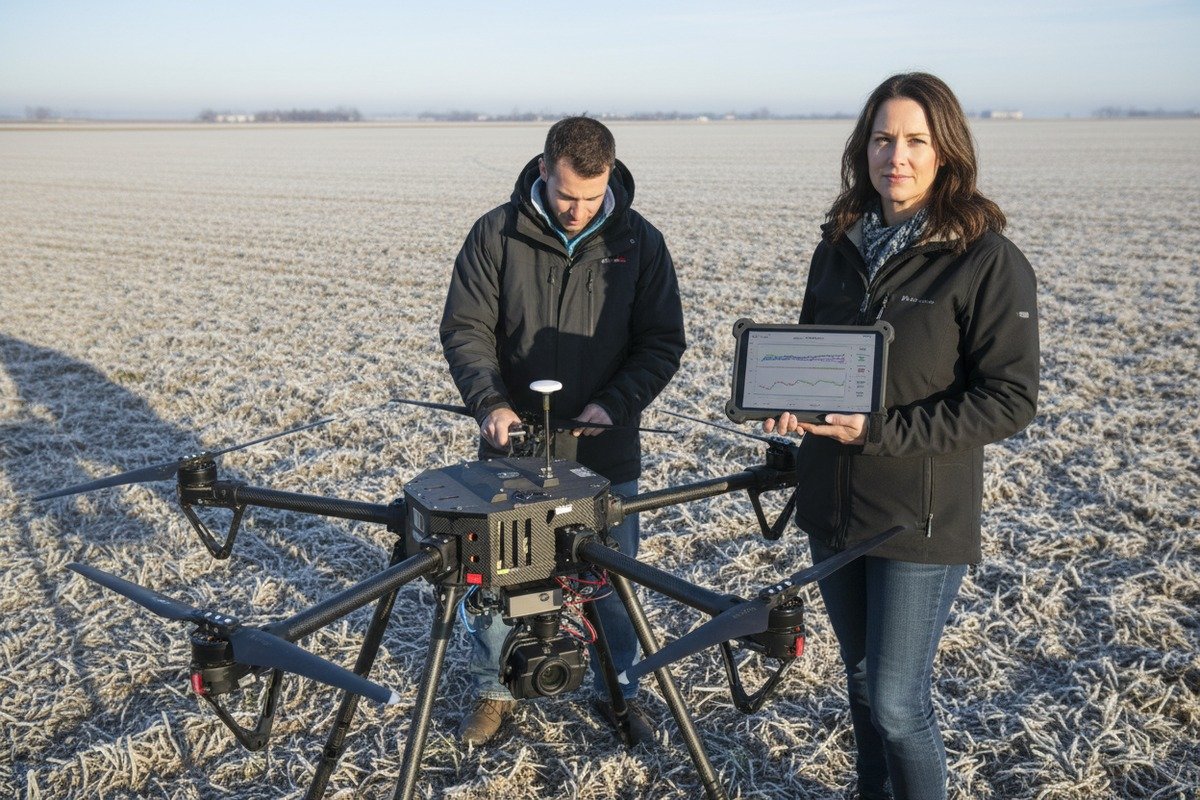
Last winter, a distributor in Canada returned three battery packs after just two weeks Battery chemistry 1. The batteries worked fine in our testing facility, but failed in -15°C field conditions. This taught our engineering team a hard lesson about cold-weather performance standards.
To evaluate low-temperature battery discharge when buying agricultural drones, request manufacturer discharge curves at multiple temperatures (25°C, 10°C, 0°C, -10°C), verify BMS cold-weather compensation features, check for integrated heating systems, and conduct real-world field tests in your actual operating environment before committing to bulk orders.
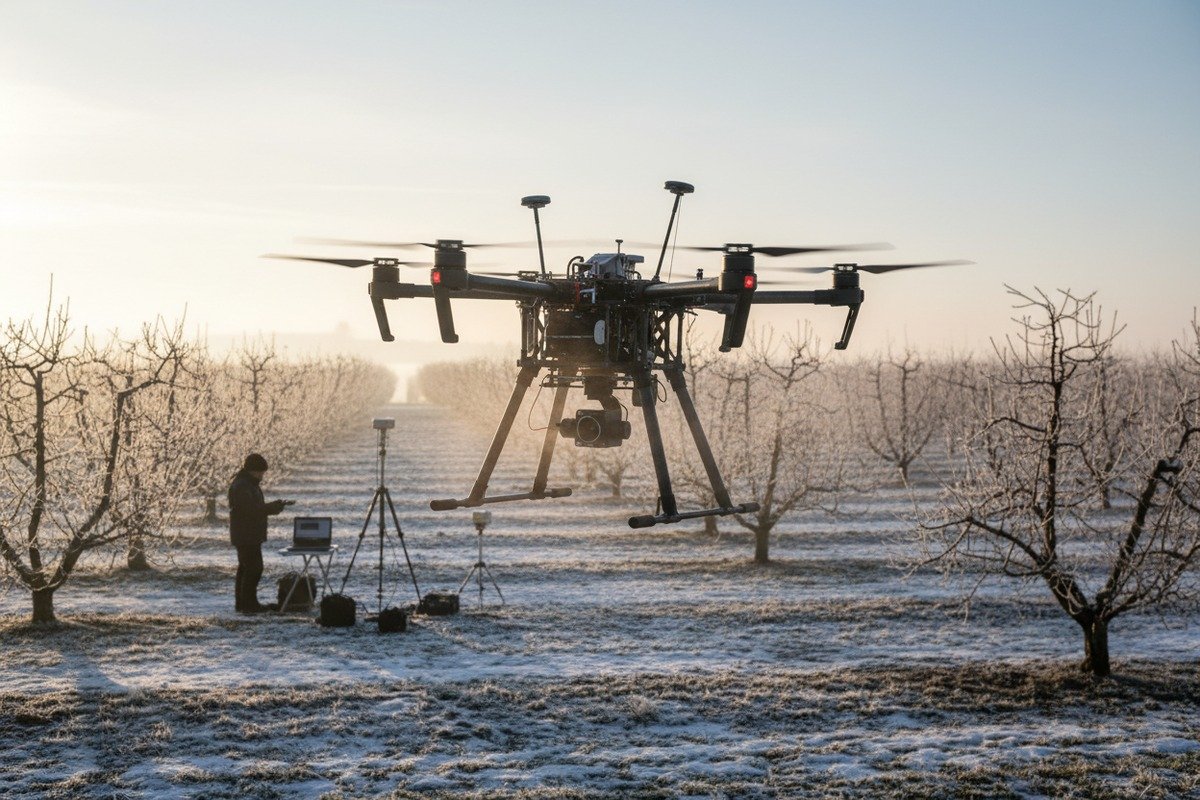
Cold weather creates unique challenges for agricultural drone operations 2. Battery chemistry changes dramatically below 15°C. This guide walks you through the technical specifications and practical tests that protect your investment.
How can I accurately predict my drone's flight time when operating in freezing temperatures?
Every season, our technical support team receives calls from frustrated operators. Their drones show 80% charge but land after only half the expected flight time. The culprit is almost always cold temperature discharge behavior that nobody explained during the sale.
To predict flight time in freezing temperatures, reduce manufacturer's rated capacity by 20-30% at 0°C and up to 50% at -10°C. Use onboard BMS telemetry to track real-time voltage sag under load. Always conduct test flights in your actual operating conditions before planning full spray missions.
Why Cold Temperatures Reduce Battery Capacity
Batteries LiPo 3 power most agricultural drones. These batteries rely on lithium-ion movement between electrodes. Cold temperatures slow this chemical reaction. The result is less available power, even when the battery shows full charge.
When our engineers test batteries at different temperatures, we see consistent patterns. A battery rated for 20,000 mAh at 25°C might deliver only 16,000 mAh at 0°C. At -10°C, that same battery might provide just 12,000 mAh. This means your 15-minute flight becomes a 9-minute flight.
Understanding Voltage Sag in Cold Conditions
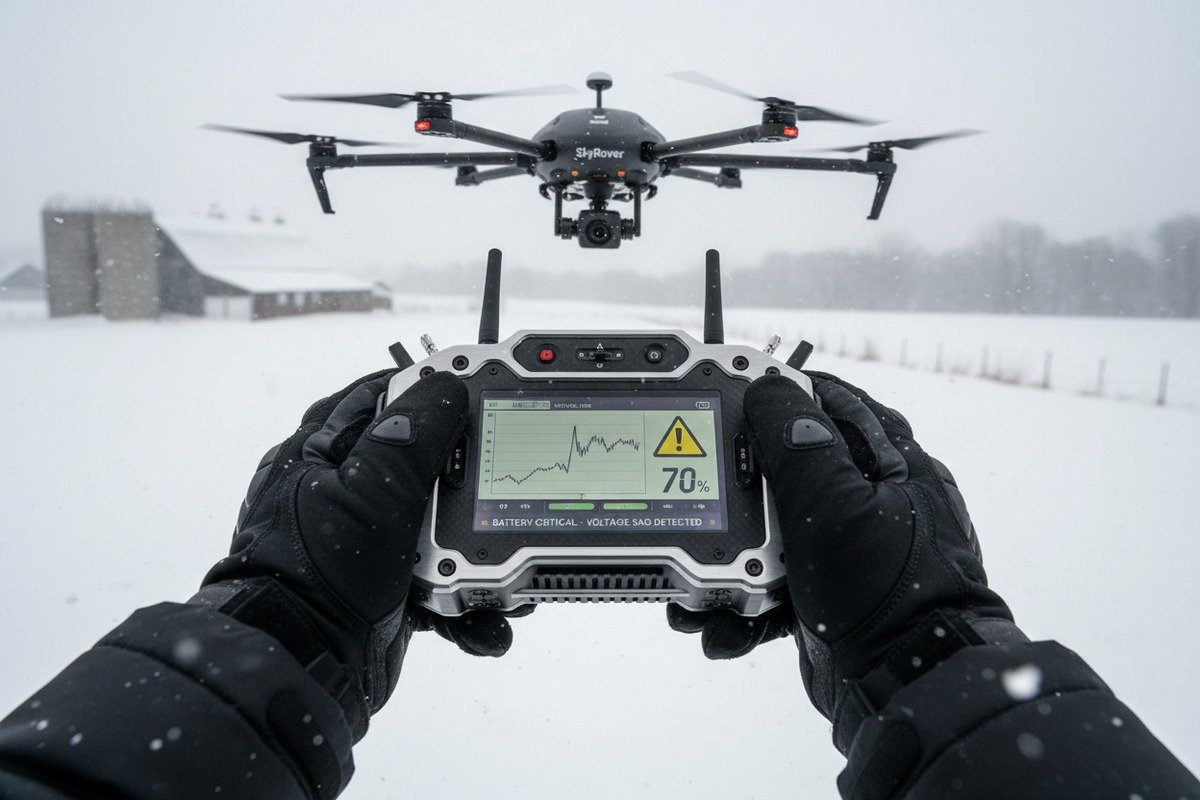
Voltage sag 4 happens when battery voltage drops suddenly under load. In cold weather, this problem intensifies. A fully charged 6S battery shows 25.2V at rest. Under heavy spray load in cold conditions, it might sag to 21V or lower.
| Température | Voltage at Rest | Voltage Under Load | Typical Sag |
|---|---|---|---|
| 25°C | 25.2V | 23.8V | 1.4V |
| 10°C | 25.2V | 22.9V | 2.3V |
| 0°C | 25.2V | 21.5V | 3.7V |
| -10°C | 25.1V | 19.8V | 5.3V |
This voltage sag triggers low-battery warnings earlier than expected. Some drones will initiate emergency landing procedures even with significant charge remaining. Understanding this behavior helps you plan safer, more efficient operations.
Practical Steps to Predict Flight Time
First, request temperature-specific discharge curves from your supplier. If they cannot provide this data, consider it a red flag. Our team provides discharge data at four temperature points for every battery model.
Second, conduct hover tests in controlled conditions. Fully charge your battery, record the starting temperature, and hover until the low-battery warning triggers. Note the actual flight time and compare it against rated specifications.
Third, build a correction factor table for your specific operation. If your region operates at -5°C average during winter, your correction factor might be 0.7. This means a 10-minute rated flight becomes a 7-minute actual flight.
What technical discharge specs should I demand from a supplier to ensure cold-weather reliability?
When we prepare quotations for distributors in northern regions, we include detailed temperature specifications. Many competitors skip this information entirely. Without proper specs, you cannot make informed purchasing decisions or set accurate customer expectations.
Demand these technical discharge specifications: C-rating at multiple temperatures, internal resistance values across temperature range, BMS temperature compensation parameters, minimum operating temperature with warranty coverage, and discharge curves showing capacity retention at 0°C and -10°C.
Essential Specifications Checklist
Your supplier should provide documentation covering all critical parameters. Missing information suggests either poor testing practices or deliberate omission of unfavorable data.
| Spécifications | Pourquoi c'est important | What to Request |
|---|---|---|
| Cote C 5 by Temperature | Shows power delivery at cold temps | Ratings at 25°C, 10°C, 0°C, -10°C |
| Résistance interne 6 | Higher resistance = more heat loss | Values at multiple temperatures |
| Capacity Retention | Predicts actual flight time | Percentage retained at each temp |
| BMS Cutoff Thresholds | Prevents damage and false warnings | Temperature-compensated values |
| Cycle Life by Temperature | Affects long-term ROI | Expected cycles at operating temp |
C-Rating Performance in Cold Weather
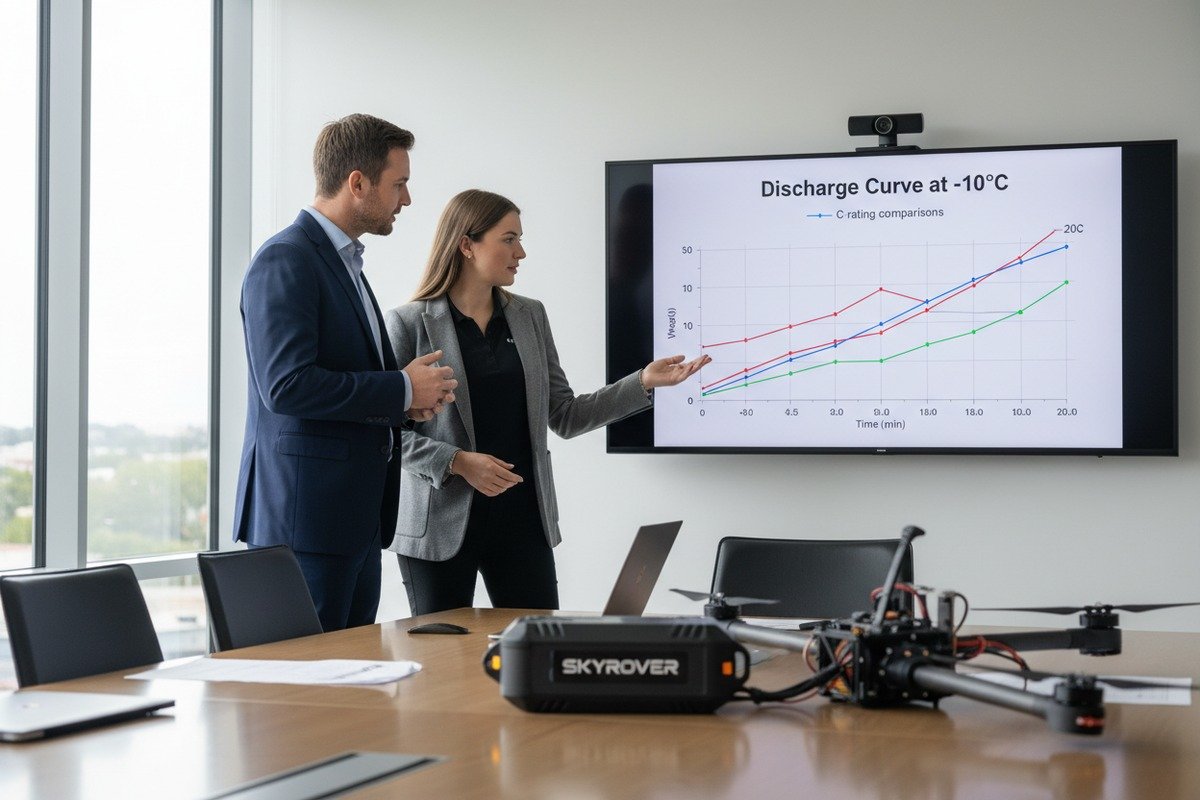
C-rating tells you how quickly a battery can safely discharge. A 20C rated battery with 15,000 mAh capacity can deliver 300A continuously at room temperature. However, this rating degrades significantly in cold conditions.
Our testing shows that a 20C battery might only safely deliver 12C at 0°C and 8C at -10°C. This reduced C-rating means your drone may struggle to maintain altitude during aggressive maneuvers or heavy payload operations.
Ask your supplier for C-rating specifications at your operating temperature. If they only provide room temperature ratings, assume a 40% reduction at 0°C for safety margin calculations.
Internal Resistance and Heat Generation
Internal resistance increases as temperature drops. Higher resistance creates more heat waste and less useful power. A healthy battery shows internal resistance below 30mΩ at room temperature. At 0°C, this same battery might read 45-50mΩ.
When evaluating suppliers, request internal resistance measurements at multiple temperatures. Also ask about cell-to-cell resistance variance. Good quality batteries maintain tight tolerance (under 5mΩ variance) across cells even in cold conditions. Poor quality batteries show increasing variance as temperature drops, leading to imbalanced discharge and reduced lifespan.
BMS Temperature Compensation Features
Modern Battery Management Systems 7 should adjust their behavior based on temperature. This includes modifying voltage cutoff thresholds, adjusting charge acceptance rates, and triggering preheating when needed.
Ask your supplier these specific questions about BMS features:
Does the BMS prevent charging below 0°C? Charging cold batteries causes lithium plating 8, which permanently damages cells and creates safety risks.
Does the BMS adjust low-voltage cutoff based on temperature? A fixed 3.2V per-cell cutoff might trigger prematurely in cold conditions due to increased voltage sag.
Does the BMS log temperature data for diagnostic purposes? This data helps identify patterns and predict maintenance needs.
How will low-temperature discharge rates impact the long-term ROI of my battery investment?
Our finance team helped a US distributor calculate total cost of ownership for a fleet operating in Minnesota. The results surprised everyone. Cold-weather operation affected not just immediate performance but also long-term battery lifespan and replacement costs.
Low-temperature discharge rates can reduce battery ROI by 30-50% through accelerated degradation, reduced cycle life, and shortened flight times. Batteries regularly discharged below 5°C may lose 40% of their rated cycle life. Investing in thermal management systems typically pays back within one season through extended battery longevity.
Cycle Life Degradation in Cold Conditions
Battery manufacturers rate cycle life at optimal temperatures, typically 25°C. When you operate outside this range, cycle life decreases. Our testing data shows clear patterns of degradation based on operating temperature.
| Température de fonctionnement | Rated Cycles | Actual Cycles | Cycle Life Retained |
|---|---|---|---|
| 20-25°C | 500 | 480-520 | 96-104% |
| 10-15°C | 500 | 400-450 | 80-90% |
| 0-5°C | 500 | 300-350 | 60-70% |
| -5 to 0°C | 500 | 200-250 | 40-50% |
These numbers represent typical LiPo battery performance. Your actual results depend on specific chemistry, charge practices, and operational intensity. However, the pattern is consistent: cold operations cost cycles.
Calculating True Cost Per Flight Hour
Simple cost calculations divide battery price by rated cycle life. This approach fails in cold-climate operations. A more accurate calculation considers actual cycle life at your operating temperature.
For example, consider a $1,200 battery rated for 500 cycles. At room temperature, cost per cycle is $2.40. If cold operations reduce cycle life to 300 cycles, actual cost per cycle rises to $4.00. Over a fleet of 20 batteries, this represents $16,000 in additional annual costs.
Our recommendation is to calculate break-even points for thermal management investments. A $200 battery heating system that maintains optimal temperature might extend cycle life from 300 to 450 cycles. This $200 investment saves $600 per battery in extended life, providing 3:1 return.
Hidden Costs of Cold-Weather Operation
Beyond direct cycle life reduction, cold operations create indirect costs that affect ROI. These include increased maintenance frequency, higher warranty claim rates, and reduced operational productivity.
Increased maintenance happens because cold-cycling stresses battery connections and creates condensation issues. When batteries move between warm storage and cold operation, moisture can accumulate on contacts and electronics. This requires more frequent cleaning and inspection.
Warranty claims increase when operators push batteries beyond their cold-weather limits. Some manufacturers void warranties for operation below specified temperatures. Before purchasing, verify warranty terms and ensure they cover your intended operating conditions.
Productivity losses occur when shorter flight times require more battery swaps. If cold weather reduces flight time from 15 minutes to 10 minutes, you need 50% more batteries or battery swaps to cover the same area. This adds labor costs and operational complexity.
Can I request custom battery heating or insulation features for my OEM agricultural drone order?
Our OEM clients often ask about customization possibilities. When we developed our cold-weather variant for a Scandinavian distributor, we learned that proper thermal management requires more than just adding a heating pad. The entire system needs integration.
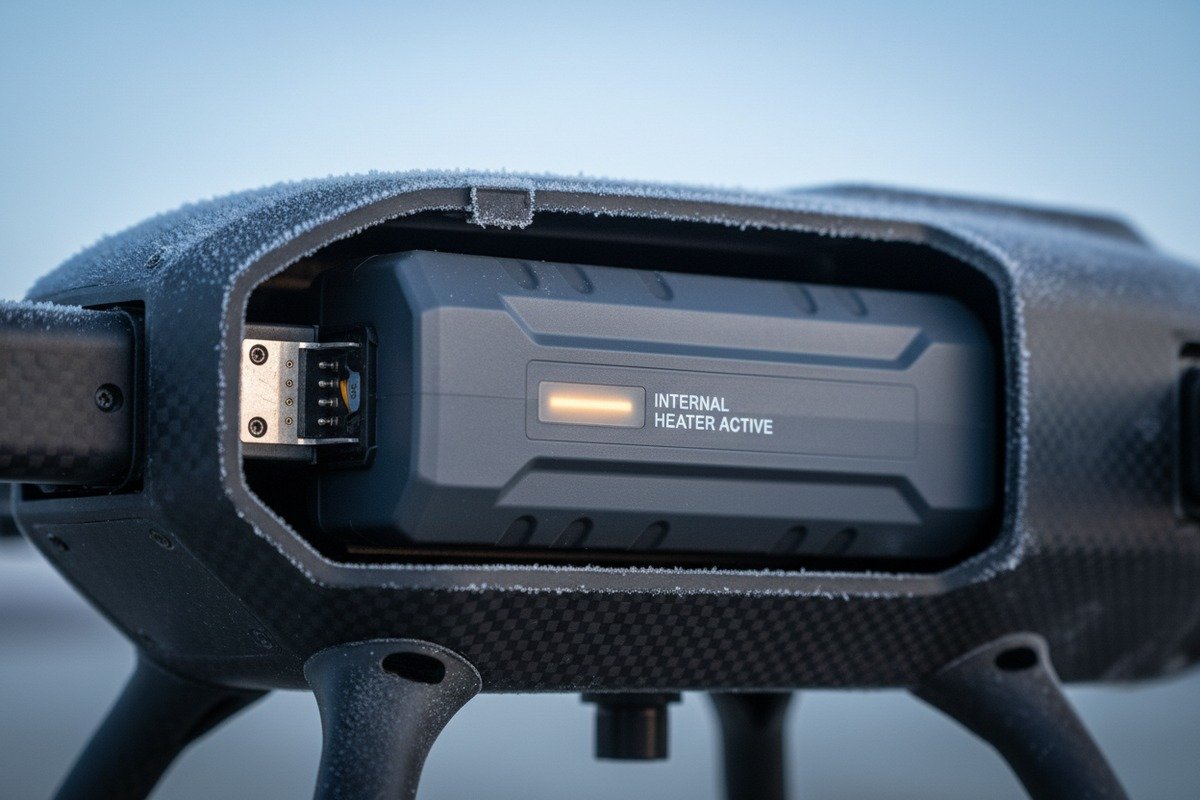
Yes, reputable manufacturers offer custom battery heating and insulation features for OEM orders. Request integrated heating elements with automatic temperature control, insulated battery compartments, pre-flight warming protocols, and BMS integration that coordinates heating with charging cycles. Minimum order quantities typically apply for custom thermal configurations.
Types of Thermal Management Solutions
Several approaches exist for managing battery temperature in cold conditions. Each has advantages and limitations depending on your operational requirements and budget constraints.
Passive insulation uses foam or other materials to slow heat loss. This simple approach costs little but provides limited protection. Insulation works best for mild cold (5-15°C) or short exposure periods. It cannot maintain temperature during extended cold exposure.
Active heating uses electrical heating elements powered by the battery itself or external sources. This approach maintains optimal temperature but consumes energy. A typical heating system draws 50-100W, which reduces available flight power. Pre-heating before flight minimizes this impact.
Hybrid systems combine insulation with active heating. Insulation reduces heat loss, so heating elements work less and consume less power. This approach provides the best cold-weather performance but adds cost and complexity.
What to Specify in Your OEM Request
When requesting custom thermal management, provide detailed specifications to ensure proper design. Vague requests lead to solutions that may not meet your actual needs.
Specify your target operating temperature range. If you need operation down to -20°C, say so explicitly. Different temperature targets require different solutions.
Specify pre-heating requirements. Do you need the system to warm batteries from cold storage, or will batteries be stored warm and only need temperature maintenance? Pre-heating cold batteries requires more power than maintaining already-warm batteries.
Specify integration requirements. Should heating activate automatically based on temperature sensors? Should the system interface with ground station software? Should heating continue during charging?
Cost Considerations for Custom Features
Custom thermal management adds cost at multiple levels. Understanding these costs helps you budget appropriately and evaluate supplier quotes.
| Élément de coût | Gamme typique | Factors Affecting Cost |
|---|---|---|
| Heating Elements | $30-80 per battery | Power rating, material quality |
| Insulation Materials | $15-40 per battery | R-value, weight constraints |
| Temperature Sensors | $10-25 per battery | Accuracy, number of points |
| BMS Integration | $50-150 per system | Software development, testing |
| Tooling/Setup | $2,000-10,000 one-time | Design complexity, MOQ |
Minimum order quantities for custom features typically range from 50-200 units. Some manufacturers, including our team, offer prototype development for smaller quantities to validate designs before production commitment.
Questions à poser à votre fournisseur
Before committing to custom thermal features, ask your supplier these questions:
What warranty applies to thermal management components? Heating elements can fail, and warranty coverage varies.
What is the energy consumption of the heating system? Higher consumption means shorter flight times or larger batteries.
How does the system handle thermal runaway scenarios? Safety systems must prevent heating elements from overheating damaged batteries.
What testing has been performed at target temperatures? Request test reports showing system performance at your specified operating conditions.
Can you provide reference customers using similar configurations? Speaking with existing users reveals real-world performance and any issues not apparent in specifications.
Conclusion
Evaluating low-temperature battery discharge protects your investment and ensures reliable cold-weather operations. Request temperature-specific specifications, conduct field tests in actual conditions, and consider thermal management systems for ROI optimization. Contact our technical team at *@******ne.com for detailed cold-weather battery documentation.
Notes de bas de page
1. Replaced with an authoritative source from the American Chemical Society explaining the fundamental chemistry of batteries. ︎
2. Replaced with a Wikipedia page providing a comprehensive overview of agricultural drones and their operations. ︎
3. Provides a comprehensive overview of lithium polymer battery technology and working principles. ︎
4. Defines voltage sag in electrical systems and its causes. ︎
5. Replaced with an authoritative article from Battery University explaining the C-rate. ︎
6. Explains internal resistance in batteries and factors influencing it, including temperature. ︎
7. Describes the functions of a Battery Management System in monitoring and managing battery performance. ︎
8. Discusses lithium plating as a degradation mechanism in lithium-ion batteries, especially at low temperatures. ︎
9. Explains battery thermal management systems and their importance for battery performance and longevity. ︎

 English
  Spanish
  German
  French
  Dutch
Dutch  Arabic
