
Lorsque notre équipe d'ingénierie teste de nouveaux Récepteurs GNSS 1 sur notre chaîne de production, nous constatons de visu comment les temps d'acquisition GPS varient considérablement en fonction de l'endroit où le drone opère dans le monde. Les acheteurs négligent souvent ce facteur critique jusqu'à ce que leurs machines soient immobilisées sur le terrain, en attente de verrouillage satellite.
Pour interroger les fournisseurs sur la vitesse d'acquisition du GPS à différentes latitudes, demandez des données spécifiques de Temps avant la première acquisition (TTFF) pour les démarrages à froid et à chaud à votre emplacement, renseignez-vous sur la prise en charge multi-constellations (GPS, GLONASS, Galileo, BeiDou) et exigez des rapports de tests en vol localisés montrant les performances réelles aux latitudes élevées, moyennes et équatoriales.
Ce guide vous explique exactement quelles questions poser, quelles données exiger et comment vérifier les affirmations avant de vous engager dans un achat. Plongeons dans les détails.
Comment puis-je vérifier si la vitesse d'acquisition du GPS du drone reste rapide à ma latitude spécifique ?
Notre usine reçoit chaque mois des appels de distributeurs au Canada et en Scandinavie qui demandent pourquoi leurs drones mettent plus de temps à obtenir un verrouillage satellite que les unités vendues à des clients au Texas ou en Espagne. Le problème est réel, et la solution commence par poser les bonnes questions de vérification avant d'acheter.
Pour vérifier la vitesse d'acquisition du GPS à votre latitude, demandez des données documentées sur les temps de première acquisition (Time-To-First-Fix) testés à des coordonnées similaires aux vôtres, demandez des données de visibilité des satellites montrant combien de satellites le récepteur peut suivre au-dessus de votre tête, et insistez pour des vols de démonstration ou des unités de location pour des tests sur site avant les commandes en gros.
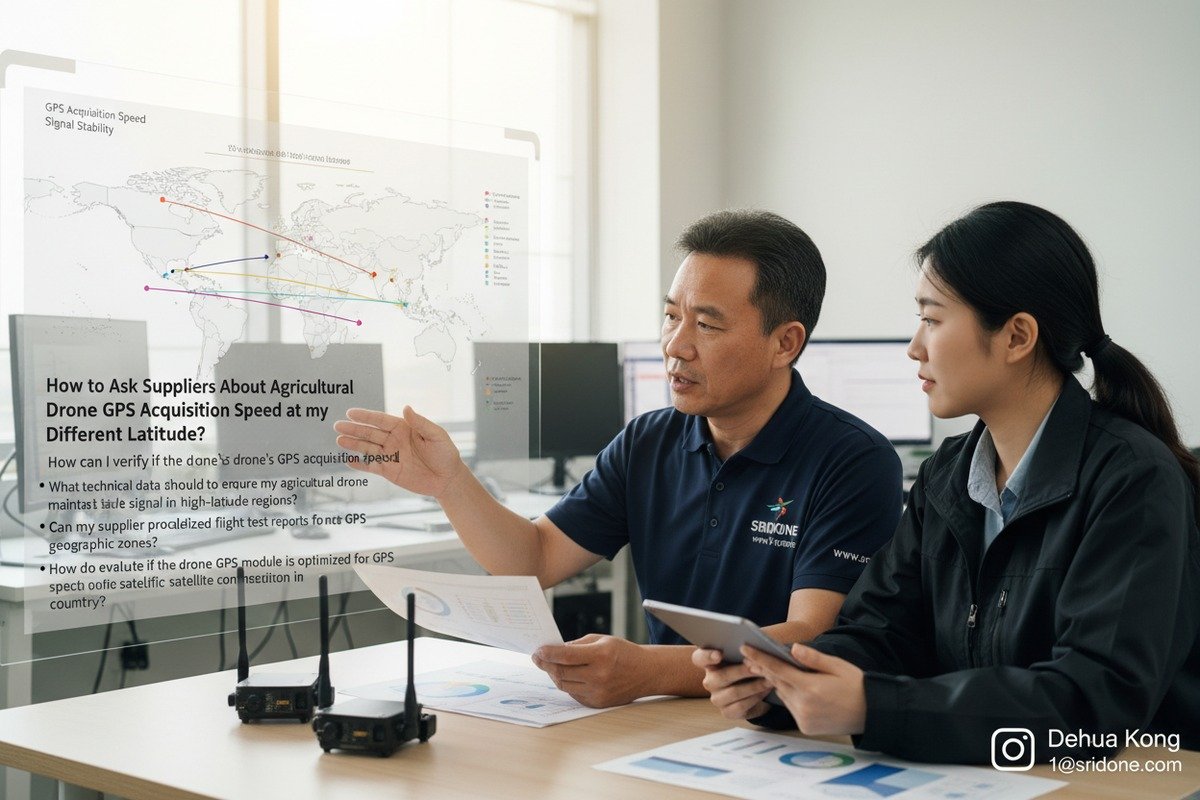
Comprendre le temps de premier verrouillage à votre emplacement
Temps de premier verrouillage (TTFF) 2 mesure le nombre de secondes écoulées depuis la mise sous tension jusqu'à ce que le récepteur GPS se verrouille sur suffisamment de satellites pour un positionnement précis. Ce nombre varie en fonction de votre latitude.
À l'équateur, les drones obtiennent généralement un verrouillage à froid en 20 à 45 secondes. Si vous vous déplacez vers le nord à 60° de latitude Nord, ce même drone peut nécessiter 45 à 90 secondes. Les démarrages à chaud (lorsque le récepteur conserve les données satellites récentes) présentent des schémas similaires : 1 à 5 secondes près de l'équateur contre 5 à 15 secondes dans les régions polaires.
Visibilité des satellites par latitude
Le nombre de satellites visibles au-dessus de votre tête affecte directement la vitesse d'acquisition. Voici ce à quoi vous attendre :
| Zone de latitude | Satellites visibles typiques | Valeur PDOP moyenne | TTFF à froid attendu |
|---|---|---|---|
| Équatoriale (0-15°) | 10-14 satellites | 1.2-1.8 | 20-35 secondes |
| Mi-latitude (30-45°) | 8-12 satellites | 1.5-2.5 | 30-50 secondes |
| Haute latitude (55-70°) | 6-10 satellites | 2.5-4.0 | 45-75 secondes |
| Polaire (>70°) | 4-8 satellites | 3.5-6.0 | 60-90+ secondes |
PDOP (Dilution de Précision de la Position) 3 mesure la qualité de la géométrie des satellites. Des nombres plus bas signifient une meilleure précision. Remarquez comment le PDOP augmente avec l'augmentation de la latitude.
Étapes de vérification pratiques
Premièrement, demandez à votre fournisseur des données TTFF testées à des latitudes comprises dans un rayon de 5 degrés de votre lieu d'exploitation. Les fiches techniques génériques indiquant "acquisition de 30 secondes" ne signifient rien si ce nombre provient de tests effectués à Singapour alors que vous cultivez au Manitoba.
Deuxièmement, demandez les journaux de test bruts. Les fabricants réputés conservent des enregistrements détaillés du nombre de satellites, des temps de fixation et des taux d'erreur lors du contrôle qualité. Notre installation stocke ces données pour chaque lot que nous produisons.
Troisièmement, organisez un vol de démonstration. Si vous prévoyez de commander 50 unités pour une flotte, insister pour tester une unité dans votre ferme réelle coûte beaucoup moins cher que de découvrir des problèmes après la livraison.
Quelles données techniques dois-je demander pour garantir que mon drone agricole maintienne un signal stable dans les régions de haute latitude ?
Lorsque nous calibrons des contrôleurs de vol pour l'exportation vers les pays nordiques, nos ingénieurs consacrent des heures supplémentaires à l'optimisation des paramètres GNSS dont les clients des climats plus chauds n'ont jamais à se soucier. Les opérations en haute latitude exigent des spécifications techniques spécifiques qui distinguent l'équipement professionnel des jouets de consommation.
Demandez la documentation sur la prise en charge multi-constellations (GPS, GLONASS, Galileo, BeiDou), les spécifications de gain d'antenne, les valeurs de sensibilité du récepteur et les données de temps de convergence RTK. Exigez également les capacités de correction ionosphérique et le temps de réacquisition du signal après de brèves obstructions, car ces métriques ont un impact direct sur la fiabilité aux hautes latitudes.
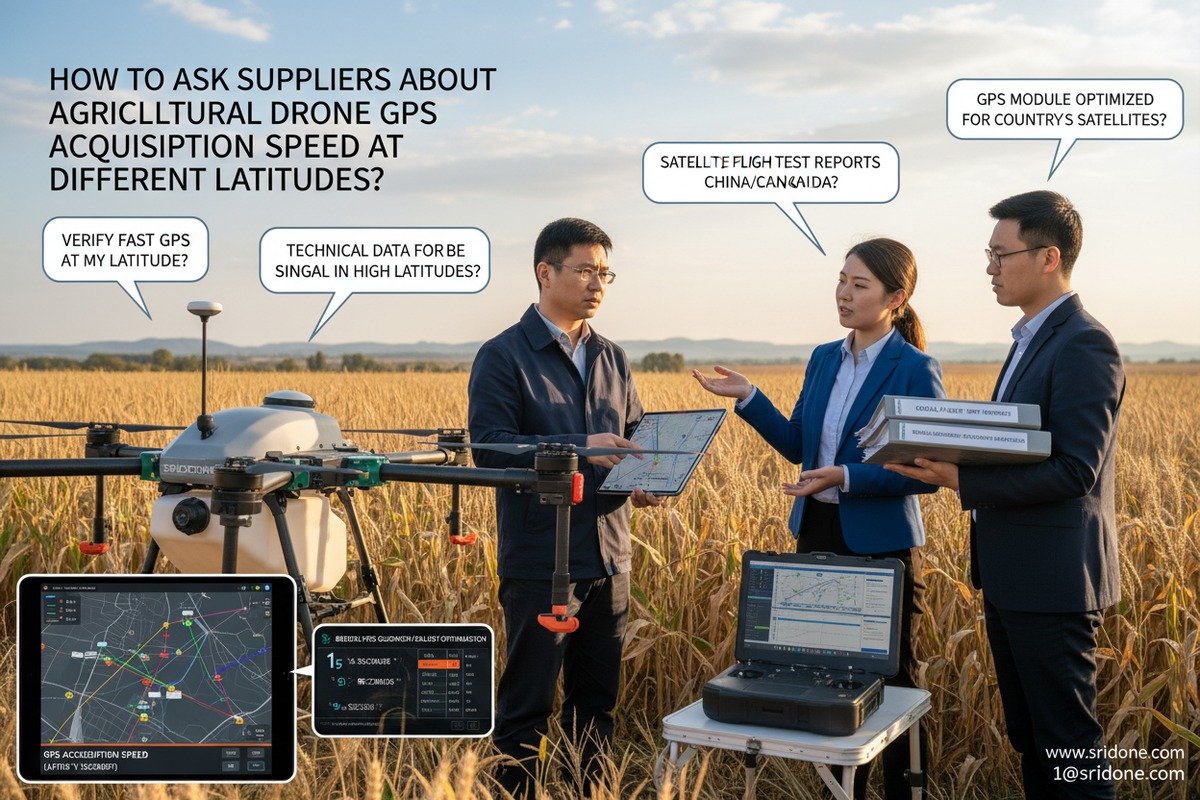
Prise en charge multi-constellations expliquée
Un drone qui n'utilise que les satellites GPS aura du mal dans les régions du nord. Les satellites GPS orbitent selon un schéma qui laisse des lacunes aux hautes latitudes. L'ajout de GLONASS (système russe) 4 comble bon nombre de ces lacunes car les satellites GLONASS ont une inclinaison orbitale plus élevée.
Les drones agricoles modernes devraient prendre en charge au moins trois constellations 5. Voici ce que chacun ajoute :
| Constellation | Nombre de satellites | Inclinaison orbitale | Avantage en haute latitude |
|---|---|---|---|
| GPS (USA) | 31 actifs | 55° | Couverture de base, moins de surcharge aux pôles |
| GLONASS (Russie) | 24 actifs | 64,8° | Meilleure couverture polaire, essentielle au-dessus de 55°N |
| Galileo (UE) | 28 actifs | 56° | Signal fort, bonne couverture de l'Europe du Nord |
| BeiDou (Chine) | 44 actifs | 55° (MEO) | Constellation la plus dense, excellente redondance |
Lorsque vous combinez les quatre, vous pouvez suivre 15 satellites ou plus, même à une latitude de 70°N. Cela améliore considérablement le PDOP et réduit le temps d'acquisition.
Spécifications de l'antenne et du récepteur
La qualité de l'antenne est plus importante que ce que la plupart des acheteurs réalisent. Demandez à votre fournisseur :
- Gain de l'antenne: Mesuré en dBi. Un gain plus élevé signifie une meilleure réception des signaux faibles. Recherchez un minimum de +3 dBi pour une utilisation à haute latitude.
- Sensibilité du récepteur: Mesuré en dBm. Des nombres plus bas (plus négatifs) sont meilleurs. Les récepteurs professionnels atteignent -160 dBm ou mieux.
- Support multi-fréquences: Les bandes L1/L2/L5 réduisent les erreurs de trajets multiples et accélèrent l'acquisition de 30 à 40 % par rapport aux récepteurs L1 uniquement.
Convergence RTK aux hautes latitudes
Systèmes RTK (cinématique en temps réel) 6 fournissent une précision centimétrique, mais ils nécessitent une première acquisition avant que les corrections ne fonctionnent. Aux hautes latitudes, la convergence RTK peut prendre de 10 à 30 secondes au lieu des 2 à 10 secondes typiques aux latitudes moyennes.
Demandez spécifiquement à votre fournisseur : " Quel est votre temps de convergence RTK à 65°N avec une vue du ciel de 50% ? " Des réponses vagues comme " très rapide " indiquent qu'ils n'ont pas testé dans des conditions réelles.
Considérations sur les interférences ionosphériques
L'aurore boréale provoque une scintillation ionosphérique qui dégrade les signaux GPS. Les récepteurs professionnels incluent des modèles de correction ionosphérique 7. Demandez si le drone prend en charge les corrections SBAS (WAAS en Amérique du Nord, EGNOS en Europe) ou s'il utilise des mesures double fréquence pour annuler directement les erreurs ionosphériques.
Mon fournisseur peut-il fournir des rapports d'essais en vol localisés sur les performances du GPS dans différentes zones géographiques ?
Lors d'une récente expédition vers une grande coopérative agricole en Alaska, nous avons inclus une documentation complète des tests en vol provenant d'essais que nous avons menés à 64°N. L'acheteur nous a ensuite dit que ces données leur ont fait gagner des semaines de dépannage car ils savaient exactement à quoi s'attendre. Tous les fournisseurs n'offrent pas ce niveau de transparence.
Oui, les fournisseurs réputés peuvent et doivent fournir des rapports de tests en vol localisés. Demandez la documentation montrant les mesures TTFF, le nombre de satellites, les valeurs PDOP et les temps de convergence RTK à partir de tests effectués à des latitudes similaires à votre lieu d'exploitation. Si les fournisseurs ne peuvent pas fournir ces données, considérez cela comme un signal d'alarme.

Ce que les rapports de tests localisés devraient inclure
Un rapport complet de tests en vol pour les performances GPS devrait contenir des points de données spécifiques. Lors de l'évaluation de la documentation du fournisseur, recherchez ces éléments :
| Élément du rapport | Ce que cela montre | Pourquoi c'est important |
|---|---|---|
| Coordonnées de test | Latitude/longitude exactes des essais | Confirme la pertinence par rapport à votre emplacement |
| Date et heure | Quand les tests ont eu lieu | Les positions des satellites changent ; les données récentes sont plus fiables |
| TTFF à froid | Secondes pour la première acquisition après mise hors tension | Performance dans le pire des cas |
| TTFF à chaud | Secondes pour réacquérir après une brève perte | Performance opérationnelle typique |
| Nombre de satellites | Nombre suivi pendant le test | Affecte directement la précision et la vitesse |
| Plage PDOP | Qualité de la géométrie en vol | Des valeurs plus basses indiquent une meilleure précision |
| Convergence RTK | Temps pour atteindre une précision de niveau cm | Crucial pour l'agriculture de précision |
| Échecs de fixation | Nombre de fois où le verrouillage a été perdu | Indicateur de fiabilité |
Comment demander cette documentation
Soyez précis dans votre demande. Au lieu de demander "Avez-vous des données de test ?", essayez cette approche :
"Veuillez fournir les rapports de test de performance GPS des vols effectués à des latitudes comprises entre 58°N et 68°N au cours des 12 derniers mois. Incluez le TTFF au démarrage à froid, le TTFF au démarrage à chaud, le nombre moyen de satellites et les valeurs PDOP. Si le RTK a été utilisé, incluez les données de temps de convergence."
Dans notre installation, nous maintenons des bases de données de test triées par bandes de latitude. Lorsque les clients le demandent, nous pouvons extraire les rapports pertinents dans les 24 heures. Les fournisseurs qui ne peuvent pas le faire soit manquent de protocoles de test appropriés, soit ont quelque chose à cacher.
Évaluation des tests tiers par rapport aux tests du fabricant
Certains fournisseurs fournissent des tests indépendants d'universités ou de stations de recherche agricole. Ces données tierces ont souvent plus de crédibilité que les affirmations des fabricants.
Cependant, vérifiez que les conditions de test correspondent à vos besoins. Un test universitaire en Californie (38°N) ne vous dit rien sur les performances en Saskatchewan (52°N). Recherchez des organisations de test dans des régions climatiquement similaires à la vôtre.
Drapeaux rouges dans les réponses des fournisseurs
Surveillez ces signes avant-coureurs :
- Fiches techniques génériques uniquement: "TTFF : <30 secondes" sans contexte de localisation est dénué de sens.
- Tests effectués uniquement dans les régions équatoriales: De nombreux fabricants effectuent des tests en Asie du Sud-Est où les conditions sont idéales.
- Refus de partager les données brutes: Les fournisseurs professionnels documentent tout. La réticence suggère un contrôle qualité médiocre.
- Rapports obsolètes: Les constellations GPS changent. Les rapports de plus de 18 mois peuvent ne pas refléter les performances actuelles.
Comment évaluer si le module GPS du drone est optimisé pour les constellations de satellites spécifiques à mon pays ?
Nos ingénieurs ont récemment optimisé le firmware pour un distributeur européen dont les clients finaux constataient des temps d'acquisition 40% plus longs que ceux promis par les fiches techniques. Le problème ne venait pas du matériel mais du logiciel : les paramètres par défaut privilégiaient le GPS et le BeiDou tout en sous-utilisant Galileo, la constellation la plus performante en Europe.
Évaluez l'optimisation du module GPS en vérifiant quelles constellations sont activées par défaut, en vérifiant la compatibilité SBAS régionale (WAAS, EGNOS, MSAS) et en confirmant que le micrologiciel du récepteur inclut des modèles de correction ionosphérique calibrés pour votre hémisphère. Demandez si le fournisseur propose des variantes de micrologiciel spécifiques à la région.
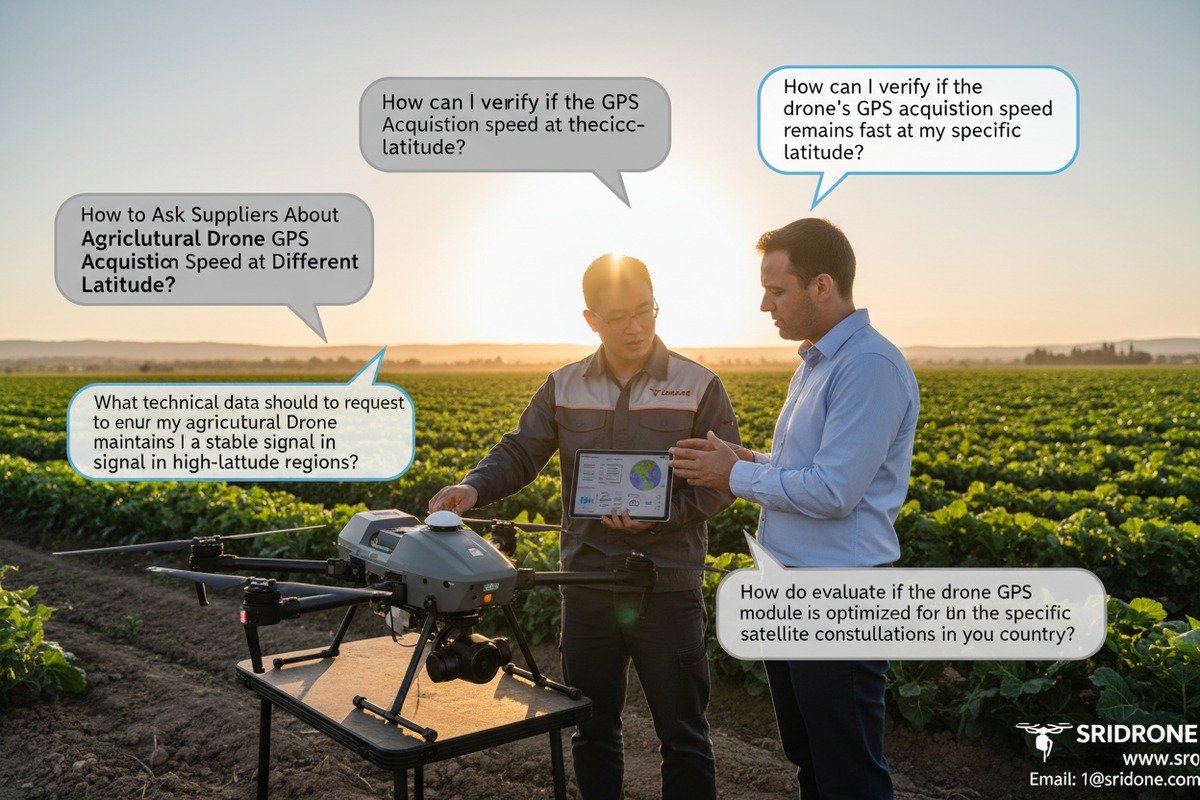
Priorité des constellations par région
Différents systèmes de satellites offrent une meilleure couverture dans différentes parties du monde. Voici un guide pour optimiser la sélection des constellations :
| Région d'exploitation | Constellation principale | Secondaire | Tertiaire | Système SBAS |
|---|---|---|---|---|
| Amérique du Nord | GPS | GLONASS | Galileo | WAAS |
| Europe de l'Ouest | Galileo | GPS | GLONASS | EGNOS |
| Europe de l'Est/Russie | GLONASS | GPS | Galileo | SDCM |
| Asie de l'Est | BeiDou | GPS | GLONASS | MSAS |
| Australie | GPS | Galileo | BeiDou | Aucun (PPP) |
| Amérique du Sud | GPS | Galileo | GLONASS | Aucun |
De nombreux récepteurs permettent des réglages manuels de priorité de constellation. Si le vôtre ne le permet pas, demandez si le fabricant peut fournir un micrologiciel personnalisé avec des paramètres par défaut optimisés.
La compatibilité SBAS est importante
Systèmes d'augmentation basés sur satellite 8 diffusent des signaux de correction qui améliorent la précision du GPS de plusieurs mètres à des niveaux sub-métriques. Ces systèmes sont spécifiques à la région :
- WAAS couvre l'Amérique du Nord
- EGNOS couvre l'Europe
- MSAS couvre le Japon
- GAGAN couvre l'Inde
Si votre récepteur de drone ne prend pas en charge votre SBAS régional, vous perdez une amélioration gratuite de la précision. Lors de l'achat, demandez : " Ce récepteur prend-il en charge EGNOS ? " (ou quel que soit le système qui couvre votre région).
Considérations sur le firmware et les algorithmes
Le matériel ne représente que la moitié de l'équation. Le firmware du récepteur contient des algorithmes qui déterminent :
- La rapidité avec laquelle le récepteur recherche les satellites
- Quels signaux prioriser lorsque plusieurs sont disponibles
- L'agressivité avec laquelle filtrer les mesures bruitées
- Quand déclarer une position valide par rapport à suspecte
Demandez à votre fournisseur si des mises à jour du firmware ont été publiées pour votre région. Certains fabricants publient des mises à jour annuelles qui intègrent de nouveaux lancements de satellites et des modèles de correction améliorés.
Tests pour l'optimisation régionale
Même avec des spécifications appropriées, les tests en conditions réelles confirment les performances réelles. Considérez ces étapes :
- Demander une unité de démonstration configurée pour votre région
- Tester à différents moments de la journée (la géométrie des satellites change toutes les heures)
- Comparer le TTFF annoncé aux mesures réelles sur au moins 10 démarrages à froid
- Noter les variations de la force du signal en utilisant l'affichage de télémétrie du drone
Si les performances réelles sont inférieures de plus de 20% aux spécifications, le récepteur peut ne pas être correctement optimisé pour votre emplacement.
Sécuriser votre investissement pour l'avenir
De nouveaux satellites sont lancés régulièrement. Satellites GPS III 9 diffusant désormais des signaux L5 améliorent la vitesse d'acquisition de 30 à 40%. BeiDou a complété sa constellation complète en 2020. Galileo a atteint sa pleine capacité opérationnelle en 2024.
Demandez aux fournisseurs : "Ce récepteur bénéficiera-t-il des lancements de nouveaux satellites, ou nécessite-t-il des mises à niveau matérielles ?" Les récepteurs dotés de capacités multi-fréquences (L1/L2/L5) peuvent tirer parti des améliorations sans remplacement.
Conclusion
La vitesse d'acquisition du GPS varie considérablement selon la latitude, et les questions que vous posez avant l'achat déterminent si votre flotte de drones agricoles fonctionne de manière fiable ou reste inactive en attendant le verrouillage satellite. Demandez des données TTFF spécifiques, une documentation sur le support multi-constellations, des rapports de test localisés et un firmware optimisé pour la région. Ces étapes préviennent des retards opérationnels coûteux dans vos champs plus tard.
Notes de bas de page
1. Explique la technologie fondamentale des récepteurs de navigation par satellite. ︎
2. Définit une métrique critique pour les performances GPS et ses différentes conditions de départ. ︎
3. Remplacé par un article complet de Wikipédia sur la Dilution de Précision, qui inclut le PDOP, comme source faisant autorité. ︎
4. Remplacé par l'article principal de Wikipédia sur GLONASS, fournissant un aperçu détaillé et faisant autorité. ︎
5. Souligne l'importance de l'utilisation de plusieurs systèmes de satellites pour améliorer les performances. ︎
6. Décrit une technologie GPS de haute précision utilisée pour une précision au niveau du centimètre. ︎
7. Explique comment les récepteurs GPS atténuent les interférences atmosphériques pour une meilleure précision. ︎
8. Remplacé par l'article de Wikipédia sur l'augmentation GNSS, en se connectant spécifiquement à la section sur les systèmes d'augmentation basés sur satellite, comme source faisant autorité et complète. ︎
9. Fournit des informations sur la dernière génération de satellites GPS et leurs capacités. ︎

 English
  Español de México
  Deutsch
  Français
  Русский
  العربية
